Re-NEET 2026 — 490 PYQs Say These 6 Chapters Decide Your Score
NEET 2026 cancelled. You have 4-6 weeks before Re-NEET. We analyzed the cancelled May paper against 490+ PYQs from 2015-2025. Here's exactly what to study, what to skip, and which chapters will carry the rescheduled exam.
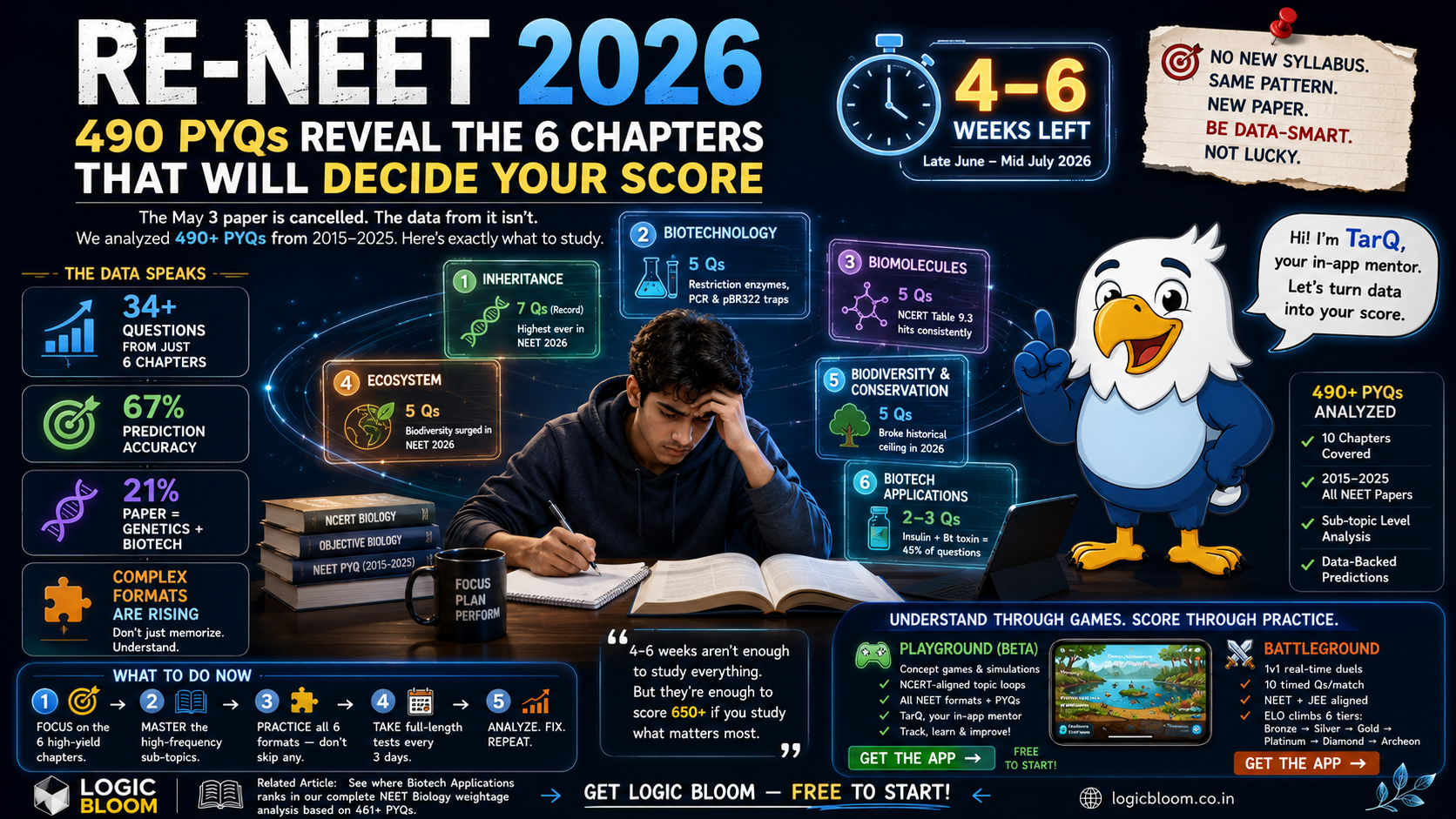
The May 3 Paper Is Dead. The Data From It Isn't.
NEET 2026 has been cancelled. The May 3 paper — attempted by 22.79 lakh candidates — is void due to a confirmed question paper leak. NTA will re-conduct the exam, likely between late June and mid-July 2026. No fresh registration. No syllabus change. Same pattern, same difficulty level, completely new paper.
You have roughly 4–6 weeks. That's not enough to restart from scratch. It's not even enough to revise everything. But it is enough to do something most students won't: let the data decide what you study.
Over the last 8 weeks, we published PYQ analyses covering 10 Biology chapters and 490+ questions from 2015 to 2025. We also published predictions before the May 3 exam — and 67% of them hit. That prediction model, corrected for the three methodology failures we named publicly, is what powers this strategy.
This article doesn't tell you to "stay calm" or "believe in yourself." Every other coaching institute is publishing that right now. This article tells you which 6 chapters carry the most marks, which sub-topics within them have the highest historical frequency, and how to allocate your 4–6 weeks based on data.
| 🎯 4–6 weeks. 490 PYQs. The data says focus here. | |
|---|---|
| The cancelled paper confirmed our predictions at 67%. The patterns don't change when the paper changes — NTA's sub-topic preferences are structural, not random. Logic Bloom's Playground (BETA) lets you play through concept simulations for every high-yield chapter listed below — understand the mechanism with TarQ, your in-app mentor, before you face the questions. | Get the app → Free to start. |
What the Cancellation Actually Changes (And What It Doesn't)
| What Changes | What Doesn't Change |
|---|---|
| The question paper — Re-NEET will be a completely fresh paper | The syllabus — no additions, no deletions, same NCERT |
| The exam date — likely late June to mid-July 2026 | NTA's testing patterns — sub-topic preferences are structural, not paper-specific |
| Your score from May 3 — void, doesn't carry forward | The format shift — multi-statement, match-the-column, assertion-reason dominate regardless of paper |
| Admit card and city slip — NTA will re-issue | Chapter weightages — the data across 11 years doesn't change because one paper leaked |
| Your competition — students who benefited from the leak are now filtered out | Your preparation — everything you studied still applies |
The critical insight: NTA's sub-topic preferences are not random — they're structural. Across 490+ questions from 2015 to 2025, the same sub-topics dominate every year. The cancelled paper confirmed this: Inheritance hit 7 questions (we predicted the surge), Biodiversity surged to 5 (we documented the under-claim), and the Genetics + Biotech cluster delivered 21% of the paper (exactly as our data predicted). A new paper will draw from the same sub-topic pool. Your PYQ-based preparation is more valuable now, not less.
The 6 Chapters That Decide 60%+ of Biology — Ranked by Data
With 4–6 weeks, you cannot revise everything equally. The data says these 6 chapters have the highest return on time invested — they carry the most questions, have the most predictable sub-topics, and show the clearest patterns across 11 years.
| 📌 Priority Chapters for Re-NEET 2026 — Ranked by Historical Yield and Predictability | |||
|---|---|---|---|
| Priority | Chapter | Why It's Top Priority | Deep Dive |
| 1 | Principles of Inheritance and Variation | Hit 7 questions in the cancelled paper (record high, 11-year avg: 4.7). We predicted 3/3 sub-topics correctly. Pedigree analysis, sickle cell substitution, ABO probability — all confirmed. This chapter is NTA's current favourite. | 52 PYQs analyzed → |
| 2 | Biotechnology: Principles & Processes | Hit 5 questions in the cancelled paper. We predicted 3/3 sub-topics — including the pBR322 restriction site trap (BamHI within tetracycline gene). PCR cycle ordering, restriction enzymes, palindromic sequences. | 44 PYQs analyzed → |
| 3 | Biomolecules | 10,486 impressions on our PYQ analysis — the most-searched chapter. 68% of questions come from just 3 sub-topics: Carbohydrates, Proteins, Enzymes. MCQ dropped from 93% to 29%. Multi-statement format now dominates. | 50 PYQs analyzed → |
| 4 | Biodiversity & Conservation | Surged from a 2.5 baseline to 5 questions in the cancelled paper — our biggest prediction miss (the "Biodiversity Under-Claim"). This surge likely represents a permanent reweighting, not a one-year spike. Treat it as a high-yield chapter for Re-NEET. | PYQ analysis coming soon |
| 5 | Ecosystem | GPP−R=NPP tested 5 times in 10 years. Ecology cluster contributed 14 questions (15.6% of biology) in the cancelled paper. MCQ dropped from 83% to 38%. Decomposition steps and pyramid inversions are guaranteed sub-topics. | 31 PYQs analyzed → |
| 6 | Biotechnology Applications | Insulin maturation + Bt toxin activation = 45% of all questions from this chapter. 8 NCERT pages deliver 2–5 questions. The highest ROI chapter in the entire syllabus by page count. Three documented NCERT single-word traps. | 29 PYQs analyzed → |
Combined, these 6 chapters accounted for 34+ questions in the cancelled paper. That's roughly 38% of the biology section from 6 out of ~38 chapters. The remaining 32 chapters split the other 62%. Your 4–6 weeks should be allocated proportionally — not equally.
What the Cancelled Paper Revealed — And Why It Still Matters
The May 3 paper is void, but the patterns it revealed about NTA's current testing priorities are not. A new paper will be written by the same NTA team, using the same question bank philosophy. These are the structural takeaways:
| Pattern From Cancelled Paper | What It Means for Re-NEET |
|---|---|
| Genetics + Biotech cluster = 21% of the paper | This cluster has dominated for 3+ years. A fresh paper won't abandon NTA's highest-yield testing zone. Prepare the cluster as one connected unit: Inheritance ↔ MBI ↔ Biotech Principles ↔ Biotech Applications. |
| Biodiversity surged from 2.5 to 5 questions | This wasn't a paper-specific accident — it reflects a broader NTA shift toward ecology and conservation. Re-NEET will likely maintain 4–5 Biodiversity questions. Don't treat this as a low-yield chapter anymore. |
| MBI collapsed from 8.1 average to 4 | We named this the "Saturation Blindspot" — NTA deliberately deemphasises over-tested chapters. Don't assume MBI returns to 8 questions in Re-NEET. Prepare it at sub-topic depth, not chapter-weight assumptions. |
| Cell Cycle collapsed from 5.6 average to 1 | The Pachytene-Diplotene trap didn't fire. Same Saturation Blindspot. The re-exam may correct this collapse — or it may double down on Ecology instead. Prepare Cell Cycle at baseline, not at premium priority. |
| 5 numerical-counting questions (new format) | This format asks "How many of the following are correct?" with 5–6 statements. No elimination possible. This format will absolutely appear in Re-NEET. Practice it specifically. |
| ~45% standard MCQ, ~55% complex formats | The format shift is structural and accelerating. Re-NEET will maintain or increase the share of multi-statement, match-the-column, and assertion-reason questions. Mock tests built on pre-2022 PYQ banks under-train you for these formats. |
| 🎯 The cancelled paper confirmed 67% of our predictions. The same data model powers your Re-NEET prep. | |
|---|---|
| We predicted Inheritance would break its ceiling (it did: 7 questions). We predicted Biotech would surge (it did: 5 questions). We predicted the format shift (confirmed). The methodology failures we named — Saturation Blindspot, Signature Trap Fallacy, Biodiversity Under-Claim — are now corrected. Logic Bloom's Playground (BETA) simulates every high-yield concept from the 6 priority chapters with TarQ as your in-app mentor. Then test yourself under exam pressure on Battleground — 1v1 timed duels. | Play the simulations → Free to start. |
The 4-Week Re-NEET Biology Plan
This plan assumes Re-NEET is roughly 4–6 weeks away. It prioritises by historical question yield, not by textbook order. Every recommendation below is backed by the PYQ data linked in each row.
| 📌 Week 1: The Genetics + Biotech Cluster (21% of the cancelled paper) | |
|---|---|
| Day 1–2: Principles of Inheritance | Focus on pedigree analysis (X-linked recessive logic), sickle cell Glu→Val substitution, ABO blood group probability calculations, and chromosomal disorders (karyotype + non-disjunction). See the full sub-topic breakdown → |
| Day 3: Molecular Basis of Inheritance | Lac operon (tested 10 of 11 years), transcription unit (promoter at 5' end), template vs coding strand. Prepare at sub-topic depth but don't over-allocate time — MBI collapsed to 4 questions and may not fully recover. 89 PYQs analyzed → |
| Day 4–5: Biotechnology (Principles + Applications) | These two chapters together: pBR322 restriction site map, PCR cycle ordering, restriction enzymes (Principles) + Bt toxin cascade, insulin C-peptide removal, RNAi dsRNA trigger, Cry protein designations (Applications). Principles → | Applications → |
| 📌 Week 2: Ecology Cluster + Biomolecules (30%+ of cancelled paper) | |
|---|---|
| Day 1–2: Ecosystem | GPP−R=NPP (5 appearances, 5 different formats), decomposition FLCHM sequence, inverted pyramid of biomass (aquatic), 10% energy transfer law (forward AND backward calculation), pyramid limitations. 31 PYQs analyzed → |
| Day 3: Biodiversity & Conservation | Surged to 5 questions in the cancelled paper. Focus on species-area relationship, biodiversity hotspots, IUCN Red List categories, in-situ vs ex-situ conservation, and ecosystem services. This chapter's weightage has permanently increased. |
| Day 4–5: Biomolecules | Top 3 sub-topics (Carbohydrates, Proteins, Enzymes) = 68% of all questions. Chitin = polymer of NAG (tested 5 times). NCERT Table 9.3 (secondary metabolites). Enzyme inhibition types. Format: 38% multi-statement now. 50 PYQs analyzed → |
| 📌 Week 3: The Remaining High-Yield Chapters | |
|---|---|
| Day 1: Cell: The Unit of Life | Plasma membrane composition, organelle classification (membrane-bound vs non-membrane-bound), 70S ribosome location trap. 55 PYQs analyzed → |
| Day 2: Human Reproduction | Gametogenesis comparison (oogenesis vs spermatogenesis), menstrual cycle hormonal interplay, oocyte arrest at Meiosis II. The oocyte trap didn't fire in the cancelled paper — it may return. 36 PYQs analyzed → |
| Day 3: Cell Cycle and Cell Division | Collapsed to 1 question in cancelled paper, but the Pachytene-Diplotene trap may return in a fresh paper. Cell cycle phase activities (G0/G1/S/G2/M), Prophase I sub-stages, cytokinesis modalities. 62 PYQs analyzed → |
| Day 4: Biological Classification | Also collapsed to 1 question. Whittaker's Five Kingdom criteria, Mycoplasma assertion-reason format, kingdom-level distinguishing features. 42 PYQs analyzed → |
| Day 5: Human Physiology chapters | Historically 14–18 questions from the combined Physiology unit. Focus on Digestion (enzyme pH specificity), Breathing (O₂ dissociation curve), Body Fluids (double circulation, blood groups), and Excretion (counter-current mechanism). |
| 📌 Week 4: Format Training + Full Mock Tests | |
|---|---|
| Day 1–2: Format-specific practice | The biggest mistake students make in Re-NEET prep: revising content without practising the format. Dedicate two full days to multi-statement questions, match-the-column, assertion-reason, and numerical-counting — across ALL chapters. These formats require a different cognitive skill than standard MCQs. |
| Day 3–4: Full-length mock tests | Take two full-length mocks under strict timing (200 minutes, 180 questions). Score them honestly. Identify the 3-4 chapters where you're losing the most marks — and spend your remaining time on those. |
| Day 5: Targeted weak-area revision | Based on mock results, spend the final revision day on your 3 weakest chapters. Don't re-read the textbook — use the PYQ data to focus on the specific sub-topics that carry the most questions. |
5 Rules for Re-NEET That Nobody Is Telling You
| 📌 Data-Driven Rules for Re-NEET 2026 | |
|---|---|
| 1. Treat the cancelled paper as your most accurate mock test | You sat a real NEET paper under real conditions. You know where you froze, where you guessed, where you ran out of time. That self-knowledge is more valuable than any mock test. Use it. Don't waste it by pretending May 3 didn't happen. |
| 2. Don't restart from Chapter 1 | The worst mistake right now is opening your textbook to page 1 and "starting fresh." You have 4–6 weeks, not 12 months. Use the PYQ data to identify your weakest high-yield chapters and prioritise those. Everything you prepared for May 3 still applies. |
| 3. The format shift will be even more aggressive | NTA knows the leaked paper's questions are now public. The re-exam paper will likely increase the share of complex formats (multi-statement, assertion-reason) to make rote memorisation of leaked questions useless. Prepare for ~60% complex formats, not 55%. |
| 4. Chapters that collapsed in May may bounce back | Cell Cycle (1 question), Biological Classification (1 question), and MBI (4 questions) all under-performed their historical averages in the cancelled paper. A fresh paper from a different question bank may correct these collapses. Don't ignore these chapters entirely — prepare them at baseline depth. |
| 5. Sub-topic prediction at depth beats chapter-weight guessing | Our prediction scoreboard proved this: sub-topic predictions hit 67%. Chapter-weight predictions failed structurally. Don't allocate study hours by assumed chapter weights — allocate by sub-topic frequency from PYQ data. |
The Complete PYQ Library — 490+ Questions Analyzed
Every chapter analysis below tracks every question asked from 2015 to 2025, identifies the most repeated sub-topics, maps the format evolution, and provides data-backed predictions. Use them as your revision roadmap.
| Chapter | PYQs Analyzed | Top Finding | Link |
|---|---|---|---|
| Biomolecules | 50 | MCQ dropped 93% → 29%. Top 3 sub-topics = 68%. | Read → |
| Molecular Basis of Inheritance | 89 | Lac operon tested 10/11 years. Collapsed to 4 in cancelled paper. | Read → |
| Cell: The Unit of Life | 55 | Plasma membrane + organelle classification dominate. | Read → |
| Principles of Inheritance | 52 | Hit 7 questions in cancelled paper — record high. | Read → |
| Biological Classification | 42 | Collapsed to 1 question. Signature trap didn't fire. | Read → |
| Biotechnology: Principles | 44 | pBR322 + PCR + restriction enzymes = 48%. | Read → |
| Cell Cycle and Division | 62 | Collapsed to 1 question. Pachytene trap missed. | Read → |
| Human Reproduction | 36 | Gametogenesis + menstrual cycle = guaranteed sub-topics. | Read → |
| Ecosystem | 31 | GPP−R=NPP tested 5 times. MCQ dropped 83% → 38%. | Read → |
| Biotechnology Applications | 29 | Insulin + Bt toxin = 45% of chapter. 3 NCERT word-swap traps. | Read → |
Done reading? Now play, understand, and duel.
| 🎯 4–6 weeks. Same syllabus. Fresh paper. This time, let the data lead. | |
|---|---|
| 🎮 Playground (BETA) Understand through games — with TarQ, your in-app mentor |
Play through concept simulations for every high-yield chapter: build food chains and watch energy drain (Ecosystem), trace the Bt toxin cascade step-by-step (Biotech Applications), manipulate pedigree charts to predict offspring genotypes (Inheritance), and sequence decomposition steps (Ecology). Each chapter map pairs concept games with readings and MCQs — understand first, then answer. Get the app → |
| ⚔️ Battleground Score through practice — 1v1 real-time duels |
Take the concepts you understood in Playground and test them under real time pressure. Challenge a friend or get matched live. 10 timed questions per match across Physics, Chemistry, Biology — JEE Main + Advanced + NEET aligned. ELO climbs through 6 tiers: Bronze → Silver → Gold → Platinum → Diamond → Archeon. Get the app → |
| Understand through games. Score through practice. Get Logic Bloom — Free to start → |
|
FAQs — Re-NEET 2026 Preparation
Q1: Is the NEET 2026 syllabus changing for Re-NEET?
No. NTA has confirmed no changes to syllabus, pattern, or difficulty level. This is a re-exam with a fresh paper, not a restructured test. Everything you prepared for May 3 still applies. Focus on revision and format training, not learning new topics.
Q2: Will Re-NEET be harder than the cancelled paper?
The content difficulty will be the same — NTA is bound by the NCERT syllabus. However, the format may be more aggressive. Since the leaked paper's questions are now public, NTA will likely increase the share of multi-statement, assertion-reason, and numerical-counting questions to make rote recall of leaked questions useless. Prepare for approximately 60% complex formats.
Q3: Should I change my preparation strategy for Re-NEET?
Don't restart from scratch. Use the 4–6 week window to strengthen weak areas identified during the cancelled exam. Focus on the 6 highest-yield chapters (listed above), practice complex question formats specifically, and treat the cancelled paper as your most accurate mock test — it showed you exactly where you're strong and where you're vulnerable.
Q4: Which chapters should I prioritise with limited time?
Based on 490+ PYQs from 2015-2025: Principles of Inheritance (7 questions in cancelled paper), Biotechnology Principles (5 questions), Biomolecules (5 questions), Biodiversity and Conservation (5 questions, surged from 2.5 average), Ecosystem (part of 14-question Ecology cluster), and Biotechnology Applications (highest ROI by page count). These 6 chapters alone accounted for 34+ questions in the cancelled paper.
Q5: Do the patterns from the cancelled paper still apply to Re-NEET?
Yes — partially. NTA's sub-topic preferences are structural, not paper-specific. The same NTA team will write the fresh paper using the same question bank philosophy. Historical patterns (which sub-topics dominate, which formats are increasing) remain valid. What may change: specific chapter weights may shift (chapters that collapsed in May may bounce back, and vice versa). Use sub-topic-level PYQ analysis rather than chapter-weight assumptions.