Principles of Inheritance NEET PYQ (2015–2025) — 52 Questions Analyzed
Hit 7 questions in NEET 2026 — the highest ever for this chapter. Pedigree, sickle cell Glu→Val, ABO probability: the 3 sub-topics we predicted months before the exam. Full trap breakdown inside.
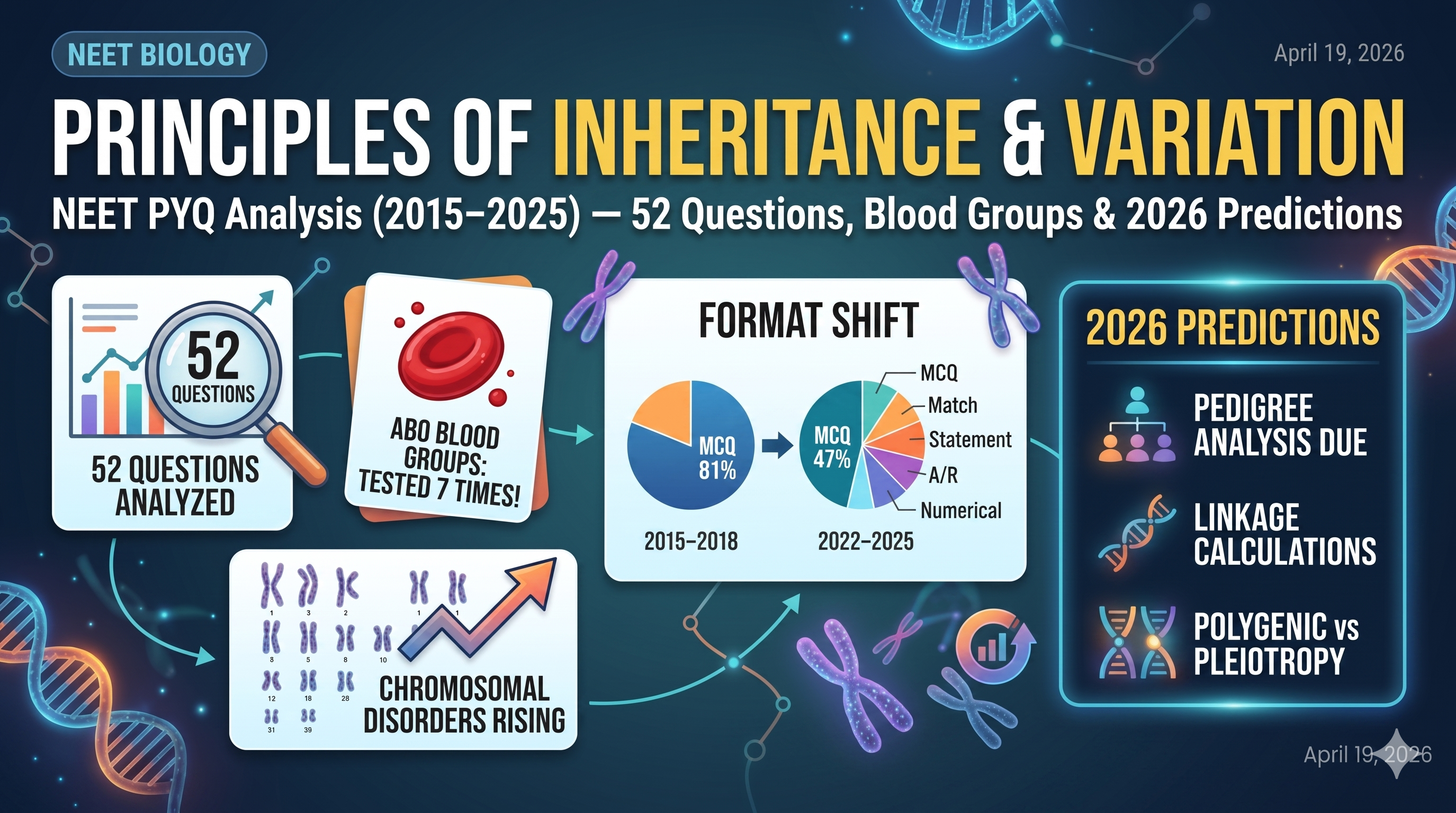
Introduction: Principles of Inheritance NEET PYQ Analysis — The Chapter Where One Question Tests Three Concepts
ABO blood grouping has appeared 7 times in 10 years. Not because NTA is lazy — because a single blood group question simultaneously tests dominance, co-dominance, AND multiple allelism. Three genetic principles, one question, zero room for confusion.
That's the defining characteristic of this chapter. A Klinefelter syndrome question tests non-disjunction, sex determination, AND karyotype notation. A sickle cell anaemia question bridges Mendelian inheritance with molecular biology. A recombination frequency question demands genetic mapping mathematics.
One implication runs through this entire chapter: blood group crosses are easy to read in a table but hard to solve under pressure. If reverse-engineering parental genotypes from offspring phenotypes still feels like guessing rather than recognition, that gap is exactly what Logic Bloom's Playground is built for. Each chapter is broken into NCERT-aligned topic loops with interactive games, readings, videos, and NEET-format practice. Currently in beta. Free to start.
We tracked all 52 questions NTA asked from Principles of Inheritance and Variation across every NEET sitting from 2015 to 2025. This is the companion to our Molecular Basis of Inheritance PYQ analysis — together these two articles map the entire Genetics cluster, which commands 25–30% of the total Biology paper.
Our PYQ analysis series: Biomolecules PYQ | Cell Biology PYQ | Biological Classification PYQ
How Many Questions: The Consistent Heavy-Hitter
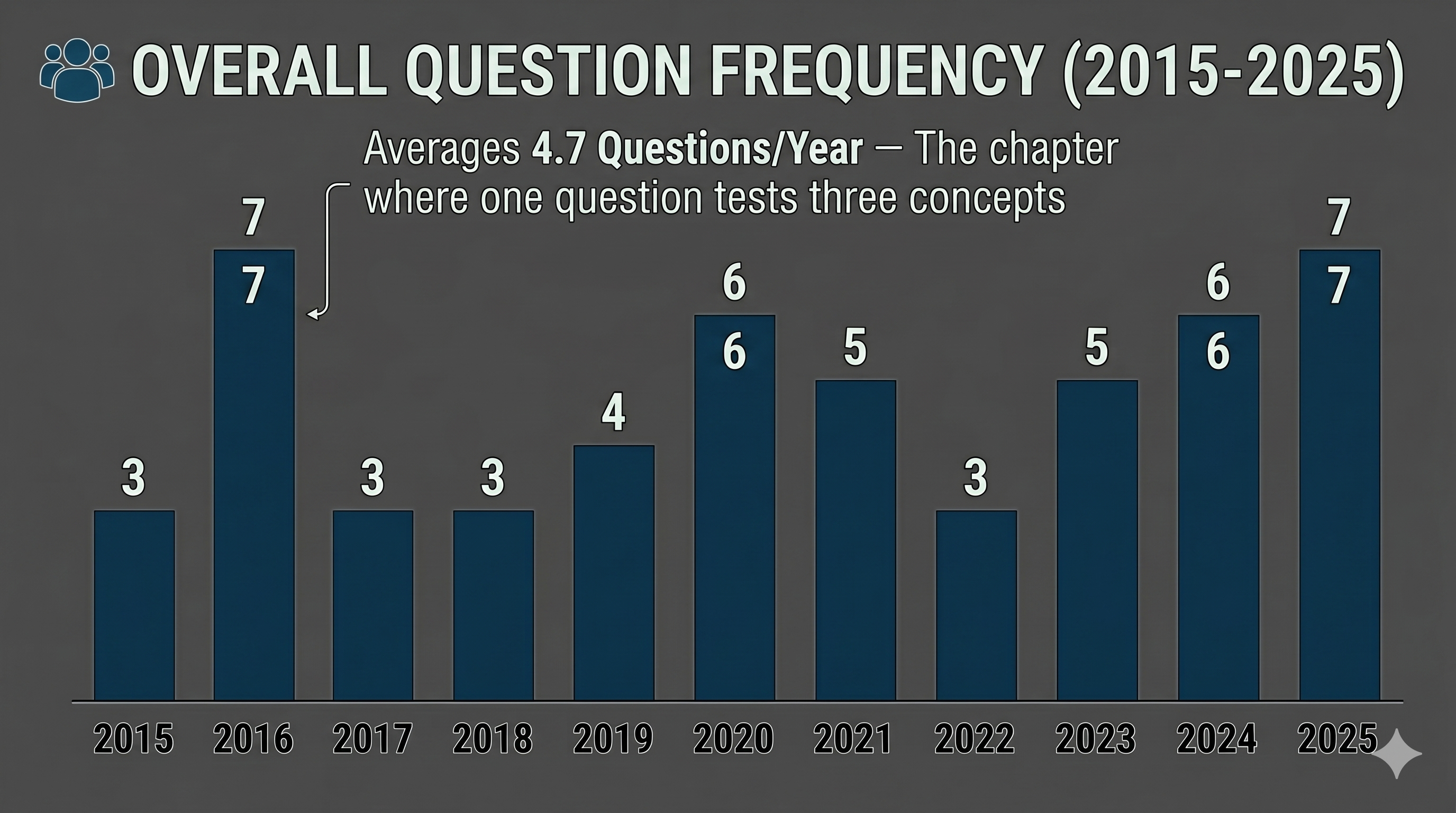
Principles of Inheritance averages 4.7 questions per year — making it the #3 chapter in all of Class 12 Biology and the second pillar of the Genetics unit.
| Year | Questions | Includes |
|---|---|---|
| 2025 | 3 | Main sitting |
| 2024 + Re-exam | 7 | Main + June re-exam |
| 2023 | 3 | Main sitting |
| 2022 | 3 | Main sitting |
| 2021 | 4 | Main sitting |
| 2020 + Phase 2 | 6 | Phase 1 + Phase 2 |
| 2019 | 5 | Main + Odisha |
| 2018 | 3 | Main sitting |
| 2017 | 5 | Main sitting |
| 2016 + Phase 2 | 6 | Phase 1 + Phase 2 |
| 2015 + Cancelled | 7 | Main + cancelled AIPMT |
Year-to-year variance is high (3 to 7) because supplementary exams inflate the count in certain years. But the floor is 3 questions per year — meaning this chapter never drops below 12 guaranteed marks.
| Chapter | Avg Qs / Year | Combined Impact |
|---|---|---|
| Molecular Basis of Inheritance | 8–9 | ~14–15 questions = 25–30% of Biology |
| Principles of Inheritance | 4–5 |
These two chapters together contribute roughly 14–15 questions per year — more than any other unit in the entire exam. If you master only MBI + Principles of Inheritance, you've secured approximately 56–60 marks from just two chapters.
Sub-Topic Frequency: What NTA Actually Cares About
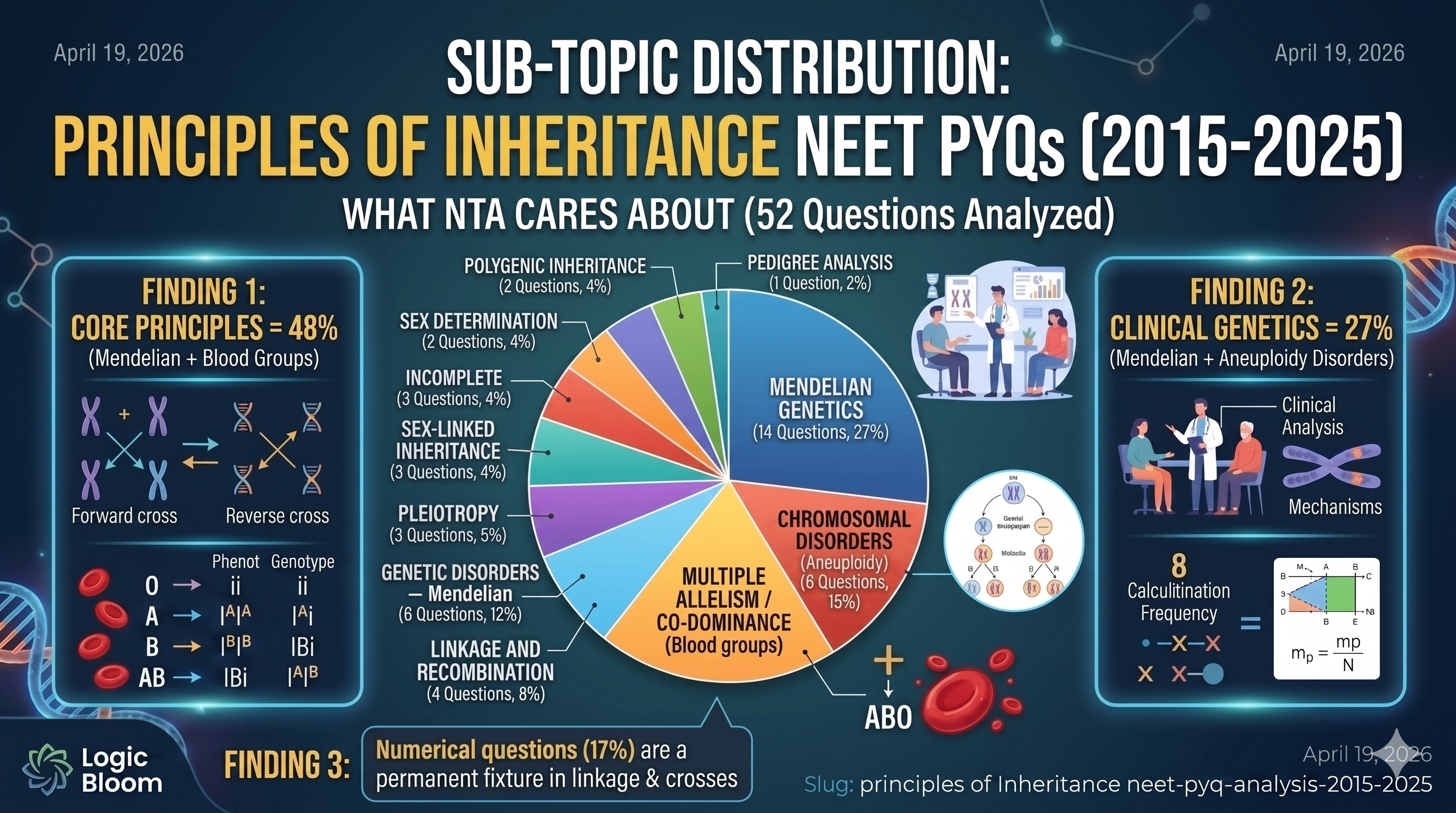
| Sub-topic | Questions | Share |
|---|---|---|
| Mendelian Genetics | 14 | 27% |
| Multiple Allelism / Co-dominance (Blood groups) | 11 | 21% |
| Chromosomal Disorders (Aneuploidy) | 8 | 15% |
| Genetic Disorders — Mendelian | 6 | 12% |
| Linkage and Recombination | 4 | 8% |
| Pleiotropy | 3 | 6% |
| Sex-Linked Inheritance | 3 | 6% |
| Incomplete Dominance | 2 | 4% |
| Sex Determination | 2 | 4% |
| Polygenic Inheritance | 2 | 4% |
| Pedigree Analysis | 1 | 2% |
Mendelian Genetics + Blood Groups = 48%. Nearly half of all questions come from these two areas. Genetic Disorders (Mendelian + Aneuploidy) = 27% — as large as Mendelian Genetics itself. NTA treats this chapter as a bridge between genetics theory and clinical medicine. If you study disorders as just a list of names, you'll fail. If you understand the mechanism behind each one, you'll ace it.
The Blood Group Phenomenon: 7 Times in 10 Years
ABO blood grouping deserves its own section. A single blood group question evaluates three genetic principles simultaneously: Dominance (I^A and I^B dominant over i), Co-dominance (I^A and I^B express equally in heterozygotes), and Multiple allelism (three alleles — I^A, I^B, i — exist in the population).
| Era | Format & Complexity |
|---|---|
| 2015–2018 | "A man with blood group A marries a woman with blood group B. What are the possible blood groups of offspring?" — Forward cross, straightforward. |
| 2019–2022 | "How many genotypes and phenotypes are possible from an I^A I^B × I^A i cross?" — Systematic Punnett square work required. |
| 2024 | "Father is B+, mother is A+, child is O+. What are their genotypes?" — Reverse engineering. Child is O (ii) → both parents must carry i → father = I^B i, mother = I^A i. Fundamentally harder cognitive task than a forward cross. |
| 2026 prediction | "If a child has blood group O and the mother is blood group A, which blood groups are IMPOSSIBLE for the father?" — Tests the I^A i heterozygous logic from the opposite direction. |
The Format Shift: 81% → 47%
This chapter has a uniquely high proportion of numerical questions that have remained stable even as standard MCQs declined — unlike any other Biology chapter.
| Format | 2015–2018 | 2022–2025 |
|---|---|---|
| Standard MCQ | 81% | 47% |
| Numerical / Cross calculations | 17% | 17% |
| Match the Column | 4% | 13% |
| Multi-statement | 8% | 13% |
| Assertion-Reason | 0% | 7% |
| Diagram-based (pedigree) | 4% | — |
Key insight: Numerical questions haven't declined. At 17% across both eras, ratio calculation questions are a permanent fixture — making this one of the most calculation-heavy Biology chapters. The 2024 re-exam's assertion-reason question — where Statement I confused polygenic inheritance with multiple allelism — is exactly the kind of semantic trap NTA is building more of.
This is the gap most coaching material misses — heavy on standard MCQs, thin on the calculation-plus-semantic-trap formats this chapter now favours. Logic Bloom's Playground breaks Principles of Inheritance into NCERT-aligned topic loops where each topic builds the underlying logic — Punnett square reasoning, blood group genotype deduction, pleiotropy vs polygenic distinction — and then drops you into NEET 2026-format practice. TarQ guides you through. Currently in beta. Free to start.
The 10 Concepts NTA Returns To Relentlessly
| 🎯 Top 10 Most Repeated Concepts — Principles of Inheritance NEET 2015–2025 | |||
|---|---|---|---|
| 1. | ABO blood grouping — multiple alleles, co-dominance, cross predictions | 7× | NCERT Section 5.2.2.1, Page 77 |
| 2. | Down syndrome (Trisomy 21) and Klinefelter syndrome (47,XXY) | 7× | NCERT Section 5.8.2, Pages 91–92 |
| 3. | Mendel's 7 contrasting traits / true breeding lines | 5× | NCERT Section 5.1, Page 70, Table 5.1 |
| 4. | Sickle cell anaemia — autosomal recessive + point mutation | 4× | NCERT Section 5.8.1, Page 90 |
| 5. | Dihybrid cross 9:3:3:1 ratio / law of independent assortment | 4× | NCERT Section 5.3, Page 80 |
| 6. | Sex determination systems — XO grasshopper, XY human | 3× | NCERT Section 5.6.1, Page 86 |
| 7. | Snapdragon incomplete dominance (1:2:1 ratio) | 3× | NCERT Section 5.2.2.1, Page 76 |
| 8. | Morgan's Drosophila experiments / linkage | 3× | NCERT Section 5.3.3, Page 83 |
| 9. | Pleiotropy — PKU and starch grain size in pea | 3× | NCERT Section 5.5, Page 85 |
| 10. | Haemophilia — X-linked recessive, carrier females | 3× | NCERT Section 5.8.1, Page 89 |
The top two — blood groups and chromosomal disorders — each appeared 7 times, accounting for 14 out of 52 questions. These are near-guaranteed marks if you know them at NCERT-line precision.
The Sickle Cell Bridge: Where Two Chapters Become One Question
Sickle cell anaemia has appeared 4–5 times in 10 years and is the single most important cross-chapter concept in all of NEET Genetics.
| Angle | What It Tests | Where It Appeared |
|---|---|---|
| Inheritance angle | Autosomal recessive — both parents must be carriers (HbA HbS). 25% of offspring will be diseased (HbS HbS). Probability calculation. | NEET 2021 |
| MBI angle | Point mutation — single base pair substitution changes 6th amino acid of β-globin chain from glutamic acid to valine (GAG→GUG). | NEET 2023 |
| Comparative trap | Sickle cell (qualitative defect — wrong amino acid) vs thalassemia (quantitative defect — reduced globin synthesis). Underlying molecular distinction tested. | NEET 2017 |
Preparation strategy: Study sickle cell as a single unified concept spanning both chapters. Know the inheritance pattern (autosomal recessive), the molecular cause (GAG→GUG, Glu→Val), the chromosomal location (chromosome 11), and the pleiotropic effects (RBC sickling → anaemia → organ damage).
Cross-Chapter Connections
| Cross-Chapter Link | What It Tests | Example |
|---|---|---|
| Inheritance + Molecular Basis of Inheritance | Macroscopic disorder traced to molecular mutation | Phenotype → genotype → specific codon change → amino acid substitution chain |
| Inheritance + Cell Division | Mechanism of aneuploidy | Non-disjunction during Anaphase I or II causes Down syndrome (trisomy 21), Klinefelter, Turner |
| Inheritance + Evolution | Population genetics → allele frequency calculation | Hardy-Weinberg question (2019): allele frequency A=0.4 → calculate genotype frequencies p², 2pq, q² |
| Inheritance + Reproductive Health | Clinical application of chromosomal genetics | Amniocentesis for detecting chromosomal abnormalities — not yet tested from Inheritance side directly, making it a 2026 candidate |
| Inheritance + Biotechnology | Genetic basis of disorder linked to treatment | ADA deficiency treatment via gene therapy — connecting Mendelian genetics with biotechnological applications |
NEET 2026 Predictions: What the Data Points To
Predicted format distribution: Standard MCQ ~40% | Numerical/Cross calculations ~20% | Match the Column ~15% | Multi-statement ~15% | Assertion-Reason ~10%
Top 5 Sub-Topics Most Likely to Appear in 2026
| # | Predicted Topic | Why It's Due |
|---|---|---|
| 1 | Linkage and recombination (genetic mapping) | Recombination frequency calculations were heavily tested in 2019–2021 but have been dormant in direct numerical format recently. A calculation requiring gene ordering on a chromosome using cM distances is overdue. |
| 2 | Pedigree analysis (diagram-based) | Visual pedigree charts absent from primary papers for 3+ years. Most probable pattern: X-linked recessive (colour blindness or haemophilia) — testing carrier females and criss-cross inheritance simultaneously. |
| 3 | Polygenic inheritance vs pleiotropy distinction | Multi-statement contrasting "one gene → multiple traits" (pleiotropy) with "multiple genes → one trait additively" (polygenic). The 2024 re-exam tested this as assertion-reason — escalation to multi-statement probable. |
| 4 | Sex determination — haplodiploid or ZW-ZZ systems | XX-XY (humans) and XX-XO (grasshopper) have been recently exhausted. Honey bee haplodiploid system or ZW-ZZ avian system (female heterogamety) are prime targets. |
| 5 | Aneuploidy mechanisms (non-disjunction) | Instead of "what is Down syndrome's karyotype," expect "at which stage of meiosis does non-disjunction cause trisomy 21?" — linking Inheritance directly to Cell Division. |
3 Concepts Due for a Return
| Concept | Last Tested | Likely Format |
|---|---|---|
| Test cross application | 2024 (definition only) | Applied cross calculation — heterozygous organism × homozygous recessive yielding 1:1 ratio |
| Morgan's recombination frequency mapping | 2021 (a,c,b,d sequence — one of hardest questions that year) | Given recombination percentages between multiple gene pairs, determine linear sequence on chromosome |
| Phenylketonuria (PKU) | Undertested relative to NCERT prominence | Multi-statement: pleiotropy (phenylalanine metabolism → mental retardation → reduced melanin) + inborn error of metabolism |
Predicted Cross-Chapter Combinations for 2026
| Combination | What to Prepare |
|---|---|
| Inheritance + Human Reproduction | X-linked trait (colour blindness) combined with gametogenesis — where X and Y chromosomes segregate during spermatogenesis/oogenesis |
| Inheritance + Biotechnology | Genetic basis of ADA deficiency combined with gene therapy methodology |
| Inheritance + Reproductive Health | Amniocentesis to detect chromosomal abnormalities (Down syndrome) — connecting genetic testing with reproductive health applications |
How to Prepare Based on the Data
| 📌 Data-Driven Preparation Strategy — Principles of Inheritance NEET 2026 | |
|---|---|
| Master ABO blood groups from every angle | Forward crosses, reverse engineering, probability calculations, genotype deduction from phenotype. 7 questions in 10 years. Practice until you can solve any blood group cross in under 90 seconds. |
| Know chromosomal disorders as karyotype + mechanism + symptoms | Don't just memorise "Down syndrome = trisomy 21." Know the karyotype (47, +21), the mechanism (non-disjunction at Anaphase I or II), the physical features, and the same detail for Turner (45, X) and Klinefelter (47, XXY). |
| Study sickle cell as a unified concept across two chapters | Inheritance pattern + molecular cause (GAG→GUG, Glu→Val) + chromosomal location (chromosome 11) + pleiotropic effects. The single most tested cross-chapter concept in NEET genetics. |
| Build a confusion matrix for overlapping concepts | Pleiotropy vs polygenic inheritance. Co-dominance vs incomplete dominance. Multiple allelism vs polygenic inheritance. If you can't explain each difference in one sentence, you're vulnerable to NTA's semantic traps. |
| Practice genetic mapping calculations | Given recombination frequencies between 4–5 gene pairs, determine the linear order. Method: find the pair with the largest recombination frequency (outermost genes), then use intermediate frequencies to place the others. This is the hardest question type — appears every 2–3 years. |
| Play through what isn't sticking | Pedigree problems get harder when you're trying to memorise the rules instead of seeing the pattern. Logic Bloom's Playground breaks Inheritance into NCERT-aligned topic loops with interactive games for cross visualisation, plus NEET-format practice on the same concepts. Currently in beta. Free to start. |
Conclusion: The Chapter That Completes the Genetics Unit
Principles of Inheritance is the chapter that gives NEET Genetics its clinical dimension. The disorders, the blood groups, the pedigrees — these aren't abstract genetics problems, they're the reasoning skills a future doctor needs at the bedside. NTA knows this, which is why the format has been shifting toward multi-concept questions that integrate mechanism, mathematics, and medicine simultaneously. Students who prepare this chapter with that integration in mind will outperform those who memorise isolated definitions by a significant margin.
Done analysing? Now play, practice, or duel.
If concepts in Principles of Inheritance — ABO blood group reverse engineering, the Pleiotropy vs Polygenic distinction, X-linked pedigree logic, the sickle cell molecular bridge — still feel like memorisation rather than understanding, Logic Bloom's Playground breaks the chapter into NCERT-aligned topic loops. Each topic has an interactive game, a reading, a video, and timed NEET 2026-format questions: multi-statement, assertion-reason, match-the-column, all built from exact NCERT lines. Spaced revision blocks and boss challenges lock concepts in. TarQ guides you through. Currently in beta.
Or take it head-to-head: Battleground is our 1v1 real-time arena — challenge a classmate to a Genetics duel, climb six ELO tiers from Bronze to Archeon, and lock in revision through competitive recall.
Understand through games. Score through practice. Free to start.
Start your Inheritance session on Logic Bloom →
FAQs — Principles of Inheritance NEET PYQ
Q1: How many questions come from Principles of Inheritance in NEET?
Principles of Inheritance and Variation averages 4.7 questions per year in NEET, contributing approximately 16–20 marks. Combined with Molecular Basis of Inheritance (8–9 questions/year), the Genetics unit accounts for 14–15 questions per paper — roughly 25–30% of the total Biology section. Mastering just these two chapters can secure approximately 56–60 marks.
Q2: What is the most tested concept from Principles of Inheritance in NEET?
ABO blood grouping and chromosomal disorders (Down syndrome, Klinefelter syndrome) are tied as the most tested, each appearing 7 times across 2015–2025. Blood group questions are uniquely valuable to NTA because a single question tests three genetic principles simultaneously: dominance, co-dominance, and multiple allelism.
Q3: How often are numerical questions asked from this chapter in NEET?
Approximately 17% of all Principles of Inheritance questions require mathematical computation — Punnett square predictions, blood group genotype deductions, or recombination frequency mapping. This proportion has remained stable across the decade even as standard MCQs declined — making this one of the most calculation-heavy Biology chapters.
Q4: What is the format shift in Inheritance questions in NEET?
Standard MCQs dropped from 81% of questions (2015–2018) to 47% (2022–2025), replaced by match-the-column (13%), multi-statement (13%), and assertion-reason (7%). Uniquely, numerical questions held steady at 17% throughout the decade, unlike other Biology chapters where numericals disappeared.
Q5: How does the Genetics unit compare to other NEET Biology units?
The Genetics unit (Principles of Inheritance + Molecular Basis of Inheritance) generates approximately 14–15 questions per year — about 25–30% of total Biology. This surpasses every other unit including Human Physiology (13–15 questions across 7 chapters), Ecology (12–14 questions across 4 chapters), and Plant Physiology (6–8 questions). See the full MBI PYQ analysis for the complete chapter-ranking comparison.