Cell: The Unit of Life NEET PYQ Analysis (2015–2025) — Trends & 2026 Predictions
Plasma membrane composition has been tested more than any other Cell Biology concept. The 10 most repeated facts with NCERT page refs, the format shift data, and Re-NEET predictions inside.
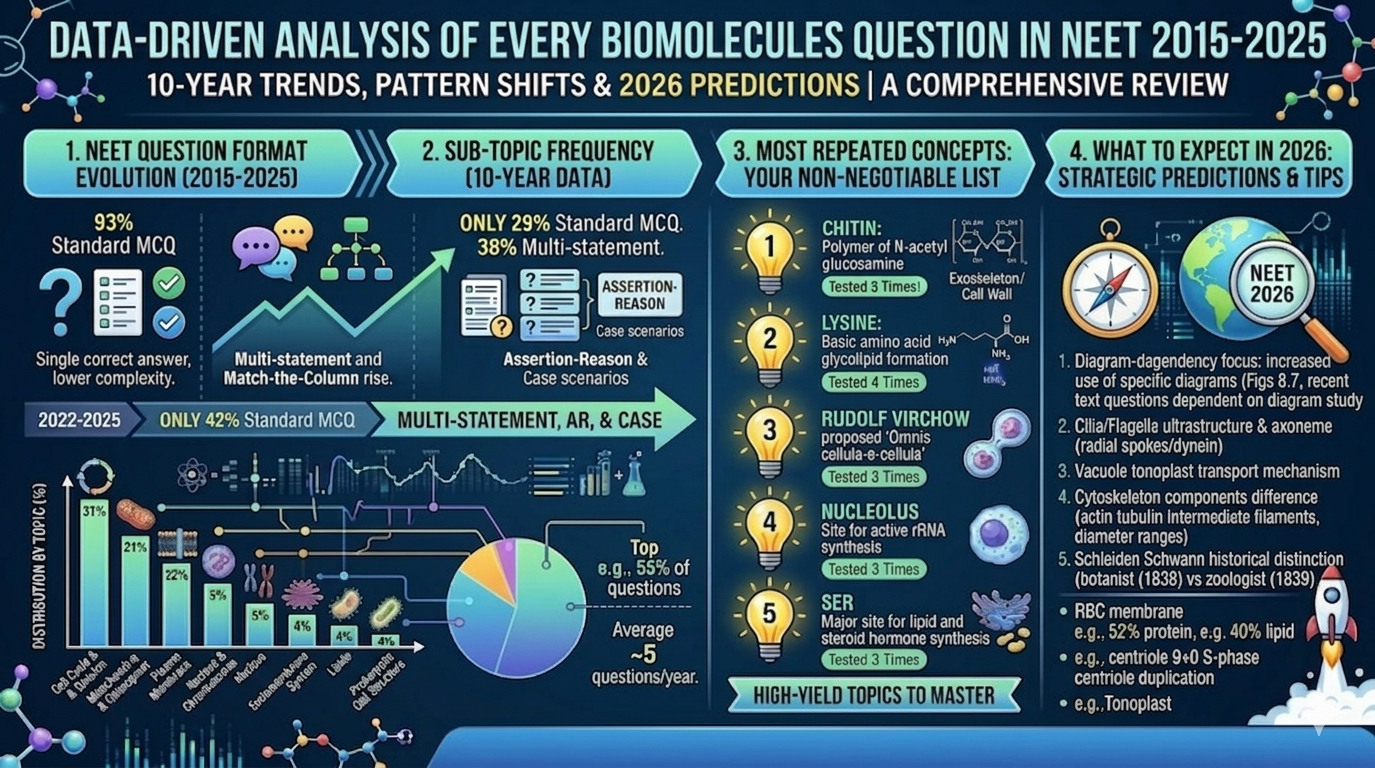
Introduction: Cell The Unit of Life NEET PYQ Analysis — What 55 Questions Reveal About How NTA Thinks
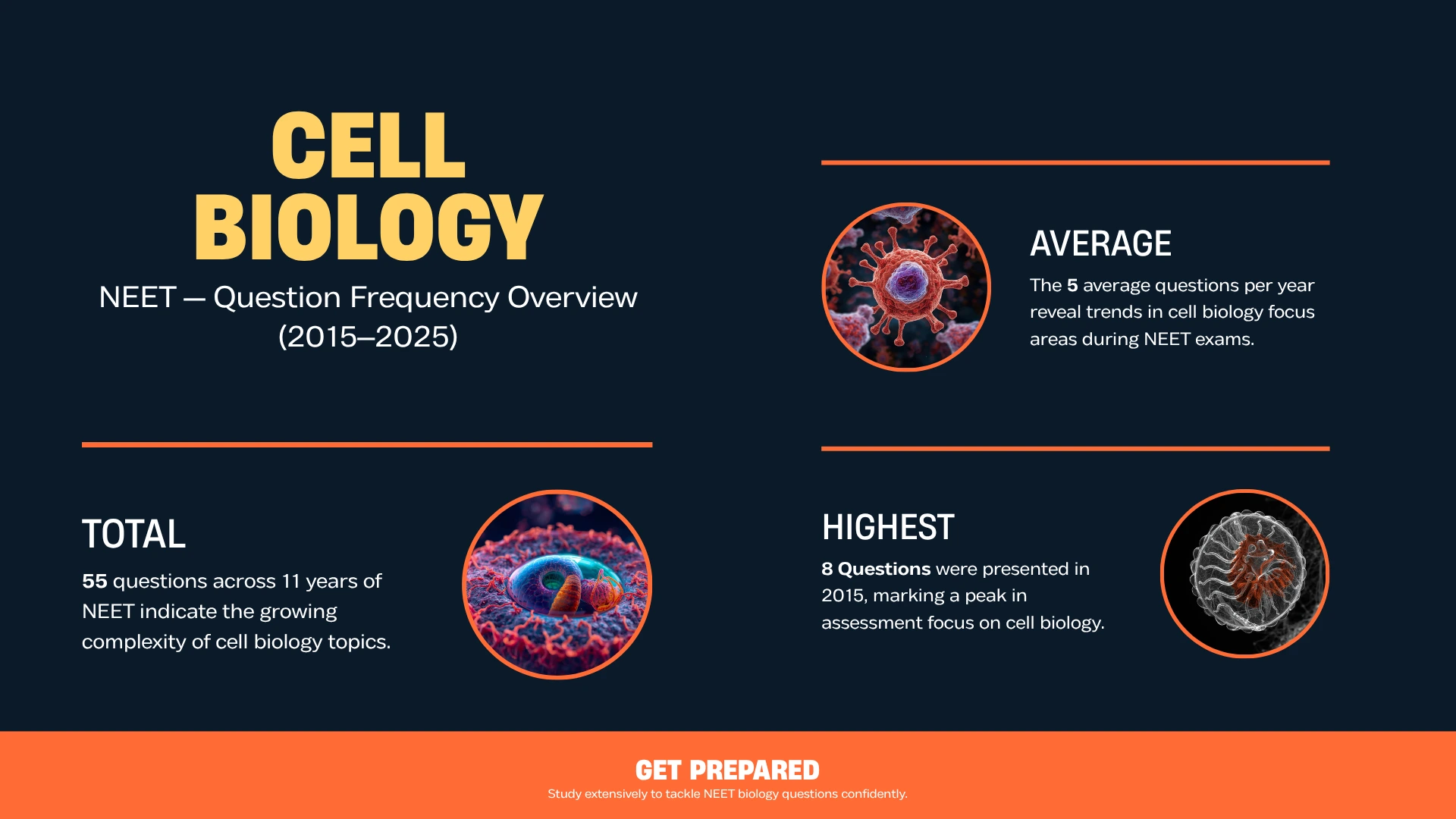
Here's what 10 years of data shows:
Mesosomes have been tested 5 times. The Golgi apparatus — specifically its cis/trans polarity — has appeared 9 times. And the 70S vs 80S ribosome distinction has evolved from a simple recall question into a multi-layered trap that catches thousands of students every year.
We tracked every single Cell Biology question from NEET 2015 through 2025 — including Phase 2 sittings, COVID sessions, and re-exams — totalling 55 questions across 11 years. Then we broke them down by sub-topic, format, difficulty, and year to extract the patterns no question bank shows you.
One pattern matters more than the rest: 35% of recent Cell Biology questions require diagram recall you can't build from text alone. If reading NCERT once isn't locking the structures into your visual memory — perinuclear space, axoneme cross-section, mitochondrial cristae — that gap is exactly what Logic Bloom's Playground is built for. Each chapter is broken into NCERT-aligned topic loops with interactive games, readings, videos, and NEET-format practice. Currently in beta. Free to start.
This is the companion to our Biomolecules PYQ trend analysis — same methodology, applied to the chapter that serves as the architectural foundation of all NEET Biology. Need to revise the concepts first? Start with our Cell: The Unit of Life notes for NEET, then come back here to understand how those concepts actually get tested.
How Many Questions Does Cell Biology Actually Carry?
Cell: The Unit of Life is one of the most consistent chapters in NEET. It never drops below 3 questions and routinely delivers 5–6. For a chapter covering roughly 15 pages of NCERT, that's an extraordinary return on study time.
| Year | Questions | Notable |
|---|---|---|
| 2025 | 5 | First assertion-reason question from this chapter |
| 2024 + Re-exam | 6 | Mesosomes tested twice in the same year |
| 2023 | 4 | First numerical ("80 proteins in ribosome") |
| 2022 | 5 | Two cell theory questions in one paper |
| 2021 | 3 | Lowest count in the decade |
| 2020 + COVID session | 6 | Highest count — diagram-based chloroplast question |
| 2019 | 4 | Virchow tested again |
| 2018 | 5 | Polysome question, nucleolus function |
| 2017 | 5 | Mycoplasma profile, fluid mosaic model |
| 2016 | 4 | Peroxisome exclusion from endomembrane system |
| 2015 + Re-exam | 8 | Highest ever — fimbriae, chromatophores, Balbiani rings |
10-year average: ~5 questions per year. That's 20 marks from a single chapter — enough to shift your rank by thousands of positions. In the Class 11 Biology hierarchy, Cell Biology ranks 5th overall but punches above its weight because questions tend to be straightforward for students who've read NCERT carefully.
| Rank | Chapter | Avg Qs / Year |
|---|---|---|
| 1 | Human Physiology (7 chapters) | 12–14 |
| 2 | Animal Kingdom | 4.5–5.2 |
| 3 | Cell Cycle & Cell Division | 4.4–4.6 |
| 4 | Biomolecules | 4.2–5.4 |
| 5 | Cell: The Unit of Life | 3.6–4.2 |
The Sub-Topic Hierarchy: Where the Marks Actually Come From
Not every organelle is tested equally. The distribution is heavily skewed toward prokaryotic structures and the Golgi apparatus — two areas many students underestimate.
| Sub-topic | Questions (10 yr) | Rank |
|---|---|---|
| Prokaryotic Cell Structure | 13 | #1 |
| Golgi Apparatus | 9 | #2 |
| Ribosomes | 8 | #3 |
| Nucleus | 8 | #3 |
| Cell Theory | 6 | #5 |
| Mitochondria | 6 | #5 |
| Plastids | 6 | #5 |
| Endoplasmic Reticulum | 5 | #8 |
| Cytoskeleton | 4 | #9 |
| Cell Membrane | 3 | #10 |
Key finding #1: Prokaryotic Cell Structure is tested more than any single organelle. With 13 questions in 10 years, mesosomes alone account for 5. Mycoplasma's unique features (no cell wall, smallest living cell, 0.3 μm) have appeared 3 times. Fimbriae, glycocalyx, gas vacuoles, inclusion bodies — every detail of the bacterial cell is fair game.
Key finding #2: Golgi apparatus questions have gotten harder, not more frequent. In 2018, NTA asked "What is the function of Golgi?" (glycosylation — one fact). By 2025, they asked an assertion-reason question testing the cis/trans polarity AND vesicle transport simultaneously. Same organelle, completely different cognitive demand.
What's Increasing in Frequency
Golgi polarity (cis vs trans face): Early questions tested basic function. Since 2022, NTA specifically targets the structural orientation — convex cis face receives from ER, concave trans face ships outward. This "ultrastructure" focus is new.
Semi-autonomous organelle membranes: Not just "mitochondria have double membranes" anymore. The 2024 question tested that the inner mitochondrial membrane is less permeable than the chloroplast envelope — a comparative detail most students skip.
Prokaryotic surface structures: NTA increasingly contrasts flagella (motility) with pili/fimbriae (adhesion). The 2016 question caught students who thought pili were involved in motility.
What's Decreasing in Frequency
Discovery history as standalone questions: "Who discovered the cell?" hasn't appeared as a direct question since 2016. These facts now appear as distractors in match-the-column questions.
Organelle nicknames: "Suicide bag" for lysosomes, "powerhouse" for mitochondria — these recall questions are essentially gone. NTA now tests the mechanism behind the nickname (acidic pH of lysosomes, cristae surface area in mitochondria).
The Format Shift: Why This Chapter Got Harder Without Changing Content
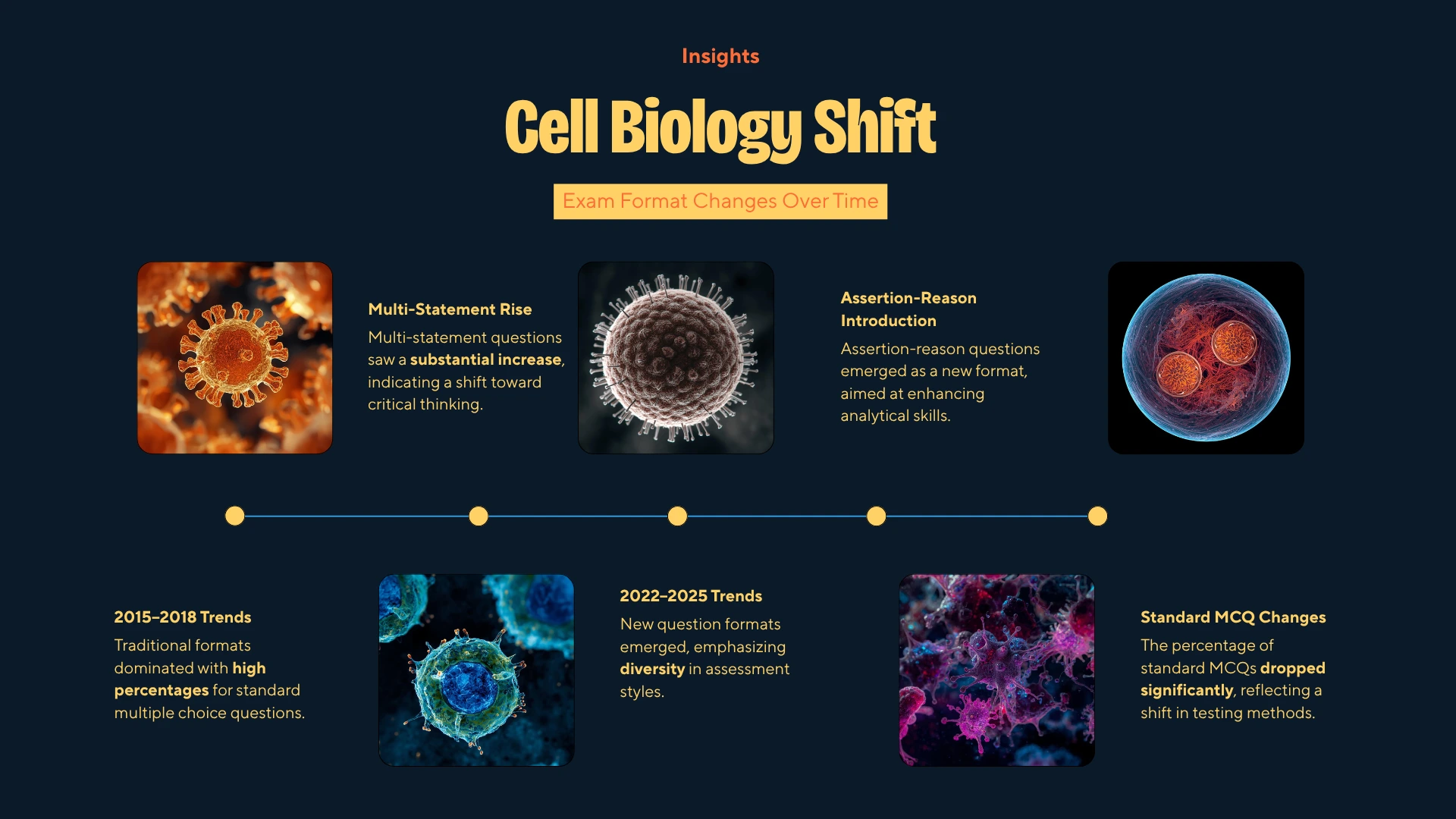
The same pattern we found in our Biomolecules analysis is playing out here — with one important difference: Cell Biology has shifted even more aggressively toward complex formats.
| Format | 2015–2018 | 2022–2025 |
|---|---|---|
| Standard MCQ | 87% | 42% |
| Match the Column | 8% | 22% |
| Multi-statement | 5% | 31% |
| Assertion-Reason | 0% | 5% |
Standard MCQs dropped from 87% to 42%. Multi-statement questions went from virtually zero to almost a third of all questions. But here's the Cell Biology-specific twist: 35% of questions in 2022–2025 had hidden diagram dependency. The question text doesn't show a diagram, but you can't answer without mentally visualising one.
Example: The 2024 question on "Axoneme" and "Cartwheel pattern" effectively tests NCERT Figures 8.10 and 8.11 without showing them. If you never studied those diagrams, you can't answer it — even though the question is "text-based." For Cell Biology specifically, diagram study is required even for questions that don't look diagram-based.
This is the gap most coaching material misses — it's heavy on standard MCQs and thin on diagram-dependent multi-statement formats. Logic Bloom's Playground breaks Cell Biology into NCERT-aligned topic loops where each topic has an interactive game built around the underlying diagram — axoneme cross-section, mitochondrial ultrastructure, fluid mosaic model — followed by NEET 2026-format questions on the same concept. TarQ guides you through. Currently in beta. Free to start.
The 70S vs 80S Ribosome Trap — A Case Study in NTA Thinking
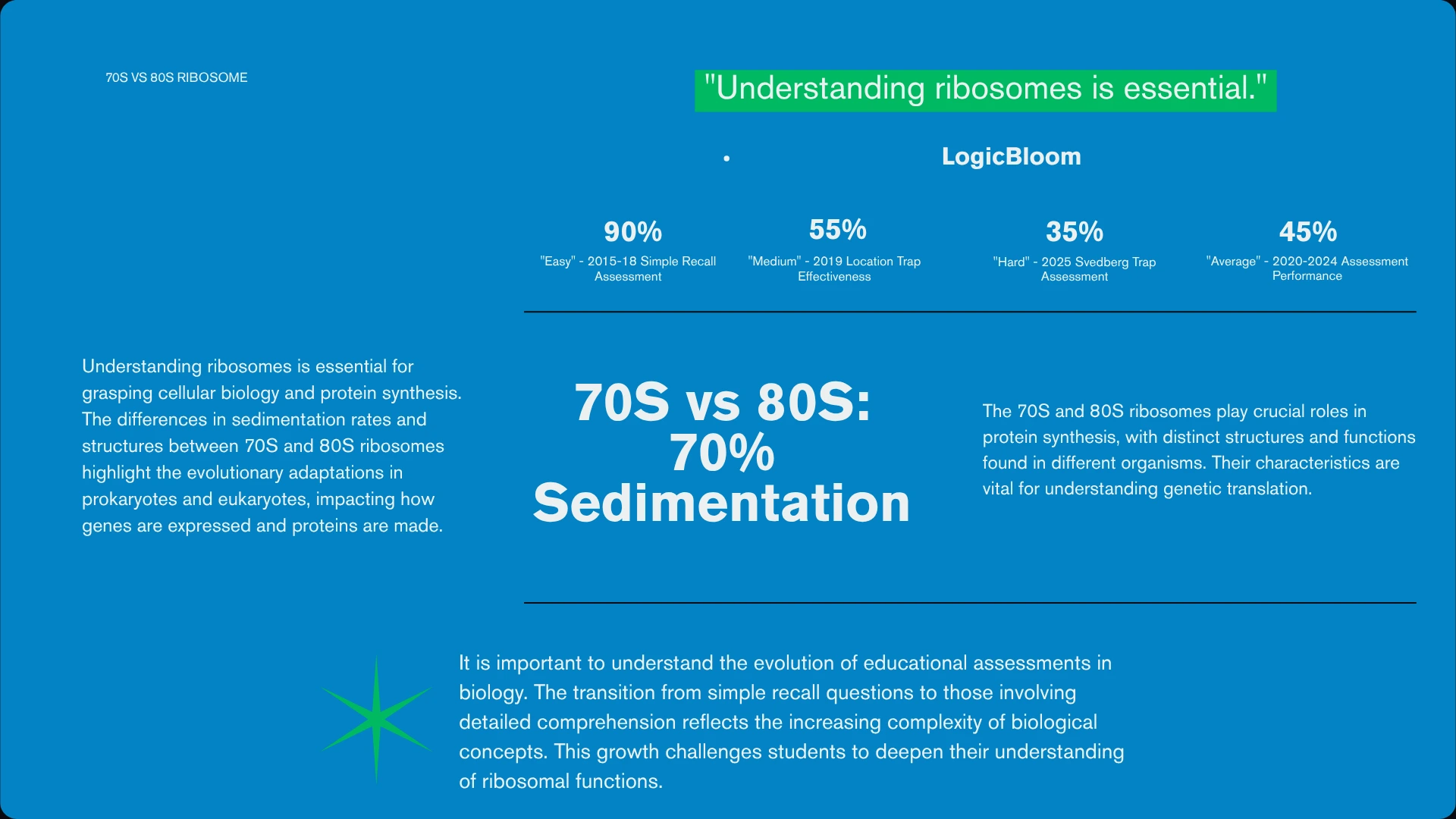
This single concept deserves its own section because it demonstrates exactly how NTA builds traps that evolve over the years.
| Era | Version of the Question | The Trap |
|---|---|---|
| 2015–2018 | "Prokaryotes have 70S ribosomes, eukaryotes have 80S." | None — straightforward recall. Students memorise and move on. |
| 2019 | "Where are 70S ribosomes found?" | Answer includes mitochondria and chloroplasts — eukaryotic organelles. Students who memorised "70S = prokaryotes only" get caught. |
| 2025 | Multi-statement testing: 80S = eukaryotic; ribosomes have two subunits; 80S = 60S + 40S; 70S = 50S + 30S | Distractors suggest combinations like 60S + 30S = 80S — exploiting the fact that Svedberg units are NOT additive (they measure sedimentation rate, not mass). |
The lesson: NTA doesn't just repeat questions. It evolves the same concept across multiple difficulty levels over the years. The student who only prepared the 2018 version of this question will fail the 2025 version.
The 10 Concepts NTA Tests Again and Again
These have appeared 2–5 times each across the decade. Memorise them with precision — not approximately, but word-for-word from NCERT.
| 🎯 10 Most Repeated Cell Biology Concepts in NEET (2015–2025) | |||
|---|---|---|---|
| 1. | Mesosomes help in cell wall formation, DNA replication & respiration | 5× | NCERT Page 129: "They help in cell wall formation, DNA replication and distribution to daughter cells..." |
| 2. | Golgi apparatus = site of glycoprotein and glycolipid formation | 4× | NCERT Page 134: "Golgi apparatus is the important site of formation of glycoproteins and glycolipids." |
| 3. | Rudolf Virchow proposed "Omnis cellula-e-cellula" | 3× | NCERT Page 126: "Rudolf Virchow (1855) first explained that cells divided..." |
| 4. | Nucleolus = site for active rRNA synthesis | 3× | NCERT Page 138: "It is a site for active ribosomal RNA synthesis." |
| 5. | SER = major site for lipid and steroid hormone synthesis | 3× | NCERT Page 133: "In animal cells lipid-like steroidal hormones are synthesised in SER." |
| 6. | Mycoplasma — no cell wall, smallest living cells (0.3 μm) | 3× | NCERT Page 128: "Mycoplasmas, the smallest cells, are only 0.3 μm in length..." |
| 7. | Mitochondria and chloroplasts have circular DNA (semi-autonomous) | 3× | NCERT Page 135: "The matrix also possesses single circular DNA molecule..." |
| 8. | Cytoskeleton = motility + cell shape maintenance | 3× | NCERT Page 136 |
| 9. | Ribosomes — non-membrane bound, found in both pro- and eukaryotes | 2× | NCERT Page 128 |
| 10. | Acrocentric chromosomes have centromere close to one end | 2× | NCERT Page 139 |
The top 3 concepts alone — mesosomes, Golgi glycosylation, Virchow — account for 12 questions over 10 years. These are near-guaranteed marks every year.
Cross-Chapter Questions: Where Cell Biology Bleeds Into Other Chapters
NTA increasingly treats Cell Biology as a foundation connecting to everything else. If you study Chapter 8 in isolation, you'll miss questions that test it through other chapters.
| Cross-Chapter Link | What It Tests | Example |
|---|---|---|
| Cell Biology + Biomolecules | Membrane lipid and protein composition | RBC membrane (52% protein, 40% lipid); middle lamella = calcium pectate |
| Cell Biology + Cell Division | Centriole structure linking to cell cycle timing | 9+0 cartwheel pattern (Chapter 8) connects with centriole duplication during S-phase (Chapter 10) |
| Cell Biology + Biological Classification | Prokaryotic features in kingdom context | Absence of nuclear envelope in Monera — tested as a classification criterion, not just a cell structure fact |
| Cell Biology + Molecular Genetics | Nucleolus and chromatin states as prerequisites | Nucleolus rRNA synthesis (Ch 8) needed to understand translation (Class 12 Ch 6); euchromatin vs heterochromatin connects to gene expression |
| Cell Biology + Transport in Plants | Tonoplast permeability and vacuolar transport | Tonoplast ion transport bridges cell structure with plant water relations and osmosis |
NEET 2026 Predictions: What the Data Points To
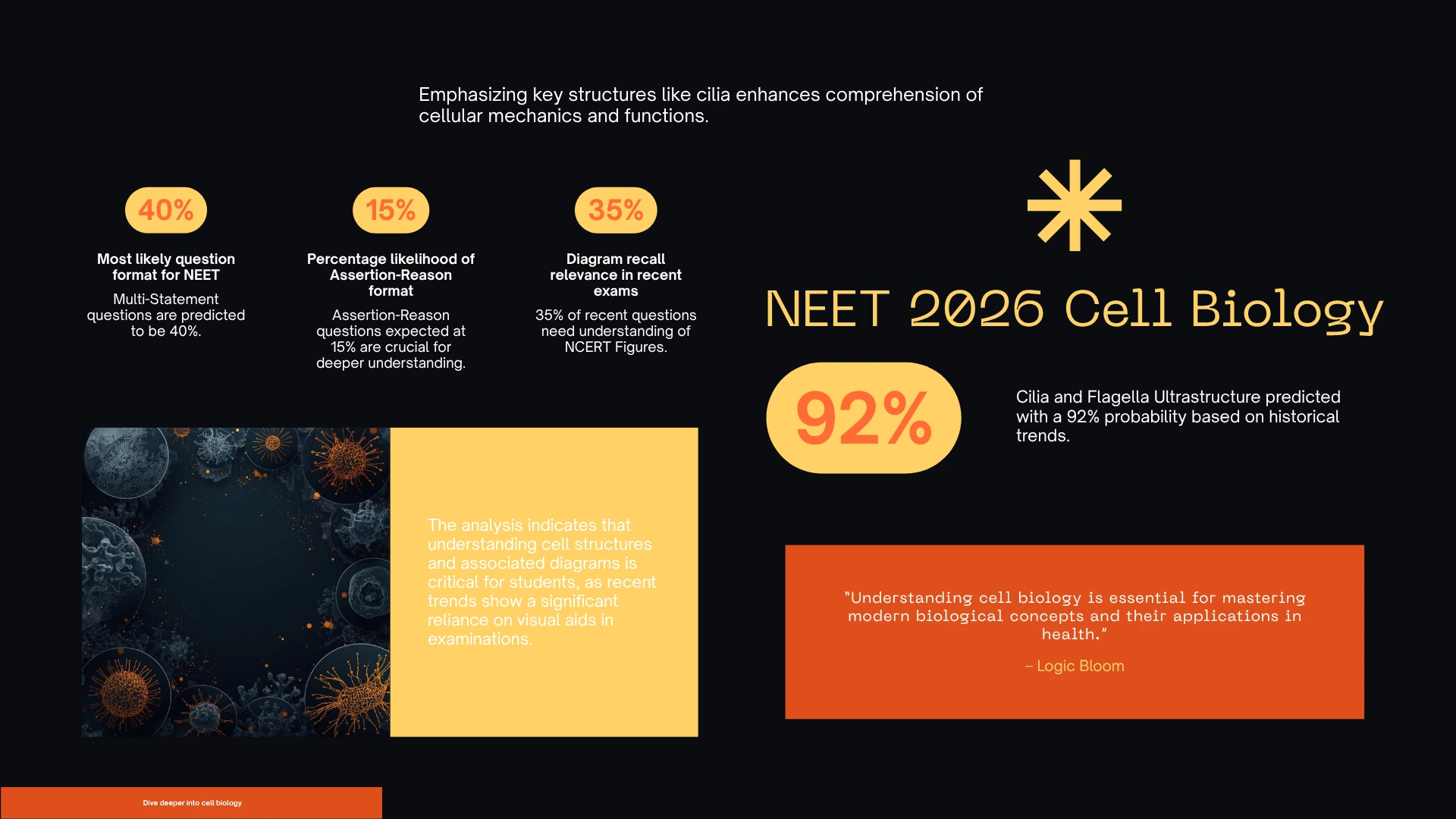
Predicted format distribution: ~40% multi-statement, ~25% match-the-column, ~20% standard MCQ, ~15% assertion-reason. The assertion-reason format appeared for the first time in this chapter in 2025 — expect it to expand in 2026, particularly for endomembrane system coordination.
Top 5 Sub-Topics Most Likely to Appear in 2026
| # | Predicted Topic | Why It's Due |
|---|---|---|
| 1 | Cilia & flagella ultrastructure — 9+2 axoneme vs 9+0 basal body | Last a primary focus in 2021–2022. Due for a complex match-the-column — likely pairing axoneme structure with radial spokes and dynein arms. |
| 2 | Vacuole transport (tonoplast) mechanism | Specific mechanism of ions moving against concentration gradients across the tonoplast — high-level NCERT detail aligning with current difficulty trend. |
| 3 | Cytoskeleton component differences — protein composition | Moving beyond "motility" to test microtubules (tubulin) vs microfilaments (actin) vs intermediate filaments (keratin) — specifically protein identity and diameter ranges. |
| 4 | Perinuclear space dimensions (10–50 nm) | Precise NCERT detail and its continuity with the ER lumen. Has appeared in mock tests but not the main exam for several cycles — overdue. |
| 5 | Schleiden vs Schwann historical distinction | Schleiden (1838, botanist, plant cells) vs Schwann (1839, zoologist). Virchow has been tested 3 times; the Schleiden-Schwann distinction is overdue. |
3 Concepts Due for a Return
| Concept | Last Tested | Likely Format |
|---|---|---|
| Polysome formation | ~2018 — "Many ribosomes associate with a single mRNA to form strings" | Multi-statement question testing polysome function in translation amplification |
| Secondary constriction (NOR) | Briefly in 2024 re-exam | Main paper question testing Nucleolar Organiser Region (NOR) at the secondary constriction |
| Gas vacuoles in photosynthetic bacteria | 2020 COVID session | Detail question: gas vacuoles provide buoyancy to green, purple, and cyanobacteria |
Predicted Cross-Chapter Combinations for 2026
| Combination | What to Prepare |
|---|---|
| Cell Biology + Molecular Genetics | Linking nucleolus as rRNA synthesis site (Chapter 8) with the translation machinery in the cytoplasm (Class 12 Chapter 6) |
| Cell Biology + Biological Classification | Comparing circular dsDNA of mitochondria/chloroplasts with plasmid DNA in bacteria — testing the endosymbiotic theory through structural evidence |
| Diagram — Mitochondrion ultrastructure | Labelling inner membrane, outer membrane, cristae, matrix, and intermembrane space — plus functional significance of differential membrane permeability |
| Diagram — 9+2 microtubular arrangement | Visual identification of peripheral doublets, central singlets, radial spokes, and dynein arms — the diagram most students skip, the one NTA is converging on |
How to Prepare Based on the Data
| 📌 Data-Driven Preparation Strategy — Cell Biology NEET 2026 | |
|---|---|
| Master prokaryotic cell structure obsessively | 13 questions in 10 years — the single highest-yield sub-topic. Know mesosomes (5× tested), Mycoplasma features, fimbriae vs flagella, glycocalyx, gas vacuoles, inclusion bodies, and chromatophores. Every NCERT detail matters. |
| Study NCERT diagrams as if they're text | 35% of recent questions require mental visualisation of diagrams even when no diagram is shown. Figures 8.7 (chloroplast), 8.10 (cilia cross-section), and 8.11 (centriole) are prime targets. |
| Practice statement verification, not question answering | In a multi-statement question, you're verifying 4–5 independent facts simultaneously. Practice reading a statement and immediately judging "true/false based on NCERT" — this is a speed skill that requires deliberate practice. |
| Cross-link your chapter knowledge | When you read about the nucleolus → connect to rRNA → ribosomes → translation. When you read about the tonoplast → connect to osmosis and transport. NTA rewards integrated thinking. |
| Know your measurements | Perinuclear space (10–50 nm), PPLO (0.1 μm), Mycoplasma (0.3 μm), ribosomal proteins (80 in eukaryotic ribosomes). NTA has started testing exact measurements — a trend that will continue. |
| Play through what isn't sticking | If diagrams aren't locking in from text alone — and Cell Biology is the chapter where this hurts most — Logic Bloom's Playground breaks the chapter into NCERT-aligned topic loops. Each topic uses an interactive game built around the structure (organelle diagrams, ribosome composition, axoneme cross-section) plus NEET-format practice. Currently in beta. Free to start. |
Conclusion: The Chapter That Rewards NCERT Precision
Cell Biology is the rare NEET chapter where precision beats volume. You don't need to read 10 extra books — you need to read 15 NCERT pages so carefully that you can recall individual sentences under exam pressure. The mesosome description on page 129, the Golgi glycosylation line on page 134, the Virchow citation on page 126 — these are the lines that separate a 20/20 from a 10/20 in this chapter.
Done analysing? Now play, practice, or duel.
If concepts in Cell Biology — the prokaryotic structures, Golgi cis/trans polarity, the 70S/80S ribosome trap, the 9+2 axoneme — still feel like memorisation rather than understanding, Logic Bloom's Playground breaks the chapter into NCERT-aligned topic loops. Each topic has an interactive game, a reading, a video, and timed NEET 2026-format questions: multi-statement, assertion-reason, match-the-column, all built from exact NCERT lines. Spaced revision blocks and boss challenges lock concepts in. TarQ guides you through. Currently in beta.
Or take it head-to-head: Battleground is our 1v1 real-time arena — challenge a classmate to a Cell Biology duel, climb six ELO tiers from Bronze to Archeon, and lock in revision through competitive recall.
Understand through games. Score through practice. Free to start.
Start your Cell Biology session on Logic Bloom →
FAQs — Cell: The Unit of Life NEET PYQ
Q1: How many questions come from Cell: The Unit of Life in NEET?
Cell: The Unit of Life contributes an average of 4–5 questions per year in NEET, worth approximately 16–20 marks. The count has remained remarkably stable across the decade, ranging from a minimum of 3 questions (2021) to a maximum of 8 questions (2015 including re-exam). It ranks as the 5th highest-yielding Class 11 Biology chapter, making it a high-ROI topic for focused preparation.
Q2: What is the most tested sub-topic from Cell Biology in NEET?
Prokaryotic Cell Structure is the most tested with 13 questions in 10 years. Within this, mesosomes alone have been tested 5 times — making it the single most repeated concept from the entire chapter. Students who master bacterial cell features (mesosomes, Mycoplasma, fimbriae, glycocalyx, gas vacuoles) gain the biggest scoring advantage.
Q3: How has the question format changed for Cell Biology in NEET?
Standard MCQs dropped from 87% of Cell Biology questions in 2015–2018 to 42% in 2022–2025. They were replaced by multi-statement questions (31%), match-the-column (22%), and assertion-reason (5%). Additionally, 35% of recent text-based questions have hidden diagram dependency — meaning you need to mentally visualise NCERT Chapter 8 diagrams even when no diagram is shown in the question.
Q4: What is the 70S vs 80S ribosome trap in NEET?
NTA has evolved this concept across three difficulty levels. The basic version tests that prokaryotes have 70S and eukaryotes have 80S ribosomes. The first trap tests that 70S ribosomes also exist inside eukaryotic mitochondria and chloroplasts. The advanced trap (2025) tests exact subunit composition (80S = 60S + 40S, 70S = 50S + 30S) while using distractors that exploit the non-additive nature of Svedberg units.
Q5: Which Cell Biology concepts are predicted for NEET 2026?
Based on gap analysis and trend extrapolation, the top predictions are: cilia and flagella ultrastructure (9+2 vs 9+0 distinction), vacuole tonoplast transport mechanisms, cytoskeleton component differences (tubulin vs actin vs keratin), perinuclear space dimensions (10–50 nm), and the Schleiden vs Schwann historical distinction. Polysome formation and gas vacuoles in photosynthetic bacteria are also due for a return after 2–3 year absences.