Cell: The Unit of Life Class 11 Notes for NEET — Organelles, Diagrams & PYQ Patterns
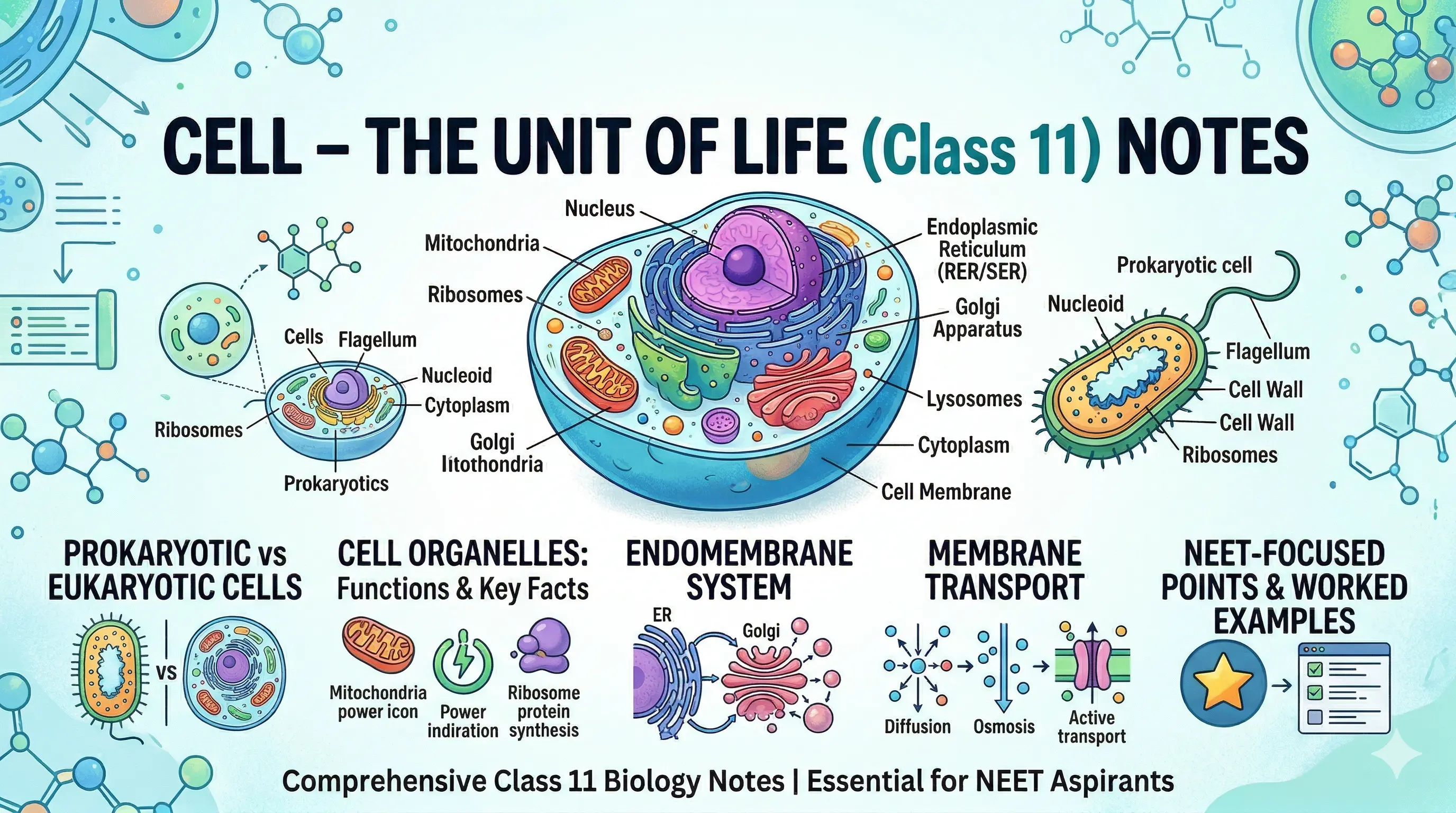
NEET-focused notes on Cell: The Unit of Life (Class 11). Covers cell organelles, prokaryotic vs eukaryotic cells, endomembrane system & membrane transport with worked examples.
Introduction: Biological Classification Class 11 Notes for NEET — The Chapter That Punishes Surface-Level Prep
There's a dangerous myth among NEET aspirants: "Biological Classification is easy — just memorise the five kingdoms and move on."
That worked five years ago. It doesn't anymore.
NEET 2025 proved something brutal about this chapter: 60% of questions now test 3+ concepts simultaneously. You won't see "Which kingdom does Amoeba belong to?" anymore. Instead, you'll see "How many of the following organisms have a cell wall, are heterotrophic, and show spore formation?" — and the list mixes bacteria, fungi, and slime moulds designed to confuse you.
These biological classification class 11 notes for NEET are built to handle that reality. We'll focus on the logic behind classification, not just the labels — because when NEET throws a multi-concept question at you, logic is what saves you, not a memorised table.
The Foundation: Why We Classify At All
Before diving into kingdoms, understand the philosophy. Classification isn't arbitrary. It exists because biologists noticed that organisms share patterns — and those patterns reflect evolutionary relationships.
NCERT Chapter 2 (Class 11 Biology) covers Whittaker's Five Kingdom Classification (1969). The five criteria Whittaker used: cell structure (prokaryotic vs eukaryotic), body organisation (unicellular vs multicellular), mode of nutrition (autotrophic vs heterotrophic vs saprophytic), reproduction, and phylogenetic relationships.
NEET often asks WHY organisms are placed in a particular kingdom — not just WHERE they are. If you understand the five criteria, you can reason through any classification question even if you've never seen that specific organism before.
Kingdom Monera — The Prokaryotic World
Monera includes all prokaryotes: bacteria and cyanobacteria (blue-green algae). This is where NEET asks the most tricky questions because the diversity within Monera is enormous.
Every member of Monera shares these features: no true nucleus (no nuclear membrane), no membrane-bound organelles, 70S ribosomes, and a cell wall (in most, but not all — Mycoplasma lacks a cell wall entirely).
Mycoplasma — the NEET favourite: Mycoplasma is the smallest known living organism that can survive and reproduce independently. It lacks a cell wall, which makes it naturally resistant to penicillin and other antibiotics that target cell wall synthesis. NEET loves this because students who memorise "all bacteria have cell walls" get caught.
Bacterial Classification You Must Know
By shape: Coccus (spherical), Bacillus (rod), Vibrio (comma), Spirillum (spiral). NEET tests this in the "match the following" format.
By cell wall (Gram staining): Gram-positive bacteria have a thick peptidoglycan layer and stain purple. Gram-negative bacteria have a thin peptidoglycan layer with an outer lipopolysaccharide membrane, and stain pink. The clinical significance: Gram-negative bacteria are generally harder to treat because the outer membrane blocks many antibiotics.
By nutrition — this is the most tested classification:
| Nutritional Type | Energy Source | Examples |
|---|---|---|
| Photoautotrophs | Light energy; fix CO₂ | Cyanobacteria (chlorophyll a on cell membranes, no chloroplasts) |
| Chemoautotrophs | Oxidise inorganic chemicals | Nitrosomonas (NH₃ → NO₂⁻), Nitrobacter (NO₂⁻ → NO₃⁻), iron bacteria, sulphur bacteria |
| Photoheterotrophs | Light; need organic carbon | Some purple non-sulphur bacteria |
| Chemoheterotrophs | Organic molecules (energy + carbon) | Most disease-causing bacteria |
NEET trap: "Cyanobacteria are placed in Kingdom Monera because ___." The answer is about prokaryotic cell structure — NOT because they photosynthesise (plants photosynthesise too). Always default to cell structure as the primary criterion.
Archaebacteria — The Extremophiles
Archaebacteria live in extreme environments. Their cell walls contain no peptidoglycan, and their membrane lipids have branched-chain hydrocarbons linked by ether bonds (not ester bonds) — adaptations that allow survival in extreme conditions.
| Group | Habitat | NEET Fact |
|---|---|---|
| Methanogens | Marshy areas, gut of ruminants | Produce methane; cow dung = biogas source |
| Halophiles | Salt lakes, salt flats | Extreme salt-lovers |
| Thermoacidophiles | Hot acidic springs | Survive high temperature and low pH simultaneously |
Kingdom Protista — The Misfit Kingdom
Protista is essentially the "everything eukaryotic that doesn't fit into plants, animals, or fungi" kingdom. All members are eukaryotic, mostly unicellular, and this is the kingdom where NEET loves testing exceptions.
Chrysophytes (golden algae and diatoms): Diatoms have cell walls made of silica (SiO₂), which doesn't decay easily. Billions of years of dead diatom shells formed diatomaceous earth — used in polishing and filtration. NEET factoid: diatom walls are indestructible and leave behind fossils, making them important in palaeontology.
Dinoflagellates: Mostly marine, photosynthetic. Many are bioluminescent. Some cause red tides — toxic algal blooms that kill marine life. They have two flagella: one longitudinal, one transverse (in a groove around the cell). Cell walls have stiff cellulose plates — not silica.
Euglenoids: This is the classic NEET confusion organism. Euglena is both autotrophic (has chloroplasts, photosynthesises in light) and heterotrophic (absorbs food in the dark). It has a pellicle (flexible protein-rich layer) instead of a cell wall. Two flagella (one short, one long). No cell wall = not a plant. But has chloroplasts = not an animal. This is why it's in Protista.
Slime Moulds: Saprophytic. In favourable conditions, they form an aggregation called plasmodium — not the malaria parasite (same name, different organism, a classic NEET trap). Under stress, they form spores with tough walls that disperse by air currents.
Protozoans — classified by their locomotory organelle:
| Type | Locomotion | Examples & NEET Notes |
|---|---|---|
| Amoeboid | Pseudopodia | Amoeba, Entamoeba (causes amoebic dysentery) |
| Flagellated | Flagella | Trypanosoma — causes sleeping sickness |
| Ciliated | Cilia | Paramaecium — extensively ciliated |
| Sporozoans | None (no locomotory organelle) | Plasmodium — causes malaria |
Kingdom Fungi — The Decomposer Kingdom
Fungi are heterotrophic eukaryotes that digest food externally and then absorb it. This mode of nutrition is called saprophytic (on dead matter) or parasitic (on living hosts).
The fungal body is a network of thread-like filaments called hyphae. A mass of hyphae = mycelium. Hyphae can be septate (with cross-walls separating cells) in Ascomycetes and Basidiomycetes, or aseptate/coenocytic (no cross-walls, multinucleate continuous cytoplasm) in Zygomycetes like Mucor. Cell walls are made of chitin — not cellulose (plants) or peptidoglycan (bacteria). This is a frequent comparison question.
The Four Fungal Classes
| Class | Common Name | Mycelium | Sexual Spores | Asexual Spores | Examples |
|---|---|---|---|---|---|
| Phycomycetes | Lower fungi | Aseptate, coenocytic | Zygospores | Sporangiospores | Mucor, Rhizopus, Albugo |
| Ascomycetes | Sac fungi | Septate | Ascospores (in ascus) | Conidia | Aspergillus, Penicillium, Yeast, Neurospora, Claviceps |
| Basidiomycetes | Club fungi | Septate | Basidiospores (on basidium) | Generally absent | Mushrooms, Agaricus, Ustilago (smut), Puccinia (rust) |
| Deuteromycetes | Imperfect fungi | Septate | Unknown / absent | Conidia | Alternaria, Colletotrichum, Trichoderma |
Key NEET facts per class:
Ascomycetes: Called sac fungi because spores form inside a sac-like structure (ascus). Neurospora is used extensively in biochemical genetics research. Claviceps grows on rye and produces ergot alkaloids. Yeast is unicellular — the exception in fungi.
Basidiomycetes: No asexual spore stage. Ustilago causes smut disease in wheat; Puccinia causes rust disease. Vegetative reproduction by fragmentation only.
Deuteromycetes: Called "imperfect" because only asexual/vegetative phases are known. Once the sexual stage is discovered, they get reclassified into Ascomycetes or Basidiomycetes.
Lichens and Mycorrhizae — Symbiotic Associations
Lichens = fungus (usually Ascomycete) + alga (or cyanobacterium). The fungus provides structure, water, and minerals. The alga provides food through photosynthesis. Lichens are pollution indicators — they cannot survive in SO₂-polluted areas. This is a near-guaranteed NEET fact.
Mycorrhizae = fungus + roots of higher plants. The fungus helps absorb phosphorus and other minerals from soil; the plant provides sugars to the fungus. Example: Glomus forms endomycorrhiza with crop plants and significantly improves nutrient uptake.
Kingdom Plantae and Kingdom Animalia — Quick NEET Essentials
| Feature | Kingdom Plantae | Kingdom Animalia |
|---|---|---|
| Cell type | Eukaryotic, multicellular | Eukaryotic, multicellular |
| Cell wall | Cellulose | Absent |
| Nutrition | Autotrophic (photosynthetic) | Heterotrophic (holozoic) |
| Examples | Algae, bryophytes, pteridophytes, gymnosperms, angiosperms | Sponges to humans — entire animal kingdom |
The key classification question: "An organism is eukaryotic, multicellular, has chitin in its cell wall, and is heterotrophic. Which kingdom?" Answer: Fungi — not Animalia, because animals have no cell wall at all.
Viruses, Viroids, Prions — The "Not Quite Alive" Zone
Viruses are not placed in any kingdom because they are acellular — they don't have cells. They are obligate intracellular parasites. Structure: a protein coat (capsid) surrounding genetic material (DNA OR RNA, never both). Some viruses have an additional lipid envelope (influenza, HIV).
| Feature | Plant Viruses | Animal Viruses | Bacteriophages |
|---|---|---|---|
| Genetic material | Usually ssRNA | DNA or RNA | Usually dsDNA |
| Example | TMV (Tobacco Mosaic Virus) | Influenza, HIV | T₂ phage |
Historical facts NEET loves: TMV was the first virus discovered — Ivanowsky (1892) found it passed through bacteria-proof filters; Beijerinck (1898) called it "contagium vivum fluidum"; Stanley (1935) crystallised TMV for the first time.
Viroids and Prions
| Agent | Composition | Diseases Caused | Discovered By |
|---|---|---|---|
| Viroids | Naked circular RNA — no protein coat at all | Potato spindle tuber disease (plants) | Diener (1971) |
| Prions | Misfolded proteins — no nucleic acid at all | Mad cow disease (BSE), Creutzfeldt-Jakob disease (humans) | Prusiner |
Worked Example: Multi-Concept NEET Problem
Question: Consider the following statements:
(A) Methanogens are archaebacteria found in gut of ruminants
(B) Dinoflagellates have cell walls with silica
(C) Deuteromycetes reproduce only by asexual spores
(D) Viroids have free RNA without a protein coat
(E) Mycoplasma lack cell wall and can survive without oxygen
How many of the above statements are correct?
(a) 2 (b) 3 (c) 4 (d) 5
Solution:
- (A) Correct. Methanogens are archaebacteria present in the gut of ruminants like cattle, where they help in cellulose digestion and produce methane (biogas).
- (B) Incorrect. Dinoflagellates have cell walls with stiff cellulose plates, not silica. It is diatoms (chrysophytes) that have silica cell walls. This is the single most common swap-trap in this chapter.
- (C) Correct. Deuteromycetes (imperfect fungi) reproduce only by asexual spores called conidia. No sexual stage has been observed — that's why they're called "imperfect."
- (D) Correct. Viroids are free RNA molecules without any protein coat. They are smaller than any known virus and cause plant diseases.
- (E) Correct. Mycoplasma lack a cell wall and many are anaerobic (can survive without oxygen). They are the smallest self-replicating organisms known.
Statements A, C, D, and E are correct. Answer: (c) 4
Notice how this single question tests across Monera (A, E), Protista (B), Fungi (C), and sub-viral particles (D). This is exactly the multi-concept format NEET 2025–2026 favours.
Quick Revision Summary
| 📌 Biological Classification Class 11 — NEET Quick Reference | |
|---|---|
| Monera | Prokaryotic. Bacteria + Cyanobacteria. Mycoplasma = no cell wall. Archaebacteria = extremophiles (methanogens, halophiles, thermoacidophiles). |
| Protista | Eukaryotic unicellular. Diatoms = silica walls. Dinoflagellates = cellulose plates + red tides. Euglena = both auto & heterotrophic + pellicle. Slime moulds = saprophytic, form plasmodium. |
| Fungi | Eukaryotic, heterotrophic, chitin cell wall. Phycomycetes (aseptate/coenocytic), Ascomycetes (sac/ascospores), Basidiomycetes (club/no asexual stage), Deuteromycetes (imperfect/no sexual stage). |
| Lichens | Fungus + alga. Pollution indicator — absent in SO₂-polluted areas. |
| Viruses | DNA OR RNA + protein coat. Acellular — not in any kingdom. TMV = first discovered (Ivanowsky 1892). |
| Viroids vs Prions | Viroids = naked RNA, no protein. Prions = misfolded protein, no nucleic acid. |
| Key NEET Traps | Diatoms ≠ Dinoflagellates (silica vs cellulose). Plasmodium (slime mould) ≠ Plasmodium (malaria parasite). Mycoplasma = no cell wall = penicillin resistant. |
Conclusion: Classification Is Logic, Not Lists
The students who struggle with Biological Classification are the ones who tried to brute-force memorise kingdom-by-kingdom lists. The students who score are the ones who internalised Whittaker's five criteria and can apply them to any organism — familiar or unfamiliar. Know the logic (cell structure → organisation → nutrition → reproduction), and the NEET multi-concept traps become far less dangerous.
If you want to build that logic through active recall rather than passive reading, Logic Bloom's Playground turns these classification patterns into visual, interactive games — drag organisms into kingdoms, match features to fungal classes, and build the taxonomy yourself. Concepts that stick, not just words you'll forget.
Try Biological Classification concept games free on Logic Bloom →
FAQs — Biological Classification Class 11 for NEET
Q1: How many questions come from Biological Classification in NEET?
Biological Classification typically contributes 2–3 direct questions in NEET. However, the chapter is increasingly integrated into multi-concept questions that combine classification with topics from other chapters. NEET 2025 showed that 60% of classification-based questions tested three or more concepts simultaneously, making conceptual clarity more important than rote memorisation.
Q2: What is the difference between Gram-positive and Gram-negative bacteria for NEET?
Gram-positive bacteria have a thick peptidoglycan layer in their cell wall and retain the crystal violet stain (appearing purple). Gram-negative bacteria have a thinner peptidoglycan layer surrounded by an outer lipopolysaccharide membrane and stain pink with the counterstain. The outer membrane of Gram-negative bacteria makes them more resistant to certain antibiotics, which is why this distinction has clinical significance.
Q3: Why is Euglena placed in Kingdom Protista and not in Plantae or Animalia?
Euglena has chloroplasts and can photosynthesise like plants, but it can also feed heterotrophically in the dark like animals. It has a pellicle instead of a cell wall, and it has flagella for locomotion. Since it shares features of both kingdoms without fully fitting either, it is placed in Protista — the kingdom for eukaryotic organisms that don't meet the strict criteria of Plantae, Fungi, or Animalia.
Q4: What is the difference between viroids and prions?
Viroids are small, circular, free RNA molecules without any protein coat that cause diseases in plants (like potato spindle tuber disease). Prions are misfolded proteins with no nucleic acid at all that cause diseases in animals and humans (like mad cow disease and Creutzfeldt-Jakob disease). The key difference: viroids have RNA but no protein; prions have protein but no nucleic acid.
Q5: Why are lichens considered pollution indicators?
Lichens are extremely sensitive to sulphur dioxide (SO₂) pollution in the atmosphere. They absorb water and nutrients directly from the air — which means they also absorb pollutants. High SO₂ concentrations damage or kill the algal partner, destroying the lichen. The presence of lichens therefore indicates clean air, while their absence signals significant air pollution, making them reliable biological indicators of air quality.