Biomolecules Class 11 Notes for NEET — Concepts, Formulas & PYQ Patterns
Master Biomolecules for NEET 2026 with concept-first notes covering enzymes, carbohydrates, proteins, lipids & nucleic acids. Includes worked examples and PYQ analysis.
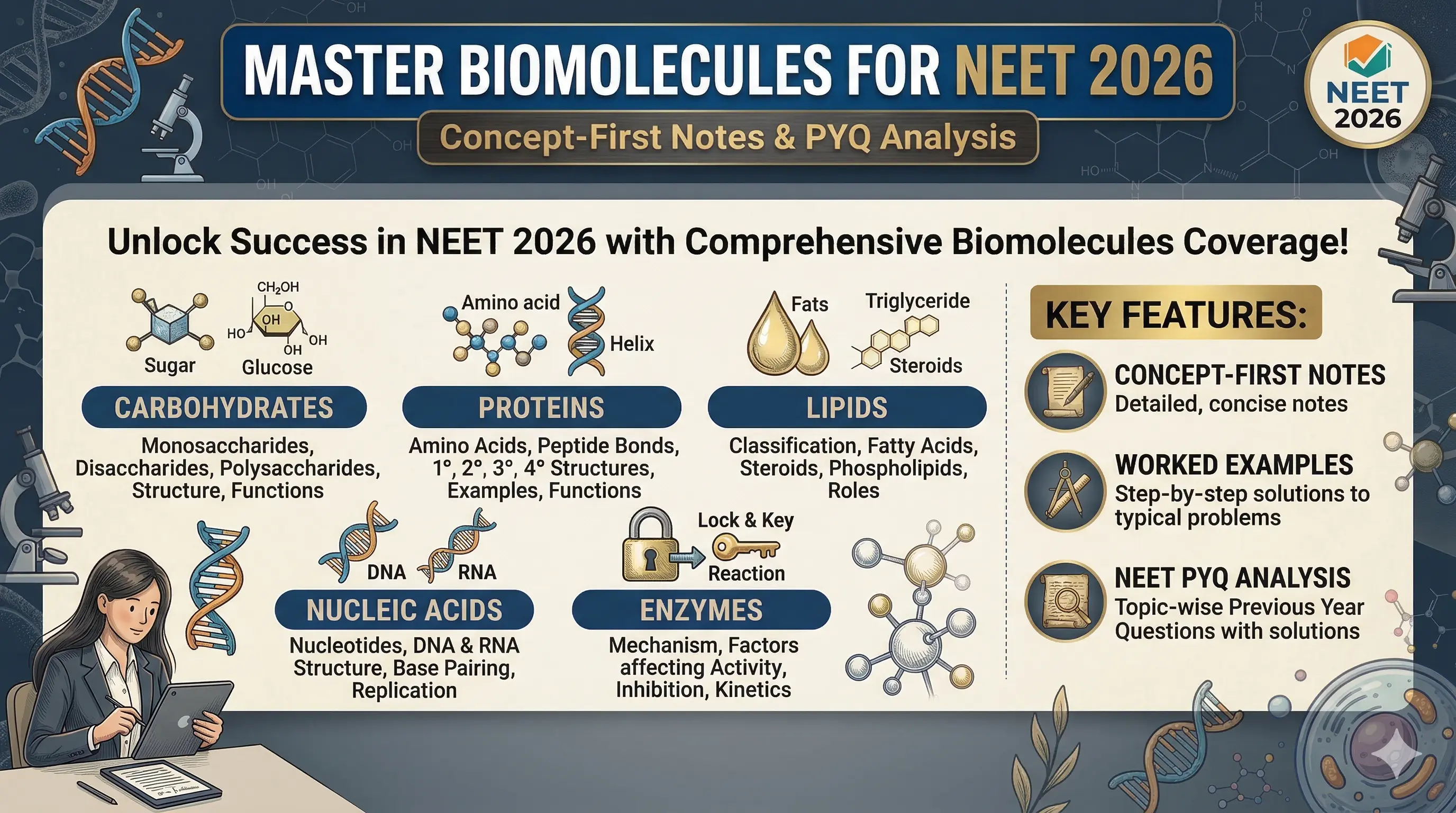
Introduction: Biomolecules Class 11 Notes for NEET — The Concepts That Actually Get Tested
Biomolecules is one of those chapters that looks deceptively simple. You read NCERT, you think you know it, and then NEET hits you with an assertion-reason question combining enzyme kinetics with metabolite classification — and suddenly nothing makes sense.
Here's the reality: Biomolecules carries 4–5 questions in NEET every year, and it has the highest percentage of assertion-reason questions in all of Class 11 Biology. That's not a chapter you can afford to skim.
These biomolecules class 11 notes for NEET are built differently. Instead of listing definitions you'll forget in a week, we'll build the concepts from the ground up — so when NEET throws you a multi-concept retrieval question, your brain actually has something to retrieve.
Why Biomolecules Matters More Than You Think
NCERT Chapter 9 (Class 11 Biology) covers biomolecules, and NTA loves this chapter for a specific reason: it sits at the intersection of Biology and Chemistry. You need to understand molecular structure AND biological function simultaneously.
In NEET 2024 and 2025, this chapter showed a clear pattern shift:
- Fewer "name-this-molecule" questions
- More "which of the following statements about X are correct" format
- Assertion-reason questions testing whether you understand why a molecule behaves a certain way
The students who score well here aren't the ones who memorised a table. They're the ones who understood the logic behind the table.
NTA's multi-statement format tests whether you truly understand enzyme inhibition — not just whether you memorised it. Play the Biomolecules concept game to build the understanding, then practice in exam format.The Four Families of Biomolecules
Every living cell runs on four molecular families. Think of them as the four departments of a company:
Carbohydrates — The Energy Department
Carbohydrates are literally "carbon + water" — their general formula is C_n(H₂O)_n. But don't let the simplicity fool you. NEET loves testing the classification.
The hierarchy you must know cold:
Monosaccharides are the monomers — single sugar units that cannot be hydrolysed further. The ones NEET cares about: glucose (aldohexose, C₆H₁₂O₆), fructose (ketohexose), galactose, ribose (C₅ — found in RNA), and deoxyribose (C₅ — found in DNA).
Disaccharides are two monosaccharides joined by a glycosidic bond. The three that appear repeatedly: sucrose (glucose + fructose), lactose (glucose + galactose), and maltose (glucose + glucose).
Polysaccharides are long chains. Starch and glycogen are storage polysaccharides (starch in plants, glycogen in animals). Cellulose is a structural polysaccharide — same glucose units as starch, but linked by β-1,4 bonds instead of α-1,4. That single bond orientation difference is why you can digest rice but not wood.
NEET trap alert: A common assertion-reason question pairs "Cellulose is a polymer of glucose" (True) with "Humans can digest cellulose" (False). The reason: humans lack cellulase enzyme. Both statements are true, but the reason doesn't explain the assertion — it's the bond type (β-linkage) that's the key structural feature.
Proteins — The Workforce
Proteins are polymers of amino acids linked by peptide bonds. There are 20 standard amino acids, and NEET expects you to know their classification.
The framework that makes this stick:
Amino acids have a central carbon bonded to four groups: an amino group (–NH₂), a carboxyl group (–COOH), a hydrogen, and a variable R-group. It's the R-group that makes each amino acid unique.
Classify by R-group properties: nonpolar (like alanine, valine), polar uncharged (like serine, threonine), positively charged (like lysine, arginine), and negatively charged (like aspartic acid, glutamic acid).
The four levels of protein structure:
| Level | Structure | Stabilising Bond(s) |
|---|---|---|
| Primary | Linear sequence of amino acids | Peptide bonds |
| Secondary | α-helix or β-pleated sheet (local folding) | Hydrogen bonds (between backbone atoms) |
| Tertiary | Overall 3D shape of the polypeptide | Disulphide bonds, hydrophobic interactions, ionic bonds, hydrogen bonds |
| Quaternary | Multiple polypeptide subunits assembled together | Same as tertiary (between subunits) |
NEET example: Sickle cell anaemia arises from a single amino acid substitution at position 6 of the β-globin chain — glutamic acid is replaced by valine. This changes the primary structure, which alters the tertiary shape of the haemoglobin molecule. A favourite NEET illustration of how sequence determines function.
NEET pattern insight: Questions on protein structure almost always test which bonds stabilise which level. Primary = peptide bonds. Secondary = hydrogen bonds. Tertiary = disulphide + hydrophobic + ionic + hydrogen. Get this hierarchy into muscle memory.
Lipids — The Reserve Department
Lipids are not true polymers (no repeating monomer units), but they're grouped together because they share one property: insoluble in water, soluble in organic solvents.
What NEET actually tests:
Simple lipids (fats and oils): A fat molecule is one glycerol esterified with three fatty acids — a triglyceride. Saturated fatty acids have no double bonds (solid at room temperature — ghee, butter). Unsaturated fatty acids have one or more double bonds (liquid at room temperature — vegetable oils).
Compound lipids: Phospholipids are the building blocks of cell membranes. One end is hydrophilic (the phosphate head), the other is hydrophobic (the fatty acid tails). This amphipathic nature is why they spontaneously form bilayers in water — and that's the structural basis of every cell membrane in your body.
Steroids: Cholesterol is the parent steroid. From cholesterol, your body makes cortisol, testosterone, estrogen, and vitamin D. NEET occasionally asks about steroid structure — four fused carbon rings (three six-membered, one five-membered).
Nucleic Acids — The Information Department
DNA and RNA are polymers of nucleotides. Each nucleotide = nitrogenous base + pentose sugar + phosphate group.
The comparison NEET loves:
| Feature | DNA | RNA |
|---|---|---|
| Sugar | Deoxyribose | Ribose |
| Bases | Adenine, Thymine, Guanine, Cytosine | Adenine, Uracil, Guanine, Cytosine |
| Strands | Double-stranded | Usually single-stranded |
| Function | Stores genetic information | Transfers and translates genetic info |
Purine bases (Adenine, Guanine) have a double-ring structure. Pyrimidine bases (Cytosine, Thymine/Uracil) have a single ring. A quick mnemonic: Pure As Gold — Purines are A and G.
In DNA, A pairs with T (2 hydrogen bonds) and G pairs with C (3 hydrogen bonds). This is Chargaff's rule, and it is tested almost every year in some form.
Enzymes — Where NEET Gets Serious
Enzymes are biological catalysts, and this is the sub-topic where NEET invests the most questions from this chapter. If you take away one section from these biomolecules class 11 notes for NEET, make it this one.
How Enzymes Work
An enzyme lowers the activation energy of a reaction without changing the equilibrium. It doesn't make impossible reactions happen — it makes possible reactions happen faster.
The lock-and-key model (Fischer, 1894) says the enzyme's active site is a rigid shape that exactly fits the substrate. The induced fit model (Koshland, 1958) is the refined version — the active site changes shape slightly to accommodate the substrate, like a glove fitting a hand. NCERT mentions both; NEET prefers questions on induced fit.
Factors Affecting Enzyme Activity
Temperature: Enzyme activity increases with temperature up to an optimum (typically 37°C for human enzymes), then drops sharply as the protein denatures. The graph is an asymmetric bell curve — steep drop on the right side.
pH: Each enzyme has an optimal pH. Pepsin works best at pH 2 (stomach acid), trypsin at pH 8 (alkaline intestine). NEET loves asking you to match enzyme → optimal pH.
Substrate concentration: At low substrate concentration, activity increases linearly. At high concentration, all enzyme molecules are saturated — adding more substrate doesn't increase rate. This plateau is V_max (maximum velocity). The substrate concentration at which the rate is V_max/2 is called the K_m (Michaelis constant). Low K_m = high enzyme affinity for substrate.
Enzyme Inhibition — The Most Tested Sub-Topic
| Type | Mechanism | Effect on K_m | Effect on V_max |
|---|---|---|---|
| Competitive Inhibition | Inhibitor resembles substrate, competes for active site. Overcome by increasing substrate concentration. | Increases K_m | No change |
| Non-Competitive Inhibition | Inhibitor binds allosteric site, changes enzyme shape. NOT overcome by more substrate. | No change | Decreases V_max |
Classic NEET example of competitive inhibition: Malonate inhibits succinate dehydrogenase because malonate's structure closely mimics succinate, allowing it to occupy the active site without being converted.
NEET trap: "Competitive inhibition increases K_m but does not change V_max" — True. "Non-competitive inhibition decreases V_max but does not change K_m" — True. These two statements are tested in almost every possible format.
Primary vs Secondary Metabolites — A Classification NEET Loves
Primary metabolites are molecules directly involved in normal growth, development, and reproduction. They're found in every organism: amino acids, sugars, organic acids, nucleotides.
Secondary metabolites are NOT directly involved in growth — they serve ecological functions like defence, attraction, or competition. They're often found only in specific organisms. Examples: alkaloids (caffeine, morphine, nicotine), terpenes (essential oils), phenolics (tannins), lectins.
The NEET question pattern: "Which of the following is a secondary metabolite?" followed by a list mixing primary and secondary metabolites. The trick is knowing that amino acids, sugars, and organic acids are ALWAYS primary. Alkaloids, terpenes, and pigments like carotenoids are secondary.
Worked Example: A Typical NEET-Style Problem
Question: Which of the following statements are correct?
(i) Sucrose is a reducing sugar
(ii) Starch gives blue colour with iodine
(iii) Cellulose is a polymer of β-D-glucose
(iv) Glycogen is stored in muscles and liver in animals
(a) (ii), (iii), and (iv) only (b) (i), (ii), and (iii) only (c) (i), (ii), (iii), and (iv) (d) (ii) and (iv) only
Solution:
- Statement (i): Incorrect. Sucrose is a non-reducing sugar. The glycosidic bond between glucose and fructose involves the reducing ends of both sugars, leaving no free anomeric carbon. This is a classic NEET trap.
- Statement (ii): Correct. Starch (specifically the amylose component) gives a blue-black colour with iodine. Iodine molecules get trapped in the helical structure of amylose.
- Statement (iii): Correct. Cellulose is a polymer of β-D-glucose units linked by β-1,4 glycosidic bonds.
- Statement (iv): Correct. Glycogen is the storage polysaccharide in animals, stored primarily in liver and skeletal muscle cells.
Answer: (a) — Statements (ii), (iii), and (iv) are correct.
Quick Revision Summary
| 📌 Biomolecules Class 11 — NEET Quick Reference | |
|---|---|
| Carbohydrates | C_n(H₂O)_n → Mono/Di/Polysaccharides. Starch (α-glucose, storage), Cellulose (β-glucose, structural). Sucrose = non-reducing sugar. |
| Proteins | 20 amino acids → peptide bonds → 4 structural levels. Primary (sequence/peptide), Secondary (α-helix/β-sheet/H-bonds), Tertiary (3D/disulphide), Quaternary (subunits). |
| Lipids | Not true polymers. Triglycerides = glycerol + 3 fatty acids. Phospholipids = amphipathic → cell membranes. Steroids = 4 fused rings. |
| Nucleic Acids | Nucleotide = base + sugar + phosphate. DNA (A-T: 2H bonds, G-C: 3H bonds). Purines (A,G) = double ring. Pyrimidines (C,T,U) = single ring. |
| Enzymes | Lower activation energy. Competitive: ↑K_m, same V_max. Non-competitive: same K_m, ↓V_max. Induced fit model > lock-and-key. |
| Metabolites | Primary (amino acids, sugars, organic acids) vs Secondary (alkaloids, terpenes, pigments). |
Conclusion: From Notes to NEET Marks
Biomolecules rewards students who understand structure-function relationships, not those who memorise isolated facts. The chapter's high assertion-reason frequency is NTA telling you exactly what to do: know why molecules behave as they do, not just what they are. Enzyme inhibition, protein structure levels, and carbohydrate classification are your three highest-return investment areas.
If you want to build an intuitive feel for how enzyme kinetics, protein folding, and metabolite classification actually work before you tackle MCQs on paper, Logic Bloom's Playground breaks these concepts down into visual, interactive simulations — concept-first, so the ideas stick rather than just the words.
Try Biomolecules concept games free on Logic Bloom →
FAQs — Biomolecules Class 11 for NEET
Q1: How many questions come from Biomolecules in NEET?
Biomolecules typically contributes 4–5 questions in NEET, making it one of the higher-weightage chapters from Class 11 Biology. The chapter also has the highest frequency of assertion-reason format questions in Class 11, so format-specific practice is essential alongside concept mastery.
Q2: What is the difference between competitive and non-competitive enzyme inhibition for NEET?
In competitive inhibition, the inhibitor competes with the substrate for the active site — it increases K_m (apparent lower affinity) but V_max remains unchanged because excess substrate can outcompete the inhibitor. In non-competitive inhibition, the inhibitor binds at an allosteric site, reducing V_max (fewer functional enzyme molecules) while K_m stays the same since substrate binding affinity is unaffected.
Q3: Why is sucrose called a non-reducing sugar?
Sucrose is a non-reducing sugar because the glycosidic bond between glucose and fructose involves the anomeric carbons of BOTH monosaccharides. Since both reducing ends are locked in the bond, there is no free anomeric carbon available to reduce Cu²⁺ in Benedict's or Fehling's test. This is distinct from maltose and lactose, where one anomeric carbon remains free.
Q4: Which biomolecules topics are most important for NEET 2026?
Based on previous year analysis, the highest-yield areas are: enzyme inhibition types (competitive vs non-competitive), the four levels of protein structure and their stabilising bonds, classification of carbohydrates with specific examples, primary vs secondary metabolites, and the structural differences between DNA and RNA. Assertion-reason questions frequently combine two of these sub-topics, so understanding connections between concepts is critical.
Q5: Is NCERT enough for Biomolecules in NEET?
NCERT Chapter 9 covers approximately 85–90% of what NEET asks from Biomolecules. However, for enzyme kinetics details (K_m, V_max relationships) and certain assertion-reason patterns, solving previous year questions is essential. The remaining 10–15% comes from applying NCERT concepts in unfamiliar combinations rather than from outside content.