Biomolecules NEET PYQ Analysis (2015–2025) — Trends & 2026 Predictions
The 10 concepts NTA has repeated 3-5 times each, the year-by-year trap that shifted 93% → 29%, and the 3 sub-topics predicted for Re-NEET. Not a question list — a pattern map.
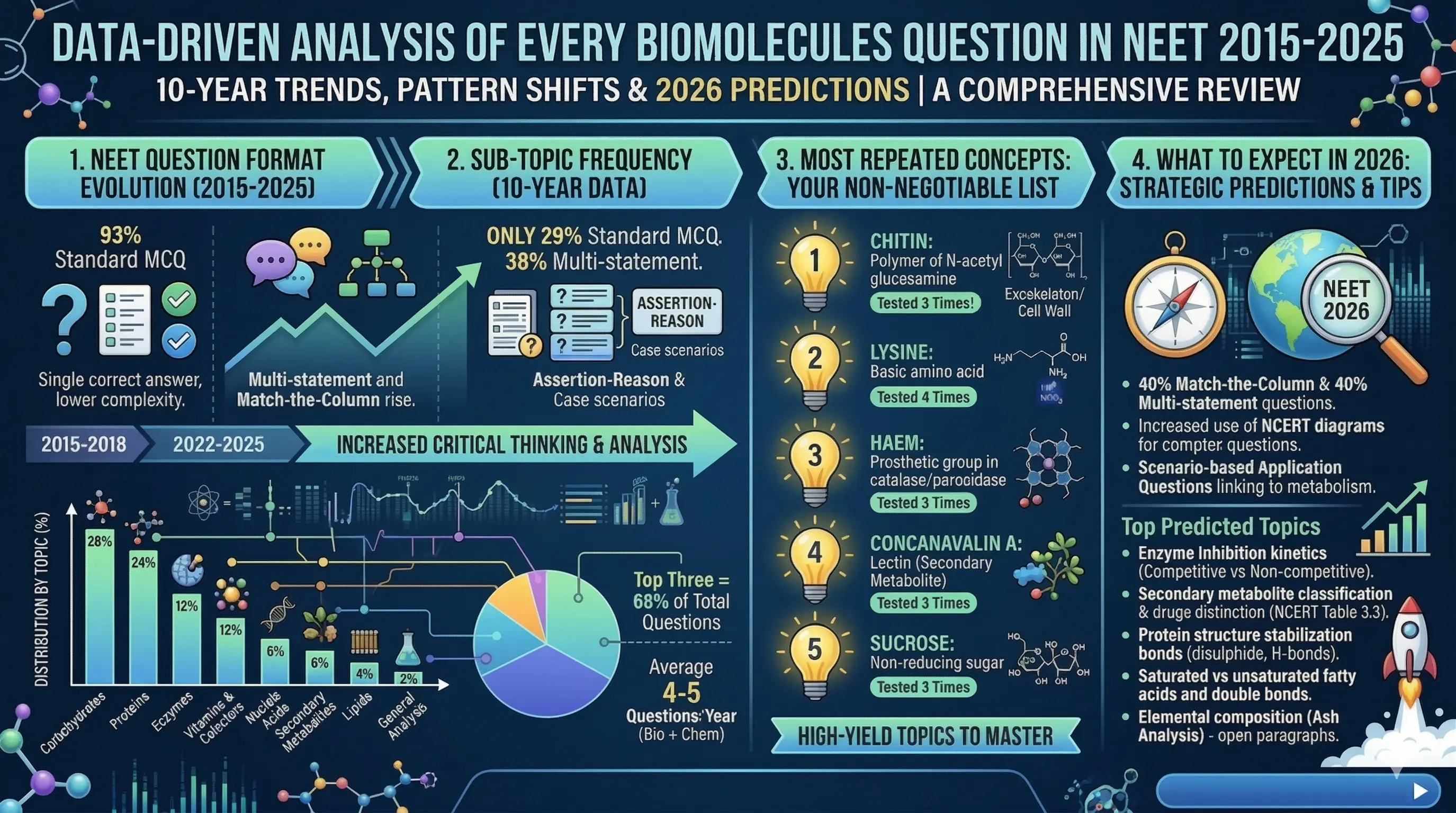
Introduction: Biomolecules NEET PYQ Analysis — The Data Behind 10 Years of Questions
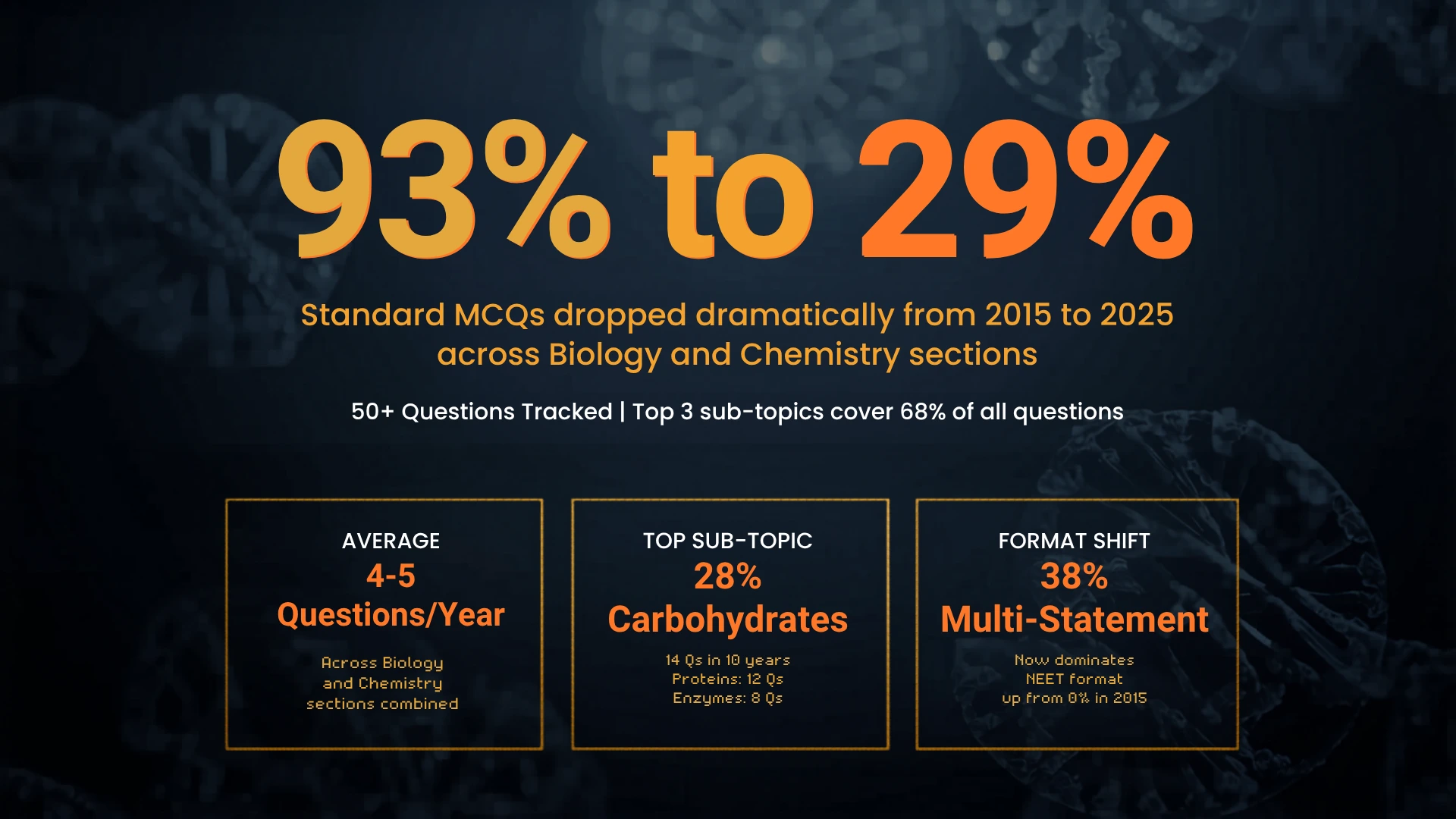
Here's a number that should change how you prepare for Biomolecules:
93% of Biomolecules questions in 2015–2018 were standard MCQs. By 2022–2025, that number dropped to 29%.
The chapter didn't change. The NCERT didn't change. But the way NTA tests it changed completely. And most students are still preparing like it's 2018.
This isn't another list of previous year questions — you can find those anywhere. This is a pattern analysis. We tracked every single Biomolecules question asked in NEET from 2015 to 2025, classified each one by sub-topic, format, and difficulty, and extracted the trends that tell you exactly how to prepare for 2026.
If you need to revise the actual concepts first, start with our Biomolecules Class 11 notes for NEET. Then come back here to understand how those concepts get tested.
| 🎯 38% of new Biomolecules questions are multi-statement | |
|---|---|
| Verifying 4–5 NCERT facts in a single question is a different cognitive skill than standard MCQ practice. Drill it on Logic Bloom's Playground (BETA) — Biomolecules topic loops with TarQ, your in-app mentor. | Get the app → Free to start. |
The Numbers: How Many Questions Does Biomolecules Actually Carry?
Biomolecules contributes questions from both Biology and Chemistry sections of NEET. Most students only count the Biology questions and underestimate this chapter's true weightage.
| Year | Biology Qs | Chemistry Qs | Total |
|---|---|---|---|
| 2025 | 4 | 2 | 6 |
| 2024 + Re-exam | 3 | 3 | 6 |
| 2023 | 2 | 2 | 4 |
| 2022 | 3 | 2 | 5 |
| 2021 | 3 | 1 | 4 |
| 2020 + Phase 2 | 3 | 2 | 5 |
| 2019 | 3 | 2 | 5 |
| 2018 | 2 | 1 | 3 |
| 2017 | 2 | 1 | 3 |
| 2016 + Phase 2 | 3 | 2 | 5 |
| 2015 + Re-exam | 3 | 1 | 4 |
Average: 4–5 questions per year across both subjects. That's 16–20 marks riding on a single Class 11 chapter. Notice the post-2020 trend — the total has been consistently 4–6 questions, up from 3–5 in the earlier years.
This makes Biomolecules the 3rd highest-yielding Class 11 Biology chapter in NEET, behind only Animal Kingdom (4–5 questions/year) and Cell Cycle & Cell Division (4 questions/year).
What NTA Actually Tests: Sub-Topic Frequency
Not all sub-topics are created equal. Some account for a quarter of all Biomolecules questions. Others have appeared once in ten years.
| Sub-topic | Questions (10 yr) | Share |
|---|---|---|
| Carbohydrates | 14 | 28% |
| Proteins | 12 | 24% |
| Enzymes | 8 | 16% |
| Vitamins & Cofactors | 6 | 12% |
| Nucleic Acids | 4 | 8% |
| Secondary Metabolites | 3 | 6% |
| Lipids | 2 | 4% |
| Chemical Analysis / General | 1 | 2% |
The top three — Carbohydrates, Proteins, and Enzymes — account for 68% of all questions. Master these three sub-topics and you cover more than two-thirds of what NEET asks from this chapter.
What's Increasing in Frequency
Enzymes went from appearing sporadically in 2015–2019 to becoming a guaranteed presence in every paper since 2020. NTA now tests prosthetic groups (catalase + haem appeared in 2025), enzyme inhibition types, and catalytic mechanism — not just definitions.
Secondary Metabolites barely existed in NEET before 2019. Then Concanavalin A appeared in 2019, the primary-vs-secondary distinction in 2021, and Ricin classification in 2021. NCERT Table 9.3 (the list of secondary metabolites) has become a favourite testing ground.
Vitamins & Cofactors — particularly from the Chemistry side — have seen steady growth. Match-the-column questions pairing vitamins with deficiency diseases are now almost guaranteed every year.
What's Decreasing in Frequency
Simple macromolecule identification ("Which of the following is a polymer?") has nearly disappeared. NTA now assumes you know the basics and tests the nuances instead.
Nucleic acid base-pairing questions have migrated from this chapter to "Molecular Basis of Inheritance" in Class 12. Biomolecules now only gets tested for the chemical structure of nucleotides (nucleoside vs nucleotide distinction, sugar types).
The Format Revolution: Why 2018 Strategies Don't Work in 2026
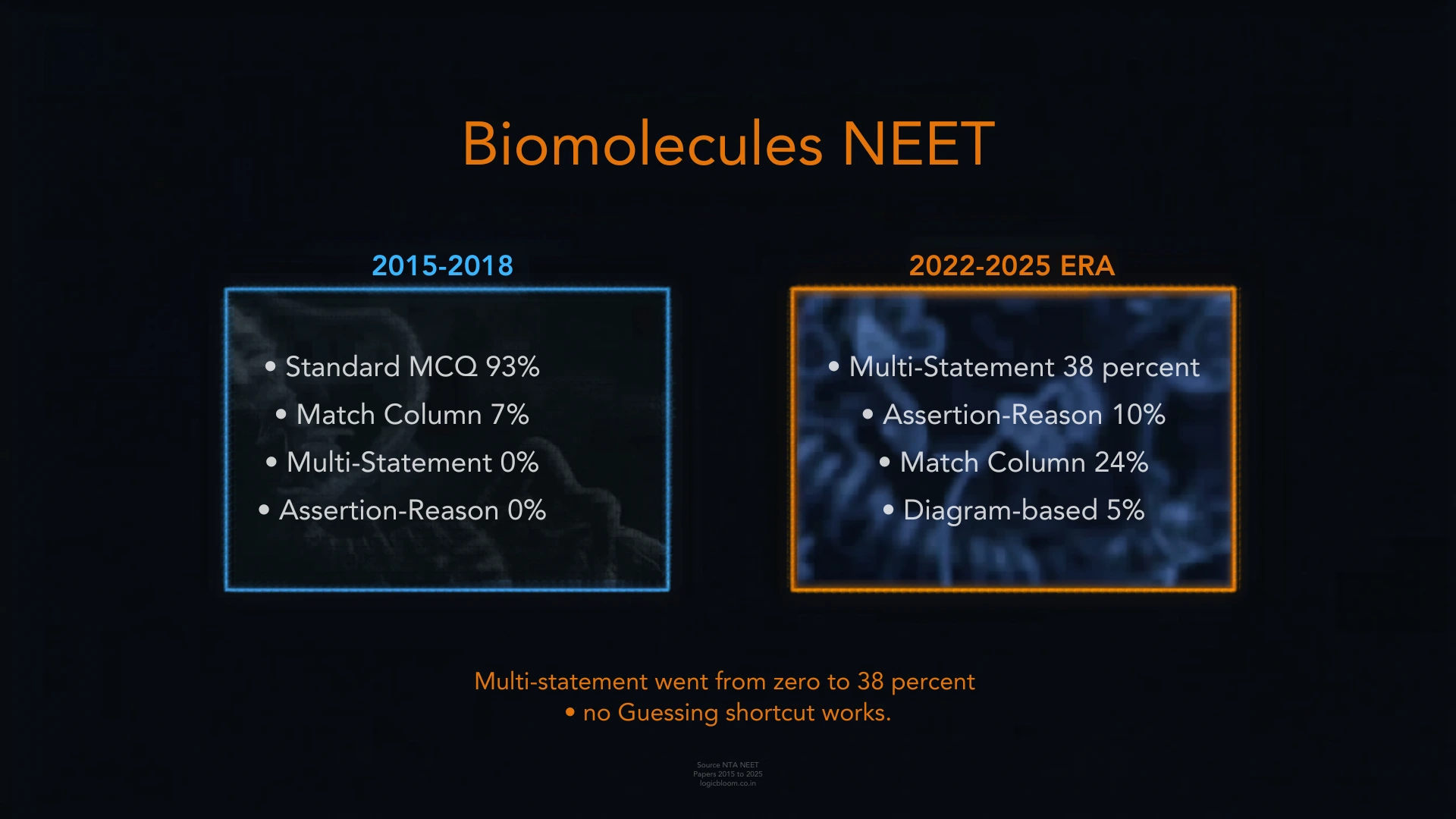
This is the single most important finding in our analysis. Here is how the question format has shifted over three periods:
| Format | 2015–2018 | 2019–2021 | 2022–2025 |
|---|---|---|---|
| Standard MCQ | 93% | 73% | 29% |
| Match the Column | 7% | 9% | 24% |
| Multi-statement | 0% | 9% | 38% |
| Assertion-Reason | 0% | 0% | 10% |
| Diagram-based | 0% | 0% | 5% |
Multi-statement questions went from 0% to 38% of all Biomolecules questions. These are the "How many of the following statements are correct?" questions where you need to verify 4–5 facts independently. You can't guess — there's no partial knowledge shortcut.
Standard MCQs dropped from 93% to 29%. If you're still practising only standard MCQs from coaching modules, you're training for an exam that no longer exists.
NTA's format shift is designed to separate students who know the NCERT from students who vaguely remember it. Every statement in a multi-statement question maps to a specific NCERT line. If you've read that line carefully, you get it. If you haven't, no elimination strategy saves you.
| 🎯 The 10 most-repeated concepts won't memorise themselves | |
|---|---|
| Chitin, lysine, haem, Concanavalin A, sucrose — these have repeated 3–5 times in 10 years. Logic Bloom's Playground (BETA) drills them in NEET 2026 format with TarQ, your in-app mentor, walking you through each one. | Drill the repeats → Free to start. |
The 10 Most Repeated Concepts — Your Non-Negotiable List
These concepts have appeared multiple times across different years and formats. If any of these catch you off guard in NEET, you've left free marks on the table.
| 🎯 10 Most Repeated Biomolecules Concepts in NEET (2015–2025) | ||
|---|---|---|
| 1. | Chitin = polymer of N-acetyl glucosamine | Tested 5 times. Most tested single fact in this chapter. |
| 2. | Lysine as a basic amino acid | Tested 4 times. Appears in standard MCQs and match-the-column. |
| 3. | Haem as prosthetic group in catalase/peroxidase | Tested 3 times. Most recently in NEET 2025. |
| 4. | Concanavalin A is a lectin (secondary metabolite) | Tested 3 times. From NCERT Table 9.3 — frequently skipped by students. |
| 5. | Sucrose is a non-reducing sugar | Tested 3 times from both Biology and Chemistry angles. |
| 6. | Triglyceride = one glycerol + three fatty acids | Tested 2 times. Appears standalone and in match-the-column. |
| 7. | Bond types — peptide, glycosidic, phosphodiester | Tested 2 times. Match-the-column favourite. |
| 8. | Essential amino acids vs non-essential | Tested 2 times. Diet-dependent vs body-synthesised distinction. |
| 9. | Glucose doesn't react with Schiff's reagent or NaHSO₃ | Tested 2 times. Chemistry-specific trap — students memorise what glucose reacts with, not what it doesn't. |
| 10. | Collagen = most abundant protein in animals; RuBisCO = most abundant protein on Earth | Tested 2 times. Paired fact that appears together. |
Cross-Chapter Connections: Where Biomolecules Shows Up Unexpectedly
NTA increasingly tests Biomolecules as a foundation that connects to other topics — not as an isolated chapter. These cross-chapter questions catch many students off guard.
| Cross-Chapter Link | What It Tests | Example |
|---|---|---|
| Biomolecules + Cell Biology | Membrane lipid and protein composition | Lecithin and cholesterol as structural components of the plasma membrane |
| Biomolecules + Human Physiology | Protein function in metabolic signalling | GLUT IV transporter in insulin signalling (2019 question) |
| Biomolecules + Digestion | Enzyme optimal pH and mechanism | Pepsin at pH 2, trypsin action in the intestine |
| Biomolecules + Molecular Genetics | Nucleotide chemistry bridging to DNA structure | Sugar type (deoxyribose vs ribose) and base-pairing rules in DNA replication |
NEET 2026 Predictions: What the Data Points To
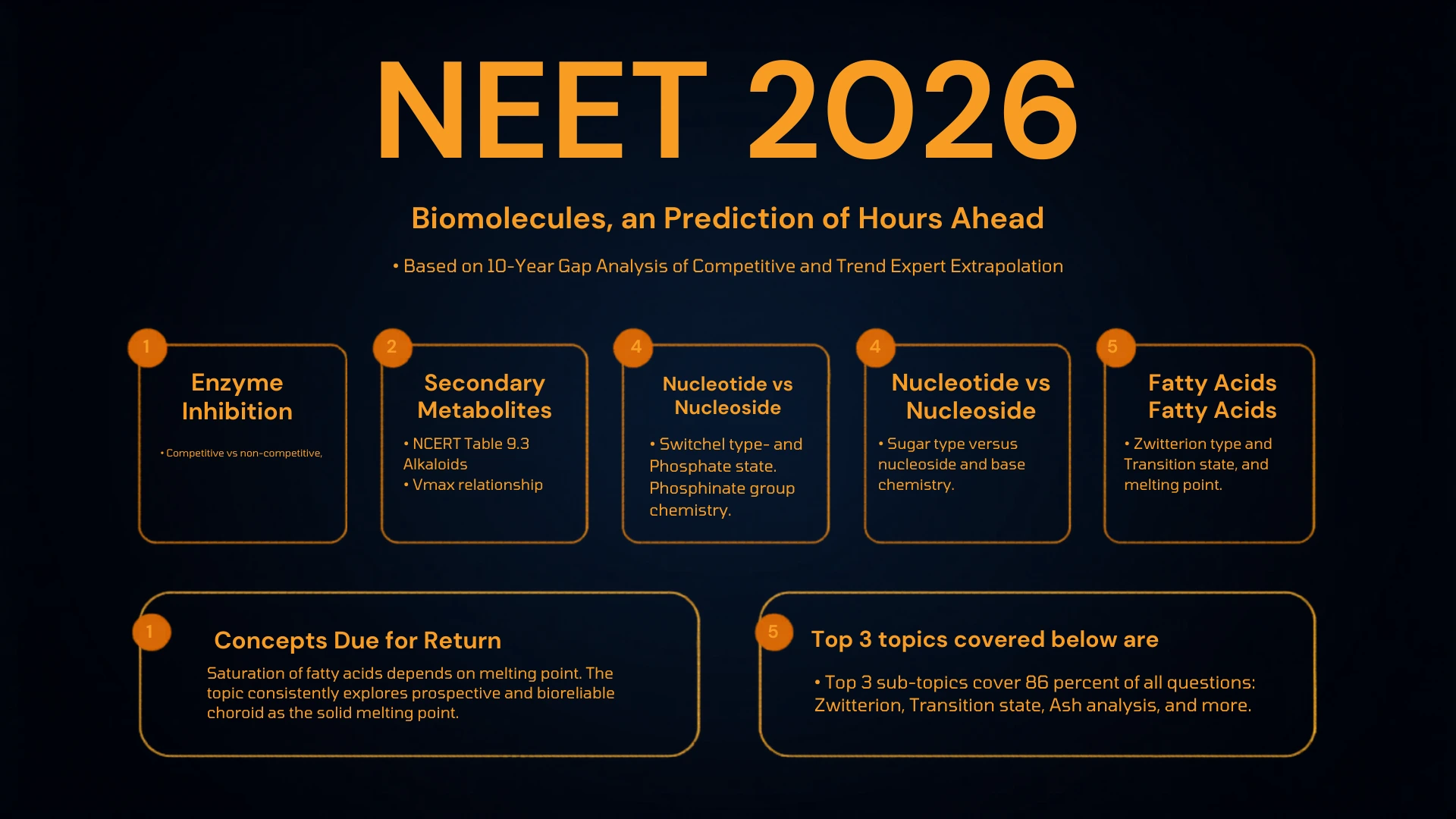
Based on every trend tracked, here is what the data predicts for Biomolecules in NEET 2026.
Predicted format distribution: Roughly 40% match-the-column and 40% multi-statement. Standard MCQs limited to one or two basic identification questions. At least one assertion-reason question is probable.
Top 5 Sub-Topics Most Likely to Appear in 2026
| # | Predicted Topic | Why It's Due |
|---|---|---|
| 1 | Enzyme inhibition (competitive vs non-competitive) | The Km/Vmax relationship under inhibition is underrepresented relative to NCERT coverage. A multi-statement question is highly probable. |
| 2 | Secondary metabolite classification — NCERT Table 9.3 | Lectins and pigments tested already. The alkaloid-vs-drug distinction (Morphine = alkaloid, Vinblastine = drug) is a prime multi-statement target. |
| 3 | Protein structure stabilisation bonds | Questions on which bonds stabilise which level (disulphide = tertiary; H-bonds = secondary) have been absent for several sittings — due for return. |
| 4 | Nucleotide vs nucleoside chemistry | Following the 2023 focus on phosphoric acid in nucleotides, a diagram-based question showing nucleotide structure and asking to identify components is likely. |
| 5 | Saturated vs unsaturated fatty acids | Double bonds and melting point relationship (why oils are liquid, fats are solid) is a clean concept not tested recently. |
3 Concepts Due for a Return
These haven't been tested in 2–3 years but are prominent in NCERT and fit current format trends:
| Concept | Last Tested | Likely Format |
|---|---|---|
| Zwitterion formation in amino acids | ~2019–2020 | Assertion-reason: "At physiological pH, amino acids exist as zwitterions" (True) + "Both –NH₂ and –COOH groups are ionised" (True, R explains A). |
| Transition state theory in enzyme catalysis | Touched in 2025 — deeper question overdue | Multi-statement on activation energy lowering without changing equilibrium. |
| Elemental composition — ash analysis | Rarely tested | Standard MCQ from Chapter 9 opening paragraphs (comparing Earth's crust to living tissue) — classic "students skip this" section that NTA targets. |
Predicted Cross-Chapter Combinations for 2026
| Combination | What to Prepare |
|---|---|
| Biomolecules + Neural Control | Sphingolipids in the myelin sheath — lipid classification tested through neuroscience context |
| Biomolecules + Respiration | Magnesium as an activator for hexokinase — enzyme cofactors tested through metabolic context |
| Biomolecules + Biotechnology | Natural DNA structure vs synthetic primers and nucleotides used in PCR |
How to Actually Prepare — Based on the Data
| 📌 Data-Driven Preparation Strategy for Biomolecules NEET 2026 | |
|---|---|
| Read NCERT line by line | Multi-statement questions test individual sentences. "Glycogen is similar to amylopectin" (correct) vs "similar to amylose" (incorrect) — one word in one NCERT line separates a right answer from a wrong one. |
| Master NCERT Table 9.3 completely | Every row is a potential match-the-column entry. Know which column each item belongs to — alkaloids, terpenoids, pigments, lectins, drugs, toxins. |
| Practice format-specific questions | Solving 100 standard MCQs won't prepare you for multi-statement questions. You need to practise verifying 4–5 statements independently and counting correct ones — it's a different cognitive skill. |
| Don't separate Biology and Chemistry Biomolecules | Chemistry questions test structure and reactions (glucose anomers, reagent reactions). Biology questions test function and classification. Both sides are needed; NTA designs cross-referencing questions. |
| Allocate 68% of time to top 3 sub-topics | Carbohydrates, Proteins, and Enzymes account for 68% of all Biomolecules questions. Within these, prioritise the 10 most-repeated concepts listed above. |
| Drill the high-yield 68% with TarQ | Carbs + Proteins + Enzymes = 68% of the marks. Logic Bloom's Playground (BETA) breaks these into NCERT-aligned topic loops — concept games, focused readings, and NEET 2026-format practice — with TarQ as your in-app mentor. Free to start. |
Conclusion: Prepare for the Exam That Exists, Not the One That Existed
The most dangerous thing about NEET preparation is using strategies designed for an older version of the exam. The data is clear: Biomolecules in 2026 will be dominated by multi-statement and match-the-column questions drawn directly from NCERT lines that most students skim. The students who score here will be the ones who read NCERT like a legal document — every word, every table, every sentence.
Done analysing? Now play, practice, or duel.
| 🎯 Logic Bloom — Built for the NEET 2026 you actually face | |
|---|---|
| 🎮 Playground (BETA) Solo practice with TarQ, your in-app mentor |
NCERT-aligned topic loops covering carbohydrate classification (chitin, sucrose, glycogen), protein structure levels and stabilising bonds, enzyme inhibition (Km/Vmax), and secondary metabolites from Table 9.3. Each loop pairs concept games with NEET 2026-format practice — multi-statement, assertion-reason, match-the-column. Get the app → |
| ⚔️ Battleground 1v1 real-time duels |
Challenge a friend or get matched live. 10 timed questions per match across Physics, Chemistry, Biology — JEE Main + Advanced + NEET aligned. ELO climbs through 6 tiers: Bronze → Silver → Gold → Platinum → Diamond → Archeon. Get the app → |
| Understand through games. Score through practice. Get Logic Bloom — Free to start → |
|
FAQs — Biomolecules NEET PYQ
Q1: How many questions come from Biomolecules in NEET every year?
Biomolecules contributes an average of 4–5 questions per year counting both Biology and Chemistry sections. From Biology alone, expect 2–4 questions; from Chemistry, 1–3 covering sugar structures, vitamin properties, and protein chemistry. Together this translates to 16–20 marks from a single Class 11 chapter, making it the 3rd highest-yielding Class 11 Biology chapter after Animal Kingdom and Cell Cycle & Cell Division. Full year-by-year data is tracked at NTA's official NEET portal.
Q2: Has the difficulty of Biomolecules questions increased in recent NEET papers?
Yes, but due to format changes rather than content complexity. Standard MCQs dropped from 93% in 2015–2018 to just 29% in 2022–2025, replaced by multi-statement questions (38%), match-the-column (24%), and assertion-reason (10%). These formats require verifying multiple facts simultaneously, making each question more time-intensive even though the underlying concepts remain NCERT Chapter 9-based.
Q3: Which Biomolecules sub-topics are most important for NEET 2026?
Carbohydrates (28%), Proteins (24%), and Enzymes (16%) are the top three sub-topics, collectively covering 68% of all questions over 10 years. For 2026 specifically, enzyme inhibition (competitive vs non-competitive), secondary metabolite classification from NCERT Table 9.3, and protein structure stabilisation bonds are predicted high-probability topics based on gap analysis.
Q4: What is the difference between Biology and Chemistry Biomolecules questions in NEET?
Biology questions focus on occurrence, function, and classification — asking about the most abundant protein, composition of cell walls, or the distinction between primary and secondary metabolites. Chemistry questions focus on structure, stereochemistry, and reactivity — asking about anomeric forms of glucose, hydrolysis products of sucrose, or which reagents glucose does or doesn't react with. Preparing for only one side leaves you vulnerable to 2–3 questions from the other subject.
Q5: What are the most repeated concepts from Biomolecules in NEET?
The single most-repeated concept is chitin as a polymer of N-acetyl glucosamine (tested 5 times in 10 years). Other frequently repeated concepts include lysine as a basic amino acid (4 times), haem as the prosthetic group in catalase (3 times), Concanavalin A as a lectin (3 times), and sucrose as a non-reducing sugar (3 times). These represent guaranteed marks if memorised accurately.