Biological Classification NEET PYQ Analysis 2015–2025
Collapsed to 1 question in NEET 2026. The Mycoplasma trap didn't fire. 42 PYQs reveal which sub-topics NTA abandoned and which will return in Re-NEET. Year-by-year pattern table inside.
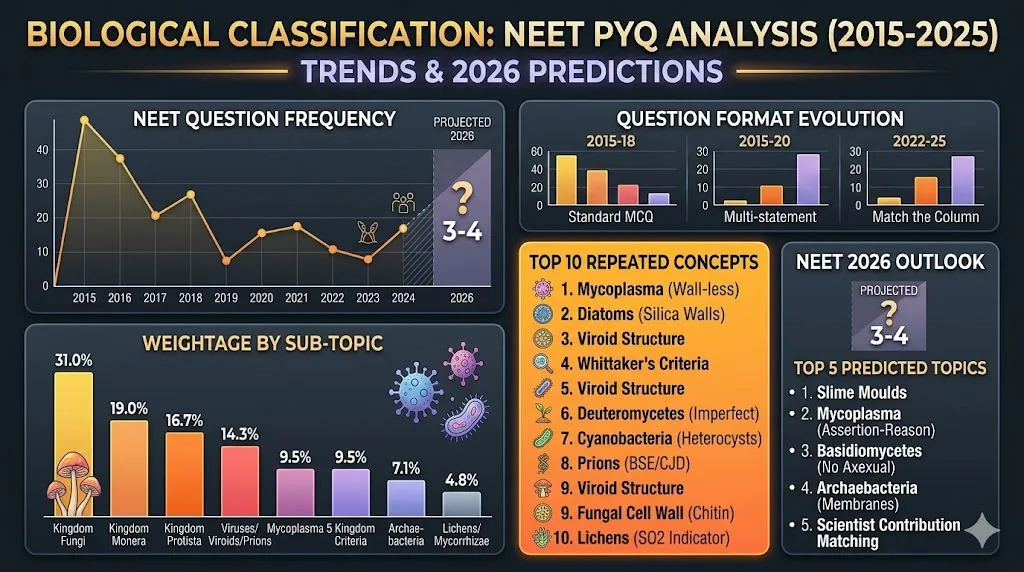
Introduction: Biological Classification NEET PYQ Analysis — Trends and 2026 Predictions
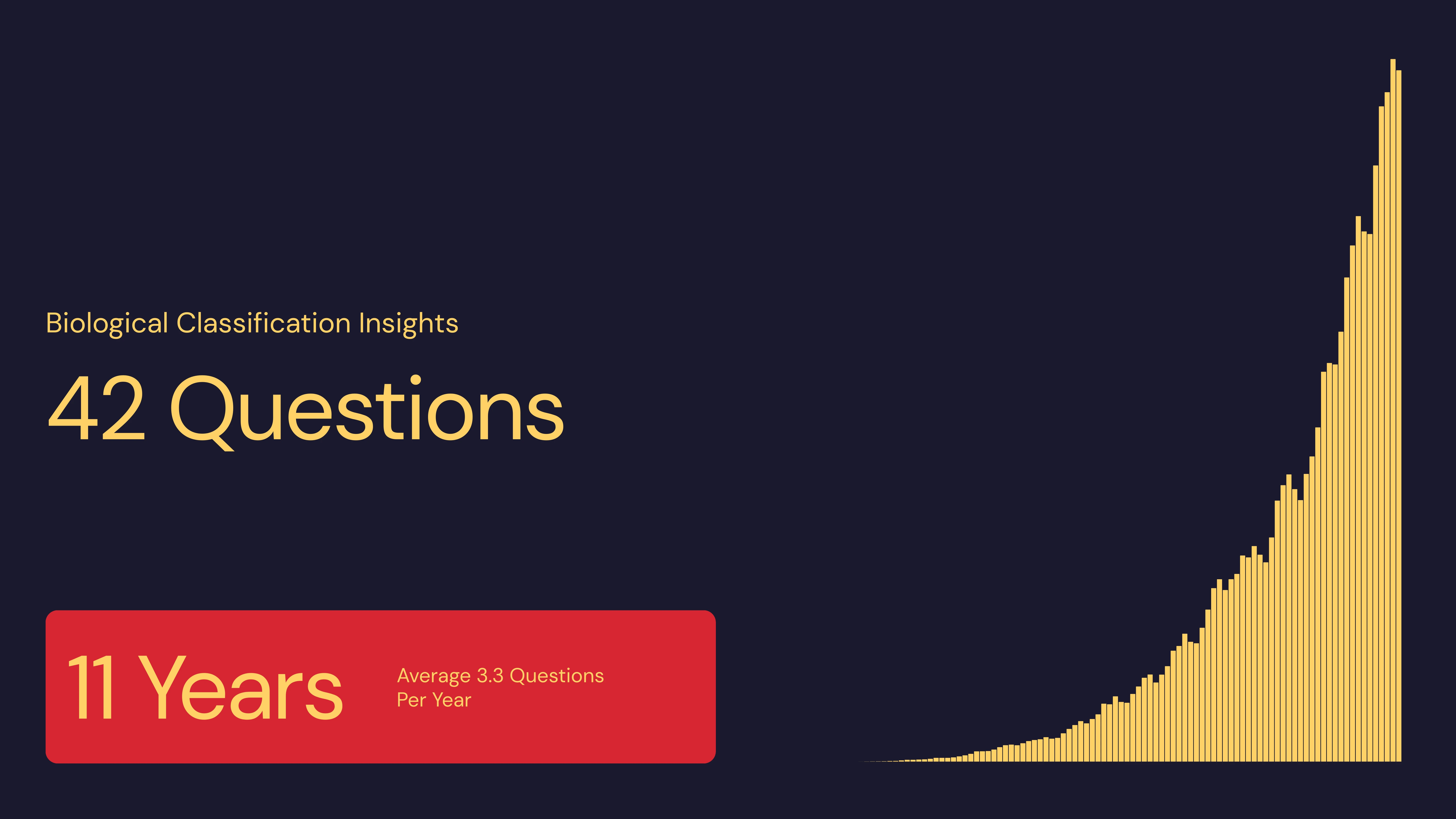
85.7% of Biological Classification questions in NEET 2015–2018 were standard single-correct MCQs. By 2022–2025, that dropped to 40% — and Kingdom Fungi alone accounts for 31% of everything the NTA asks from this chapter.
The chapter content hasn't changed. The NCERT hasn't changed. What changed is the NTA's method: the same facts are now tested through multi-statement formats, Match the Column, and Assertion-Reason questions that require you to evaluate logic, not just recall labels. A student who prepared this chapter exclusively from 2015–2019 question banks is training for a paper that no longer exists.
Multi-statement questions deliberately mix facts across kingdoms — one Monera statement, one Protista, one Fungi, one sub-viral. If kingdom-level recall isn't sticking from text alone, that gap is exactly what Logic Bloom's Playground is built for. Each chapter is broken into NCERT-aligned topic loops with interactive games, readings, videos, and NEET-format practice. Currently in beta. Free to start.
This analysis covers every identified question from Biological Classification across all NEET sittings from 2015 to 2025 — including Phase 2 and re-examinations — to give you a precise map of what gets tested, how often, and where the paper is heading in 2026.
If you want the concept framework alongside this data, start with the companion notes: Biological Classification Class 11 Notes for NEET. For context on how PYQ analysis works as a study tool, see our Biomolecules PYQ Analysis and Cell: The Unit of Life PYQ Analysis.
Questions per Year: 2015–2025
The chapter maintains a consistent Tier 2 presence — never disappearing, never dominating. Across 11 years, 42 questions have been identified across all sittings.
| Year | Questions | Sittings Included |
|---|---|---|
| 2025 | 3 | Main sitting |
| 2024 | 4 | Main sitting |
| 2024 Re-exam | 3 | Re-examination (June 23) |
| 2023 | 1 | Main sitting |
| 2022 | 4 | Main sitting |
| 2021 | 2 | Main sitting |
| 2020 | 3 | Phase 1 & 2 |
| 2019 | 2 | Main sitting |
| 2018 | 5 | Main sitting |
| 2017 | 4 | Main sitting |
| 2016 | 3 | Phase 1 & 2 |
| 2015 | 8 | Main & Re-exam |
Average: 3.3 questions per year. 2015 was the historical peak at 8 questions; 2023 was the floor at 1. The 2024 main + re-exam combination brought the effective annual count back to 7, signalling a possible upswing. Plan for 3–4 questions in 2026.
Sub-topic Frequency Analysis (2015–2025)
Not all kingdoms are created equal on the NEET paper. Kingdom Fungi alone accounts for nearly one-third of all questions in this chapter.
| Sub-topic | Questions | % Share |
|---|---|---|
| Kingdom Fungi (all classes combined) | 13 | 31.0% |
| Kingdom Monera (Eubacteria + Cyanobacteria) | 8 | 19.0% |
| Kingdom Protista (all sub-groups) | 7 | 16.7% |
| Viruses, Viroids, and Prions | 6 | 14.3% |
| Mycoplasma (wall-less prokaryotes) | 4 | 9.5% |
| Five Kingdom Classification Criteria | 4 | 9.5% |
| Archaebacteria (extreme habitats) | 3 | 7.1% |
| Lichens and Mycorrhizae | 2 | 4.8% |
The first implication: if you spend 80% of your revision on Fungi and Monera, you're covering roughly 50% of the question pool. The second implication: Viroids and Prions — which students routinely skip as "minor topics" — account for 14.3% of all questions, more than Mycoplasma and more than the Five Kingdom criteria combined.
What's Increasing in Frequency
Kingdom Fungi classification: Questions have moved from "name the imperfect fungi class" (2015) to Match the Column formats linking genera, common names, and specific spore types (2024). The spore formation mechanism — endogenous Ascospores vs. exogenous Basidiospores — is now a recurring discriminator.
Kingdom Monera — metabolic detail: Cyanobacteria questions have evolved from simple kingdom-assignment (2022) to specific structures like Heterocysts and their functional role in nitrogen fixation (2021, 2024 Re). The 2024 re-exam added a conceptual question on prokaryotic structural simplicity vs. metabolic complexity — a framing that requires understanding metabolism, not just nomenclature.
Sub-viral agents: These appeared in 6 of the 11 years analysed — a 54.5% hit rate. Since 2019, Prion questions have become more disease-specific (BSE in cattle, CJD in humans). Viroid questions reliably return to T.O. Diener's discovery and the absence of a protein coat.
Kingdom Protista — nutritional diversity: The 2024 Match the Column on nutritional modes across Euglenoids, Dinoflagellates, Slime Moulds, and Plasmodium represents the highest complexity Protista question in the decade. Mixotrophy in Euglena is now a tested concept and will likely return in a more evaluative format.
What's Declining in Frequency
History of classification systems: Artificial vs. Natural vs. Phylogenetic classification dominated pre-2017 papers but have effectively disappeared since. The NTA has decided that Whittaker's criteria are the only classification history worth testing.
Simple kingdom-level identification: "Which organism belongs to which kingdom" as a standalone MCQ was common in 2015–2017 but has mostly been absorbed into harder multi-kingdom comparison formats. The knowledge is still tested — just embedded in more complex question structures.
Format Evolution: 2015–2018 vs. 2022–2025
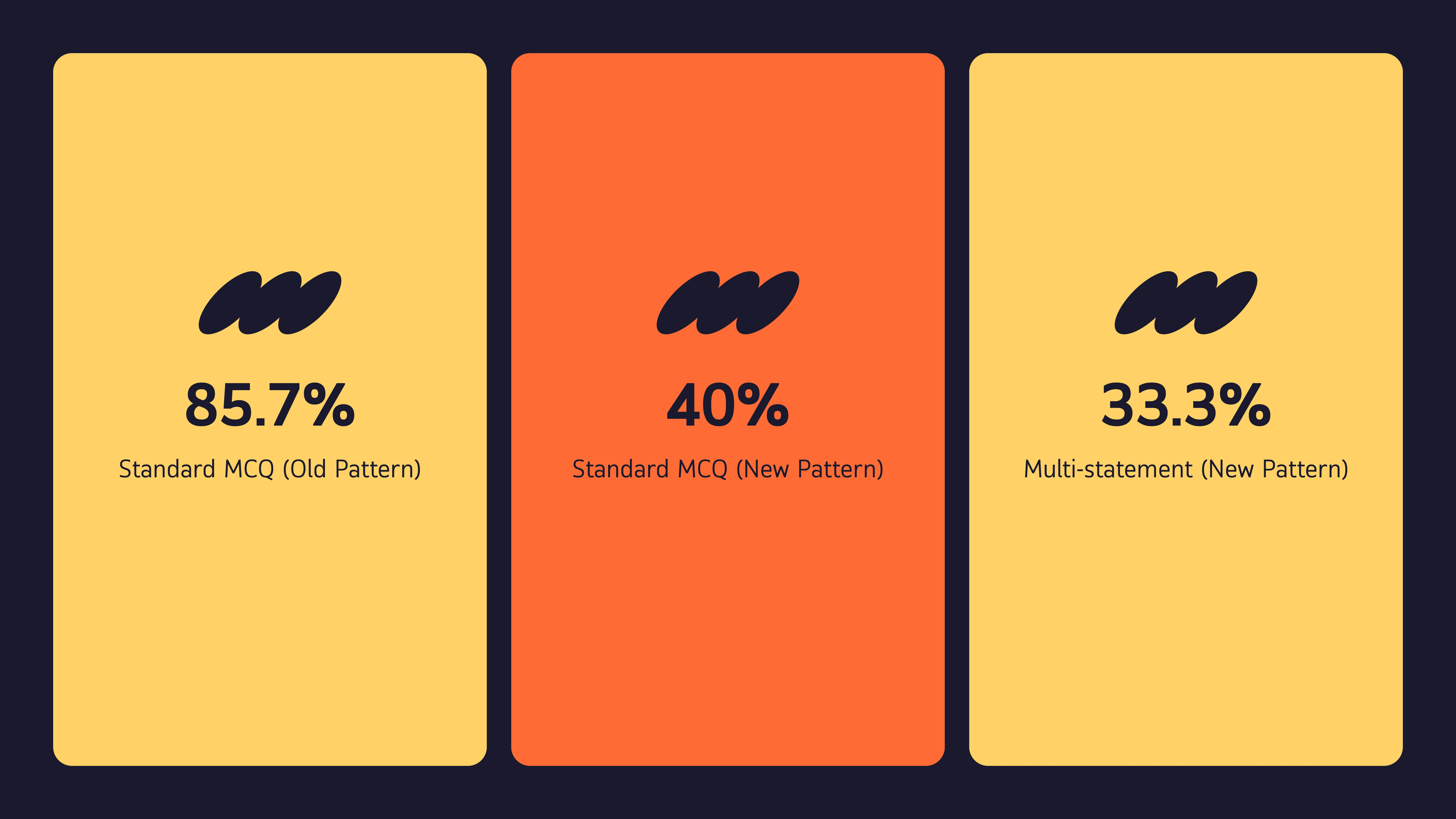
| Question Format | 2015–2018 | 2022–2025 |
|---|---|---|
| Standard MCQ (single correct) | 85.7% | 40.0% |
| Match the Column | 9.5% | 26.7% |
| Multi-statement (Stmt I/II or similar) | 4.8% | 33.3% |
| Diagram-based | 0.0% | 0.0% |
The standard MCQ share has been cut by more than half. Multi-statement formats have gone from nearly absent to constituting a third of all questions. The practical consequence: you cannot afford to know Mycoplasma only as "wall-less prokaryote." You need to know that its lack of a wall makes it filterable through bacterial filters, pleomorphic in shape, and resistant to penicillin-class antibiotics — and that these three features together make it a classic multi-statement trap.
This is the gap most coaching material misses — it's heavy on standard MCQs and thin on the multi-statement formats that now dominate. Logic Bloom's Playground breaks Biological Classification into NCERT-aligned topic loops where each topic uses an interactive game built around the kingdom or sub-group, followed by NEET 2026-format questions on the same concepts. TarQ guides you through. Currently in beta. Free to start.
Top 10 Most Repeated Concepts (with NCERT References)
These are the concepts the NTA returns to across multiple years. Knowing them at surface level is not enough — every concept below has been tested in at least two different question formats.
| 🎯 Top 10 Most Repeated Concepts — Biological Classification NEET 2015–2025 | |||
|---|---|---|---|
| 1. | Mycoplasma: smallest, wall-less, pathogenic, anaerobic | 5× | NCERT Page 14, final paragraph |
| 2. | Diatoms: silica walls, indestructible, chief ocean producers | 4× | NCERT Pages 14–15, Section 2.2.1 |
| 3. | Whittaker's criteria: cell type, nutrition, body organisation | 3× | NCERT Page 11, Table 2.1 and para 2 |
| 4. | Viroid structure: free RNA, no protein coat, discovered by T.O. Diener | 3× | NCERT Page 27, Section 2.6 |
| 5. | Methanogens in ruminant guts → biogas production | 3× | NCERT Page 13, Section 2.1.1 |
| 6. | Deuteromycetes: imperfect fungi, absence of sexual stage | 2× | NCERT Page 24, Section 2.3.4 |
| 7. | Cyanobacteria: Heterocysts for nitrogen fixation | 2× | NCERT Page 13, Section 2.1.2 |
| 8. | Prions: abnormally folded proteins causing BSE and CJD | 2× | NCERT Page 27, Section 2.6 |
| 9. | Fungal cell wall: Chitin — not Cellulose | 2× | NCERT Page 21, para 1 |
| 10. | Lichens as SO₂ pollution bioindicators | 2× | NCERT Page 27, final paragraph |
Every single concept maps to a specific sentence in a specific NCERT paragraph. The NTA is not testing understanding in the abstract — it is testing whether you read the right lines carefully enough to catch the deliberate substitutions it plants in wrong-statement questions.
Cross-Chapter Connections
| Cross-Chapter Link | What It Tests | Example |
|---|---|---|
| Classification + Cell Biology | Prokaryote vs. eukaryote structural distinction used as a classification criterion | Absence of membrane-bound organelles in Monera (2018, 2021) |
| Classification + Biomolecules | Chemical nature of cell walls across kingdoms | Chitin (Fungi) vs. Peptidoglycan (Bacteria) vs. Cellulose (Algae) — 2016 and 2024 questions |
| Classification + Ecology | Lichens as pollution bioindicators; Mycorrhizae and phosphorus absorption | Lichens (SO₂ sensitivity) linked to environmental biology; Mycorrhizae bridging to Plant Physiology |
| Classification + Human Health | Protozoan parasites and sub-viral disease agents | Plasmodium → malaria; Trypanosoma → sleeping sickness; Prions → neurodegeneration |
NEET 2026 Predictions: What the Data Points To
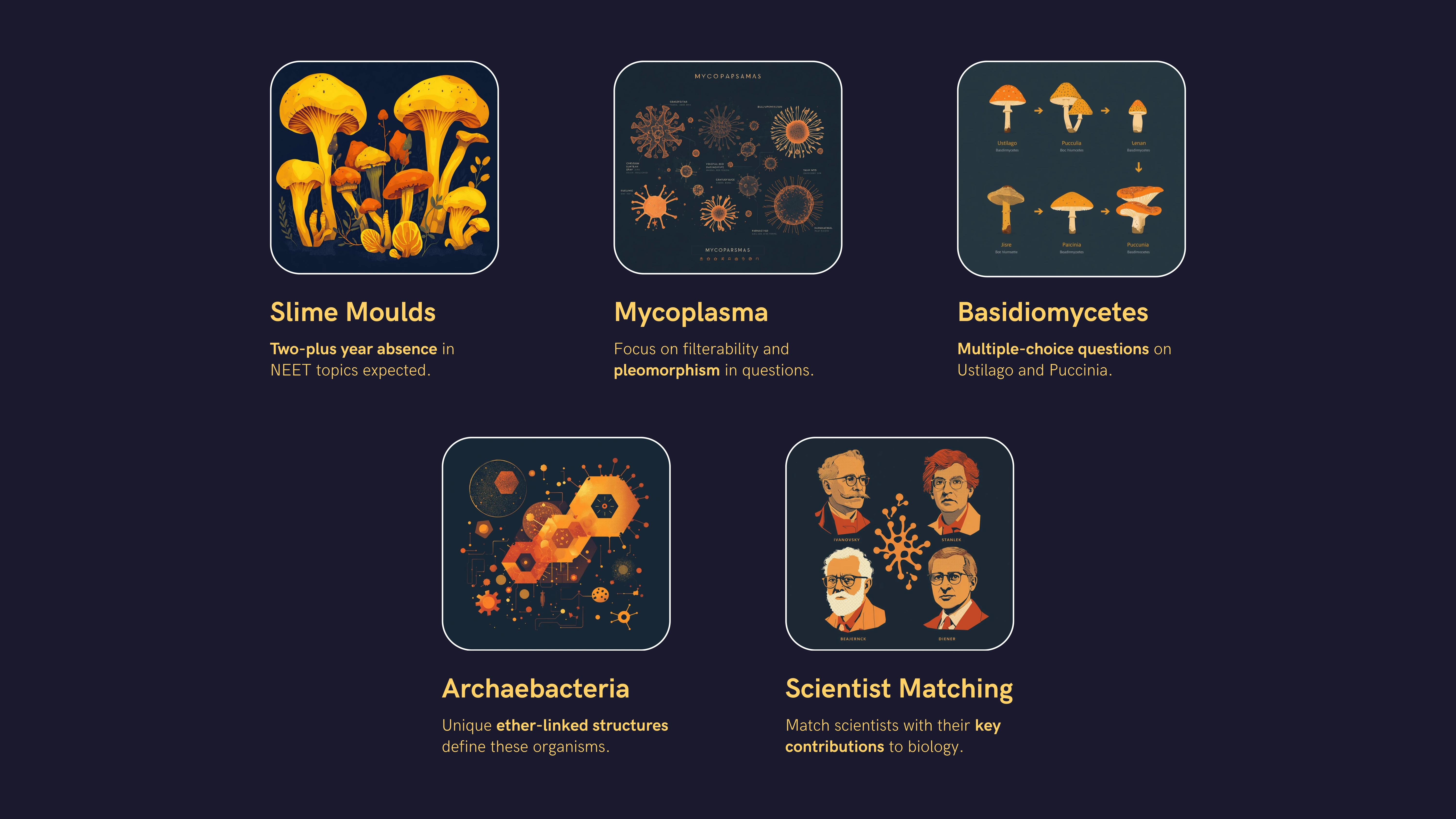
Predicted format distribution: Standard MCQ ~35–40% | Multi-statement ~35% | Match the Column ~25–30%.
Top 5 Most Likely Sub-Topics for 2026
| # | Predicted Topic | Why It's Due |
|---|---|---|
| 1 | Slime Moulds | Absent from standalone primary questions for 2+ years. Spore formation with true walls and aggregation into a plasmodium under unfavourable conditions are the likely test points. |
| 2 | Mycoplasma in Assertion-Reason format | Assertion: Mycoplasma can pass through bacterial filters. Reason: Mycoplasma lack a cell wall and are pleomorphic. The question will hinge on whether Reason correctly explains Assertion. |
| 3 | Basidiomycetes — no asexual stage and common names | A standalone MCQ on Ustilago (smut) or Puccinia (rust) characteristics is overdue following the 2024 Match the Column treatment. |
| 4 | Archaebacteria — structural basis for extreme habitat survival | Previous questions asked which organism survives extremes. 2026 is likely to ask why — what makes Archaebacterial membranes (ether-linked branched lipids) and walls different from Eubacterial equivalents. |
| 5 | Scientist–contribution Match the Column | Ivanovsky, Beijerinck, Stanley, and Diener provide a clean four-item Match the Column set. The NTA has tested individual scientists; the combined matching format is a logical escalation. |
Concepts Due for a Return (2–3 Year Absence)
| Concept | Last Tested | Likely Format |
|---|---|---|
| Mixotrophic nutrition in Euglena | 2024 (prominently) | Multi-statement comparing Euglenoid and Dinoflagellate nutrition modes |
| Lichen sensitivity to SO₂ pollution | 2019 | Unusually long gap (6 years) for a 2× concept — standalone MCQ or multi-statement return |
| Bacterial reproduction — binary fission vs. endospore formation | ~2022 | Assertion-Reason: endospore formation under unfavourable conditions as a survival mechanism |
Predicted Cross-Chapter Combination for 2026
The highest-probability structure is a "How many of the following statements are correct?" question mixing all four kingdom areas in a single 4-mark question:
| Statement | Kingdom / Topic |
|---|---|
| Heterocysts in Nostoc/Anabaena fix atmospheric nitrogen | Monera — Cyanobacteria |
| Euglenoids show mixotrophic nutrition | Protista — Euglenoids |
| Phycomycetes have aseptate, coenocytic hyphae | Fungi — Phycomycetes |
| Viroids lack a protein coat | Sub-viral agents |
This format forces complete chapter coverage in a single question — and it's the exact structure NTA has been converging toward since 2022.
How to Prepare Based on the Data
| 📌 Data-Driven Preparation Strategy — Biological Classification NEET 2026 | |
|---|---|
| Prioritise Fungi and Monera, but don't hollow out the rest | Fungi (31%) + Monera (19%) = ~50% of questions. The remaining 50% — Protista, sub-viral agents, Mycoplasma, classification criteria — cannot be left at surface level. The 2026 "how many are correct" format mixes kingdoms; weak coverage anywhere costs you the entire question. |
| Convert factual recall into statement evaluation | For every concept in the Top 10 list, generate a deliberately wrong statement about it. Mycoplasma has a rigid cell wall. Basidiospores are produced endogenously. Diatom walls are easily destructible. Practice identifying exactly why each statement is false — multi-statement questions test your ability to catch the wrong claim. |
| Build a comparative table for the four fungal classes | Track: septation, sexual stage presence, spore type, spore formation mechanism (endo vs. exo), example genera, and ecological/scientific role. Fill every cell from NCERT and know it without hesitation. |
| Memorise the sub-viral agents paragraph verbatim | Viruses → Viroids → Prions occupies half a page in NCERT Chapter 2 but accounts for 14.3% of all questions from this chapter. Every word in "free RNA, lacks the protein coat" (Viroids) and "abnormally folded protein" (Prions) is a potential substitution point in a wrong-statement question. |
| Map Protista to nutritional modes, not just examples | The 2024 Match the Column showed the current interest: not which organism belongs to Protista, but what each sub-group eats and how. Know the nutritional mode of Chrysophytes, Dinoflagellates, Euglenoids, Slime Moulds, and the four protozoan sub-groups as fluently as you know their names. |
| Play through what isn't sticking | Classification is the chapter most students try to brute-force memorise — and forget within a week. Logic Bloom's Playground breaks Biological Classification into NCERT-aligned topic loops with interactive games for the kingdom and sub-group structure, plus NEET-format practice. Currently in beta. Free to start. |
Conclusion: The Chapter That Rewards Sentence-Level NCERT Reading
Biological Classification in 2026 will not be won by students who remember which organisms go in which kingdom. It will be won by students who can evaluate five simultaneous statements — one from Monera, one from Protista, one from Fungi, one from sub-viral agents — and correctly count the true ones. That requires a kind of reading that goes beyond passive familiarity: every NCERT sentence in Chapter 2 is a potential exam statement, and every word in it is a potential substitution point.
Done analysing? Now play, practice, or duel.
If concepts in Biological Classification — the four fungal classes, sub-viral agents, Whittaker's criteria, Mycoplasma's wall-less features — still feel like memorisation rather than understanding, Logic Bloom's Playground breaks the chapter into NCERT-aligned topic loops. Each topic has an interactive game, a reading, a video, and timed NEET 2026-format questions: multi-statement, assertion-reason, match-the-column, all built from exact NCERT lines. Spaced revision blocks and boss challenges lock concepts in. TarQ guides you through. Currently in beta.
Or take it head-to-head: Battleground is our 1v1 real-time arena — challenge a classmate to a Biological Classification duel, climb six ELO tiers from Bronze to Archeon, and lock in revision through competitive recall.
Understand through games. Score through practice. Free to start.
Start your Biological Classification session on Logic Bloom →
FAQs — Biological Classification NEET PYQ
Q1: How many questions come from Biological Classification in NEET every year?
The chapter has averaged 3.3 questions per year from 2015 to 2025. The range has been 1 (2023) to 8 (2015). Planning for 3–4 questions in NEET 2026 is a reasonable assumption based on recent trend data.
Q2: Which sub-topic of Biological Classification has the highest weightage in NEET?
Kingdom Fungi accounts for 31% of all questions from this chapter over the last decade — the highest of any sub-topic. This includes questions on all four fungal classes (Phycomycetes, Ascomycetes, Basidiomycetes, Deuteromycetes). Kingdom Monera is second at 19%.
Q3: Are Viroids and Prions important for NEET from Biological Classification?
Yes, significantly. Sub-viral agents combined account for 14.3% of all Biological Classification questions across 2015–2025 — a 54.5% annual hit rate. Viroid structure (free RNA, no protein coat, T.O. Diener) and Prion disease links (BSE/CJD) are high-frequency recurring concepts.
Q4: Has the question format for Biological Classification changed in recent NEET papers?
Yes, substantially. Standard MCQs dropped from 85.7% (2015–2018) to 40% (2022–2025). Multi-statement formats rose from under 5% to over 33% in the same period. Match the Column increased from under 10% to nearly 27%. Practising only from older question banks will not prepare you for the current paper.
Q5: What are the most important NCERT pages for Biological Classification NEET questions?
The highest-density areas in NCERT Chapter 2 are: Page 14 (Mycoplasma), Pages 14–15 (Diatoms), Page 21 (Fungal cell wall — chitin), Pages 21–24 (Fungal class characteristics), and Page 27 (Viroids, Prions, Lichens). Every concept in the Top 10 most repeated list maps to these sections.