NEET Biology Chapter Wise Weightage — 332 PYQs Analyzed (2015-2025)
490+ NEET Biology PYQs analyzed across 11 years. Chapter-by-chapter weightage, format shifts, and predictions. Updated after May 2026 cancellation. The most complete NEET Biology data hub available.
Introduction: NEET Biology Chapter Wise Weightage — What 332 PYQs Actually Reveal
Every coaching institute publishes a "chapter wise weightage" list for NEET. Most of them are vague pie charts with no source data, recycled from 2019 analysis, with the same generic advice: "all chapters are important."
We did something different. We went through 332 individual questions from 6 of the highest-weightage NEET Biology chapters — every question from 2015 to 2025, across all phases, re-exams, and special sittings — and built the real numbers. Not estimates. Not approximations. Actual counted, classified, year-by-year data.
The result is a chapter weightage map that tells you not just what to study, but exactly how much each chapter is worth, how the questions are changing, and where to spend your next hour for maximum marks.
| 🎯 Stop reading weightage charts. Start scoring from them. | |
|---|---|
| Knowing MBI is worth 36 marks doesn't get you 36 marks. Practising the exact format NTA is testing does. Logic Bloom's Playground (BETA) breaks every high-weightage chapter on this page into NCERT-aligned topic loops — interactive concept games, focused reading, and NEET-format questions — so weightage data turns into actual answers. TarQ, our concept-first mascot, walks you through each loop. | Open the Playground (BETA) → Free to start. |
The Real Weightage Ranking: Data, Not Opinions
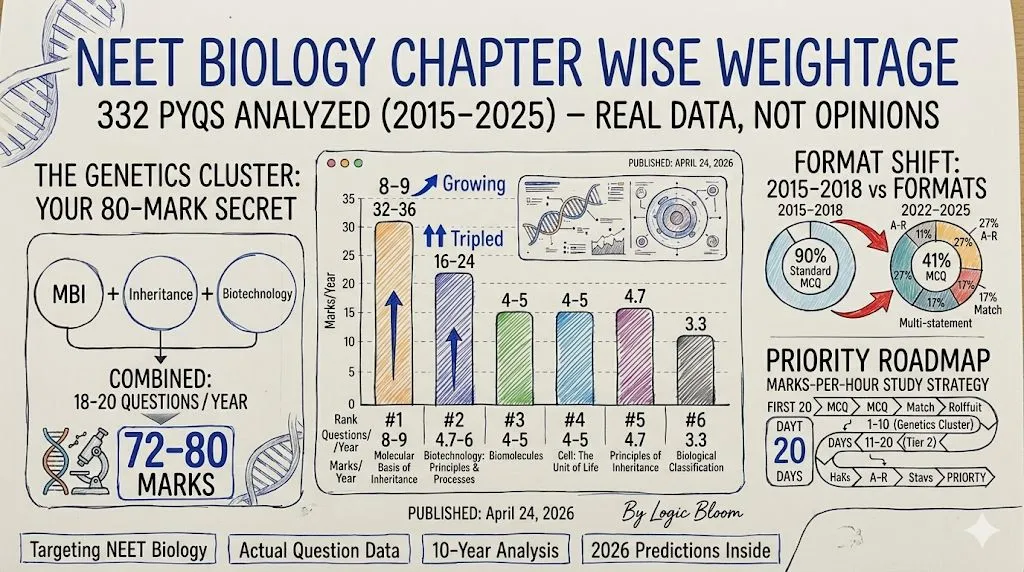
Here's what 332 questions across 10 years reveal about which chapters actually decide your NEET Biology score:
| Rank | Chapter | Class | Avg Qs / Year | Marks / Year | 10-Year Trend | Deep Dive |
|---|---|---|---|---|---|---|
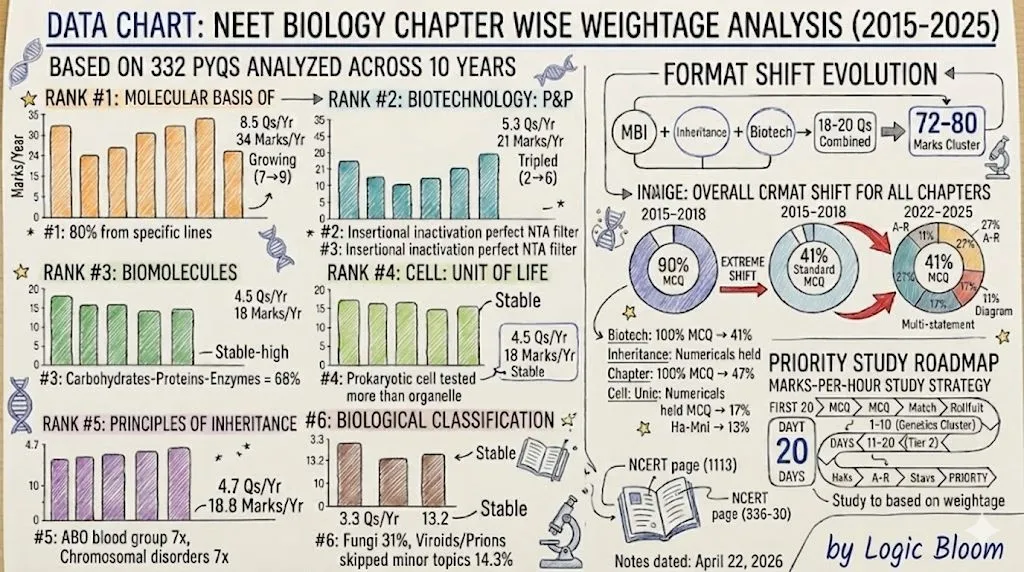
| #1 | Molecular Basis of Inheritance | 12 | 8–9 | 32–36 | ↑ Growing (7→9) | Full analysis → |
| #2 | Biotechnology: Principles & Processes | 12 | 4.7–6 | 16–24 | ↑↑ Tripled (2→6) | Full analysis → |
| #3 | Biomolecules | 11 | 4–5 | 16–20 | ↑ Stable-high | Full analysis → |
| #4 | Cell: The Unit of Life | 11 | 4–5 | 16–20 | → Stable | Full analysis → |
| #5 | Principles of Inheritance | 12 | 4.7 | 16–20 | → Stable | Full analysis → |
| #6 | Biological Classification | 11 | 3.3 | 12–16 | → Stable | Full analysis → |
These 6 chapters alone account for roughly 30–35 questions per year — approximately 35–40% of the entire Biology paper. But the weightage isn't equal. MBI at 8–9 questions contributes nearly double the marks of Biological Classification at 3.3 questions. A student who gives both chapters equal time is fundamentally miscallocating their preparation.
The Number That Changes Everything: The Genetics Cluster
The single most important strategic insight from our analysis:
Molecular Basis of Inheritance + Principles of Inheritance + Biotechnology = approximately 18–20 questions per year. That's roughly 70–80 marks from just 3 chapters.
These three chapters share massive conceptual overlap — restriction enzymes rely on base pairing from MBI, PCR is DNA replication in a test tube, sickle cell anaemia bridges Mendelian inheritance with molecular mutation, and gene therapy connects all three. If you study these three chapters as a single integrated unit, you're building the cross-chapter connections that NTA specifically tests in multi-statement questions.
| Unit | Chapters | Combined Qs / Year | Marks |
|---|---|---|---|
| Genetics + Biotechnology | MBI + Inheritance + Biotech | 18–20 | 72–80 |
| Human Physiology | 7 chapters combined | 13–15 | 52–60 |
| Ecology | 4 chapters combined | 12–14 | 48–56 |
| Plant Diversity | 3 chapters combined | 6–8 | 24–32 |
The Genetics cluster wins — not by a small margin, but by a commanding lead. And it comes from just 3 chapters versus 7 for Physiology and 4 for Ecology.
The Format Shift Every Student Needs to Know
We tracked the question format evolution across all 6 chapters. The pattern is identical everywhere:
| Format | 2015–2018 Average | 2022–2025 Average | Change |
|---|---|---|---|
| Standard MCQ | 90% | 41% | −49 percentage points |
| Multi-statement | 3% | 27% | +24 |
| Match the Column | 5% | 17% | +12 |
| Assertion-Reason | 0.5% | 11% | +10.5 |
| Diagram / Process-ordering | 1.5% | 4% | +2.5 |
Standard MCQs have been cut in half across every chapter we analyzed. The chapter with the most extreme shift: Biotechnology went from 100% MCQs to 41%. The most stable: Principles of Inheritance — numericals held steady at 17% even as MCQs declined, because genetic crosses inherently require calculations.
If you're solving PYQs from 2015–2018 question banks, you're training for an exam that no longer exists. The questions look different now. They demand simultaneous verification of multiple facts under time pressure — a fundamentally different cognitive skill from choosing one option out of four.
| ⚠️ Your question bank is 5 years out of date. | |
|---|---|
| Standard MCQs collapsed from 90% to 41%. Multi-statement, assertion-reason, and match-the-column now decide your rank. Logic Bloom's Playground (BETA) drills these formats chapter-by-chapter inside NCERT-aligned topic loops, while TarQ walks you through the concepts NTA is converging on — not the ones it's left behind. | Drill the new format → Free to start. |
The Marks-Per-Hour Strategy: Where to Invest Your Time
Tier 1 — Study First, Study Most (120+ marks combined)
| Chapter | Marks | NCERT Pages | Key Insight |
|---|---|---|---|
| Molecular Basis of Inheritance | 36 | ~15 | Highest marks-per-page ratio in the syllabus. 80% of questions come from specific NCERT lines. Line-by-line reading of Chapter 6 is the single most efficient study activity in NEET Biology. |
| Principles of Inheritance | 20 | ~25 | ABO blood group concept alone appeared 7 times. Chromosomal disorders (Down syndrome, Klinefelter syndrome) appeared 7 times. These two concepts = 14 questions in 10 years. |
| Biotechnology: Principles and Processes | 24 | ~12 | The pBR322 diagram, PCR steps, and restriction enzyme mechanics are tested relentlessly. Chapter tripled in weightage from 2015 to 2025 — NTA is actively increasing investment here. |
Tier 2 — High Yield, Stable Returns (~50–60 marks combined)
| Chapter | Marks | Key Insight |
|---|---|---|
| Biomolecules | 20 | The Carbohydrates-Proteins-Enzymes trio accounts for 68% of all questions. The top 5 most repeated concepts — including chitin as N-acetyl glucosamine polymer and sucrose as a non-reducing sugar — are worth memorising word-for-word from NCERT. |
| Cell: The Unit of Life | 20 | Prokaryotic cell structure is tested more than any individual organelle (13 questions in 10 years). The 70S vs 80S ribosome trap has evolved across three difficulty levels — basic facts no longer sufficient. |
| Biological Classification | 14 | Kingdom Fungi accounts for 31% of all questions. Viroids and Prions — which most students skip as "minor topics" — account for 14.3%. |
The 10 Concepts Most Likely to Appear in NEET 2026
Aggregating prediction data from all 6 PYQ analyses, these are the concepts with the highest statistical probability of appearing in NEET 2026:
| 🎯 Top 10 Predicted Concepts — NEET Biology 2026 | ||
|---|---|---|
| 1. | Lac operon regulatory dynamics | Appeared in 10 of 11 years — the most predictable question in NEET Biology. Format: match-the-column (genes→products) or multi-statement (operon state with/without lactose). |
| 2. | ABO blood group cross — reverse engineering | 7 appearances in 10 years. Expect: given the child's blood group, deduce parental genotypes — not a forward cross. |
| 3. | Post-transcriptional modifications — capping, tailing, splicing | Tested in 2025, reinforced annually since. NCERT Chapter 6 page 111 is the single highest-density page in MBI. |
| 4. | pBR322 restriction site mapping | NTA is increasingly testing spatial recall of the vector map. Know which restriction sites (BamHI/SalI in tetR, PvuI/PstI in ampR) are inside which resistance genes. |
| 5. | Enzyme inhibition — competitive vs non-competitive | From Biomolecules. The Km/Vmax relationship under different inhibition types is underrepresented relative to NCERT coverage. Statistically overdue. |
| 6. | Mesosomes — multi-functional role | 5 appearances in 10 years from Cell Biology. Cell wall formation, DNA replication, AND respiration — the triple function is the multi-statement target. |
| 7. | Chromosomal disorders with karyotype notation | NTA now tests 47,XXY notation AND non-disjunction mechanism — not just syndrome names. Expect "at which meiotic stage?" format. |
| 8. | PCR temperature specifics or primer design | Basic steps and Taq polymerase origin exhausted. Expect: 94°C denaturation, 50–65°C annealing, 72°C extension, or primer as short synthetic oligonucleotide. |
| 9. | Fungi classification — spore types and septation | The endogenous (Ascospores) vs exogenous (Basidiospores) distinction and "imperfect fungi" concept are intensifying in complexity. |
| 10. | Cilia/flagella ultrastructure — 9+2 axoneme vs 9+0 basal body | Due for a complex match-the-column return in Cell Biology — pairing axoneme components (peripheral doublets, central singlets, dynein arms) with their functional roles. |
What's Coming in 2026: The Format Prediction
Based on the trajectory across all 6 chapters, expect approximately 55–60% of Biology questions to be in complex formats (multi-statement, match-the-column, assertion-reason, diagram-based). Standard MCQs will account for only 40–45%.
This has three practical implications:
1. Practice statement verification, not question answering. In a multi-statement question, you're not answering one question — you're evaluating 4–5 independent facts. The skill is binary judgment speed: "Is this statement true or false based on NCERT?" Repeat until it's reflexive.
2. Build mental diagrams for every chapter. Approximately 20–35% of questions across chapters require visual recall — pBR322, replication fork, lac operon schematic, 9+2 axoneme, prokaryotic cell structure. Even "text-based" questions often test diagram knowledge implicitly.
3. Cross-link your chapters. NTA's favourite difficulty technique is testing one chapter's concept through another chapter's context. Sickle cell anaemia bridges Inheritance + MBI. Restriction enzymes bridge Biotechnology + MBI. Mesosomes bridge Cell Biology + Classification. Students who study chapters in isolation miss these connections.
The Bottom Line: Your 30-Day Study Priority Order
| 📌 30-Day NEET Biology Priority Plan — Based on 332 PYQs | ||
|---|---|---|
| Days 1–10 | MBI (36 marks) + Principles of Inheritance (20 marks) + Biotechnology (24 marks) | = 80 marks secured |
| Days 11–20 | Biomolecules (20 marks) + Cell Biology (20 marks) + Biological Classification (14 marks) | = 54 more marks |
| Days 21–30 | Remaining chapters (Human Physiology, Ecology, Plant Kingdom, Morphology, Animal Kingdom) + Full paper practice + Revision | = Rest of syllabus |
| Daily, all 30 days | Logic Bloom Playground (BETA) topic loops on the day's chapter (with TarQ guiding through concept games + NEET-format questions) + short Battleground duels on yesterday's chapter for spaced retention. Open Logic Bloom → | = Compounding gains |
In the first 10 days, you secure 80 marks from 3 chapters. In the next 10, you add 54 marks from 3 more. That's 134 marks — roughly 37% of the Biology paper — from 6 chapters that together represent about 70 pages of NCERT. This isn't a shortcut. It's a priority order backed by 332 data points across 10 years of NEET papers.
Conclusion: The Exam Is Different Now — Your Preparation Should Be Too
The NEET Biology paper of 2026 will not look like the 2018 paper. The chapters are the same, the NCERT is the same — but 59% of questions now arrive in formats that demand simultaneous evaluation of multiple facts, causal reasoning, or visual diagram recall. The student who prepares for this version of the exam, rather than the version from 5 years ago, has a structural advantage before they read a single question.
The data points to three priorities: master the Genetics cluster as an integrated unit, read NCERT at sentence-level precision (not paragraph-level familiarity), and practice the formats NTA is converging on — not the formats it has left behind.
Done analysing? Now play, practice, or duel.
You've seen the data. 332 PYQs say where the marks live. Now turn analysis into score — solo, or against another aspirant in real time.
| 🎯 Logic Bloom — Built for the NEET 2026 you actually face | |
|---|---|
| 🎮 Playground (BETA) Solo, concept-first practice with TarQ |
NCERT-aligned topic loops across every high-weightage chapter — lac operon dynamics, ABO blood group reverse engineering, pBR322 restriction-site mapping, post-transcriptional modifications, mesosome multi-function, prokaryotic cell structure, Kingdom Fungi spore types, 9+2 axoneme. Each loop pairs interactive concept games with focused reading and NEET-format practice (multi-statement, match-the-column, assertion-reason). Open the Playground → |
| ⚔️ Battleground 1v1 real-time duels |
Challenge a friend or get matched live. 10 timed questions per match across Physics, Chemistry, Biology — JEE Main + Advanced + NEET aligned. ELO rating climbs through 6 tiers: Bronze → Silver → Gold → Platinum → Diamond → Archeon. Friend challenges, the Throne system, and post-match explainers convert wrong answers into long-term recall. Enter the Battleground → |
|
Open Logic Bloom → Understand through games. Score through practice. Free to start. |
|
FAQs — NEET Biology Chapter Wise Weightage
Q1: Which chapter has the highest weightage in NEET Biology?
Molecular Basis of Inheritance (Class 12, Chapter 6) has the highest weightage of any individual chapter, contributing 8–9 questions per year (32–36 marks). This is nearly double the second-highest chapter. Since 2022, the count has stabilised at 9 questions per paper — approximately 10% of the total Biology score on NEET.
Q2: How many questions come from each chapter in NEET Biology?
Based on our analysis of 332 PYQs across 2015–2025: MBI averages 8–9 questions/year, Biotechnology 4.7–6, Biomolecules 4–5, Cell Biology 4–5, Principles of Inheritance 4.7, and Biological Classification 3.3. These 6 chapters account for approximately 35–40% of the Biology paper.
Q3: What is the most important unit for NEET Biology 2026?
The Genetics cluster (Molecular Basis of Inheritance + Principles of Inheritance + Biotechnology) contributes approximately 18–20 questions per year worth 72–80 marks. This surpasses Human Physiology (13–15 questions across 7 chapters) and Ecology (12–14 questions across 4 chapters) by a significant margin — and the three chapters share deep conceptual overlap.
Q4: Has the NEET Biology question format changed?
Dramatically. Standard MCQs dropped from approximately 90% of questions in 2015–2018 to just 41% in 2022–2025 across all chapters we analyzed. They were replaced by multi-statement (27%), match-the-column (17%), assertion-reason (11%), and diagram-based formats. Students preparing with older question banks are training for an exam that no longer exists. The most extreme shift: Biotechnology went from 100% MCQ to 41%.
Q5: Which NEET Biology chapters should I study first?
Based on marks-per-page analysis: (1) Molecular Basis of Inheritance — 36 marks from ~15 NCERT pages, (2) Biotechnology: Principles and Processes — 24 marks from ~12 pages, (3) Principles of Inheritance — 20 marks from ~25 pages. These three chapters together secure approximately 80 marks and share significant conceptual overlap, making integrated study highly efficient.