NEET 2026 Biology Paper Analysis — Chapter Distribution vs 11 Years of PYQs
The May 3 NEET 2026 paper is cancelled but the data isn't wasted. Genetics cluster hit 21%. Biodiversity surged to 5 questions. MBI collapsed. These patterns predict the rescheduled exam.
Introduction: NEET 2026 Biology Paper Analysis — Chapter Distribution and Format Trends
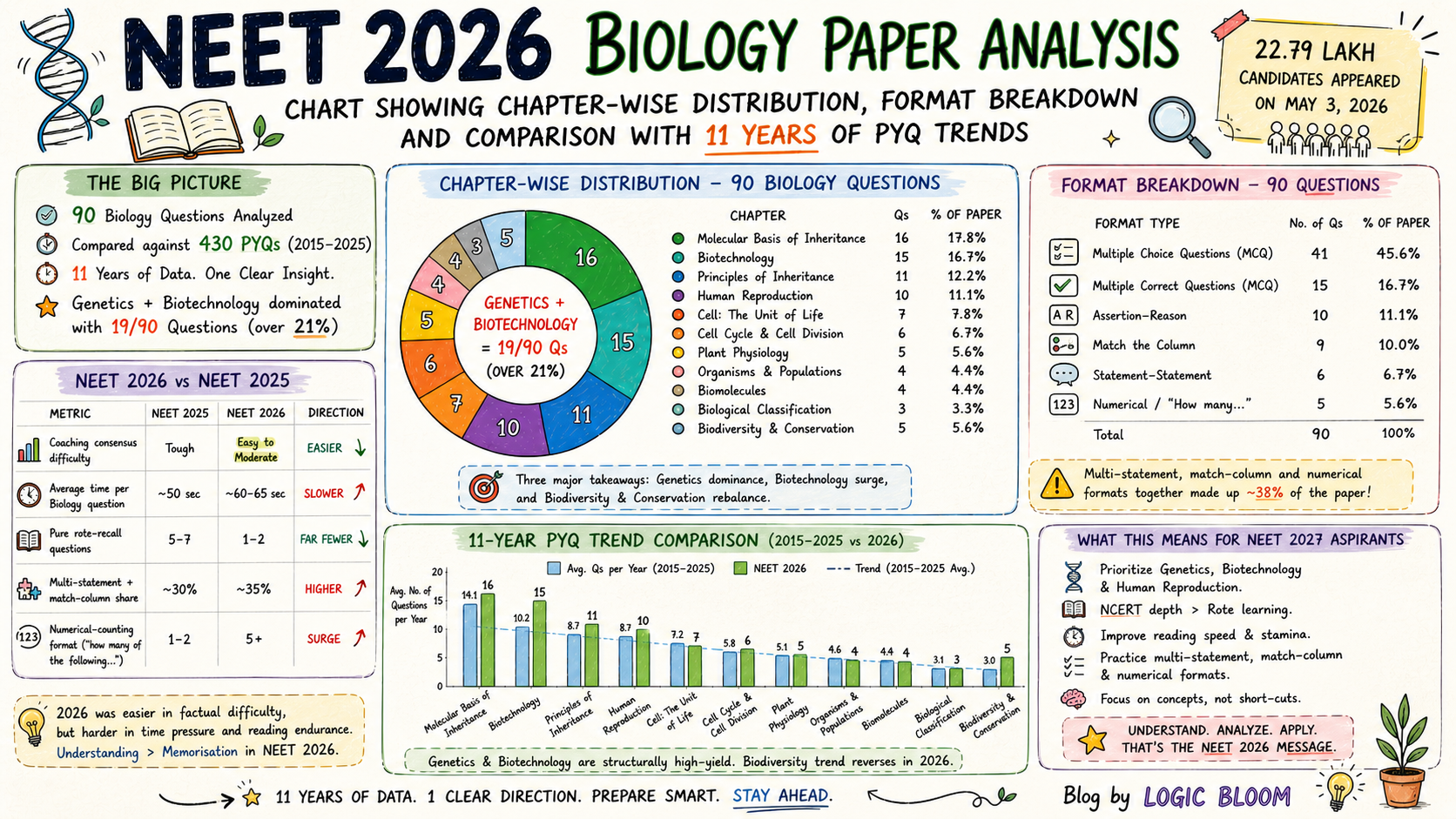
NEET 2026 was written on Sunday, May 3, by 22.79 lakh candidates — the largest entrance examination cohort in Indian history. We've matched the 90 biology questions against our database of 430 NEET Biology PYQs from 2015 to 2025 to answer the questions every aspirant is asking.
Was the paper harder or easier than the 11-year average? Which chapters dominated? Did our predictions hold up? And — for NEET 2027 aspirants — what does this paper tell us about where NTA is heading?
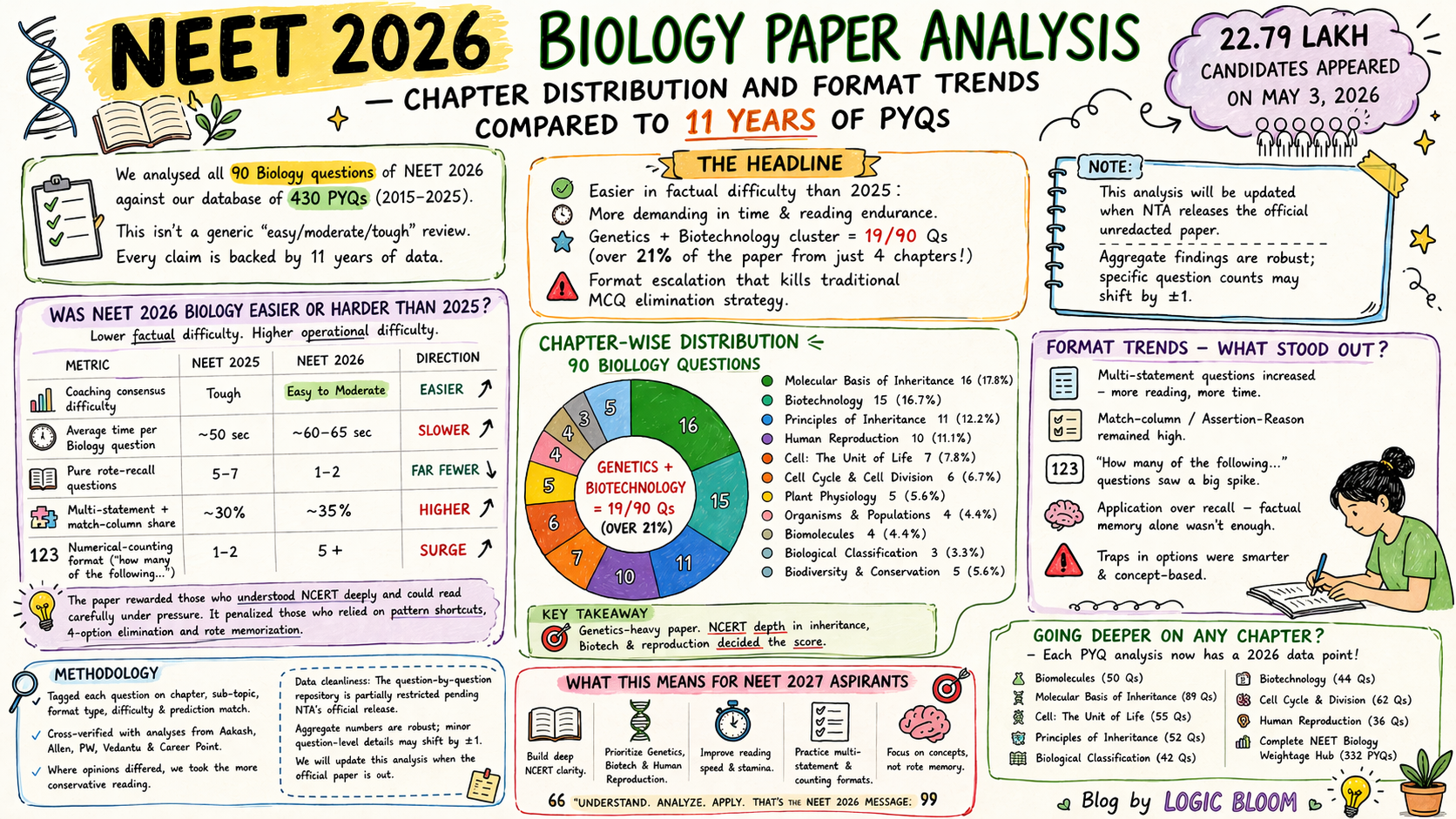
The headline: NEET 2026 was easier in factual difficulty than 2025 but significantly more demanding in time and reading endurance. The Genetics + Biotechnology cluster contributed 19 of 90 biology questions — over 21% of the paper from just four chapters. And NTA introduced a format escalation that effectively kills traditional MCQ elimination strategy.
This analysis will be updated when NTA releases the official unredacted paper. Aggregate findings are robust; specific question counts may shift by ±1 in either direction.
| 🎯 21% of NEET 2026 came from 4 chapters in Genetics + Biotech | |
|---|---|
| If you're prepping for NEET 2027, the Genetics cluster + Biotechnology aren't optional anymore. Logic Bloom's Playground (BETA) drills these chapters in NEET 2026 format with TarQ, your in-app mentor. | Start NEET 2027 prep → Free to start. |
Going deeper on any chapter? Each PYQ analysis below now has a fresh 2026 data point:
| Chapter | PYQs Analysed | Deep Dive |
|---|---|---|
| Biomolecules | 50 | Full analysis → |
| Molecular Basis of Inheritance | 89 | Full analysis → |
| Cell: The Unit of Life | 55 | Full analysis → |
| Principles of Inheritance | 52 | Full analysis → |
| Biological Classification | 42 | Full analysis → |
| Biotechnology: Principles & Processes | 44 | Full analysis → |
| Cell Cycle and Cell Division | 62 | Full analysis → |
| Human Reproduction | 36 | Full analysis → |
| Complete Biology Weightage Hub | 332+ | Full analysis → |
Was NEET 2026 Biology Easier or Harder Than 2025?
The factual difficulty of the paper was lower than 2025. The operational difficulty was higher.
| Metric | NEET 2025 | NEET 2026 | Direction |
|---|---|---|---|
| Coaching consensus difficulty | Tough | Easy to Moderate | ↓ Easier |
| Average time per Biology question | ~50 sec | ~60–65 sec | ↑ Slower |
| Pure rote-recall questions | 5–7 | 1–2 | ↓ Far fewer |
| Multi-statement + match-column share | ~30% | ~35% | ↑ Higher |
| Numerical-counting format ("how many…") | 1–2 | 5+ | ↑ Surge |
The paper rewarded students who genuinely understood NCERT and could read carefully under pressure. It penalised those who relied on three things: pattern-recognition shortcuts, traditional 4-option elimination, and rote memorisation of dates and discoveries. As Vedantu wrote in their post-exam analysis: "understanding beats memorisation" — which has been the core thesis across our entire PYQ blog series since January.
Chapter-Wise Distribution — Where the 90 Biology Questions Came From
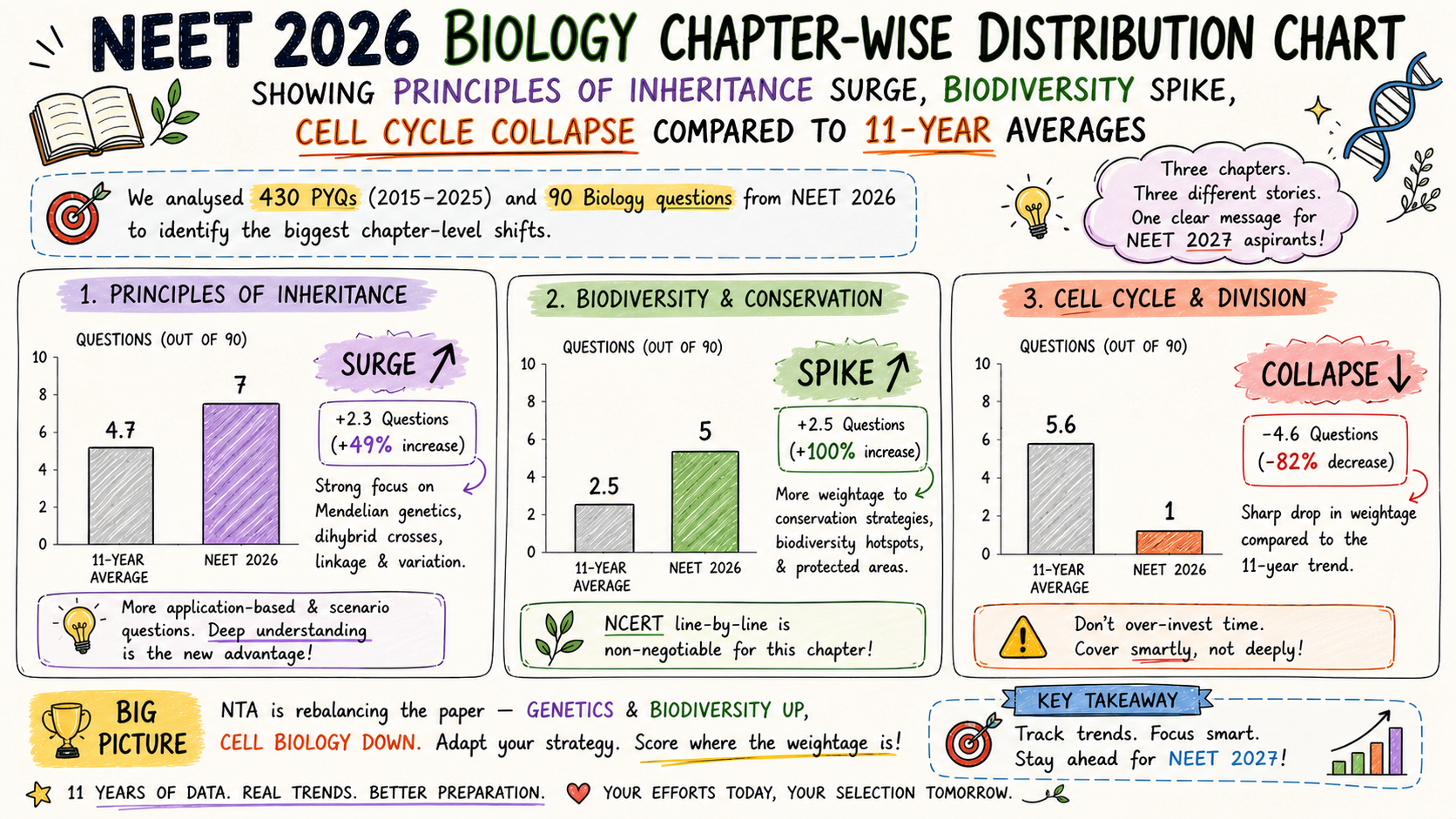
The paper followed historical clustering with three notable rebalances. Genetics dominated (as predicted), Biotechnology surged beyond its 11-year baseline, and Biodiversity & Conservation broke its historical pattern with five questions where it has typically had two or three.
Question counts below reflect cross-verified data from coaching institute analyses (Aakash, Allen, PW, Vedantu, Career Point). Counts for individual chapters may shift by ±1 when NTA releases the official unredacted paper. Cluster-level totals and directional findings are robust.
| Chapter | 11-Year Avg | NEET 2026 | Direction |
|---|---|---|---|
| Principles of Inheritance and Variation | 4.7 | 7 | ↑ Major surge |
| Biotechnology — Principles | 4.0 | 5 | ↑ Above avg |
| Biotechnology — Applications | 2.5 | 3 | ↑ Above avg |
| Biomolecules | 4.5 | 5 | → In line |
| Biodiversity and Conservation | 2.5 | 5 | ↑ Major surge |
| Molecular Basis of Inheritance | 8.1 | 4 | ↓ Below avg |
| Cell: The Unit of Life | 5.0 | 4 | → In line |
| Animal Kingdom | 3.5 | 4 | ↑ Above avg |
| Morphology of Flowering Plants | 3.5 | 4 | → In line |
| Ecosystem | 3.0 | 3 | → In line |
| Organisms and Populations | 3.0 | 3 | → In line |
| Sexual Reproduction in Flowering Plants | 3.0 | 3 | → In line |
| Photosynthesis in Higher Plants | 3.0 | 3 | → In line |
| Plant Growth and Development | 2.5 | 3 | → In line |
| Evolution | 2.5 | 3 | → In line |
| Human Reproduction | 3.3 | 3 | → In line |
| Breathing and Exchange of Gases | 2.5 | 3 | → In line |
| Locomotion and Movement | 2.5 | 3 | → In line |
| Cell Cycle and Cell Division | 5.6 | 1 | ↓ Major drop |
| Biological Classification | 3.8 | 1 | ↓ Major drop |
| Other chapters | — | 18 | Distributed |
Three chapter-level stories:
Principles of Inheritance broke the historical ceiling — seven questions in a single sitting, where the chapter has never previously exceeded six. Combined with Molecular Basis of Inheritance, the Genetics cluster contributed 11 questions — a near-record.
Cell Cycle and Biological Classification collapsed — both well below historical norms. The signature pachytene–diplotene trap that we documented across multiple PYQ blogs was almost entirely absent. Aspirants who over-allocated revision time to Prophase I sub-stages did not get rewarded.
Biodiversity and Conservation surged to five questions — roughly double its baseline. Combined with Ecosystem and Organisms and Populations, the Ecology + Evolution cluster contributed approximately 14 questions (~15.6% of the biology paper).
Format Breakdown — The Single-Fact MCQ Continues to Lose Ground
| Format Type | 2015–2018 Avg | 2022–2025 Avg | NEET 2026 |
|---|---|---|---|
| Standard single-fact MCQ | ~92% | ~42% | ~45% |
| Match-the-Column | ~1% | ~13% | ~20% |
| Multi-statement | ~5% | ~28% | ~15% |
| Assertion-Reason | ~2% | ~17% | ~10% |
| Diagram-based / visual | <1% | ~5% | ~10% |
The structural surprise: Match-the-Column expanded sharply at the expense of Multi-statement, rising from a 13% baseline to roughly 20% of the paper. Match-the-Column rewards systematic elimination if the candidate has solid base recall — a less punishing format than multi-statement evaluation. NTA appears to be calibrating between formats to keep the difficulty profile balanced.
The Real Story: NTA's New "Numerical Counting" Format
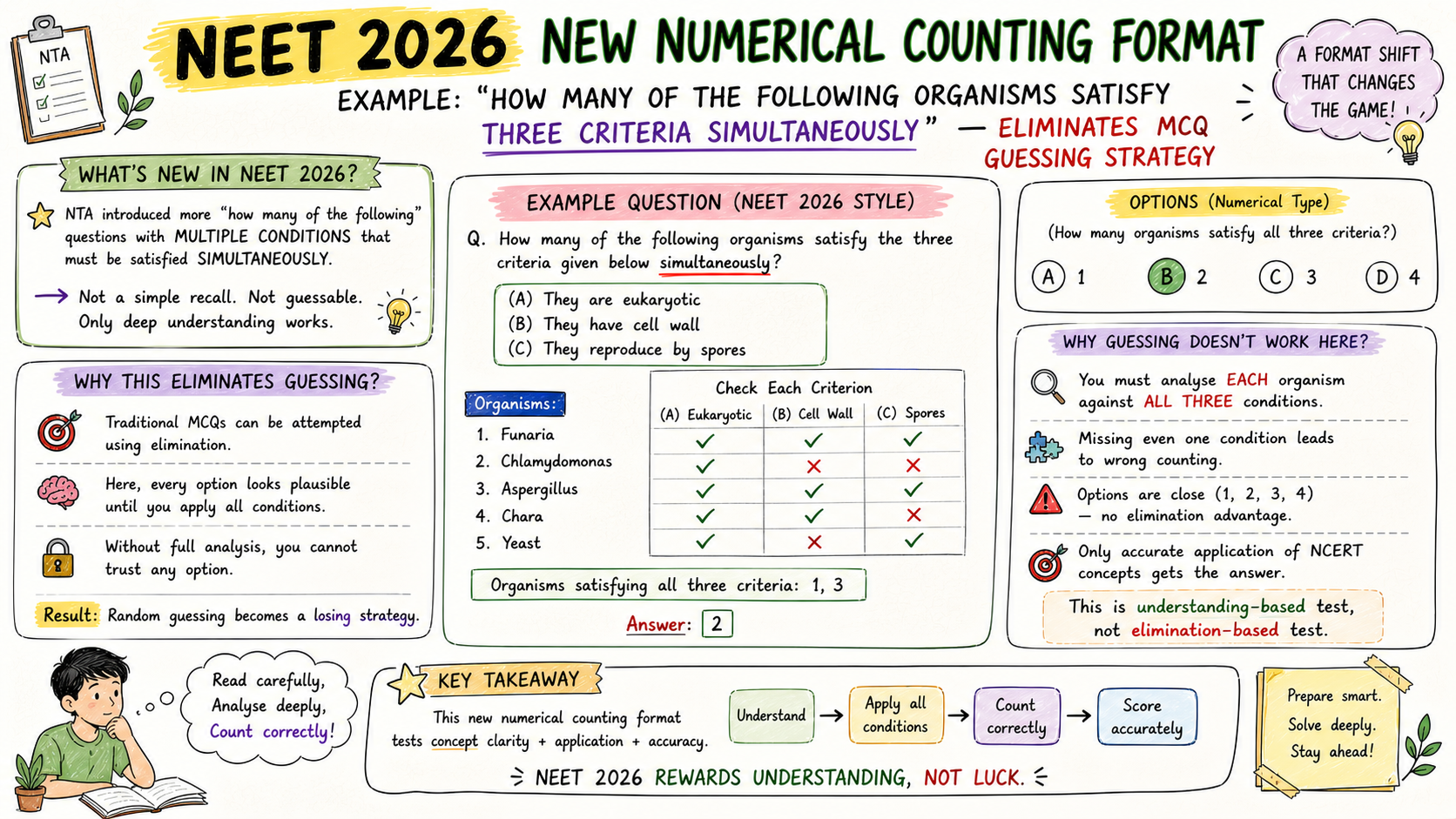
Five questions in NEET 2026 used a format that didn't exist meaningfully in any previous NEET paper: "How many of the following statements/organisms/structures are correct?" with five or six items in the stem.
Example from the paper (Section B Zoology): the question listed five organisms — Aedes, Limulus, Pheretima, Ancylostoma, Antedon — and asked how many satisfy three independent criteria simultaneously: presence of a true coelom, metameric segmentation, and a closed circulatory system. The correct answer requires evaluating five organisms across three criteria — fifteen independent factual judgments — to arrive at a single number from 0 to 5.
This format completely nullifies elimination strategy. In a standard MCQ, removing one option gives you a 33% chance. In a numerical-counting question, there is no option to eliminate. You either know all the facts or you don't. This is the single most consequential format shift in NEET 2026 for NEET 2027 aspirants to internalise.
| 🎯 Older PYQ banks don't drill the numerical-counting format | |
|---|---|
| 5 questions in NEET 2026 used this format. Pre-2024 question banks systematically miss it. Logic Bloom (BETA) builds NEET 2026-format practice — multi-statement, assertion-reason, match-the-column, numerical-counting — into every chapter loop, with TarQ mentoring you through. | Get the app → Free to start. |
Predictions — Hit, Miss, or Partial?
| Chapter | Top 3 Predictions Made | Hit Rate |
|---|---|---|
| Biomolecules | Secondary metabolites; Enzyme classification; Nucleic acid Chargaff rules | 2 of 3 confirmed |
| MBI | Lac operon; Replication direction; Translation codons | 2 of 3 confirmed |
| Cell Biology | Organelle classification; Mito/chloroplast comparison; Plasma membrane | 2 of 3 confirmed |
| Principles of Inheritance | Pedigree analysis; Sex-linked disorders; Chromosomal disorders | 3 of 3 confirmed ✓ |
| Biological Classification | Kingdom Fungi sub-classes; Lichens/mycorrhiza; Viruses/viroids/prions | 1 of 3 (chapter under-tested) |
| Biotechnology | pBR322 features; Restriction enzymes; PCR cycle | 3 of 3 confirmed ✓ |
| Cell Cycle | Prophase I sub-stages; Mitosis vs meiosis; Cytokinesis differences | 1 of 3 (chapter under-tested) |
| Human Reproduction | Spermatogenesis vs oogenesis; Menstrual cycle hormones; Implantation | 2 of 3 confirmed |
Aggregate hit-rate: 16 of 24 predicted sub-topics (67%) appeared in the actual paper. Misses were concentrated in two chapters that were under-represented overall (Cell Cycle and Biological Classification) — not in incorrect predictions about which sub-topics within those chapters would appear. The PYQ-trend approach is structurally validated: NEET is predictable when you have eleven years of historical data tagged at the sub-topic level.
Trap Status — Which Signature Traps Did NTA Set in 2026?
| Trap | Set in 2026? | Variation |
|---|---|---|
| 70S vs 80S ribosome confusion | Indirect | Tested through nucleolar rRNA synthesis distinction rather than direct organelle confusion |
| Hershey-Chase isotope assignment | Not set | Replaced by replication mechanism and disorder probability questions |
| Pachytene vs diplotene events | Not set | Cell Cycle was under-tested overall |
| Codominance vs incomplete dominance | Implicit | Folded into broader Mendelian disorder probability questions |
| Two oocyte arrest stages | Not set | Human Reproduction focused on hormonal cycle and implantation |
| Blue-white selection logic | Not set explicitly | Biotech focused on restriction enzymes and cloning vectors instead |
| Sickle cell substitution (Glu→Val at position 6) | Set ✓ | Embedded within Mendelian disorder questions |
| Promoter-terminator direction | Set ✓ | Embedded within transcription unit and restriction enzyme questions |
| Lac operon regulatory logic | Set ✓ | Direct test |
Two New Traps Worth Flagging for NEET 2027
The GnRH Trap. A question listed four hormone-target pairs and asked which was incorrect. The trap: GnRH → Gonads. Students who reasoned "Gonadotropin-Releasing Hormone, so it must target the gonads" walked into a textbook trap. NCERT explicitly states GnRH targets the anterior pituitary, which then releases LH and FSH that act on the gonads. The hormone's name describes its function (releasing gonadotropins), not its target.
The Adrenal Cortex vs Medulla Trap. A question asked which adrenal-cortex hormone induces hyperglycemia. The distractor options included both epinephrine and cortisol. Both elevate blood glucose — but epinephrine is secreted by the adrenal medulla, not the cortex. Students who pattern-matched "hyperglycemia" to "fight or flight" missed the anatomical qualifier in the question stem.
These traps share a structure: NTA gives you a question where the obvious answer is correct on the physiological outcome but wrong on the anatomical specificity. Reading slowly is no longer optional.
Three Surprises in NEET 2026 Biology
| Surprise | What Happened | NEET 2027 Implication |
|---|---|---|
| Biodiversity and Conservation broke its ceiling | 5 questions — double the baseline. Tested Evil Quartet drivers, in-situ vs ex-situ conservation specifics, and sacred groves — mechanistic content, not broad reading. | Treat Biodiversity & Conservation with the same revision intensity as Ecosystem. Plan for 4–5 questions. |
| Rationalised syllabus boundaries are not airtight | A question on the hepatic portal system and hexose absorption — intersecting with a rationalised chapter — was framed through Body Fluids and Circulation, technically within the active syllabus. | Don't treat rationalised content as "skip these chapters." Treat it as "de-emphasised but still functionally testable through connections." |
| Numerical-counting format went from rare to systematic | 5 times — and four of those five were in Section B, directly determining top-percentile ranking. | Build this format into every mock test diet from Day 1. Older PYQ banks (pre-2024) systematically under-represent it. |
How NEET 2026 Compares to Coaching Institute Predictions
| Institute | Difficulty Rating | Notable Observation |
|---|---|---|
| Physics Wallah | Easy | Botany rated very easy; questions described as direct and NCERT-based, with Genetics and Ecology more straightforward than 2025. |
| Vedantu | Easy to Moderate | Biology described as the most scoring section; conceptual understanding emphasised over memorisation. |
| Aakash | Easy to Moderate, Lengthy | NCERT-heavy paper; rewarded students focused on NCERT diagrams and in-text notes. |
| Allen | Average / Moderate | High match-the-column density flagged as a time challenge. Polled 58% moderate / 34% easy in initial survey. |
| Career Point | Moderate | Botany flagged as a time-drain due to statement-based question density. |
Disagreement is purely on Botany pacing, not content difficulty. Universally, every institute confirmed the paper was NCERT-rooted and that conceptual understanding — not memorisation — was the differentiator.
Expected Cutoff and Rank Compression
| Threshold | Projected Score (Coaching Consensus) | Note |
|---|---|---|
| Top 100 AIR | 715–720 marks | Near-perfect performance required |
| Government MBBS seat (AIQ, safe score) | 615+ marks | Based on PW, Aakash, Allen, Vedantu projections |
| ⚠️ Rank compression zone | 600–660 marks | Single half-question swing = 2,000–3,000 rank movement |
These are projections. Wait for NTA's official cutoff announcement before treating any number as final.
What This Means for NEET 2027 Aspirants
| 📌 5 Strategic Takeaways for NEET 2027 — Ranked by Impact | |
|---|---|
| 1. Genetics + Biotechnology is mandatory, not high-yield | 19 of 90 biology questions — 21% of the paper from four chapters. A NEET 2027 student who is shaky on Principles of Inheritance, MBI, or Biotechnology cannot make it up elsewhere. |
| 2. Master the numerical-counting format from Day 1 | Older PYQs (2015–2020) systematically under-train this format. Every mock test diet for NEET 2027 must include it. Treat it as a separate skill: evaluating each item in a stem independently, with absolute certainty, without cross-referencing the others. |
| 3. Diagrams are testable matrices, not illustrations | NTA is increasingly testing spatial relationships — visceral vs parietal layers, terminal vs respiratory bronchioles, anterior vs posterior orientations. Redrawing complex NCERT diagrams from memory needs to become a standard revision protocol. |
| 4. Biodiversity and Conservation is no longer a soft fallback | 5 questions in 2026 likely represents a sustained reweighting. Plan for 4–5 questions and prepare with the same rigour as for Ecosystem. |
| 5. Anatomical and nomenclature traps reward slow, careful reading | The GnRH-targets-pituitary trap and the adrenal-cortex-vs-medulla trap both punish fast reading. Building reading discipline — slowing down on every question stem long enough to check anatomical qualifiers — is now as important as content mastery. |
| 6. Drill all of this with TarQ as your mentor | Genetics cluster, numerical-counting format, anatomical traps, NCERT diagrams. Logic Bloom's Playground (BETA) breaks NEET 2026 testing reality into NCERT-aligned topic loops — concept games, focused readings, and NEET 2026-format practice — with TarQ as your in-app mentor. Free to start. |
Done with the Analysis? Now Play, Practice, or Duel.
| 🎯 Logic Bloom — Built for the NEET 2027 you're actually preparing for | |
|---|---|
| 🎮 Playground (BETA) Solo practice with TarQ, your in-app mentor |
NCERT-aligned topic loops covering the Genetics cluster (Inheritance + MBI), Biotechnology (pBR322, restriction enzymes, PCR), Biodiversity (Evil Quartet, in-situ vs ex-situ), and the anatomical traps (GnRH targets, adrenal cortex vs medulla). Each loop pairs concept games with NEET 2026-format practice — multi-statement, assertion-reason, match-the-column, numerical-counting. Get the app → |
| ⚔️ Battleground 1v1 real-time duels |
Challenge a friend or get matched live. 10 timed questions per match across Physics, Chemistry, Biology — JEE Main + Advanced + NEET aligned. ELO climbs through 6 tiers: Bronze → Silver → Gold → Platinum → Diamond → Archeon. Get the app → |
| Understand through games. Score through practice. Get Logic Bloom — Free to start → |
|
See where each chapter ranks across 11 years in our complete NEET Biology weightage analysis.
FAQs — NEET 2026 Biology Paper Analysis
Q1: Was the NEET 2026 Biology paper harder than 2025?
Factually, NEET 2026 was easier than 2025. Coaching institute consensus across PW, Vedantu, Aakash, and Allen rated it Easy to Moderate, while 2025 was widely considered tough. However, NEET 2026 was significantly more time-demanding — multi-statement and match-the-column formats made up roughly 35% of the paper, and a new numerical-counting format consumed 60–90 seconds per question. Aspirants who scored well had genuine NCERT understanding combined with reading discipline, not those relying on memorisation. Check the NTA official portal for official statistics.
Q2: Which chapter had the most questions in NEET 2026 Biology?
Principles of Inheritance and Variation led NEET 2026 Biology with 7 questions, breaking its 11-year average of 4.7 and exceeding any single-paper count in the 2015–2025 window. Combined with Molecular Basis of Inheritance, the Genetics cluster contributed 11 questions — nearly 12% of the entire biology paper. Biotechnology (Principles + Applications) followed with 8 questions combined, also above its historical baseline.
Q3: Did NTA introduce any new question formats in NEET 2026?
Yes. The "numerical counting" format — questions asking "how many of the following statements/organisms/structures satisfy [criteria]" — appeared 5 times, up from 1–2 in earlier papers. This format eliminates traditional MCQ elimination strategy because there are no answer choices to eliminate; the candidate must independently verify every premise. Match-the-Column also expanded from a 13% baseline to roughly 20% of the paper. NEET 2027 aspirants should treat both as mandatory practice formats from the start of preparation.
Q4: What is the expected NEET 2026 cutoff based on this paper?
Coaching institutes have projected: Top 100 AIR threshold around 715–720 marks, and Government MBBS seat under All India Quota at approximately 615+ marks. The 600–660 range is expected to see severe rank compression where a single half-question swing could move candidates by 2,000–3,000 ranks. These are projections from Physics Wallah, Aakash, Allen, and Vedantu — wait for NTA's official cutoff announcement before treating any number as final.
Q5: What should NEET 2027 aspirants take away from the 2026 paper?
Three things matter most. First, the Genetics + Biotechnology cluster contributed 21% of the biology paper from four chapters — these are now mandatory mastery, not high-yield options. Second, the new numerical-counting format kills traditional elimination strategy and must be drilled extensively in mock tests. Third, NTA is increasingly setting anatomical-origin and nomenclature traps (like GnRH targeting the pituitary, not the gonads) that reward slow, careful reading of question stems over fast pattern-matching. See the full strategic breakdown in our master weightage analysis.