Cell Cycle & Division NEET PYQ (2015–2025) — Prophase I Dominates
Prophase I dominated this chapter for a decade — then Cell Cycle collapsed to 1 question in NEET 2026. The Pachytene-Diplotene trap we predicted didn't fire. What happens in Re-NEET? 62 PYQs decoded.
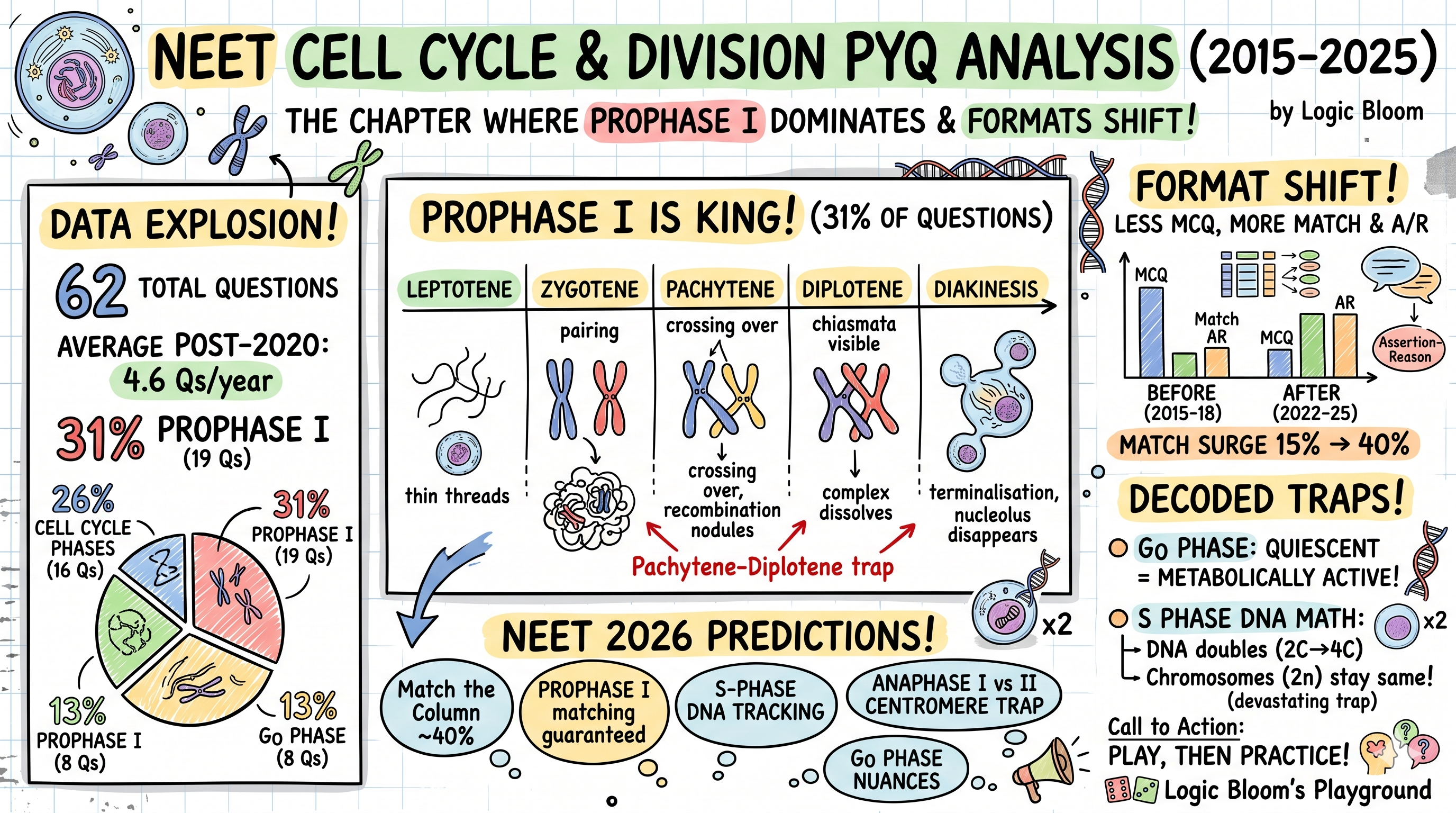
Introduction: Cell Cycle and Cell Division NEET PYQ — The Chapter Where One Sub-Stage Gets 31% of All Questions
Prophase I has five sub-stages. NTA tests all five — simultaneously — in a single match-the-column question. And they do it almost every year.
Leptotene → Zygotene → Pachytene → Diplotene → Diakinesis. Five names. Five defining events. Five potential traps. The synaptonemal complex forms in Zygotene but dissolves in Diplotene. Crossing over happens in Pachytene, but the physical evidence (chiasmata) only becomes visible in Diplotene. Terminalisation occurs in Diakinesis. If you confuse any single mapping, you lose 4 marks.
We tracked 62 questions from Cell Cycle and Cell Division across every NEET sitting from 2015 to 2025. Prophase I alone accounts for 31% of all questions — the most heavily tested single sub-topic from any chapter in our entire PYQ series.
This is our 7th PYQ trend analysis. See the full series: Biomolecules | MBI | Cell Biology | Principles of Inheritance | Biotechnology | Biological Classification | Master weightage analysis — 332 PYQs
| 🎯 Five sub-stages. Zero room for confusion. | |
|---|---|
| Leptotene → Zygotene → Pachytene → Diplotene → Diakinesis. One mapping wrong in NTA's match-the-column and 4 marks are gone. Logic Bloom's Playground (BETA) breaks Cell Division into NCERT-aligned topic loops — interactive concept games, focused reading, and NEET-format question drills — so Prophase I becomes reflex, not recall. TarQ, our concept-first mentor, walks you through every sub-stage event. | Drill Prophase I → Free to start. |
The Numbers: A Consistent 4-5 Question Chapter
Cell Cycle and Cell Division ranks #3 in Class 11 Biology by weightage, reliably delivering 4–5 questions per standard exam sitting.
| Year | Questions | Includes |
|---|---|---|
| 2025 | 4 | Main sitting |
| 2024 + Re-exam | 9 | Main (4) + Re-exam (5) |
| 2023 + Manipur | 11 | Main (6) + Manipur (5) — peak year |
| 2022 | 9 | Phase 1 (5) + Phase 2 (4) |
| 2021 | 5 | Single sitting |
| 2020 + Phase 2 | 10 | Phase 1 (4) + Phase 2 (6) |
| 2019 | 2 | Single sitting — NTA transition year |
| 2018 | 1 | Single sitting |
| 2017 | 2 | Single sitting |
| 2016 | 6 | Phase 1 (3) + Phase 2 (3) |
| 2015 | 3 | AIPMT + Cancelled re-test |
Post-2020 average: 4.6 questions per year — representing roughly 9% of the Botany section. The ROI per NCERT page is among the highest in the entire syllabus: a short chapter yielding 16–20 marks consistently.
Where 62 Questions Come From: The Sub-Topic Split
| Sub-topic | Questions | Share |
|---|---|---|
| Meiosis I — Prophase I | 19 | 30.6% |
| Cell Cycle Phases (G1, S, G2, M) | 16 | 25.8% |
| G0 Phase / Quiescent Stage | 8 | 12.9% |
| Mitosis vs Meiosis Comparison | 5 | 8.0% |
| Mitosis — Metaphase | 4 | 6.4% |
| Mitosis — Anaphase | 3 | 4.8% |
| Cyclin / CDK / Cell Cycle Regulation | 2 | 3.2% |
| Significance of Meiosis | 2 | 3.2% |
| Others (Telophase, Prokaryotic, Prophase) | 3 | 4.8% |
Finding 1: Prophase I is the undisputed king. 19 questions from a single sub-stage of a single phase. NTA treats it not as one topic but as a rigid five-step chronology that can be tested from five different angles. Finding 2: Cell Cycle Phases = 26%. G1, S, G2 mechanics — particularly DNA doubling during S phase while chromosome number stays constant — are tested with mathematical precision. Finding 3: G0 phase is rising fast, from a rarely-tested concept to 13% of all questions.
| Process | Share of Questions |
|---|---|
| Cell Cycle & Interphase | 38% |
| Meiosis (overwhelmingly Prophase I) | 42% |
| Mitosis | 20% |
Meiosis gets double the attention of mitosis. Within meiosis, Prophase I consumes 90% of the focus. Meiosis II is almost never tested independently — it only appears in comparison to mitosis.
The Prophase I Trap: How NTA Turns 5 Sub-Stages Into 5 Traps
This is the most heavily tested single concept in our entire PYQ series. Here's exactly how NTA weaponises it:
| Sub-stage | What NTA Tests | The Trap |
|---|---|---|
| Leptotene | Chromosomes appear as thin threads | Students confuse with Zygotene |
| Zygotene | Synapsis begins, synaptonemal complex forms, bivalents appear | Students think crossing over happens here — it doesn't |
| Pachytene | Crossing over occurs, recombination nodules appear, recombinase acts | Students confuse with Diplotene — where chiasmata BECOME VISIBLE, but crossing over already happened in Pachytene |
| Diplotene | Synaptonemal complex dissolves, chiasmata become visible | The critical trap: crossing over happened in Pachytene, but you SEE the evidence (chiasmata) only in Diplotene |
| Diakinesis | Terminalisation of chiasmata, nucleolus disappears | Students forget this stage exists — or confuse terminalisation with dissolution |
The 2022 assertion-reason trap: "Assertion: Synaptonemal complex forms in Zygotene. Reason: It helps in synapsis of non-homologous chromosomes." The assertion is TRUE, but the reason is FALSE — the synaptonemal complex pairs homologous chromosomes, not non-homologous ones. Students who vaguely remember "synaptonemal complex = pairing" without the specificity of "homologous only" get caught.
The Format Shift: 65% → 25% MCQ
| Format | 2015–2018 | 2022–2025 |
|---|---|---|
| Standard MCQ | 65% | 25% |
| Match the Column | 15% | 40% |
| Assertion-Reason | 0% | 15% |
| Multi-statement / Sequencing | 10% | 20% |
| Numerical | 10% | 0% (shifted to multi-statement) |
Match-the-column surged from 15% to 40% — the highest proportion we've seen in any chapter across our 7-blog series. Prophase I's five sub-stages are naturally suited for a 4-item matching question. Diagram-based questions have disappeared entirely — replaced by text-based phase descriptions. Instead of showing a cell at metaphase and asking "which phase?", NTA now describes it verbally ("chromosomes aligned at equator, spindle fibres attached to kinetochores") and you identify the phase from text. Harder.
| ⚠️ Match-the-column at 40% — the highest of any chapter. | |
|---|---|
| 4 out of 4 correct = 4 marks. 3 out of 4 = 0 marks (with negative marking applied). Standard MCQs collapsed from 65% to 25% — old question banks won't train you for the format that actually decides this chapter. Logic Bloom's Playground (BETA) NEET-format drills hit match-the-column, assertion-reason, and multi-statement directly inside topic loops, with TarQ reinforcing the underlying sub-stage logic. | Practise the new format → Free to start. |
The S-Phase DNA Trap: Math That Decides Marks
Cell Cycle questions increasingly involve quantitative reasoning about DNA content vs chromosome number. The key principle: during S phase, DNA replicates (2C → 4C), but sister chromatids remain attached at a single centromere, so chromosome number stays at 2n. Chromosome number only halves during Anaphase I of meiosis.
| Question Type | What's Tested | Year |
|---|---|---|
| Type 1 — Direct calculation | "If initial DNA is 8C, after S phase it will be?" → 16C. (DNA doubles; chromosome count unchanged.) | 2020 Phase 2 |
| Type 2 — Chromosome vs DNA distinction | "Chromosomes in G1 are 36. Chromosomes in S phase are?" → Still 36. DNA doubles but chromosome count doesn't change until centromere splitting. | 2020 Phase 2 |
| Type 3 — Cross-phase tracking | "A somatic cell that just completed S phase, compared to a gamete of the same species, has?" → Twice the chromosomes (2n vs n) and four times the DNA (4C vs C). | 2015 |
These are free marks if you understand the principle. Most students who get them wrong confuse DNA content with chromosome number — thinking that because DNA doubles, chromosomes must too.
The G0 Trap: "Quiescent" ≠ "Inactive"
G0 phase has appeared 8 times in 10 years — and the testing pattern is always the same trap. What students assume: G0 = cell has stopped everything = inactive. What NCERT says: G0 cells exit the cell cycle from G1. They stop dividing but remain metabolically active — continuing tissue-specific functions (nerve cells conducting impulses, muscle cells contracting).
| Year | Format | What Was Tested |
|---|---|---|
| 2025 | Multi-statement | "G0 cells are quiescent... this does not mean the cell is metabolically inactive." (TRUE) |
| 2022 | MCQ | "Which phase does a cell exit from to enter G0?" (Answer: G1, not S phase) |
| 2019–2020 | Various | G0 = exit from G1 = metabolically active but non-proliferative |
2026 prediction: Expect a multi-statement where one claim says "G0 cells have halted protein synthesis" (FALSE — they continue synthesis for tissue-specific functions). The trap targets students who equate "not dividing" with "not synthesising."
The 10 Concepts NTA Cannot Stop Testing
| 🎯 Top 10 Most Repeated Cell Division Concepts in NEET (2015–2025) | ||
|---|---|---|
| 1. | Prophase I sequence + events (synapsis → crossing over → chiasmata) | 15+ | NCERT Pages 167–168: "Crossing over is the exchange of gene segments... at pachytene." |
| 2. | S phase: DNA doubles (2C→4C), chromosome number stays 2n | 12+ | NCERT Page 163: "Amount of DNA per cell doubles... chromosome number remains the same." |
| 3. | G0 phase: metabolically active, non-proliferative, exits G1 | 8 | NCERT Page 164: "These cells that do not divide further exit G1 phase to enter... G0." |
| 4. | Kinetochore + spindle attachment at Metaphase | 6 | NCERT Page 165: "Spindle fibres attach to kinetochores of chromosomes." |
| 5. | Anaphase centromere splitting (Mitosis/Meiosis II vs NOT in Meiosis I) | 5 | NCERT Pages 165/170: "Centromeres split and chromatids separate." |
| 6. | Synaptonemal complex: forms in Zygotene, dissolves in Diplotene | 5 | NCERT Page 168: "The beginning of diplotene is recognised by the dissolution of the synaptonemal complex." |
| 7. | Significance of meiosis: genetic variation + chromosome number conservation | 4 | NCERT Page 170: "Meiosis is the mechanism by which conservation of specific chromosome number... is achieved." |
| 8. | Aneuploidy vs Polyploidy (segregation failure vs cytokinesis failure) | 3 | Cross-chapter with Principles of Inheritance |
| 9. | Cell cycle duration (human = 24 hrs, yeast = 90 min) | 3 | NCERT Page 163 |
| 10. | Recombinase enzyme action during Pachytene | 3 | NCERT Page 168: "Crossing over is an enzyme-mediated process... recombinase." |
The top two concepts — Prophase I events and S-phase DNA math — have appeared a combined 27+ times. These alone could account for roughly half of all Cell Division questions you'll ever face in NEET.
Cross-Chapter Connections
| Cross-Chapter Link | What It Tests | Example |
|---|---|---|
| Cell Division + Principles of Inheritance | Mechanism of chromosomal disorders | Non-disjunction during Anaphase I/II → Down syndrome, Klinefelter syndrome. Cytokinesis failure → polyploidy. 2024 re-exam tested both in one multi-statement. |
| Cell Division + Cell Biology | Centriole duplication timing | Centrosome duplication during S phase bridges Chapter 8 (structure) and Chapter 10 (process). Same S phase that doubles DNA also doubles the centrosome. |
| Cell Division + MBI | Molecular mechanism of crossing over | Recombinase enzyme during Pachytene connects physical crossing over with molecular DNA backbone severing and re-ligation — an MBI-level biochemistry concept. |
| Cell Division + Human Reproduction | Oocyte developmental arrest | Primary oocytes arrest in Dictyotene stage (a prolonged Diplotene) for months or years before ovulation — testing Prophase I sub-stage knowledge through reproductive biology context. |
NEET 2026 Predictions: What the Data Points To
Predicted format distribution: Match the Column ~40% (2 questions — Prophase I sub-stages + cell cycle phases) | Multi-statement ~25% (1 question — G0 phase or aneuploidy vs polyploidy) | Assertion-Reason ~15% (1 question — significance of meiosis or synaptonemal complex specificity) | Standard MCQ ~20% (1 question — basic phase identification)
Top 5 Sub-Topics Most Likely to Appear in 2026
| # | Predicted Topic | Why It's Due |
|---|---|---|
| 1 | G0 phase nuances | The metabolically active but non-proliferative distinction. Likely trap: "G0 cells have halted protein synthesis" (FALSE — they continue tissue-specific synthesis). |
| 2 | S-phase DNA quantification | A numerical or multi-statement tracking DNA content (2C → 4C) while enforcing that chromosome number stays 2n. Format: "If G1 has X chromosomes and Y DNA, what does G2 have?" |
| 3 | Prophase I sub-stage matching | Near-guaranteed. Expect recombination nodules → Pachytene, synaptonemal complex dissolution → Diplotene, terminalisation → Diakinesis in a single match-the-column. |
| 4 | Anaphase I vs Anaphase II mechanics | The centromere trap — homologous chromosomes separate in Anaphase I (centromere intact) vs sister chromatids separate in Anaphase II (centromere splits). Statement-based format. |
| 5 | Cytokinesis modalities | Plant cell plate (centrifugal growth, phragmoplast) vs animal cleavage furrow (centripetal growth). Statistically overdue for a dedicated question. |
3 Concepts Due for a Return
| Concept | Last Tested | Likely Format |
|---|---|---|
| Anaphase Promoting Complex (APC) | ~2017 | If APC fails, chromosomes cannot segregate → arrest at metaphase. Tests protein regulation of the cell cycle. |
| Generation time calculations | Sporadic | Yeast = 90 min, E. coli = 20 min. A 2ⁿ growth calculation (parallel to PCR math in Biotechnology) is overdue. |
| Syncytium / polyploidy from cytokinesis failure | Rarely standalone | Telophase without cytokinesis → multinucleate cells. Example: liquid endosperm in coconut. Bridges cell division with developmental biology. |
Predicted Cross-Chapter Combinations for 2026
| Combination | What to Prepare |
|---|---|
| Cell Division + Human Reproduction | Oocyte arrest in Dictyotene (prolonged Diplotene) — testing Prophase I sub-stage knowledge through reproductive biology. Primary oocyte stays in Dictyotene until just before ovulation. |
| Cell Division + Biomolecules | Tubulin protein synthesis during G2 phase → polymerisation into microtubules → mitotic spindle formation. Tests cell cycle phases through biomolecule classification. |
| Meiosis + Principles of Inheritance | Non-disjunction during Anaphase I/II → specific chromosomal disorders. Down syndrome from chromosome 21 non-disjunction — "at which meiotic stage does the error occur?" |
How to Prepare Based on the Data
| 📌 Data-Driven Preparation Strategy — Cell Cycle & Cell Division NEET 2026 | |
|---|---|
| Memorise Prophase I as a rigid five-step sequence with zero ambiguity | Leptotene (thin threads) → Zygotene (synapsis + synaptonemal complex forms) → Pachytene (crossing over + recombination nodules + recombinase) → Diplotene (synaptonemal complex dissolves + chiasmata visible) → Diakinesis (terminalisation + nucleolus disappears). Each step has ONE defining event. Know it cold. |
| Build the DNA vs chromosome mental model | Draw a timeline: G1 (2n, 2C) → S (2n, 4C) → G2 (2n, 4C) → After Meiosis I (n, 2C) → After Meiosis II (n, C). Practice calculating any value given any starting point. Chromosome count and DNA content are independent variables until centromere splitting. |
| Practice match-the-column questions specifically | This format constitutes 40% of Cell Division questions — the highest of any chapter. You need all 4 matches correct to get 4 marks. Three correct and one wrong = 0 marks (negative marking applies). The margin for error is zero. |
| Cross-link with Inheritance every time you study non-disjunction | Connect every non-disjunction event to the specific disorder it causes. Connect every crossing over study to recombination frequency (cM units) from Principles of Inheritance. NTA rewards this integrated thinking. |
| See where this chapter sits in the full picture | Check our complete NEET Biology weightage analysis to prioritise this chapter relative to the full 332-question dataset. |
| Train the format daily — solo, then in duels | Use Logic Bloom Playground (BETA) topic loops on Prophase I sub-stages, S-phase DNA tracking, G0 nuances, and Anaphase I vs II mechanics — with TarQ guiding the concept-game-then-practice cycle. Then test recall against another aspirant in Battleground 1v1 duels for spaced retention. Open Logic Bloom → |
Conclusion: The Chapter That Rewards Sequence Precision
Cell Division is uniquely unforgiving. Most NEET Biology chapters reward broad conceptual understanding, but this one rewards sequential precision — the ability to recall five sub-stages in the right order, match each to its correct event, and distinguish between processes that differ by a single step. The match-the-column format at 40% is NTA's way of enforcing this precision. Four correct and one wrong gets you zero marks. No partial credit, no guessing shortcut.
The students who ace this chapter are the ones who treat Prophase I not as five things to remember, but as five unique events they can recall instantly under pressure. Build that automaticity through active practice — not passive reading.
Done analysing? Now play, practice, or duel.
62 PYQs. Five sub-stages. One match-the-column format that decides 40% of marks. You've seen the data — now turn it into an answer reflex, solo or against another aspirant in real time.
| 🎯 Logic Bloom — Built for the NEET 2026 you actually face | |
|---|---|
| 🎮 Playground (BETA) Solo, concept-first practice with TarQ |
NCERT-aligned topic loops covering Prophase I sub-stages (Leptotene → Zygotene → Pachytene → Diplotene → Diakinesis) with their defining events, S-phase DNA math (2C→4C while chromosome number stays 2n), G0 phase nuances (metabolically active but non-proliferative), Anaphase I vs II centromere mechanics, kinetochore-spindle attachment, and cytokinesis modalities (cell plate vs cleavage furrow). Each loop pairs interactive concept games with focused reading and NEET-format practice — match-the-column, assertion-reason, multi-statement. Open the Playground → |
| ⚔️ Battleground 1v1 real-time duels |
Challenge a friend or get matched live. 10 timed questions per match across Physics, Chemistry, Biology — JEE Main + Advanced + NEET aligned. ELO climbs through 6 tiers: Bronze → Silver → Gold → Platinum → Diamond → Archeon. Friend challenges, the Throne system, and post-match explainers convert every wrong answer into long-term recall. Enter the Battleground → |
|
Open Logic Bloom → Understand through games. Score through practice. Free to start. |
|
FAQs — Cell Cycle and Cell Division NEET PYQ
Q1: How many questions come from Cell Cycle and Cell Division in NEET?
Cell Cycle and Cell Division averages 4–5 questions per year in NEET, contributing approximately 16–20 marks. It ranks #3 among Class 11 Biology chapters by weightage. The post-2020 average is 4.6 questions per standard sitting, representing roughly 9% of the Botany section — an exceptionally high ROI given the chapter's short NCERT page count.
Q2: What is the most tested sub-topic from Cell Division in NEET?
Prophase I of Meiosis I is the most tested, accounting for 31% of all Cell Division questions — 19 out of 62 across 2015–2025. The five sub-stages (Leptotene, Zygotene, Pachytene, Diplotene, Diakinesis) are tested as a rigid chronological sequence, frequently using match-the-column format to test all five simultaneously.
Q3: How has the question format changed for Cell Division in NEET?
Standard MCQs dropped from 65% (2015–2018) to just 25% (2022–2025). Match-the-column surged from 15% to 40% — the highest proportion of any chapter across our 7-blog PYQ series. Assertion-reason rose from 0% to 15%. Direct diagram-based phase identification has disappeared entirely, replaced by text-based phase description questions.
Q4: What is the Pachytene-Diplotene trap in NEET?
NTA's favourite Cell Division trap exploits the distinction between crossing over (the molecular event, which occurs during Pachytene) and chiasmata (the visible X-shaped structures, which only become visible during Diplotene). Students who associate "chiasmata" with "crossing over" select Pachytene when the correct answer is Diplotene — a distinction that has been tested in multiple formats across several years.
Q5: What numerical calculations should I prepare from Cell Division for NEET?
Two types: DNA content tracking through the cell cycle — knowing that DNA doubles from 2C to 4C during S phase while chromosome number stays 2n (chromosome number and DNA content are independent variables until centromere splitting occurs) — and generation time calculations (yeast completes the cell cycle in 90 minutes, E. coli in 20 minutes).