Biotechnology NEET PYQ (2015–2025) — 44 Questions, pBR322 Traps Analyzed
NTA swaps "alkaline" for "acidic," "E. coli" for "Agrobacterium," "cow" for "buffalo." Three documented single-word NCERT traps, each tested multiple times. The trap table + Re-NEET predictions inside.
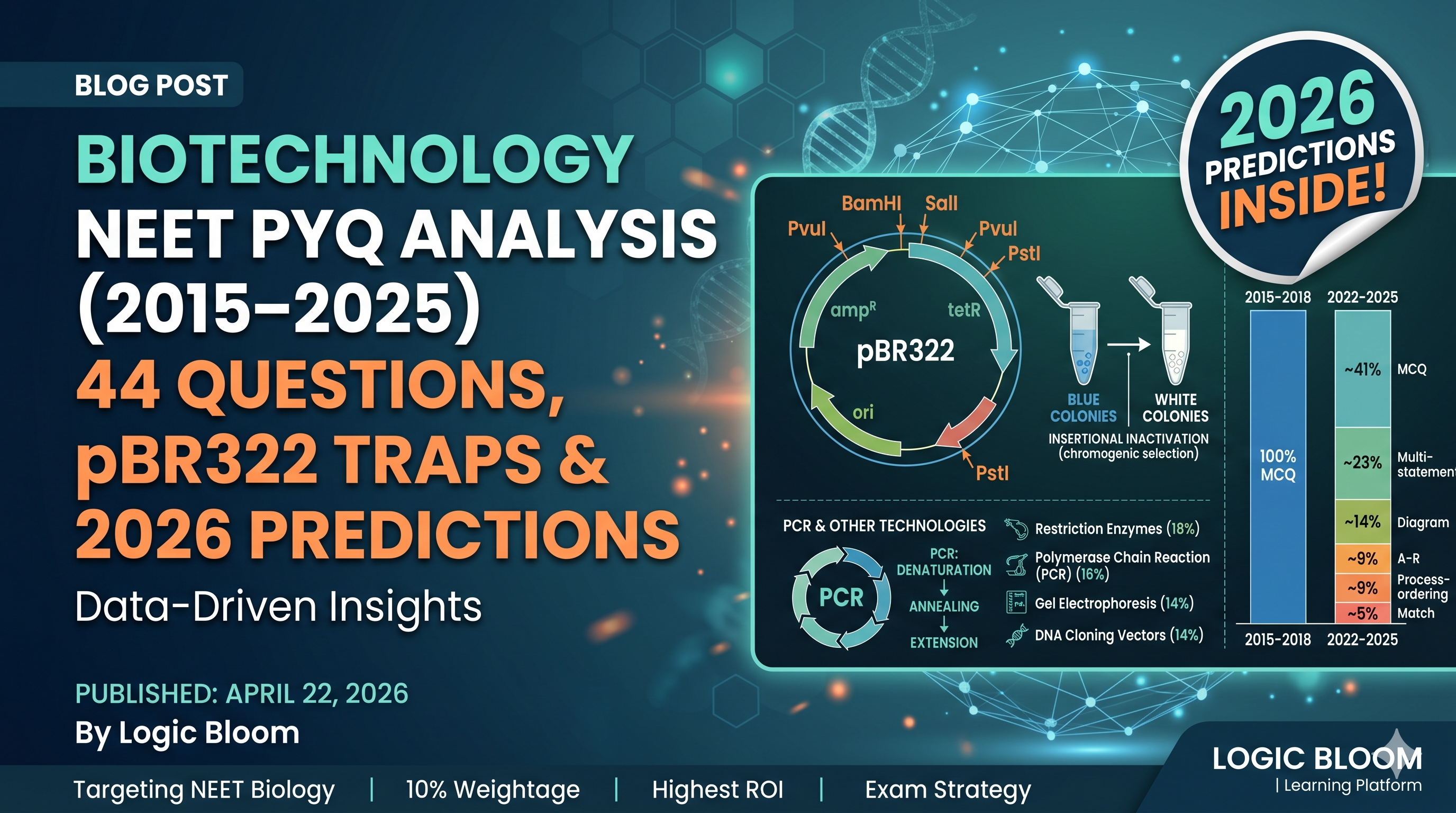
Introduction: Biotechnology NEET PYQ Analysis — The Chapter Where 100% MCQ Became 41%
No chapter in NEET Biology has undergone a more violent format transformation than Biotechnology.
In the 2015–2018 block, 100% of Biotechnology questions were standard MCQs. Every single one. By the 2022–2025 block, that dropped to 41% — replaced by multi-statement evaluations, assertion-reason questions, diagram-based identifications, and process-ordering sequences.
The content didn't change. The NCERT didn't change. But a chapter that used to test "Taq polymerase comes from Thermus aquaticus" now tests whether you can read a masked pBR322 diagram, identify which restriction site disrupts which antibiotic resistance gene, and predict colony colour on a chromogenic substrate — all in one question.
The pBR322 plasmid map is the most tested diagram in the entire NEET Biology paper. If you can't draw it from memory in 30 seconds — every restriction site inside every antibiotic resistance gene — you're losing 4–8 marks before NTA even sets the question. If that recall isn't locking in from textbook reads alone, that gap is exactly what Logic Bloom's Playground is built for. Each chapter is broken into NCERT-aligned topic loops with interactive games, readings, videos, and NEET-format practice. Currently in beta. Free to start.
We tracked all 44 questions from Biotechnology: Principles and Processes across every NEET sitting from 2015 to 2025. This completes the Class 12 Biology top 3 alongside our analyses of Molecular Basis of Inheritance PYQ and Principles of Inheritance PYQ, and our Class 11 analyses of Biomolecules PYQ and Cell Biology PYQ.
The Numbers: 2 Questions Became 6
Biotechnology's question count has tripled over the decade — the largest growth rate of any Biology chapter.
| Year | Questions | Notable |
|---|---|---|
| 2025 | 6 | First diagram-based bioreactor + pBR322 questions |
| 2024 + Re-exam | 5 | PCR process-ordering, pBR322 ori diagram |
| 2023 + Manipur | 4 | First assertion-reason for restriction enzymes |
| 2022 (P1 + P2) | 7 | Peak count — cellulase/chitinase, competent hosts |
| 2021 | 3 | Chilled ethanol precipitation, PCR denaturation |
| 2020 (P1 + P2) | 5 | EcoRI palindrome sequence, ori definition |
| 2019 | 2 | PCR step ordering, molecular scissors |
| 2018 | 1 | Retrovirus as vector — lowest year |
| 2017 | 2 | Ethidium bromide, selectable markers |
| 2016 (P1 + P2) | 5 | Taq source, blunt ends (EcoRV), downstream processing |
| 2015 | 2 | Restriction enzyme discovery, DNA ligase |
From a baseline of 1–2 questions in 2015–2018, the chapter now reliably delivers 4–6 questions per exam — worth 16–24 marks. The combined Biotechnology unit (Principles + Applications) averages 8–9 questions per year — roughly 10% of the entire Biology paper. That's the same weightage as Molecular Basis of Inheritance, from a significantly shorter NCERT chapter. The ROI per page of study is arguably the highest in the entire curriculum.
Sub-Topic Frequency: The Holy Trinity
| Sub-topic | Questions | Share |
|---|---|---|
| Restriction Enzymes | 8 | 18% |
| Polymerase Chain Reaction (PCR) | 7 | 16% |
| Gel Electrophoresis | 6 | 14% |
| DNA Cloning Vectors | 6 | 14% |
| Enzymes Used in rDNA Technology | 5 | 11% |
| Insertional Inactivation | 4 | 9% |
| Bioreactors | 2 | 5% |
| Origin of Replication | 2 | 5% |
| Genetic Engineering Steps | 2 | 5% |
| Process Steps / Host Cells / History | 2 | 5% |
Restriction enzymes, PCR, and gel electrophoresis account for 48% of all questions — cutting DNA, amplifying it, and visualising it. Master these three sub-topics deeply and you cover nearly half the question pool.
The surprise: Insertional Inactivation went from 0 questions (2015–2019) to 4 questions (2020–2025). The blue-white colony selection mechanism has become a favourite precisely because it demands multi-step reasoning: foreign DNA insertion → lacZ disruption → no β-galactosidase → no blue colour → white colonies = recombinants. This causal chain is perfect for NTA's multi-statement format.
What's Increasing in Frequency
Insertional inactivation and chromogenic screening: Virtually absent before 2020, now appearing almost annually. NTA has identified this concept as the perfect filter — it requires understanding gene disruption, enzyme function, AND phenotypic expression simultaneously.
Bioreactors and downstream processing: The applied, industrial end of biotechnology is gaining traction. The 2025 diagram-based question on bioreactor components (identifying a foam breaker) signals that NTA wants students to know the engineering, not just the biology.
PCR mathematics: The 2025 introduction of the 2ⁿ amplification equation marks a shift from "where does Taq come from?" to "how much DNA do you get after n cycles?" Computational biology has arrived in NEET Biotechnology.
Diagram-based pBR322 questions: The plasmid map is being tested with increasing spatial precision — identifying restriction sites within specific resistance genes, understanding ori function from a masked diagram.
What's Decreasing in Frequency
Historical context: "Who discovered restriction enzymes?" — these have effectively disappeared as standalone questions and now appear only as minor distractors in match-the-column formats.
Basic definitions: "What is a plasmid?" or "Define a cloning vector" — gone. NTA assumes you know what a plasmid is and tests whether you can navigate its restriction map.
The Format Revolution: 100% → 41%
This is the most extreme format shift of any chapter across all five PYQ analyses in this series.
| Format | 2015–2018 | 2022–2025 |
|---|---|---|
| Standard MCQ | 100% | 41% |
| Multi-statement | 0% | 23% |
| Diagram-based | 0% | 14% |
| Assertion-Reason | 0% | 9% |
| Process-ordering | 0% | 9% |
| Match the Column | 0% | 5% |
Every complex format was at 0% in 2015–2018. This chapter went from pure recall to the full spectrum of NTA's assessment toolkit in just a few years. The process-ordering format is particularly important because Biotechnology is inherently sequential — rDNA technology is a protocol, PCR is a cycle. NTA exploits this sequential nature with step-ordering questions that don't work in most other chapters.
This is the gap most coaching material misses — heavy on standard MCQs (which are now the minority), thin on process-ordering, diagram identification, and multi-statement causal chains. Logic Bloom's Playground breaks Biotechnology into NCERT-aligned topic loops where each topic builds the underlying logic — rDNA workflow sequencing, pBR322 spatial recall, blue-white colony reasoning, PCR thermal cycle math — and then drops you into NEET 2026-format practice on the same concepts. TarQ guides you through. Currently in beta. Free to start.
The pBR322 Map: NEET's Most Targeted Diagram
The E. coli cloning vector pBR322 is the single most tested diagram in NEET Biology. NTA tests it across multiple axes, demanding total spatial and functional recall.
| What's Tested | The Fact | Year Appeared |
|---|---|---|
| Restriction sites in tetR gene | BamHI and SalI are inside the tetracycline resistance gene. Insertion here → tetracycline-sensitive recombinants. | 2023, 2024 Re-exam |
| Restriction sites in ampR gene | PvuI and PstI are inside the ampicillin resistance gene. Insertion here → ampicillin-sensitive recombinants. | 2024 Re-exam |
| ori function (masked diagram) | Controls the copy number of the linked DNA — not replication per se, but copy number regulation. | 2024 |
| Blue-white selection polarity | White colonies = recombinant (insert disrupted lacZ → no β-galactosidase → no blue). Blue colonies = non-recombinant. 2025 multi-statement tested students who confused this direction. | 2025 |
Preparation strategy: Draw the pBR322 map from memory until you can reproduce it in 30 seconds — ori position, ampR gene, tetR gene, and the restriction sites inside each. This single diagram is worth 4–8 marks across the exam.
PCR: The Question That Never Misses
PCR has appeared in 7 of the 11 years analysed. It is the most consistently tested procedural concept in the chapter.
| Era | What NTA Tested | Example |
|---|---|---|
| 2015–2017 | Source organism of Taq polymerase | "Thermus aquaticus" |
| 2019–2021 | Step sequencing + thermal logic | "Which step fails without high temperature?" → Denaturation |
| 2022–2024 | Process ordering + assertion-reason | "Arrange: Denaturation → Annealing → Extension → Amplification" |
| 2025 | Mathematical amplification | "DNA copies follow 2ⁿ equation" — n = number of cycles |
2026 prediction: NTA will likely target primer design specifics — short, chemically synthesised oligonucleotides complementary to regions flanking the target DNA — or temperature specifications per phase (denaturation at 94–98°C, annealing at 50–65°C, extension at 72°C). These are NCERT details not yet directly tested.
Cross-Chapter Connections: The Biotechnology Web
Biotechnology is the most cross-chapter-dependent topic in the syllabus. Almost every question implicitly requires knowledge from at least one other chapter.
| Cross-Chapter Link | What It Tests | The Connection |
|---|---|---|
| Biotechnology + MBI | PCR as DNA replication in a test tube | Thermal denaturation = helicase function; primers = primase function; Taq = DNA Pol III function. Restriction enzymes rely on palindromic base pairing — an MBI concept. |
| Biotechnology + Inheritance | Gene therapy vectors and Mendelian disorders | ADA deficiency treatment via retroviral vector bridges rDNA mechanics with Mendelian genetics. 2018 retrovirus-as-vector question. |
| Biotechnology + Cell Biology | Transformation overcoming membrane barrier | Competent cell transformation: DNA is hydrophilic and can't cross the hydrophobic lipid bilayer. CaCl₂/heat shock, electroporation, and microinjection are methods to overcome this barrier. |
| Biotechnology + Biological Classification | Cell wall enzyme specificity for DNA isolation | Bacteria → lysozyme (breaks peptidoglycan). Plants → cellulase (breaks cellulose). Fungi → chitinase (breaks chitin). 2022 Phase 2 question. |
The 10 Concepts NTA Cannot Stop Testing
| 🎯 Top 10 Most Repeated Biotechnology Concepts in NEET (2015–2025) | ||
|---|---|---|
| 1. | Ethidium bromide + UV for DNA visualisation | 4× | NCERT Page 198: "…staining the DNA with ethidium bromide followed by exposure to UV radiation." |
| 2. | Restriction enzymes cut at palindromic sequences, creating sticky ends | 4× | NCERT Page 196: "…cut the strand of DNA a little away from the centre of the palindrome sites." |
| 3. | DNA ligase joins cut DNA fragments | 4× | NCERT Page 197: "…the enzyme DNA ligase, which acts on cut DNA molecules and joins their ends." |
| 4. | Taq polymerase from Thermus aquaticus — thermostable | 3× | NCERT Page 202: "…a thermostable DNA polymerase (isolated from a bacterium, Thermus aquaticus)." |
| 5. | Blue-white selection: white colonies = recombinant | 3× | NCERT Page 199: "Presence of a chromogenic substrate gives blue coloured colonies if the plasmid does not have an insert." |
| 6. | Ori controls copy number of linked DNA | 3× | NCERT Page 199: "…responsible for controlling the copy number of the linked DNA." |
| 7. | pBR322: BamHI/SalI within tetR gene; PvuI/PstI within ampR gene | 2× | NCERT Page 199, Diagram 11.4 |
| 8. | Bioreactor components — foam breaker, impeller | 2× | NCERT Page 204: "A stirred-tank reactor is usually cylindrical…" |
| 9. | PCR steps: Denaturation → Annealing → Extension | 2× | NCERT Page 202, Diagram 11.6 |
| 10. | DNA precipitation with chilled ethanol | 2× | NCERT Page 201: "…purified DNA ultimately precipitates out after the addition of chilled ethanol." |
The top 3 — ethidium bromide, palindromic cleavage, and DNA ligase — each appeared 4 times. These are the foundational tools of molecular biology, and NTA treats them as non-negotiable knowledge.
NEET 2026 Predictions: What the Data Points To
Predicted format distribution: Standard MCQ ~35% | Multi-statement ~25% | Diagram-based ~15% | Assertion-Reason ~10% | Process-ordering ~10% | Match the Column ~5%
Top 5 Sub-Topics Most Likely to Appear in 2026
| # | Predicted Topic | Why It's Due |
|---|---|---|
| 1 | Insertional inactivation — antibiotic resistance screening method | Blue-white screening tested; the alternative method — replica plating on two antibiotics to identify recombinants that lost one resistance — is overdue for a multi-statement evaluation. |
| 2 | Competent host cell transformation methods compared | CaCl₂/heat shock for bacteria vs biolistics (gene gun with gold/tungsten particles) for plants vs microinjection for animal cells. Prime for a match-the-column format. |
| 3 | Gel electrophoresis — migration mechanics and elution | Ethidium bromide questions exhausted. Next logical target: the inverse relationship between fragment size and migration distance, and the process of eluting separated fragments from the agarose gel. |
| 4 | Downstream processing sequence | Separation → purification → preservative addition → clinical trials/quality control. The 2025 bioreactor diagram opened this door — expect a process-ordering question completing the industrial pipeline. |
| 5 | Restriction enzyme blunt vs sticky ends | EcoRV (blunt ends) was last tested in 2016. A return question comparing blunt-end vs sticky-end ligation efficiency, or asking which enzymes produce which type, is statistically overdue. |
3 Concepts Due for a Return
| Concept | Last Tested | Likely Format |
|---|---|---|
| Agrobacterium Ti plasmid as natural vector for dicots | 2024 (name only) | Mechanism question: how the T-DNA region integrates into the plant genome |
| DNA precipitation with chilled ethanol (spooling) | 2021 | One step in a multi-statement process-ordering question about DNA isolation |
| Lysozyme/cellulase/chitinase for different cell types | 2022 Phase 2 | Three-kingdom bridge question: bacteria (lysozyme-peptidoglycan), plants (cellulase-cellulose), fungi (chitinase-chitin) |
Predicted Cross-Chapter Combination and pBR322 2026 Trap
| Prediction Type | Details |
|---|---|
| Cross-chapter — Biotechnology + MBI | Multi-statement comparing thermal denaturation in PCR with enzymatic unwinding by helicase during natural replication — same result (strand separation), different mechanisms (94°C heat vs enzyme-mediated hydrogen bond breaking). |
| pBR322 Assertion-Reason trap | Assertion: "Insertion of alien DNA at the PvuI site of pBR322 leads to ampicillin susceptibility." → TRUE (PvuI is in ampR). Reason: "PvuI is located within the tetracycline resistance gene." → FALSE (PvuI is in ampR, not tetR). Students must have perfect spatial recall of the vector map to catch this. |
| PCR 2026 — almost certainly yes | 7 of 11 years tested. Since basic steps and Taq have been exhausted, expect either primer design specifics (short synthetic oligonucleotides complementary to flanking regions) or temperature specifications (94°C denaturation, 50–65°C annealing, 72°C extension). |
How to Prepare Based on the Data
| 📌 Data-Driven Preparation Strategy — Biotechnology NEET 2026 | |
|---|---|
| Draw pBR322 from memory — daily | Every restriction site, every resistance gene, ori, rop, lacZ. This single diagram is worth more marks per minute of study than any other visual in the syllabus. Target: reproduce in 30 seconds. |
| Learn the tools as a connected system, not a list | Restriction enzyme cuts DNA → ligase joins it → vector carries it → transformation inserts it → selectable marker identifies it → chromogenic substrate confirms it. Each tool only makes sense in the context of the next step. |
| Practice process-ordering questions specifically | This format is unique to Biotechnology and can't be prepared by solving standard MCQs. Write out the rDNA protocol and PCR cycle steps on flashcards. Shuffle and reorder until the sequence is automatic. |
| Cross-link every Biotechnology concept to MBI | Restriction enzymes → palindromic base pairing. PCR → DNA replication. Primers → primase function. Thermal denaturation → helicase function. This dual-chapter strategy doubles your marks from the same study time. |
| Know the three enzymes for three cell types | Lysozyme for bacteria (peptidoglycan). Cellulase for plants (cellulose). Chitinase for fungi (chitin). One fact bridging Biotechnology, Cell Biology, and Biological Classification — three chapters, one question. |
| Play through what isn't sticking | Biotechnology is procedural — every technique is a sequence, every diagram is a workflow. If pBR322 spatial recall, blue-white logic polarity, or PCR step ordering still feel like memorisation, Logic Bloom's Playground breaks the chapter into NCERT-aligned topic loops with interactive games for diagram and process recall, plus NEET-format practice. Currently in beta. Free to start. |
Conclusion: The Chapter That Rewards Process Thinking
Biotechnology is the only NEET Biology chapter that is fundamentally procedural. Every technique is a sequence of steps, every tool serves a function in a larger pipeline, and every diagram is a map of a molecular workflow. The students who score here aren't the ones who memorised the most facts — they're the ones who can trace a molecular biology experiment from sample collection through to verified product, and catch the error in any step along the way. That's exactly the cognitive skill NTA is building toward with its format shift.
Done analysing? Now play, practice, or duel.
If concepts in Biotechnology — the pBR322 vector map, blue-white selection polarity, the PCR thermal cycle, sticky vs blunt ends, the three cell-wall-digesting enzymes — still feel like memorisation rather than understanding, Logic Bloom's Playground breaks the chapter into NCERT-aligned topic loops. Each topic has an interactive game, a reading, a video, and timed NEET 2026-format questions: multi-statement, assertion-reason, diagram-based, and the process-ordering format unique to this chapter — all built from exact NCERT lines. Spaced revision blocks and boss challenges lock concepts in. TarQ guides you through. Currently in beta.
Or take it head-to-head: Battleground is our 1v1 real-time arena — challenge a classmate to a Biotechnology duel, climb six ELO tiers from Bronze to Archeon, and lock in revision through competitive recall.
Understand through games. Score through practice. Free to start.
Start your Biotechnology session on Logic Bloom →
FAQs — Biotechnology NEET PYQ
Q1: How many questions come from Biotechnology: Principles and Processes in NEET?
Biotechnology: Principles and Processes has grown from 1–2 questions per year (2015–2018) to 4–6 questions per year (2022–2025), worth 16–24 marks. Combined with Biotechnology Applications (Chapter 12), the unit averages 8–9 questions per year — approximately 10% of the entire NEET Biology paper. The ROI per page of NCERT study is arguably the highest in the curriculum.
Q2: What is the most tested sub-topic from Biotechnology in NEET?
Restriction enzymes (18%), PCR (16%), and gel electrophoresis (14%) are the top three, collectively accounting for 48% of all questions — the technologies for cutting, amplifying, and visualising DNA.
Q3: How has the question format changed for Biotechnology in NEET?
This chapter has undergone the most extreme format shift of any Biology chapter — standard MCQs went from 100% of questions in 2015–2018 to just 41% in 2022–2025. Multi-statement questions rose from 0% to 23%, diagram-based from 0% to 14%, and process-ordering formats from 0% to 9%. Every complex format was completely absent in the early era and now accounts for a majority of questions.
Q4: How important is the pBR322 diagram for NEET?
The pBR322 plasmid map is the single most tested diagram in NEET Biology. NTA tests restriction site locations within antibiotic resistance genes (BamHI/SalI in tetR, PvuI/PstI in ampR), ori function, and the insertional inactivation mechanism. Questions in 2023, 2024, 2024 Re-exam, and 2025 all required spatial recall of this specific diagram.
Q5: Will PCR appear in NEET 2026?
Almost certainly. PCR has appeared in 7 of the 11 years analysed. Since basic facts (Taq polymerase source, step sequencing, 2ⁿ formula) have all been recently tested, the 2026 question will likely target primer design specifics (short synthetic oligonucleotides complementary to flanking regions) or the precise temperature requirements for each PCR phase (94°C denaturation, 50–65°C annealing, 72°C extension).