Molecular Basis of Inheritance NEET PYQ (2015–2025) — 89 Questions Analyzed
Lac operon appeared 10 of 11 years — then MBI collapsed to 4 questions in NEET 2026. The sub-topics that survived, the ones that didn't, and what Re-NEET will test. 89 PYQs mapped.
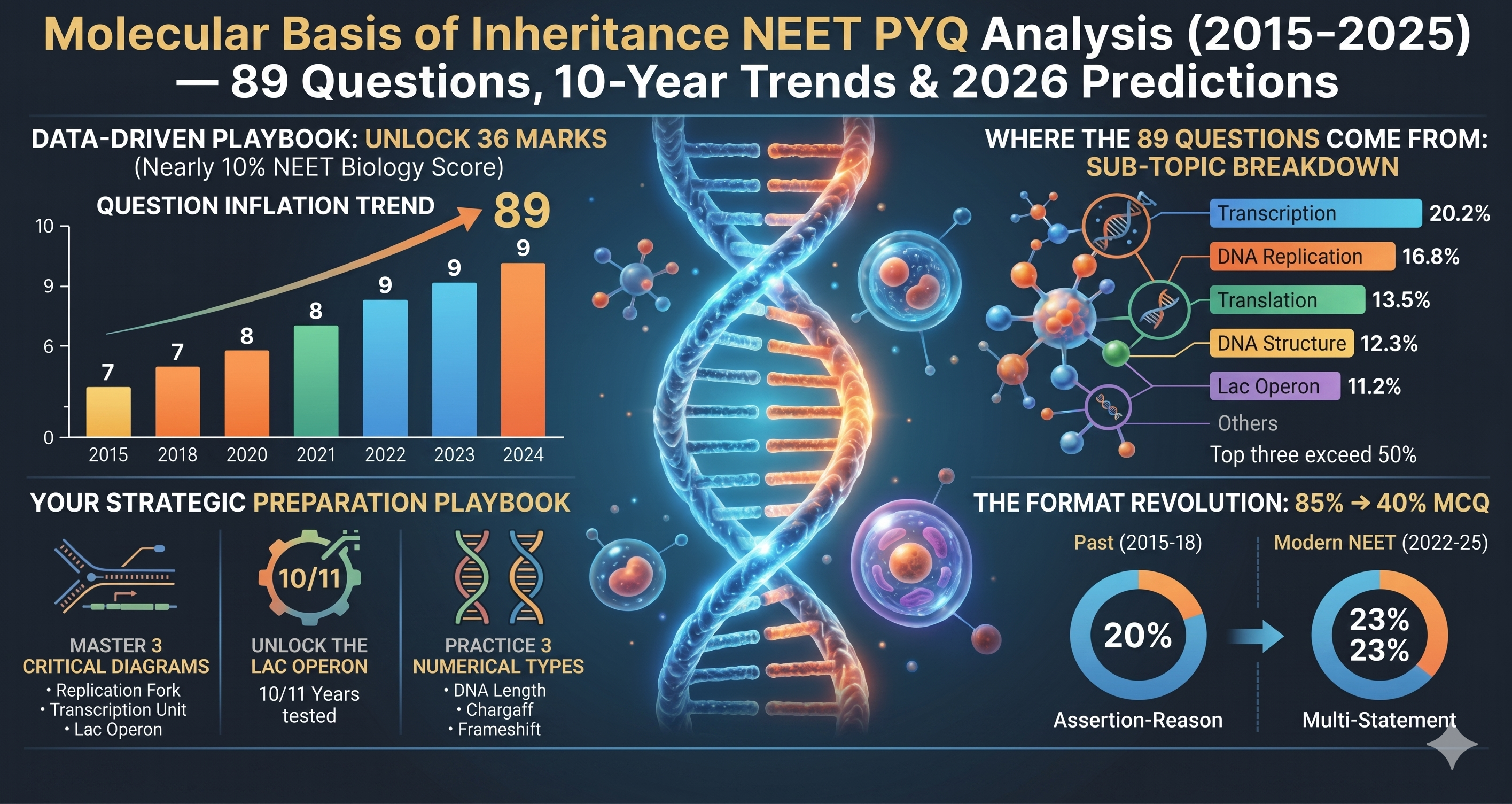
Introduction: Molecular Basis of Inheritance NEET PYQ Analysis — The Chapter Worth 36 Marks
One chapter. Nine questions. Thirty-six marks. Nearly 10% of your entire Biology score.
That's not a projection — that's what Molecular Basis of Inheritance has consistently delivered since 2022. No other chapter in the entire 32-chapter NEET Biology syllabus comes close.
We tracked all 89 questions NTA asked from this chapter across every NEET sitting from 2015 to 2025 — including Phase 2 exams, the COVID session, Odisha re-exam, and the 2024 re-examination. Then we broke each one down by sub-topic, format, difficulty, and year. What emerged is a clear playbook.
One pattern matters more than the rest: 20–25% of MBI questions require mental visualisation of NCERT diagrams — the replication fork, the transcription unit, the lac operon — even when no diagram is shown in the question. If those structures don't lock in from text alone, that gap is exactly what Logic Bloom's Playground is built for. Each chapter is broken into NCERT-aligned topic loops with interactive games, readings, videos, and NEET-format practice. Currently in beta. Free to start.
This is our fourth PYQ trend analysis in this series. The same methodology produced results for: Biomolecules PYQ Analysis, Cell: The Unit of Life PYQ Analysis, and Biological Classification PYQ Analysis.
The Numbers: 7 Questions Became 9
The chapter's weightage hasn't just been high — it's been growing.
| Year | Questions | Marks | Trend |
|---|---|---|---|
| 2025 | 9 | 36 | Plateau at max |
| 2024 + Re-exam | 9 | 36 | Stable at top |
| 2023 | 9 | 36 | Stable |
| 2022 | 9 | 36 | Jump year |
| 2021 | 8 | 32 | Stable |
| 2020 + Phase 2 | 8 | 32 | Increasing |
| 2019 + Odisha | 7 | 28 | Minor dip |
| 2018 | 8 | 32 | Increasing |
| 2017 | 8 | 32 | Increasing |
| 2016 + Phase 2 | 7 | 28 | Stable |
| 2015 + Re-test | 7 | 28 | Baseline |
From 7 questions in 2015–2016 to a locked-in 9 questions since 2022 — that's a 28% increase in question density over the decade. No other chapter has seen this kind of deliberate inflation by NTA.
| Rank | Chapter | Avg Qs / Year |
|---|---|---|
| 1 | Molecular Basis of Inheritance | 8.0–9.0 |
| 2 | Biotechnology: Principles & Processes | 4.7–6.0 |
| 3 | Cell Cycle and Cell Division | 4.4–4.6 |
| 4 | Biomolecules | 4.2–5.0 |
| 5 | Principles of Inheritance & Variation | 4.2–4.5 |
MBI generates nearly double the questions of the second-ranked chapter. If you're allocating equal study time to every chapter, you're making a mathematical error.
Where the 89 Questions Come From: Sub-Topic Breakdown
| Sub-topic | Questions | Share |
|---|---|---|
| Transcription | 18 | 20.2% |
| DNA Replication | 15 | 16.8% |
| Translation & Protein Synthesis | 12 | 13.5% |
| DNA Structure | 11 | 12.3% |
| Regulation of Gene Expression (Lac Operon) | 10 | 11.2% |
| Historical Experiments | 8 | 9.0% |
| Genetic Code & Mutations | 7 | 7.8% |
| DNA Packaging | 4 | 4.5% |
| Human Genome Project | 2 | 2.2% |
| DNA Fingerprinting | 2 | 2.2% |
The top three sub-topics — Transcription, DNA Replication, and Translation — account for over 50% of all questions. HGP and DNA Fingerprinting together produce only 4 questions in 10 years — students who spend hours memorising chromosome-wise gene counts are making a poor time investment.
What's Increasing in Frequency
Transcription enzymology: Not just "what is transcription" but specifically which RNA polymerase does what. RNA Pol I → rRNA, Pol II → hnRNA (mRNA precursor), Pol III → tRNA, 5S rRNA, snRNA. This three-way split has become a recurring test of precision.
Post-transcriptional modifications: Capping (methyl guanosine at 5' end), tailing (poly-A at 3' end), and splicing (intron removal) appeared in NEET 2025 as a multi-statement question. Expect this annually.
Lac operon dynamics: NTA doesn't test the definition anymore. It tests what happens when lactose is present vs absent, and the specific gene-to-protein mapping (z → β-galactosidase, y → permease, a → transacetylase).
Replication enzyme specificity: Helicase + DNA ligase are tested as a pair in multi-statement questions. The constraint that DNA Polymerase III can only synthesise in 5'→3' direction and needs an RNA primer is the logical foundation for leading vs lagging strand questions.
What's Decreasing in Frequency
Historical experiments as standalone questions: Griffith's experiment, Avery-MacLeod-McCarty — these were standalone MCQs in 2015–2017. Now they're compressed into match-the-column arrays where you recall four experiments to earn one question's marks.
RNA World Hypothesis and basic DNA structure facts ("DNA is double-stranded") — these appear mainly in re-exams but have mostly disappeared from the main sitting.
The Format Shift: 85% → 40%
| Format | 2015–2018 | 2022–2025 |
|---|---|---|
| Standard MCQ | 85% | 40% |
| Assertion-Reason | 2% | 20% |
| Multi-statement | 3% | 23% |
| Match the Column | 8% | 15% |
| Numerical | 2% | 2% |
Assertion-reason went from 2% to 20% — a 10× increase. This format is perfect for MBI because every molecular process has a causal chain. Example from NEET 2025: "Assertion: RNA can both store genetic info and catalyse reactions. Reason: DNA is chemically more stable and allows repair mechanisms." You need to understand why DNA replaced RNA as the primary genetic material — not just that it did.
The practical consequence: In a 9-question allocation from this chapter, expect 4–5 questions in assertion-reason or multi-statement format. That's 16–20 marks riding on your ability to evaluate biological causality, not recall isolated facts.
This is the gap most coaching material misses — heavy on standard MCQs, thin on assertion-reason and multi-statement evaluation. Logic Bloom's Playground breaks Molecular Basis of Inheritance into NCERT-aligned topic loops where each topic builds the underlying causal chain — replication direction, lac operon regulation, transcription unit polarity — and then drops you into NEET 2026-format questions on the same concepts. TarQ guides you through. Currently in beta. Free to start.
The 10 Concepts NTA Cannot Stop Testing
| 🎯 Top 10 Most Repeated MBI Concepts in NEET (2015–2025) | ||
|---|---|---|
| 1. | Post-transcriptional modifications — capping (5' methyl-G), tailing (3' poly-A), splicing (intron removal) | NCERT Page 111, Para 1 |
| 2. | Hershey-Chase experiment — ³²P labelled DNA entered bacteria, ³⁵S labelled protein stayed outside. Proved DNA is genetic material. | NCERT Page 101, Para 2 |
| 3. | Lac operon gene products — z→β-galactosidase, y→permease, a→transacetylase. Repressor (i gene) binds operator to block transcription. | NCERT Page 116, Para 3 |
| 4. | DNA dimensions — 0.34 nm between base pairs. Human genome = 3.3×10⁹ bp. Total length = bp × 0.34 nm. | NCERT Page 96, Para 2 |
| 5. | Eukaryotic RNA polymerase specificity — Pol I→rRNA, Pol II→hnRNA, Pol III→tRNA, 5S rRNA, snRNA | NCERT Page 111, Para 1 |
| 6. | DNA ligase seals Okazaki fragments — lagging strand synthesised discontinuously because polymerase only works 5'→3' | NCERT Page 106, Para 2 |
| 7. | Genetic code properties — triplet, degenerate, nearly universal, non-overlapping, non-ambiguous. AUG = start (Met). UAA/UAG/UGA = stop. | NCERT Page 112, Table 6.1 |
| 8. | Nucleosome structure — negatively charged DNA wraps around positively charged histone octamer (rich in lysine + arginine). H1 = linker histone. | NCERT Page 99, Para 1 |
| 9. | 23S rRNA as ribozyme — catalyses peptide bond formation in bacterial translation. Evidence for RNA world. | NCERT Page 115, Para 1 |
| 10. | Chargaff's rule — A=T, G=C. Purines=Pyrimidines. Used to calculate base percentages (if C=17%, then G=17%, A=33%, T=33%). | NCERT Page 97, Para 1 |
Every single concept maps to a specific paragraph on a specific page. NTA doesn't test "understanding of transcription" in the abstract — it tests whether you've read page 111, paragraph 1, and can verify five statements derived from those three sentences.
The Lac Operon: NEET's Most Predictable Question
The lac operon has appeared in some form in 10 out of 11 years analysed. It is the closest thing NEET has to a guaranteed question from any chapter. But the way it's tested has evolved dramatically:
| Era | Format & Complexity |
|---|---|
| 2015–2018 | "What does the i gene code for?" → Repressor protein. One fact, one mark. |
| 2019–2022 | Match the column — i, z, y, a genes matched to repressor, β-galactosidase, permease, transacetylase. Four facts, one mark. |
| 2023–2025 | Multi-statement evaluating the regulatory cascade: "In the presence of lactose, the repressor changes conformation and cannot bind the operator, allowing RNA polymerase to access the promoter..." Every clause verified independently. |
| 2026 prediction | Match-the-column linking genes to products AND functions, or multi-statement evaluating operon state under different glucose/lactose combinations. Prepare for both. |
Cross-Chapter Connections: Where MBI Becomes Inescapable
This chapter bleeds into more other chapters than any other in the syllabus. If you study MBI deeply, you're simultaneously preparing for 3–4 other chapters.
| Cross-Chapter Link | What It Tests | Example Connection |
|---|---|---|
| MBI + Biotechnology | PCR mechanics mirror replication enzymology | Thermal denaturation (PCR) = helicase function; primer annealing = primase; restriction enzymes rely on complementary base pairing |
| MBI + Principles of Inheritance | Molecular mechanism behind Mendelian disorders | Sickle cell anaemia: single nucleotide substitution (GAG→GUG, glutamic acid→valine) connected to autosomal recessive inheritance pattern |
| MBI + Cell Biology | Chromatin states bridging chapters | Heterochromatin and euchromatin (MBI) connect to nucleus structure; nucleolus as rRNA synthesis site bridges both chapters |
| MBI + Biomolecules | Bond chemistry at the molecular level | N-glycosidic bonds (base-to-sugar) and phosphodiester bonds (nucleotide-to-nucleotide) tested as MBI structure requiring Biomolecules-level chemistry |
| MBI + Evolution | RNA world molecular evidence | 23S rRNA as ribozyme connects MBI's molecular evidence to evolutionary theory about the origin of genetic material |
Hidden Diagram Dependency: 20–25% of Questions
Between 2022–2025, an estimated 20–25% of MBI questions required mental recall of specific NCERT diagrams — even when no diagram was shown in the question.
| Critical Diagram | What You Must Be Able to Visualise | Questions It Unlocks |
|---|---|---|
| The replication fork | Leading strand (continuous, toward fork) vs lagging strand (discontinuous, Okazaki fragments, away from fork) | DNA ligase, primase, 5'→3' constraint questions |
| The transcription unit | Promoter at 3' end of template strand (= 5' end of coding strand). Template strand reads 3'→5', coding strand is 5'→3'. Confusing orientations = #1 error source. | Strand polarity, promoter position, terminator questions |
| The lac operon schematic | Linear sequence: i gene → promoter → operator → z → y → a. Repressor binding to operator. Conformational change when lactose binds. | All operon state questions — impossible without spatial recall |
Numerical Questions: The MBI-Specific Trap
MBI is one of the few Biology chapters that generates genuine calculation questions — appearing roughly once per year and consistently at high difficulty.
| Type | Method | Appeared |
|---|---|---|
| DNA length calculation | Total length = base pairs × 0.34 nm. Example: 6.6×10⁹ bp → 6.6×10⁹ × 0.34 nm = 2.2 metres. | 2020 Phase 1; multiple variants |
| Chargaff's rule application | If C=17% → G=17%, then A+T = 66%, so A=T=33%. Four values from one given percentage. | 2015; recurring template |
| Frameshift mutation codon counting | Given 999 bases (333 amino acids), base 901 deleted: codons 1–300 unaffected; remaining 98 bases → 32 complete frameshifted codons + 1 incomplete = 33 altered codons. | NEET 2017 — considered one of the hardest Biology questions of the decade |
These are free marks for prepared students — mechanical calculations with no ambiguity — but only if you've practised the method beforehand. Most students skip them, making them high-discrimination questions that boost rank disproportionately.
NEET 2026 Predictions: What the Data Points To
Predicted format distribution: Standard MCQ ~40% (3–4 questions) | Assertion-Reason ~20% (2 questions) | Multi-statement ~23% (2 questions) | Match the Column ~15% (1 question) | Numerical ~2% (0–1 question).
That means 4–5 of the 9 questions will require evaluating multiple statements or causal relationships simultaneously.
Top 5 Sub-Topics Most Likely to Appear in 2026
| # | Predicted Topic | Why It's Due |
|---|---|---|
| 1 | Transcription and replication enzymology | Distinguishing DNA Pol I vs DNA Pol III, or testing the three eukaryotic RNA polymerases. The 5'→3' synthesis constraint is the logical backbone of at least one question per year. |
| 2 | Lac operon regulatory dynamics | Near-guaranteed. Likely format: match-the-column (genes → products) or multi-statement (operon state with/without lactose, with/without glucose). |
| 3 | Genetic code mathematics + frameshift mutations | Triplet code properties (degenerate, universal, non-overlapping) combined with a deletion/insertion calculation. Tests conceptual understanding and mathematical application simultaneously. |
| 4 | Nucleosome packaging and chromatin biochemistry | Histone octamer composition, positive charge from lysine/arginine, H1 linker role, euchromatin vs heterochromatin — absent for several sittings, due for a multi-statement return. |
| 5 | Post-transcriptional modifications | Tested in 2025; likely reinforced in 2026 with a more complex assertion-reason format linking capping/tailing/splicing to the functional significance of each modification. |
3 Concepts Due for a Return
| Concept | Last Tested | Likely Format |
|---|---|---|
| Avery, MacLeod & McCarty's biochemical proof | ~2018–2019 | Match-the-column: specific enzymes used (proteases, RNases, DNases) to prove DNA is the transforming principle |
| tRNA adaptor molecule architecture | Sporadically | Multi-statement: anticodon loop, amino acid acceptor end (3' CCA), and "charging" by aminoacyl-tRNA synthetase — undertested relative to NCERT coverage |
| VNTRs in DNA fingerprinting | Rarely standalone | Procedural sequencing question: isolation → digestion → electrophoresis → blotting → hybridisation → autoradiography |
How to Prepare: A Data-Driven Strategy
| 📌 Data-Driven Preparation Strategy — MBI NEET 2026 | |
|---|---|
| Spend disproportionate time here | MBI alone is worth as much as 3–4 other chapters combined. If you're giving every chapter equal hours, you're underinvesting here by roughly 50%. |
| Master the three NCERT diagrams from memory | Replication fork, transcription unit, and lac operon schematic. Practice drawing them from scratch until you can reproduce each in under 60 seconds. 20–25% of questions require this spatial recall. |
| Build causal chains, not flashcards | Why is replication semi-conservative? Why is the lagging strand discontinuous? Why does DNA polymerase need an RNA primer? Every "why" is a potential assertion-reason question. Understanding causality beats memorising outcomes. |
| Practice the three numerical types | DNA length calculation, Chargaff's rule percentages, and frameshift mutation codon counting. These are free marks if practised — but only if practised. Most students skip them and lose disproportionate rank. |
| Cross-link MBI to Biotechnology at every step | Every time you study a replication enzyme, ask: "How does PCR use this principle?" Every time you study base pairing, ask: "How do restriction enzymes exploit this?" These two chapters share more conceptual DNA than any other pair in the syllabus. |
| Read NCERT page 111 five times | Post-transcriptional modifications and RNA polymerase specificity — the two most-tested modern sub-topics — both come from this single page. It is the highest-density page in the entire MBI chapter. |
| Play through what isn't sticking | MBI is the highest-weightage chapter and the one most students try to brute-force through repeated NCERT reads. If lac operon regulation, replication direction, or the three RNA polymerases still feel like recitation rather than understanding, Logic Bloom's Playground breaks MBI into NCERT-aligned topic loops with interactive games for each, plus NEET-format practice. Currently in beta. Free to start. |
Conclusion: The Chapter That Decides Rank Gaps
In a competitive exam where the difference between a good rank and a great rank is often 5–10 marks, MBI is where those marks are hiding. Nine questions, 36 marks, a predictable topic distribution, and formats that are learnable with deliberate practice. Students who treat this chapter like any other chapter are leaving roughly 15 marks on the table. Students who treat it like the 10% of Biology it actually represents leave the exam with a genuine scoring advantage.
Done analysing? Now play, practice, or duel.
If concepts in MBI — lac operon regulation, the replication fork, the three RNA polymerases, the genetic code's properties, post-transcriptional modifications — still feel like memorisation rather than understanding, Logic Bloom's Playground breaks the chapter into NCERT-aligned topic loops. Each topic has an interactive game, a reading, a video, and timed NEET 2026-format questions: multi-statement, assertion-reason, match-the-column, all built from exact NCERT lines. Spaced revision blocks and boss challenges lock concepts in. TarQ guides you through. Currently in beta.
Or take it head-to-head: Battleground is our 1v1 real-time arena — challenge a classmate to an MBI duel, climb six ELO tiers from Bronze to Archeon, and lock in revision through competitive recall.
Understand through games. Score through practice. Free to start.
Start your MBI session on Logic Bloom →
FAQs — Molecular Basis of Inheritance NEET PYQ
Q1: How many questions come from Molecular Basis of Inheritance in NEET?
Molecular Basis of Inheritance is the single highest-weightage chapter in the entire NEET Biology syllabus. It generates an average of 8–9 questions per year, worth 32–36 marks. Since 2022, the count has stabilised at 9 questions per paper — approximately 10% of the total Biology score. No other individual chapter comes close to this yield.
Q2: Which sub-topics from MBI are tested most frequently in NEET?
Transcription (20.2%), DNA Replication (16.8%), and Translation (13.5%) are the top three, collectively accounting for over 50% of all MBI questions. The Lac Operon (11.2%) and DNA Structure (12.3%) complete the top five. HGP and DNA Fingerprinting are low-yield at roughly 2% each.
Q3: How often is the lac operon tested in NEET?
The lac operon has appeared in some form in 10 out of 11 years analysed (2015–2025) — a 91% hit rate, making it the most predictable topic in the entire chapter. Questions have evolved from simple "what does gene z code for" MCQs to complex multi-statement evaluations of operon regulatory states under different substrate conditions. It is effectively a guaranteed question every year.
Q4: Has the question format for MBI changed in recent NEET papers?
Dramatically. Standard MCQs dropped from 85% (2015–2018) to 40% (2022–2025). Assertion-reason surged from 2% to 20% — a 10× increase — and multi-statement formats rose from 3% to 23%. This means 4–5 of the expected 9 questions in NEET 2026 will require evaluating multiple biological statements or causal relationships simultaneously.
Q5: What numerical calculations should I prepare from MBI for NEET?
Three types: DNA length calculation (base pairs × 0.34 nm), Chargaff's rule percentage problems (if one base is given, calculate all four), and frameshift mutation codon counting (calculating how many codons are altered when a base is inserted or deleted). These appear roughly once per year and are high-discrimination questions — most students skip them, so getting them right significantly boosts rank.