Human Reproduction NEET PYQ (2015–2025) — Menstrual Cycle & Oocyte Trap
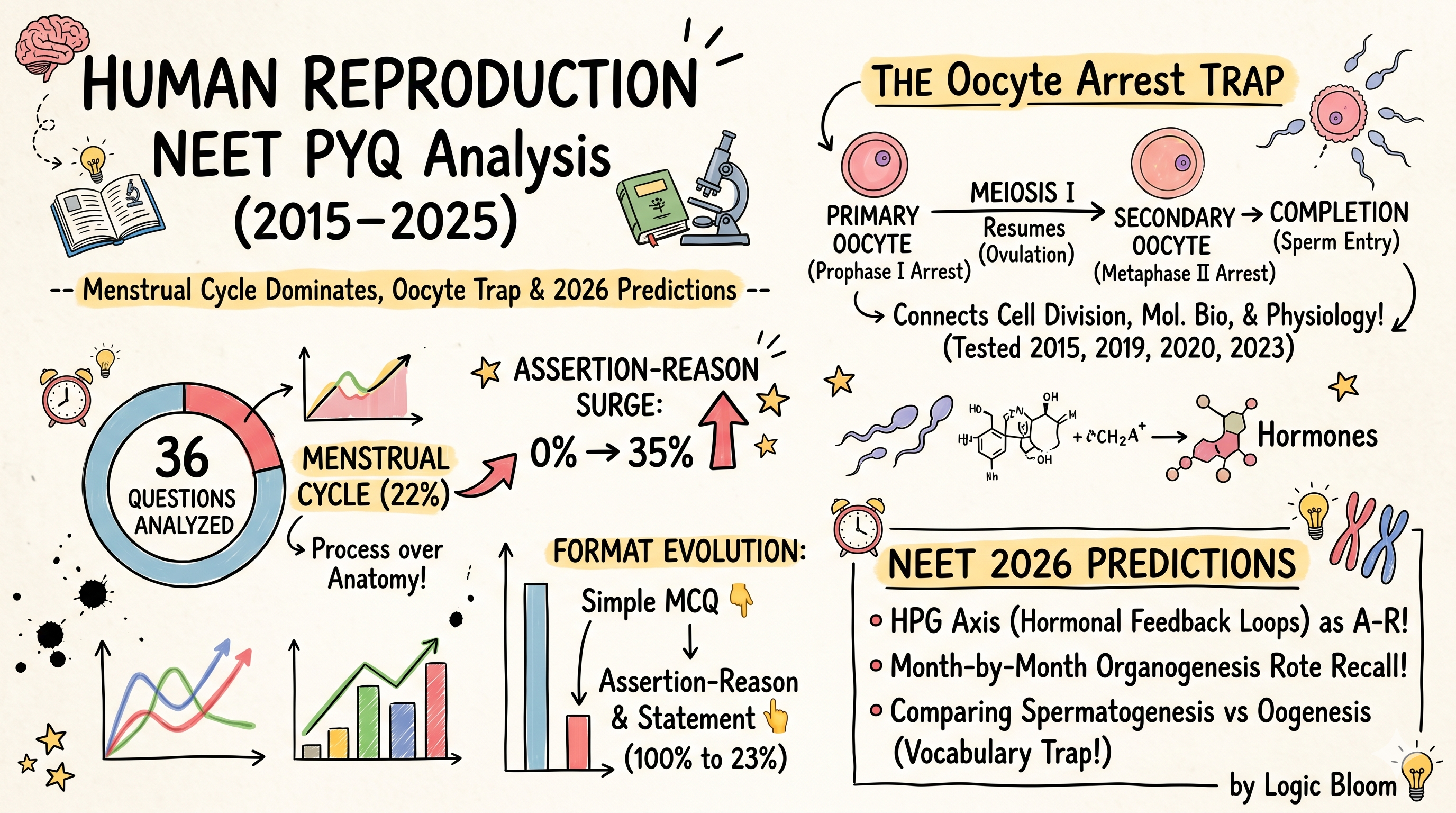
The oocyte arrest trap has appeared 4 times in 10 years — but didn't fire in NEET 2026. Gametogenesis and menstrual cycle confirmed instead. Does the trap return for Re-NEET? 36 PYQs say this.
Introduction: Human Reproduction NEET PYQ — The Chapter Where One Concept Bridges Three Chapters
Here's the question NTA keeps asking, year after year, in different disguises:
"When is Meiosis II of the secondary oocyte completed?"
It appeared in 2015, 2019, 2020, and 2023. Four times in ten years. But it's not really a Human Reproduction question — it simultaneously tests Cell Division (meiotic arrest mechanics), Molecular Biology (metaphase-promoting factor), and Reproductive Physiology (sperm entry as the trigger). One question, three chapters, zero room for isolated preparation.
We tracked 36 verified questions across every NEET sitting from 2015 to 2025. The menstrual cycle alone accounts for 22% of all questions, and the format has shifted from 100% standard MCQs to just 23% — with assertion-reason surging from zero to 35%.
This is our 8th PYQ trend analysis. Full series: Master weightage analysis — 394+ PYQs | MBI PYQ | Cell Cycle & Division PYQ | Principles of Inheritance PYQ
| 🎯 One question. Three chapters. Memorising won't cut it. | |
|---|---|
| The oocyte arrest question alone has bridged Cell Division, Human Reproduction, and Molecular Biology four times in ten years. Assertion-reason now decides 35% of marks in this chapter — the highest of any chapter in our series. Logic Bloom's Playground (BETA) breaks Human Reproduction into NCERT-aligned topic loops — interactive concept games, focused reading, and NEET-format question drills — with TarQ, your in-app mentor, walking you through every cascade in the HPG axis. | Master the HPG axis → Free to start. |
How Many Questions: The Reliable 4-Question Chapter
Human Reproduction ranks #4 in Class 12 Biology, consistently delivering 3–4 questions per standard sitting.
| Year | Questions | Notable |
|---|---|---|
| 2025 | 4 | Multi-statement on embryonic milestones + gametogenesis comparison |
| 2024 + Re-exam | 6 | Three assertion-reason questions in one chapter — unprecedented |
| 2023 | 5 | HPG axis sequencing + menstrual cycle statements |
| 2022 | 4 | Spermiogenesis vs spermiation trap + oogenesis onset |
| 2021 | 3 | Zona pellucida receptors, relaxin source, parturition |
| 2020 | 2 | Meiosis II completion trigger + hormone-organ matching |
| 2019 | 2 | Polar body extrusion + sperm pathway |
| 2018 | 3 | Placental hormones + menstrual phase matching |
| 2016 | 2 | GnRH regulation + fertilisation site |
| 2015 | 3 | Meiosis II arrest + ovulation hormones + corpus luteum |
The Reproduction mega-unit: Human Reproduction (7.2%) + Reproductive Health (6.8%) + Sexual Reproduction in Flowering Plants (5.1%) + Reproduction in Organisms = roughly 20% of the entire Class 12 Biology paper. Mastering the hormonal and cellular principles in Human Reproduction directly boosts accuracy in all three companion chapters.
Sub-Topic Frequency: The Menstrual Cycle Reigns
| Sub-topic | Questions | Share |
|---|---|---|
| Menstrual Cycle | 8 | 22.2% |
| Hormonal Regulation (HPG axis) | 7 | 19.4% |
| Fertilization Mechanics | 6 | 16.6% |
| Male Reproductive System | 4 | 11.1% |
| Gametogenesis (Comparative) | 3 | 8.3% |
| Spermatogenesis | 2 | 5.5% |
| Embryonic Development | 2 | 5.5% |
| Female Reproductive System | 2 | 5.5% |
| Parturition and Lactation | 2 | 5.5% |
| Placenta and Pregnancy | 2 | 5.5% |
The top three — Menstrual Cycle, Hormonal Regulation, and Fertilization — account for 58% of all questions. NTA tests Human Reproduction as a dynamic hormonal system, not a structural diagram. Embryonic Development jumped from near-zero to multi-statement format in both 2024 and 2025 — a new testing frontier demanding precise month-by-month organogenesis recall.
What's Increasing in Frequency
Assertion-reason on hormonal feedback loops: The HPG axis (hypothalamus → GnRH → pituitary → FSH/LH → gonads → testosterone/estrogen/progesterone → feedback) has become NTA's favourite assertion-reason template. The 2024 trap: "Assertion: FSH acts on follicles AND Leydig cells" (FALSE — FSH acts on Sertoli cells, LH acts on Leydig cells).
Embryonic developmental timelines: Month-by-month organogenesis appeared in both 2024 and 2025 as multi-statement questions — pure rote timeline memorisation rewarding students who know NCERT's specific milestones.
Comparative gametogenesis: NTA now tests oogenesis vs spermatogenesis against each other — when each begins, whether meiosis is continuous or arrested, and which produces equal vs unequal daughter cells.
What's Decreasing in Frequency
Basic anatomical identification ("Name this part of the ovary") and simple hormone naming ("Which hormone is secreted by the corpus luteum?") have nearly vanished — these facts are now embedded in process-based questions or serve as traps in match-the-column formats.
The Format Shift: 100% → 23% MCQ
| Format | 2015–2018 | 2022–2025 |
|---|---|---|
| Standard MCQ | 100% | 23% |
| Assertion-Reason | 0% | 35% |
| Multi-statement | 0% | 29% |
| Match the Column | 0% | 12% |
Assertion-reason went from 0% to 35% — the highest proportion we've seen for this format in any chapter across our entire PYQ series. Human Reproduction is uniquely suited for A-R because every hormonal relationship is a cause-and-effect chain. "Assertion: Endometrium disintegrates during menstruation. Reason: Corpus luteum degenerates, cutting progesterone supply." These require multi-step causal reasoning, not recall.
| ⚠️ Assertion-reason at 35% — the highest of any chapter. | |
|---|---|
| Standard MCQs collapsed from 100% to 23%. Over 60% of Human Reproduction questions now require evaluating cause-and-effect chains across multiple statements — old question banks won't train you for this. Logic Bloom's Playground (BETA) drills assertion-reason and multi-statement formats inside NCERT-aligned topic loops, with TarQ mentoring you through the causal logic NTA actually tests. | Drill cause-and-effect → Free to start. |
The Oocyte Arrest Trap: NTA's Favourite Cross-Chapter Weapon
This concept has been tested 4 times (2015, 2019, 2020, 2023) and is the single most important cross-chapter bridge in NEET Zoology.
The biology: Primary oocytes begin meiosis during fetal development but arrest at Prophase I (Diplotene/Dictyotene stage) — the same sub-stage detailed in our Cell Cycle PYQ analysis. At ovulation, Meiosis I resumes, producing a secondary oocyte that immediately arrests again at Metaphase II. Meiosis II only completes when a sperm enters.
| Year | How NTA Asked It | The Trap |
|---|---|---|
| 2015 | "In human females, meiosis-II is not completed until?" | Students who answer "ovulation" instead of "fertilisation" |
| 2019 | "Extrusion of second polar body occurs?" | Students who confuse polar body formation with oocyte maturation |
| 2020 | "Meiotic division of secondary oocyte is completed?" | Same concept, rephrased — tests whether students memorised the answer or understood the mechanism |
| 2023 | "Meiotic division of the secondary oocyte is completed at the time of?" | Exact repeat of 2020 format — students who didn't understand still lose marks |
One question tests three chapters simultaneously: Cell Division (which stage is the arrest at?), Human Reproduction (what triggers completion?), and Molecular Biology (what cellular mechanism holds the arrest — metaphase-promoting factor). If you understand this concept deeply, you get 4 marks for free every 2–3 years.
The Spermiogenesis vs Spermiation Semantic Trap
This has appeared 3 times (2018, 2022, 2024) and is a pure vocabulary trap.
| Term | Definition | Common Confusion |
|---|---|---|
| Spermiogenesis | Morphological transformation of round spermatids into streamlined spermatozoa — head formation, acrosome development, middle piece mitochondria arrangement, tail growth. No cell division. | Students think this is the process from spermatogonia → sperm (it's from spermatid → sperm only) |
| Spermiation | The physical release of mature spermatozoa from Sertoli cells into the lumen of seminiferous tubules. | Students confuse with spermiogenesis (morphogenesis) or epididymal maturation |
The 2022 trap: "Statement II: Spermiogenesis is the formation of sperms from spermatogonia" (FALSE — spermiogenesis is from spermatids). One wrong word, 4 marks lost.
The 10 Concepts NTA Returns To
| 🎯 Top 10 Most Repeated Human Reproduction Concepts in NEET (2015–2025) | ||
|---|---|---|
| 1. | Meiosis II completion triggered by sperm entry | 4× | Trap: students answer "ovulation" instead of "fertilisation" |
| 2. | Spermiogenesis vs spermiation distinction | 3× | Confusing morphogenesis with release |
| 3. | Sperm transport pathway sequence | 2× | Trap: missing rete testis or vasa efferentia |
| 4. | Placental hormones (hCG, hPL, estrogen, progesterone) | 2× | Trap: confusing relaxin (ovary source) with placental hormones |
| 5. | Gametogenesis temporal differences (fetal vs puberty onset) | 2× | Trap: assuming both oogenesis and spermatogenesis start at puberty |
| 6. | Corpus luteum → progesterone → endometrial maintenance | 2× | Trap: not linking corpus luteum degeneration to menstruation onset |
| 7. | Embryonic milestones (heart at 4 wks, limbs at 8 wks, genitalia at 12 wks, eyelids at 24 wks) | 2× | Month-by-month confusion — must know exact weeks, not approximate months |
| 8. | FSH → Sertoli cells; LH → Leydig cells | 2× | Swapping target cells is the trap — FSH ≠ Leydig, LH ≠ Sertoli |
| 9. | Fertilisation site = ampullary-isthmic junction | 2× | Trap: students select uterine fundus or ovary |
| 10. | Colostrum contains IgA antibodies | 1× | Trap: confusing passive immunity (IgA via colostrum) with active immunity |
Cross-Chapter Connections
| Cross-Chapter Link | What It Tests | Example |
|---|---|---|
| Human Reproduction + Cell Cycle & Division | Meiotic arrest mechanics bridging chapters | Primary oocyte arrested at Dictyotene (Prophase I sub-stage). Secondary oocyte arrested at Metaphase II until sperm entry. |
| Human Reproduction + Principles of Inheritance | Oogenesis errors → chromosomal disorders | Extended meiotic arrest in older females → increased non-disjunction risk during delayed Anaphase I → trisomy 21 |
| Human Reproduction + Chemical Coordination | HPG axis as a unified neuroendocrine circuit | GnRH from hypothalamus → FSH/LH from anterior pituitary → testosterone/estrogen from gonads → negative feedback. Spans two chapters. |
| Human Reproduction + Reproductive Health | Luteal phase → contraceptive mechanism | Luteal phase progesterone → oral contraceptive action. Sperm pathway anatomy → vasectomy procedure. Colostrum → passive immunity → Human Health & Disease. |
| Human Reproduction + MBI | S-phase replication during spermatogonia multiplication | DNA replication during S phase of spermatogonia mitosis connects reproductive physiology to molecular genetics. |
NEET 2026 Predictions: What the Data Points To
Predicted format distribution: Assertion-Reason ~30% (1–2 questions — HPG axis, corpus luteum function) | Multi-statement ~30% (1 question — gametogenesis comparison or embryonic milestones) | Standard MCQ ~25% (1 question — basic pathway or identification) | Match the Column ~15% (0–1 question — hormone-organ matching)
Top 5 Sub-Topics Most Likely to Appear in 2026
| # | Predicted Topic | Why It's Due |
|---|---|---|
| 1 | Menstrual cycle hormonal interplay | 22% historical hit rate — near-guaranteed. Focus on luteal phase mechanics: progesterone from corpus luteum maintains endometrium; corpus luteum degeneration → progesterone withdrawal → menstruation. |
| 2 | Comparative gametogenesis | Accelerating trend. Multi-statement contrasting oogenesis (fetal onset, discontinuous, unequal cytoplasmic division) with spermatogenesis (puberty onset, continuous, equal division). |
| 3 | Fertilization mechanics | Meiosis II completion trigger (4× tested) will return. The acrosomal reaction, zona pellucida binding, and cortical reaction are all high-probability sub-topics. |
| 4 | Embryonic development timelines | Following 2024 and 2025 precedent: heart (4 weeks), limbs (8 weeks), external genitalia (12 weeks), eyelids (24 weeks), hair (5 months). Likely format: match-the-column or multi-statement. |
| 5 | Male accessory gland secretions | Specific biochemical contributions — seminal vesicles (fructose), prostate (calcium, enzymes), bulbourethral glands (lubrication) — underrepresented and statistically overdue for match-the-column. |
3 Concepts Due for a Return
| Concept | Last Tested | Likely Format |
|---|---|---|
| Ploidy tracking through spermatogenesis | Sporadic | 2n→2n→n→n through primary spermatocyte → secondary spermatocyte → spermatid, with DNA content tracking (4C→2C→C). Combines Cell Division math with reproductive physiology. |
| Blastocyst architecture | Rarely primary focus | Inner cell mass (forms embryo) vs trophoblast (forms placenta + implantation). This distinction hasn't been the primary focus recently — overdue. |
| Parturition mechanism — fetal ejection reflex | ~2021 | Oxytocin → uterine contraction → more oxytocin → positive feedback loop. Assertion-reason format likely — mechanism tests causal chain reasoning. |
Predicted Cross-Chapter Combinations for 2026
| Combination | What to Prepare |
|---|---|
| Human Reproduction + Inheritance + Cell Division | Multi-statement linking extended oocyte meiotic arrest in older females → increased non-disjunction risk during delayed Anaphase I → trisomy 21 (Down syndrome). Three chapters, one question, one trap. |
| HPG axis hormonal graph (implicit diagram) | Not as a direct labelling question — but as implicit visual recall needed for an assertion-reason. "Assertion: LH and FSH surge just before ovulation. Reason: Rising estrogen from the developing follicle triggers positive feedback on the pituitary." Requires mentally visualising the NCERT hormonal graph. |
| Oocyte arrest from Human Reproduction angle | Near-certain. "At what stage are primary oocytes arrested before puberty?" with traps offering Metaphase I, Metaphase II, or Anaphase I. Answer: Diplotene of Prophase I. |
How to Prepare Based on the Data
| 📌 Data-Driven Preparation Strategy — Human Reproduction NEET 2026 | |
|---|---|
| Master the HPG axis as a single connected circuit | Don't study GnRH, FSH, LH, testosterone, estrogen, and progesterone as separate hormones. Study them as a cascade: hypothalamus → pituitary → gonads → feedback. When NTA asks an assertion-reason about one link, you need to instantly see the whole chain. |
| Know the oocyte arrest timeline cold | Primary oocyte: arrested at Prophase I (Diplotene/Dictyotene) during fetal life. Secondary oocyte: arrested at Metaphase II. Completion: triggered by sperm entry. This three-stage arrest sequence is worth 4 marks every 2–3 years. |
| Memorise embryonic milestones as a timeline, not a list | Heart = 4 weeks. Limbs = 8 weeks. External genitalia = 12 weeks. Eyelids = 24 weeks. Hair = 5 months. NTA tests these as multi-statement verification — you confirm or deny each milestone independently. |
| Distinguish spermiogenesis from spermiation — permanently | Spermiogenesis = shape change (spermatid → spermatozoon, no division). Spermiation = release from Sertoli cells into seminiferous tubule lumen. Write these on a flashcard and never confuse them again. |
| Cross-link with Cell Division and Inheritance | Every fertilisation question tests meiosis completion — revisit the Cell Cycle PYQ analysis. Every oocyte arrest discussion connects to chromosomal disorders via Principles of Inheritance. See the complete picture in our master weightage analysis. |
| Train the format daily — solo, then in duels | Use Logic Bloom Playground (BETA) topic loops on the HPG axis cascade, oocyte arrest timeline, gametogenesis comparison, and embryonic milestones — with TarQ, your in-app mentor, walking you through every cause-and-effect link. Then test causal recall against another aspirant in Battleground 1v1 duels for spaced retention. Open Logic Bloom → |
Conclusion: The Chapter That Rewards Causal Thinking
Human Reproduction is where NTA tests whether you understand biology or merely know it. The assertion-reason format at 35% — the highest of any chapter in our series — is a direct signal: the exam wants causal reasoning, not recall. Why does the endometrium disintegrate? Why does ovulation require an LH surge? Why does Meiosis II only complete at fertilisation? Students who can answer the "why" chain, not just the "what," will outperform those who memorised the outcome without understanding the mechanism.
Done analysing? Now play, practice, or duel.
36 PYQs. One oocyte arrest question that bridges three chapters. Assertion-reason at 35%. You've seen the data — now turn it into causal-chain reflexes, solo or against another aspirant in real time.
| 🎯 Logic Bloom — Built for the NEET 2026 you actually face | |
|---|---|
| 🎮 Playground (BETA) Solo practice with TarQ, your in-app mentor |
NCERT-aligned topic loops covering the HPG axis cascade (GnRH → FSH/LH → testosterone/estrogen/progesterone → feedback), the oocyte arrest timeline (Diplotene/Dictyotene → Metaphase II → sperm-triggered completion), spermiogenesis vs spermiation distinction, comparative gametogenesis (oogenesis fetal onset vs spermatogenesis puberty onset), placental hormones (hCG, hPL, relaxin, estrogen, progesterone), embryonic milestones (heart at 4 weeks, limbs at 8, genitalia at 12, eyelids at 24), fertilisation site mechanics (ampullary-isthmic junction), and the spermatogenesis ploidy chain. Each loop pairs interactive concept games with focused reading and NEET-format practice — assertion-reason, multi-statement, match-the-column. Open the Playground → |
| ⚔️ Battleground 1v1 real-time duels |
Challenge a friend or get matched live. 10 timed questions per match across Physics, Chemistry, Biology — JEE Main + Advanced + NEET aligned. ELO climbs through 6 tiers: Bronze → Silver → Gold → Platinum → Diamond → Archeon. Friend challenges, the Throne system, and post-match explainers convert every wrong answer into long-term recall. Enter the Battleground → |
|
Open Logic Bloom → Understand through games. Score through practice. Free to start. |
|
FAQs — Human Reproduction NEET PYQ
Q1: How many questions come from Human Reproduction in NEET?
Human Reproduction averages 3–4 questions per year in NEET, contributing approximately 12–16 marks. It ranks #4 among Class 12 Biology chapters with a 7.2% weightage. The combined Reproduction unit (Human Reproduction + Reproductive Health + Sexual Reproduction in Flowering Plants + Reproduction in Organisms) accounts for approximately 20% of the entire Class 12 Biology paper.
Q2: What is the most tested sub-topic from Human Reproduction in NEET?
The Menstrual Cycle is the most tested at 22.2%, followed by Hormonal Regulation / HPG axis (19.4%) and Fertilization Mechanics (16.6%). Together these three process-oriented sub-topics account for 58% of all Human Reproduction questions.
Q3: What is the oocyte arrest trap in NEET?
NTA has tested meiotic arrest 4 times (2015, 2019, 2020, 2023). Primary oocytes arrest at Prophase I (Diplotene/Dictyotene) during fetal life and remain arrested until ovulation. Secondary oocytes then arrest at Metaphase II until sperm entry triggers completion. This single concept tests Human Reproduction, Cell Division, and Molecular Biology simultaneously.
Q4: How has the question format changed for Human Reproduction in NEET?
Standard MCQs dropped from 100% (2015–2018) to just 23% (2022–2025). Assertion-reason surged from 0% to 35% — the highest proportion of any chapter in our analysis series. Multi-statement evaluation rose from 0% to 29%. Over 60% of Human Reproduction questions now require evaluating multiple statements or causal relationships simultaneously.
Q5: What is the difference between spermiogenesis and spermiation in NEET?
This semantic trap has appeared 3 times (2018, 2022, 2024). Spermiogenesis is the morphological transformation of round spermatids into streamlined spermatozoa — no cell division occurs. Spermiation is the physical release of mature spermatozoa from Sertoli cells into the seminiferous tubule lumen. NTA swaps these terms in multi-statement traps to catch students who haven't memorised the precise distinction.