Biotech Applications NEET PYQ — 45% From Just 2 Concepts
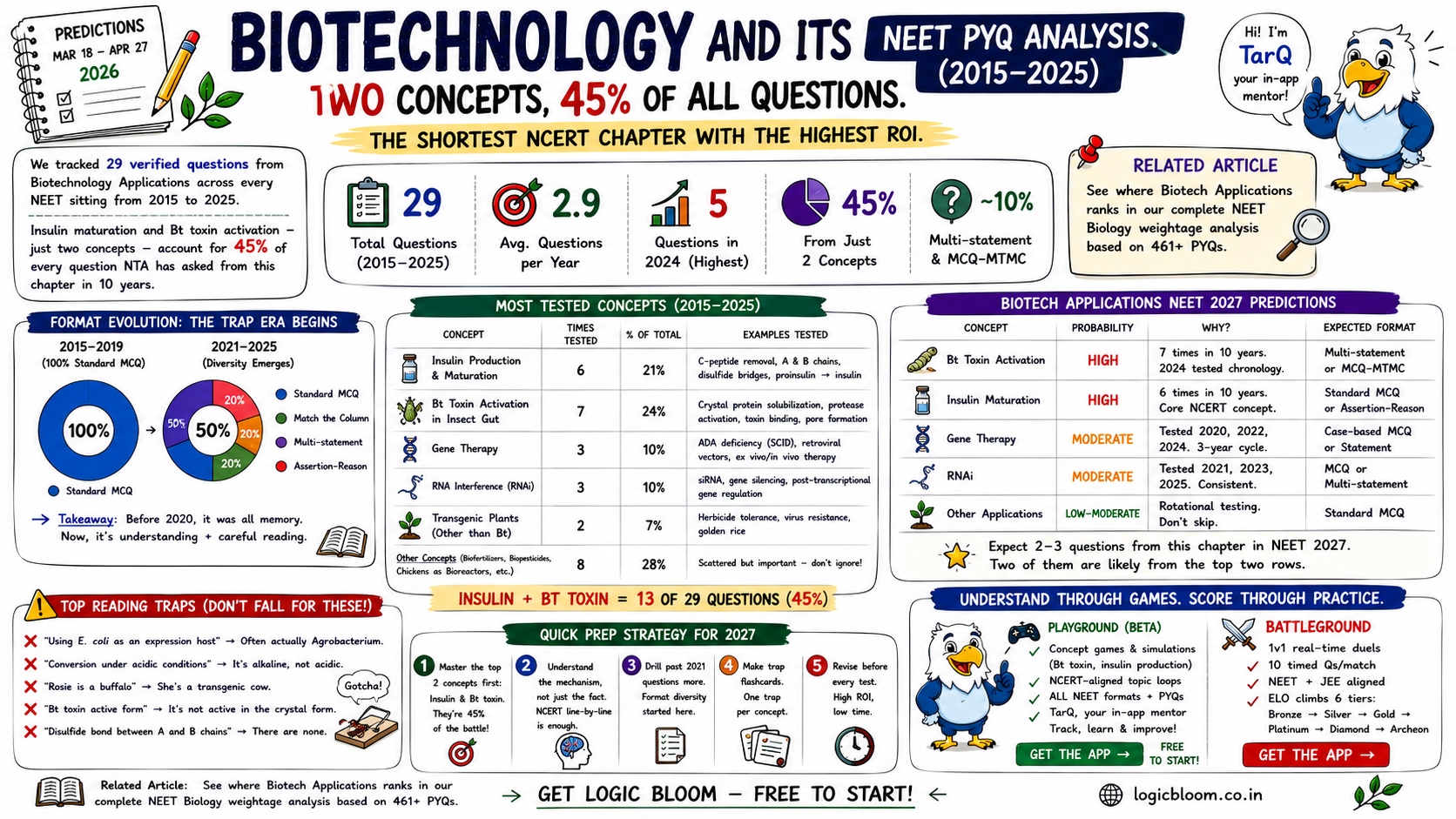
29 Biotech Applications PYQs analyzed. Insulin + Bt toxin = 45% of all questions. 100% MCQ before 2020, now half are statement traps. NTA's 3 single-word swaps exposed. Rescheduled 2026 update.
Introduction: The Shortest NCERT Chapter With the Highest ROI
Here's the number that should reshape how you allocate study time for this chapter:
Insulin maturation and Bt toxin activation — just two concepts — account for 45% of every question NTA has asked from Biotechnology Applications in 10 years.
That's not a loose pattern. It's a structural feature of the exam. The chapter is barely 8 pages in NCERT. But those 8 pages reliably deliver 2-3 questions per year — and in 2024, NTA pulled 5 questions from this chapter alone, including a multi-step chronological sequencing question on the Bt toxin cascade that most coaching modules don't prepare students for.
This is our 10th PYQ analysis, and it completes the Genetics + Biotechnology cluster — the same cluster that contributed 21% of NEET 2026. We've already published analyses for Principles of Inheritance, Molecular Basis of Inheritance, and Biotechnology: Principles and Processes. This article closes the loop.
| 🎯 100% of this chapter was standard MCQ before 2020. Now half the questions are statement-based traps. | |
|---|---|
| NTA swaps "E. coli" for "Agrobacterium," flips "alkaline" to "acidic," and calls Rosie a "buffalo" instead of a cow. These aren't hard concepts — they're reading traps. Logic Bloom's Playground (BETA) lets you play through Bt toxin and insulin simulations with TarQ, your in-app mentor — understand the mechanism first, then the traps can't catch you. | Get the app → Free to start. |
How Many Questions: 2-3 Baseline, But 2024 Surged to 5
| Year | Questions | Context |
|---|---|---|
| 2025 | 2 | RNAi molecular trigger + insulin host organism |
| 2024 + Re-exam | 5 | Peak year — Bt mechanism sequencing, insulin trap, GEAC assertion-reason |
| 2023 + Manipur | 2 | Molecular diagnostics + application mapping |
| 2022 | 3 | Gene therapy limitations, insulin C-peptide, Rosie trap |
| 2021 | 1 | The "Rosie is a buffalo" reading trap |
| 2020 + Phase 2 | 3 | Insulin bonds, GEAC, Bt source organism |
| 2019 | 3 | Bioprospecting, RNAi, Golden Rice |
| 2018 | 2 | Biopiracy + insulin disulfide bridges |
| 2017 | 1 | Low-yield year |
| 2016 + Phase 2 | 3 | Gene therapy, RNAi root target, glyphosate tolerance |
| 2015 | 3 | Bt activation, Golden Rice, first recombinant hormone |
Average: 2-3 questions per year. But 2024 broke the ceiling with 5 questions across the main and re-exam sittings. Combined with Biotechnology Principles (4-5 questions), the complete Biotech unit delivers 7-8 questions annually — roughly 18-19% of the Zoology paper from just two short chapters.
The return on time invested is extraordinary. Chapter 12 is 8 pages in NCERT. That's 8 pages for 2-5 guaranteed questions. No other chapter in Biology offers this ratio.
Sub-Topic Frequency: Two Concepts Dominate Everything
| Sub-topic | Questions (10 yr) | Share |
|---|---|---|
| Insulin Production (proinsulin, C-peptide, disulfide bonds) | 7 | 24.1% |
| Bt Crops (Cry proteins, toxin activation, pest specificity) | 6 | 20.7% |
| Gene Therapy (ADA deficiency, lymphocyte lifespan) | 4 | 13.8% |
| RNA Interference (dsRNA, Meloidogyne incognita) | 4 | 13.8% |
| GM Organisms / Transgenic Animals | 3 | 10.3% |
| Transgenic Plants for Food | 3 | 10.3% |
| Bioethics & GEAC | 2 | 6.9% |
| Biopiracy & Patents | 2 | 6.9% |
Insulin Production + Bt Crops = 44.8% of all questions. Add Gene Therapy and RNAi, and four sub-topics account for 72.4% of everything NTA has ever asked from this chapter. The concentration is extreme — and it means your study time should be equally concentrated.
What's Increasing in Frequency
Mechanistic depth on Bt toxin. In 2015, NTA asked what activates the protoxin (alkaline pH — one fact). By 2024, NTA asked students to arrange the full Bt toxin cascade in chronological order: Cry protein synthesis → inactive protoxin → alkaline gut solubilisation → midgut epithelial binding → pore formation → cell lysis. Same concept, six-step sequencing. The depth escalation is unmistakable.
Insulin post-translational processing. Questions evolved from "Who made recombinant insulin?" (Eli Lilly, 2015) → "What bonds link the A and B chains?" (disulfide, 2018) → "What is removed during maturation?" (C-peptide, 2022) → "Was it produced in Agrobacterium or E. coli?" (E. coli — Agrobacterium is the trap, 2024). Each year tests a deeper layer of the same mechanism.
Transgenic animals for medicine. Alpha-1-antitrypsin (for emphysema treatment) appeared in the 2024 match-the-column. Rosie the cow and human alpha-lactalbumin appeared in 2021 and 2022. Medical applications of transgenic animals are surging as NTA exhausts the simpler agricultural applications.
What's Decreasing or Fading
Surface-level Golden Rice questions are gone. "Golden Rice has Vitamin A" was tested in 2015 and 2019. Since then, the concept hasn't returned as a standalone question. If it returns, expect it embedded in a multi-statement alongside other transgenic crops — not as a one-line MCQ.
Biopiracy definitions are fading. "What is biopiracy?" appeared in 2018 and "What is bioprospecting?" in 2019. Neither concept has been the focus of a primary paper question since. These are now reserve-list items — easy marks when they appear, but not reliable enough to prioritise.
The Format Shift: 100% → 50% Standard MCQ
| Format | 2015–2019 | 2020–2025 |
|---|---|---|
| Standard MCQ | 100% | ~50% |
| Multi-statement (Statement I & II) | 0% | ~27% |
| Match the Column | 0% | ~14% |
| Assertion-Reason | 0% | ~5% |
| Sequencing / Chronology | 0% | ~5% |
Before 2020, every single question from this chapter was a standard MCQ. Since 2022, nearly half are complex formats — multi-statement, match-the-column, assertion-reason, or sequencing. The chapter didn't get harder in content. It got harder in how the content is delivered.
The multi-statement format is especially dangerous here because this chapter's NCERT text contains precise qualifying words that NTA can swap. "Alkaline" becomes "acidic." "E. coli" becomes "Agrobacterium." "Cow" becomes "buffalo." Each swap is a single-word substitution that turns a correct statement into a trap — and catching it requires having understood the mechanism, not just memorised the fact.
| 🎯 NTA's three favourite single-word swaps in this chapter — and they've used each one multiple times | |
|---|---|
| "Acidic" instead of alkaline. "Agrobacterium" instead of E. coli. "Buffalo" instead of cow. These aren't knowledge problems — they're understanding problems. If you understand why the gut must be alkaline, you'll catch the swap every time. Logic Bloom's Playground (BETA) walks you through the Bt toxin and insulin mechanisms as interactive simulations with TarQ — so you understand the why before you face the trap. Then test yourself under pressure on Battleground — 1v1 timed duels where Biotech questions hit at exam speed. | Play the simulation → Free to start. |
The NCERT Trap: This Chapter's Signature Weapon
Most NEET Biology chapters test knowledge. Biotechnology Applications tests reading precision. NTA has developed a specific trap architecture for this chapter: take a correct NCERT statement, change exactly one word, and present it as Statement I or Statement II. Students who memorised the fact from a summary sheet get caught. Students who understood the mechanism catch the swap instantly.
The three documented NCERT traps and how they've evolved:
| The Trap | What NCERT Says | What NTA Swaps | Why Understanding Beats Memorisation |
|---|---|---|---|
| The pH Trap Tested: 2015, 2024, 2024 Re-exam |
"The inactive protoxin gets converted into active form due to the alkaline pH of the gut" (Page 208) | "Bt toxin is activated due to acidic pH of insect gut" | Students assume all guts are acidic (like human stomach). Insect midgut is alkaline. If you've simulated the Bt cascade, you know alkaline solubilisation is the trigger — the swap is obvious. |
| The Host Organism Trap Tested: 2024, 2025 |
"Eli Lilly... introduced them in plasmids of E. coli to produce insulin chains" (Page 211) | "DNA sequences for A and B insulin chains were introduced in Agrobacterium" | Students associate Agrobacterium with biotech generally (it's a plant vector in Chapter 11). But insulin is a human protein — it needs a bacterial host, not a plant vector. Understanding the logic catches the swap. |
| The Taxonomy Trap Tested: 2021, 2022 |
"The first transgenic cow, Rosie, produced human protein-enriched milk" (Page 213) | "The first transgenic buffalo Rosie..." | Students recognise "Rosie" and skip the species. If you know Rosie produced human alpha-lactalbumin (a cow milk protein modified for human nutrition), "buffalo" immediately sounds wrong. |
The pattern is clear. NTA doesn't test whether you know the facts from this chapter. NTA tests whether you can catch a single-word substitution under time pressure. The defence isn't more memorisation — it's deeper understanding of the underlying mechanism.
The 10 Concepts NTA Returns To
| 🎯 10 Most Repeated Biotech Applications Concepts in NEET (2015–2025) | ||
|---|---|---|
| 1. | Bt toxin activation via alkaline pH | Tested 3 times. Page 208. Protoxin → alkaline gut → crystal solubilisation → pore formation. |
| 2. | Insulin C-peptide removal (proinsulin → mature insulin) | Tested 3 times. Page 211. C-peptide absent in mature insulin. |
| 3. | RNAi silencing via complementary dsRNA | Tested 3 times. Page 209. "Silencing of a specific mRNA due to a complementary dsRNA molecule." |
| 4. | Insulin A & B chains linked by disulfide bridges (not hydrogen bonds) | Tested 3 times. Page 211. The "hydrogen bonds" swap is NTA's favourite chemistry trap. |
| 5. | Gene therapy limitation: lymphocytes are not immortal | Tested 2 times. Page 211. "The patient requires periodic infusion." |
| 6. | Cry protein pest specificity (Cry1Ac = bollworm, Cry1Ab = corn borer) | Tested 2 times. Page 209. The Roman numeral and suffix distinction is the trap. |
| 7. | GEAC — Genetic Engineering Approval Committee | Tested 2 times. Page 213. Now tested within assertion-reason constructs. |
| 8. | Insulin host organism: E. coli (not Agrobacterium) | Tested 2 times. Page 211. The Agrobacterium swap is NTA's most effective recent trap. |
| 9. | Rosie the cow — human alpha-lactalbumin in milk | Tested 2 times. Page 213. The "buffalo" swap is a reading comprehension test. |
| 10. | Molecular diagnostics superiority (ELISA/PCR vs serum/urine analysis) | Tested 2 times. Page 212. "Early detection is not possible" with conventional methods. |
Cross-Chapter Connections: Where Biotech Applications Bridges Other Chapters
This chapter functions as a hub — NTA uses it to connect concepts from across the Class 11 and 12 syllabus. If you prepare this chapter in isolation, you miss the connections that drive the hardest questions.
| Cross-Chapter Link | What It Tests | Example |
|---|---|---|
| Biotech Applications + Biotech Principles | Recombinant DNA technology applied to insulin production | Using restriction enzymes + vectors to insert human insulin gene into E. coli plasmid |
| Biotech Applications + MBI | Central dogma → RNAi interruption point | dsRNA binds mRNA, physically preventing ribosomal translation |
| Biotech Applications + Biomolecules | Protein structure: disulfide bonds in insulin | 2020 trap: "A and B chains linked by hydrogen bonds" (False — disulfide bridges) |
| Biotech Applications + Inheritance | Genetic modification in Mendelian context | Transgenic organisms as applied genetics |
| Biotech Applications + Human Health | ADA deficiency bridges immunology | Gene therapy questions require understanding T-lymphocyte function and immune degradation |
NEET 2027 Predictions: What the Data Points To
Predicted Format Distribution
| Format | Predicted Share |
|---|---|
| Multi-statement (Statement I & II) | ~35% |
| Standard MCQ | ~30% |
| Match the Column | ~20% |
| Assertion-Reason | ~10% |
| Sequencing / Chronology | ~5% |
Top 5 Sub-Topics Most Likely to Appear
| # | Predicted Topic | Why It's Due |
|---|---|---|
| 1 | Insulin post-translational modification | The C-peptide removal step and disulfide bond formation are NTA's most reliable testing ground in this chapter. 7 appearances in 10 years — virtually guaranteed. |
| 2 | Bt toxin activation cascade | The full sequencing (protoxin → alkaline pH → solubilisation → pore formation → lysis) was tested in 2024 Re-exam. Expect an assertion-reason version where Statement II provides the wrong pH trigger. |
| 3 | ADA deficiency gene therapy — limitations focus | NTA is shifting from "What happened in 1990?" to "Why do lymphocytes need periodic infusion?" Expect a statement evaluating somatic vs embryonic stem cell permanence. |
| 4 | RNAi mechanism — dsRNA as trigger | Tested in 2019 and 2025. The depth is increasing — expect a question connecting RNAi to the central dogma: dsRNA binding mRNA to prevent translation. |
| 5 | Transgenic animals as bioreactors | Alpha-1-antitrypsin appeared in 2024 match-the-column. Rosie appeared in 2021-2022. Medical applications of transgenic mammals are trending sharply upward. |
3 Concepts Due for a Return
| Concept | Last Tested | Likely Format |
|---|---|---|
| Biopiracy — Basmati Rice patent case | ~2018-2019 | Standard MCQ or multi-statement. The legal framework around Indian biological resource exploitation is overdue. |
| Golden Rice biofortification (daffodil gene for β-carotene) | ~2019 | Multi-statement pairing Golden Rice with other transgenic crops. The specific botanical source (daffodil) is the trap element. |
| Molecular diagnostics — ELISA/PCR vs serum/urine | ~2023 | Statement I & II: "Conventional serum analysis enables early diagnosis" (False — ELISA/PCR does). |
Predicted Cross-Chapter Combinations
Biotech Applications + Microbes in Human Welfare: Bacillus thuringiensis classified simultaneously as a natural biocontrol agent (Microbes chapter) and as the source of the engineered Cry gene (Biotech chapter). A match-the-column pairing both applications is high probability.
Biotech Applications + MBI (Central Dogma): Assertion-reason linking DNA → mRNA → Protein with the exact interruption point of RNAi — dsRNA binding mRNA to physically prevent ribosomal translation.
Gene Therapy + Human Immunology: ADA deficiency combined with T-lymphocyte maturation. Why does ADA loss paralyse the immune response? This forces dual-chapter application of immunology and biotech knowledge.
3 Specific NTA Traps to Watch For
Cry protein designation swap: "Cry1Ab controls cotton bollworms" (False — it controls corn borer). The Roman numeral and suffix are the only difference between the two genes. Memorise: Cry1Ac = cotton bollworm. Cry1Ab = corn borer.
RNAi domain trap: "RNA interference is a cellular defence mechanism in prokaryotes" (False — NCERT explicitly states it occurs in eukaryotic organisms only).
Insulin host organism trap: "Eli Lilly used Agrobacterium to commercially produce human insulin" (False — E. coli). This exact trap appeared in 2024 and will return because it's so effective.
How to Prepare Based on the Data
| 📌 Data-Driven Preparation Strategy for Biotech Applications NEET 2027 | |
|---|---|
| Allocate 45% of your time to insulin and Bt toxin | These two concepts account for 45% of all questions from this chapter. Know the full insulin maturation pathway (proinsulin → C-peptide removal → A + B chains → disulfide bonds) and the full Bt toxin cascade (Cry gene → protoxin → alkaline pH → crystal solubilisation → midgut pore → lysis). |
| Memorise Cry protein designations as mnemonics | Cry1Ac = cotton bollworm (Ac = Ac-tual cotton). Cry1Ab = corn borer (Ab = corn cob). Cry2Ab also targets cotton bollworms. The Roman numeral + suffix system is NTA's favourite micro-trap. |
| Read NCERT Chapter 12 as a legal document | The "buffalo" trap, the "acidic pH" trap, the "Agrobacterium" trap — every one of these exploits students who read summary notes instead of the exact NCERT text. 8 pages. Read every word. |
| Connect this chapter to the rest of the Biotech cluster | Insulin production uses the same restriction enzymes and vectors from Chapter 11. RNAi connects to MBI's central dogma. Disulfide bonds connect to Biomolecules protein structure. Study the cluster as one connected unit. |
| Practice statement-swap detection specifically | Take each of the 10 most-repeated concepts above. Write the correct NCERT statement. Then write one version with a single word changed. Practice catching the change in under 10 seconds. This is the exact skill NEET 2027 will test. |
| Understand the mechanisms through simulation, then duel to score | The Bt toxin cascade and insulin maturation pathway are easier to remember when you've seen them play out visually. Logic Bloom's Playground (BETA) walks you through these mechanisms as interactive simulations with TarQ — play to understand the concept, then take that understanding into Battleground — 1v1 duels where Biotech questions hit under real time pressure. Free to start. |
Done analysing? Now play, practice, or duel.
| 🎯 The Genetics + Biotech cluster = 21% of NEET 2026. This article completes the set. | |
|---|---|
| 🎮 Playground (BETA) Understand through games — with TarQ, your in-app mentor |
Play through interactive simulations that make Biotech mechanisms stick: watch the Bt toxin cascade unfold step-by-step (protoxin → alkaline gut → pore formation), trace insulin maturation from proinsulin to functional hormone, and see how dsRNA silences mRNA in the RNAi pathway. Each chapter map pairs concept games with readings and MCQs — understand first, then answer. Get the app → |
| ⚔️ Battleground Score through practice — 1v1 real-time duels |
Take the concepts you understood in Playground and test them under pressure. Challenge a friend or get matched live. 10 timed questions per match across Physics, Chemistry, Biology — JEE Main + Advanced + NEET aligned. ELO climbs through 6 tiers: Bronze → Silver → Gold → Platinum → Diamond → Archeon. Get the app → |
| Understand through games. Score through practice. Get Logic Bloom — Free to start → |
|
FAQs — Biotechnology Applications NEET PYQ
Q1: How many questions come from Biotechnology Applications in NEET?
Biotechnology Applications averages 2-3 questions per year, with a peak of 5 questions in 2024 (across main exam and re-exam). Combined with Biotechnology Principles (4-5 questions), the full Biotech unit delivers 7-8 questions annually — approximately 18-19% of the Zoology paper from just two short NCERT chapters.
Q2: What are the most tested concepts from Biotechnology Applications in NEET?
The top four most tested concepts are: Bt toxin activation via alkaline pH (3 times), insulin C-peptide removal during maturation (3 times), RNAi silencing via complementary dsRNA (3 times), and insulin chain linkage via disulfide bridges (3 times). Together, insulin production and Bt crops account for 45% of all questions from this chapter across 10 years.
Q3: Has the question format changed for Biotechnology Applications in NEET?
Drastically. Between 2015-2019, 100% of questions from this chapter were standard MCQs. Since 2020, approximately half are complex formats — multi-statement (27%), match-the-column (14%), assertion-reason (5%), and chronological sequencing (5%). The NTA uses single-word substitutions in statements to create traps that test reading precision under time pressure.
Q4: What is the Bt toxin activation mechanism tested in NEET?
NTA tests the complete cascade: Bacillus thuringiensis produces Cry proteins as inactive protoxin crystals. When ingested by the target insect, the alkaline pH of the insect midgut (not acidic — this is the most common trap) solubilises the crystals into active toxin. The toxin binds to midgut epithelial cells, creates pores, causes cell lysis and death. NTA has tested this at increasing depth — from single-fact recall (2015) to full chronological sequencing (2024).
Q5: How should I prepare Biotechnology Applications differently from Biotechnology Principles?
Principles (Chapter 11) tests the tools — restriction enzymes, vectors like pBR322, PCR, gel electrophoresis. Applications (Chapter 12) tests what those tools produce — Bt crops, recombinant insulin, gene therapy, RNAi. The key difference: Applications questions increasingly test mechanisms and traps (single-word NCERT substitutions), while Principles questions test spatial recall and process ordering. Prepare both as one connected unit since NTA designs cross-chapter questions that bridge tool and application.