Ecosystem NEET PYQ — 31 Questions Exposed, 83% Format Shift
GPP−R=NPP tested 5 times — but never the same way twice. The year-by-year trap evolution table, the 10 concepts NTA returns to, and why Ecology's 14-question surge changes your Re-NEET strategy.
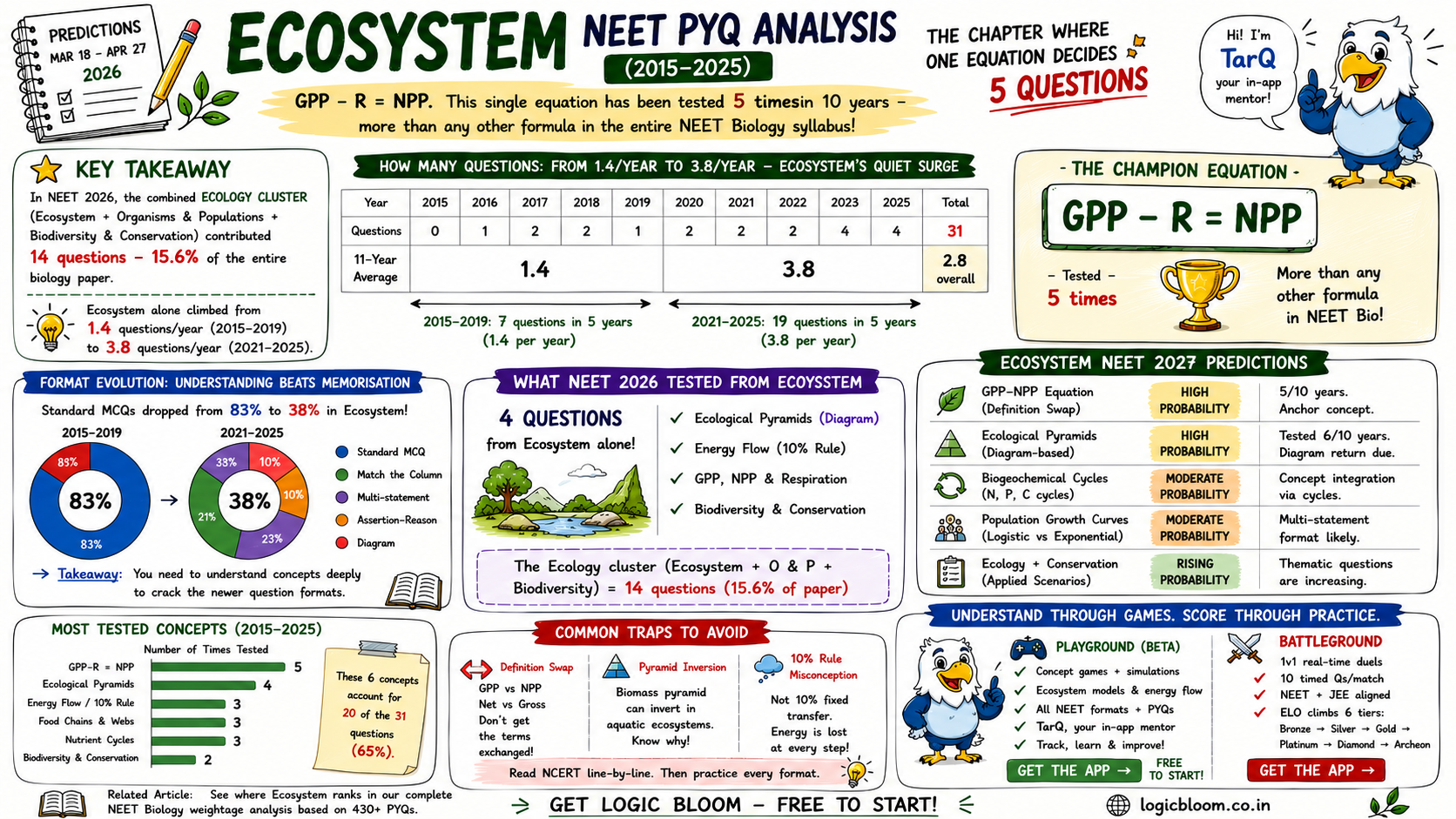
Introduction: One Equation, Five Appearances, Ten Years
GPP − R = NPP.
That single equation has been tested 5 times in 10 years — more than any other formula in the entire NEET Biology syllabus. NTA asks it as a standard MCQ. As a statement-based trap. As an algebraic substitution. As a definitional swap where "Net" and "Gross" are silently exchanged in the question stem. Every time, students who read the NCERT line once get it right. Students who memorised it from a summary sheet get caught by the linguistic variation.
But here's the number that changes everything about how you should prepare: in NEET 2026, the combined Ecology cluster (Ecosystem + Organisms and Populations + Biodiversity and Conservation) contributed 14 questions — 15.6% of the entire biology paper. Ecosystem alone went from averaging 1.4 questions per year in 2015-2019 to 3.8 questions per year in 2021-2025.
This is our first Ecology PYQ analysis — opening a new cluster to match the Ecology surge we documented in our NEET 2026 paper analysis. We tracked 31 verified questions from the Ecosystem chapter across every NEET sitting from 2015 to 2025, and the patterns are unmistakable.
| 🎯 Standard MCQs dropped from 83% to 38% in Ecosystem — understanding beats memorisation now | |
|---|---|
| You can't spot a GPP-NPP definition swap if you only memorised the formula. You need to understand why GPP is always greater than NPP. Logic Bloom's Playground (BETA) lets you play through ecosystem simulations — watch energy flow drop at each trophic level, see pyramids invert in real time — with TarQ, your in-app mentor, guiding you through the concept before you face the questions. | Get the app → Free to start. |
How Many Questions: From 1.4/Year to 3.8/Year — Ecosystem's Quiet Surge
Ecosystem didn't explode overnight. It climbed steadily, and most students haven't noticed because it happened gradually.
| Year | Questions | Context |
|---|---|---|
| 2025 | 4 | NMC revised syllabus era — sustained high count |
| 2024 + Re-exam | 6 | Peak year — main (4) + re-exam (2) |
| 2023 | 3 | Decomposition multi-statement introduced |
| 2022 | 3 | Statement-based format arrives for this chapter |
| 2021 | 3 | Section A/B expansion — more room for Ecology |
| 2020 + Phase 2 | 2 | Pandemic era |
| 2019 | 1 | Single standard MCQ |
| 2018 | 1 | Inverted pyramid numerical |
| 2017 | 1 | Standing crop definition |
| 2016 + Phase 2 | 2 | Tansley + chemosynthetic bacteria |
| 2015 | 2 | Standing crop + secondary succession |
2015-2019 average: 1.4 questions/year. 2021-2025 average: 3.8 questions/year. That's a 2.7x increase. The NMC syllabus rationalization removed Ecological Succession and Nutrient Cycling from the active syllabus — but instead of reducing the chapter's weightage, NTA deepened it. Fewer sub-topics, more questions per sub-topic.
Combined with the Ecology cluster's 14-question showing in NEET 2026, Ecosystem has graduated from a "last-week revision" chapter to a Tier 1 scoring zone that demands the same preparation intensity as Molecular Basis of Inheritance or Principles of Inheritance.
Sub-Topic Frequency: Three Pillars Carry 65% of the Chapter
| Sub-topic | Questions (10 yr) | Share |
|---|---|---|
| Productivity (GPP, NPP) | 8 | 25.8% |
| Ecological Pyramids | 6 | 19.4% |
| Energy Flow (10% law, food chains) | 6 | 19.4% |
| Decomposition | 4 | 12.9% |
| Specific Ecosystems / Standing Crop | 4 | 12.9% |
| Nutrient Cycling | 1 | 3.2% (dropped from syllabus) |
| Ecological Succession | 1 | 3.2% (dropped from syllabus) |
| Ecosystem Services | 1 | 3.2% |
Productivity + Pyramids + Energy Flow = 64.5% of all Ecosystem questions. These three sub-topics are the mathematical and conceptual pillars of the chapter. If you master the GPP-NPP equation, the 10% energy transfer law, and the conditions for pyramid inversion, you've covered nearly two-thirds of everything NTA asks.
The syllabus shift matters. Ecological Succession and Nutrient Cycling were removed by the NMC rationalization. They haven't appeared in a single question since. That freed-up question space went entirely to Decomposition and Energy Flow — deeper testing of fewer topics, not broader coverage.
What's Increasing in Frequency
Decomposition mechanics surged from zero questions in 2015-2019 to 4 questions in 2020-2025. NTA doesn't test "what is decomposition?" — it tests the exact sequential steps: Fragmentation → Leaching → Catabolism → Humification → Mineralisation. The 2023 multi-statement question required students to verify five independent claims about these steps. Confusing fragmentation (physical, by earthworms) with catabolism (enzymatic, by fungi) was the specific trap.
Statement-based formats on Productivity replaced standard MCQs entirely. The GPP-NPP equation now appears as Statement I/II traps where "Net" and "Gross" definitions are silently swapped. The 2025 question explicitly substituted the NPP definition into the GPP label — catching students who recognized the formula shape without reading the qualifier.
Energy transfer calculations evolved from simple forward calculations (apply 10% three times) to backward calculations (given apex predator energy, calculate producer energy by multiplying by 10 repeatedly). The 2024 re-exam question demanded both the 10% law AND the GPP-NPP distinction simultaneously.
What's Decreasing or Gone
Ecological Succession is functionally dead. Xerosere, hydrosere, lithosere, seral stages — none of it has been tested since the syllabus rationalization. Don't spend a single hour on succession for NEET 2027.
Nutrient Cycling (carbon, phosphorus, nitrogen cycles) is gone. The detailed biogeochemical cycles were removed from the active NCERT. One question appeared historically; zero since rationalization.
Historical scientist questions are fading. "A.G. Tansley coined the term ecosystem" appeared in 2016; "Ramdeo Misra is the father of Indian Ecology" in 2025. These are easy marks when they appear, but they're becoming rarer — NTA prefers mechanistic testing over biographical recall.
The Format Shift: 83% → 38% Standard MCQ
| Format | 2015–2018 | 2022–2025 |
|---|---|---|
| Standard MCQ | 83% | 38% |
| Statement-based (I & II) | 0% | 31% |
| Match the Column | 0% | 13% |
| Multi-statement | 0% | 6% |
| Numerical / Diagram-based | 17% | 13% |
Statement-based questions went from 0% to 31%. This format is specifically engineered for Ecosystem because the chapter's NCERT text contains precise qualifying words — "always," "only," "generally," "not exempt" — that NTA can swap or negate to create traps. A student who knows the GPP-NPP relationship vaguely will fail when Statement II replaces "Net" with "Gross" in the definition.
NTA calls this the "time-tax." A statement-based question requires reading and verifying two independent biological claims — doubling the cognitive load per question compared to a standard MCQ. For a chapter that contributes 3-4 questions, that's 6-8 independent fact-checks under time pressure.
| 🎯 GPP − R = NPP has been tested 5 times — but never the same way twice | |
|---|---|
| NTA swaps definitions, reverses the equation, substitutes terms. Memorising the formula won't save you — you need to understand why R can never be zero. Logic Bloom's Playground (BETA) walks you through ecosystem energy simulations with TarQ — see where respiration drains energy at every level, then face the statement-swap questions that catch students who only memorised. Once you understand, duel it out on Battleground — 1v1 timed matches where Ecology questions hit under real exam pressure. | Play the simulation → Free to start. |
The GPP-NPP Trap: NEET's Most Repeated Ecosystem Weapon
This single equation deserves its own section because no other concept in the Ecosystem chapter — or arguably in all of NEET Ecology — has been tested with this frequency and variation.
The NCERT line: "Gross primary productivity minus respiration losses (R), is the net primary productivity (NPP)." — Page 243.
How NTA has weaponised it across 5 appearances:
| Year | How NTA asked it | The trap |
|---|---|---|
| 2019 | Pick the correct equation from four options: GPP+NPP=R, NPP−R=GPP, GPP−R=NPP, NPP−GPP=R | Students who memorised the shape but not the direction get caught by reversed versions |
| 2020 | "Which statement is correct regarding GPP and NPP?" | The correct answer — "GPP is always more than NPP" — tests whether you understand R as a biological tax that can never be zero |
| 2021 | "In the equation GPP−R=NPP, R represents?" | Straightforward, but repeated — NTA wants to anchor this as a guaranteed fact |
| 2023 | Same question as 2021 — "R here is ______" | Exact repeat. NTA is testing whether students in 2023 prepared from 2021 PYQs |
| 2025 | Statement I: Solar energy is primary source (True). Statement II: "The rate of production of organic matter by photosynthesis is called NPP" (False — that's GPP) | The most sophisticated version. NTA swapped "Gross" for "Net" in the definition, catching students who read "productivity" and stopped reading |
The evolution is clear. In 2019, NTA tested whether you knew the formula. By 2025, NTA tested whether you could catch a definitional swap inside a statement-evaluation format. Same concept, five difficulty levels, one trap architecture: linguistic substitution under time pressure.
The Inverted Pyramid: The Counter-Intuitive Concept NTA Loves
The inverted pyramid of biomass in aquatic ecosystems has appeared 3 times — making it the second most tested concept after the GPP equation.
Why it's counter-intuitive: In a terrestrial ecosystem, producers (trees, grasses) have the most biomass, and each successive trophic level has less. The pyramid is upright. In an aquatic ecosystem, phytoplankton (producers) have less standing biomass than the fish that eat them — because phytoplankton reproduce so fast that their standing crop at any given moment is small, even though their total productivity is enormous. The pyramid inverts.
The 2021 trap: "Which of the following is NOT correct?" — the incorrect option was "Pyramid of biomass in sea is generally upright." Students who assumed all pyramids are upright got caught. The pyramid of energy is always upright (thermodynamics guarantees it). The pyramid of biomass inverts in aquatic ecosystems. Confusing the two is exactly what NTA engineers.
The 2018 numerical: Given biomass data (Secondary consumer: 120g, Primary consumer: 60g, Producer: 10g), identify the pyramid type. The data shows biomass increasing upward — an inverted pyramid. Students who assumed the data must form an upright pyramid didn't read the numbers.
The 10 Concepts NTA Returns To
| 🎯 10 Most Repeated Ecosystem Concepts in NEET (2015–2025) | ||
|---|---|---|
| 1. | GPP − R = NPP (the equation) | Tested 5 times. Page 243. Most repeated single concept in this chapter. |
| 2. | Inverted pyramid of biomass in aquatic ecosystems | Tested 3 times. Page 248. Phytoplankton turnover rate creates the inversion. |
| 3. | Lignin and chitin slow decomposition | Tested 3 times. Page 244. "Slower if detritus is rich in lignin and chitin." |
| 4. | Unidirectional energy flow + 2nd law of thermodynamics | Tested 2 times. Page 245. "Ecosystems are not exempt from the Second Law." |
| 5. | Lindeman's 10% energy transfer law | Tested 2 times. Page 246. Both forward and backward calculations. |
| 6. | Decomposition steps: Fragmentation → Leaching → Catabolism → Humification → Mineralisation | Tested 2 times. Page 243. The sequential order is the tested element. |
| 7. | Pyramids don't accommodate food webs or saprophytes | Tested 2 times. Page 248. Limitations of ecological modeling. |
| 8. | Standing crop = mass of living material at a trophic level at a particular time | Tested 2 times. Page 246. Distinct from "standing state" (inorganic nutrients). |
| 9. | Units of productivity: (kcal m⁻²) yr⁻¹ | Tested 1 time. Page 243. Dimensional analysis — energy per area per time. |
| 10. | Ramdeo Misra = Father of Ecology in India | Tested 1 time. Pre-chapter biography. Easy mark when it appears. |
Cross-Chapter Connections: Where Ecosystem Bleeds Into Other Chapters
NEET 2026's 14-question Ecology allocation means NTA can no longer test chapters in isolation. The examiner is actively dissolving chapter boundaries within the Ecology cluster.
| Cross-Chapter Link | What It Tests | Example |
|---|---|---|
| Ecosystem + Organisms & Populations | Trophic levels governed by population interactions | Inverted pyramid of numbers in a parasitic food chain — one tree supports thousands of parasites |
| Ecosystem + Biodiversity & Conservation | Ecosystem services linked to biodiversity | Robert Costanza's $33 trillion valuation relies on intact biodiversity |
| Ecosystem + Photosynthesis | GPP fundamentally bound to photosynthetic efficiency | Plants capture only 2-10% of PAR — a bridging concept |
| Ecosystem + Biological Classification | Decomposition by fungi and bacteria | Catabolism and mineralisation stages performed by specific microbial genera |
| Ecosystem + Environmental Issues | Eutrophication spikes primary productivity | Cultural eutrophication → algal blooms → ecosystem collapse |
NEET 2027 Predictions: What the Data Points To
Predicted Format Distribution
| Format | Predicted Share |
|---|---|
| Statement-based (I & II) | ~35% |
| Standard MCQ | ~30% |
| Match the Column | ~15% |
| Numerical / Diagram-based | ~15% |
| Multi-statement | ~5% |
Top 5 Sub-Topics Most Likely to Appear
| # | Predicted Topic | Why It's Due |
|---|---|---|
| 1 | GPP vs NPP dynamics | Virtually guaranteed. Allows both definitional testing and algebraic manipulation. Tested 5 times already — no sign of stopping. |
| 2 | Decomposition mechanics (FLCHM sequence) | With succession removed, decomposition absorbs the testing load. Expect a multi-statement requiring verification of each step's definition. |
| 3 | Energy flow — 10% law calculation | The only reliable numerical calculation source in Botany. A multi-step problem (solar radiation → PAR → GPP → 10% transfer) is highly probable. |
| 4 | Pyramid inversion (biomass in aquatic vs energy always upright) | Counter-intuitive concepts are NTA's favourite assertion-reason targets. The biomass-energy distinction is perfect for this format. |
| 5 | Pyramid limitations (food webs and saprophytes excluded) | Tested twice but absent recently. The theoretical limitation that pyramids can't model complex food webs is overdue. |
3 Concepts Due for a Return
| Concept | Last Tested | Likely Format |
|---|---|---|
| Photosynthetically Active Radiation (PAR) | Not directly tested recently | Multi-step numerical: incident radiation → PAR (less than 50%) → captured by plants (2-10%) → GPP → NPP |
| Standing crop vs standing state | ~2015 | Statement I & II trap. Standing crop = living biomass. Standing state = inorganic nutrients. Linguistic similarity is the weapon. |
| Costanza's $33 trillion ecosystem services estimate | Not tested in 2020-2025 | Match the Column: percentage breakdown (50% soil formation, 6% climate regulation, etc.) |
Predicted Cross-Chapter Combinations
Ecosystem + Plant Physiology: How stomatal closure during water stress directly reduces GPP of a terrestrial ecosystem — testing productivity through a physiology lens.
Ecosystem + Microbes in Human Welfare: A multi-statement requiring identification of specific fungal or bacterial genera responsible for catabolism and mineralisation stages of decomposition.
Ecosystem + Biodiversity: How the extinction of a keystone species alters energy flow and destabilises ecological pyramids within a defined habitat.
Will a Pyramid Diagram Appear?
High probability. Expect NTA to provide an unlabelled inverted pyramid and ask the candidate to identify both the ecosystem type (aquatic) and the parameter being measured (biomass). The trap: students who assume all pyramids are upright will misidentify the diagram.
Predicted Numerical Question
A multi-step energy calculation: given incident solar radiation → calculate PAR → apply 2-10% capture rule for GPP → subtract R for NPP → apply 10% law for secondary consumer. This tests three concepts in a single numerical — exactly the escalation trend we've tracked across all PYQ blogs.
How to Prepare Based on the Data
| 📌 Data-Driven Preparation Strategy for Ecosystem NEET 2027 | |
|---|---|
| Memorise GPP − R = NPP as a three-part concept, not a formula | Know the equation. Know that GPP is always greater than NPP. Know the exact NCERT definition of each term. NTA tests all three independently. |
| Master decomposition as FLCHM — a fixed sequence | Fragmentation (physical, by detritivores) → Leaching (water-soluble nutrients go into soil) → Catabolism (enzymatic, by fungi/bacteria) → Humification (dark amorphous humus forms) → Mineralisation (humus → inorganic nutrients). Know which agent does which step. |
| Know three pyramid inversions cold | Biomass: inverted in aquatic (phytoplankton turnover). Numbers: inverted in tree ecosystem (one tree, many insects, more parasites). Energy: NEVER inverted (thermodynamics). The energy-biomass distinction is the trap. |
| Practice statement-swap detection | The 2025 GPP-NPP trap worked by swapping one word in a definition. Practice reading NCERT definitions and spotting when a qualifier has been changed — this is the core skill for statement-based questions. |
| Don't study succession or nutrient cycling for NEET 2027 | Removed from syllabus. Zero questions since rationalization. Reallocate that time to decomposition and energy flow. |
| Understand through simulations, then score through duels | The 10% law and GPP-NPP dynamics are hard to internalise from text alone. Logic Bloom's Playground (BETA) lets you play through ecosystem simulations — build food chains, watch energy drain at each trophic level, see why R can never be zero — with TarQ guiding you through the concept. Then take that understanding into Battleground — 1v1 duels where Ecology questions hit under real time pressure. Free to start. |
Done analysing? Now play, practice, or duel.
| 🎯 Ecology surged to 15.6% of NEET 2026. The same data powers your 2027 prep. | |
|---|---|
| 🎮 Playground (BETA) Understand through games — with TarQ, your in-app mentor |
Play through interactive simulations that make Ecosystem concepts stick: build food chains and watch energy drain 90% at each trophic level, manipulate GPP and R to see why NPP can never exceed GPP, sequence the decomposition steps and see what breaks when you swap catabolism with fragmentation. Each chapter map pairs concept games with readings and MCQs — so you understand first, then answer. Get the app → |
| ⚔️ Battleground Score through practice — 1v1 real-time duels |
Take the concepts you understood in Playground and test them under pressure. Challenge a friend or get matched live. 10 timed questions per match across Physics, Chemistry, Biology — JEE Main + Advanced + NEET aligned. ELO climbs through 6 tiers: Bronze → Silver → Gold → Platinum → Diamond → Archeon. Get the app → |
| Understand through games. Score through practice. Get Logic Bloom — Free to start → |
|
FAQs — Ecosystem NEET PYQ
Q1: How many questions come from Ecosystem in NEET?
Ecosystem averaged 1.4 questions per year from 2015-2019 but surged to 3.8 questions per year from 2021-2025. Combined with Organisms and Populations and Biodiversity and Conservation, the full Ecology cluster contributed 14 questions (15.6% of the biology paper) in NEET 2026. NEET 2027 aspirants should plan for 3-4 Ecosystem questions as a baseline.
Q2: What is the most tested concept from Ecosystem in NEET?
The equation GPP − R = NPP is the most tested concept, appearing 5 times in 10 years. NTA tests it as a standard equation selection, as a definitional statement where "Net" and "Gross" are swapped, and as an algebraic relationship where R (respiration) must be identified. The second most tested concept is the inverted pyramid of biomass in aquatic ecosystems (3 times).
Q3: How has the question format changed for Ecosystem in NEET?
Standard MCQs dropped from 83% (2015-2018) to 38% (2022-2025). Statement-based formats (Statement I and II evaluation) surged from 0% to 31%. Match the Column rose from 0% to 13%. These formats implement what NTA calls a "time-tax" — each question requires verifying multiple independent facts, doubling the cognitive load per question.
Q4: Are Ecological Succession and Nutrient Cycling still tested in NEET?
No. Both topics were removed during the NMC syllabus rationalization. Neither has appeared in any NEET question since the rationalization was enforced. The testing load that previously went to these topics has been entirely redistributed to Decomposition and Energy Flow. NEET 2027 aspirants should not allocate any preparation time to succession or nutrient cycling.
Q5: What numerical calculations should I prepare from Ecosystem for NEET?
Two types. First, the 10% energy transfer law — both forward calculations (applying the 10% reduction across trophic levels) and backward calculations (multiplying by 10 to find base energy from apex predator data). Second, the GPP-NPP algebraic relationship where R must be calculated or identified. A multi-step numerical combining PAR capture with the 10% law is a high-probability format for NEET 2027.