NEET 2026 Was 67% Predictable — And We Published It All Before the Exam
16 of 24 sub-topic predictions confirmed in the cancelled May paper. 3 methodology failures named. The cancelled exam validates our data model — and tells us exactly what the rescheduled paper will test.
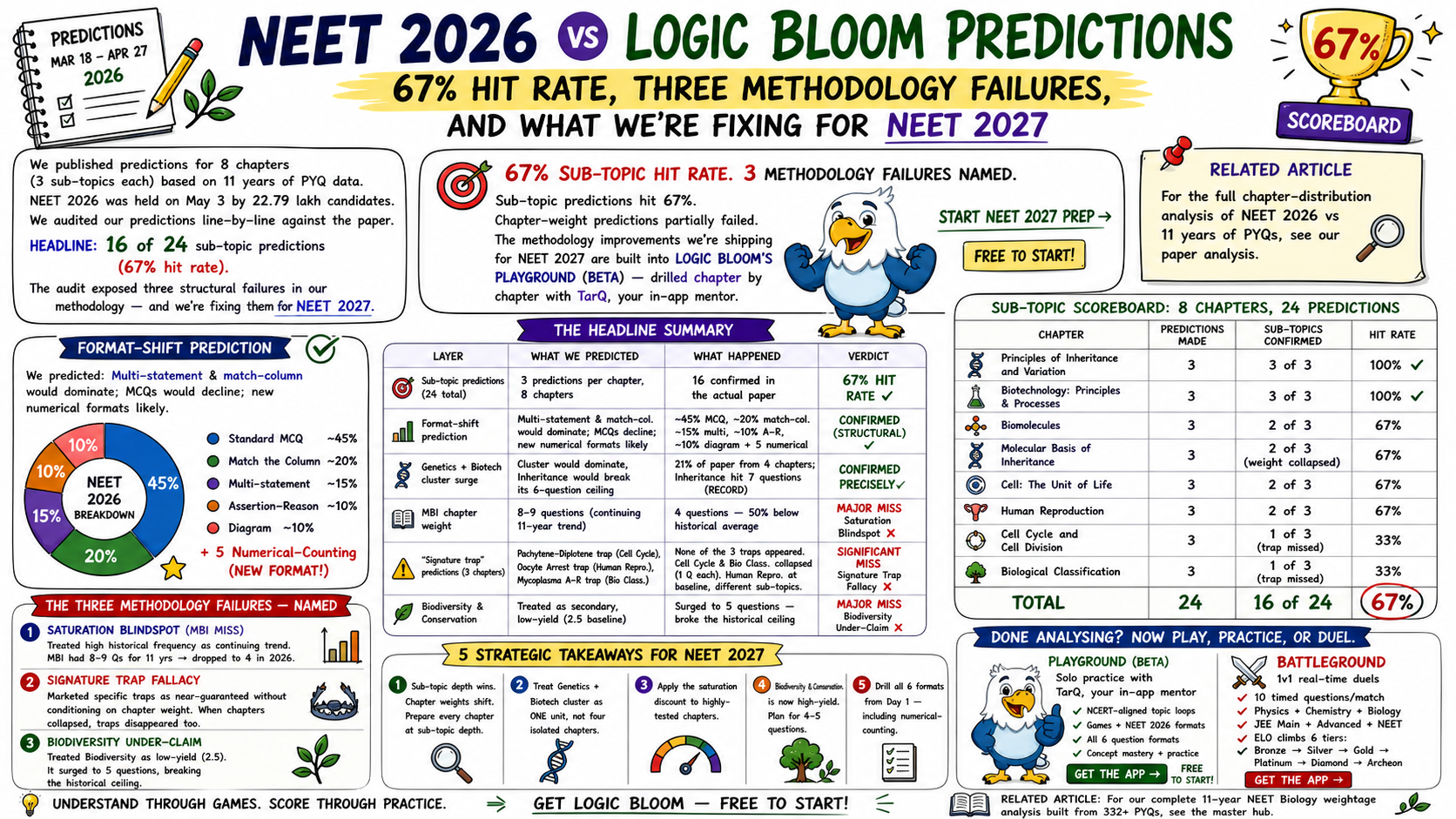
Introduction: We Predicted NEET 2026 in March. Here's the Honest Scorecard.
Between March 18 and April 27, 2026, we published 8 chapter-level PYQ analyses on Logic Bloom. Each one ended with the same section: predicted top sub-topics for NEET 2026, with reasoning grounded in 11 years of historical PYQ data.
NEET 2026 was written on Sunday, May 3, by 22.79 lakh candidates. We then audited our predictions line-by-line against the actual question paper. This article is that audit, published in full.
The headline: 16 of 24 sub-topic predictions confirmed (67% hit rate). The audit also identified three structural failures in our methodology that the headline number obscures — failures we're naming and fixing for NEET 2027 below. This is the honest version.
| 🎯 67% sub-topic hit rate. 3 methodology failures named. | |
|---|---|
| Sub-topic predictions hit 67%. Chapter-weight predictions partially failed. The methodology improvements we're shipping for NEET 2027 are built into Logic Bloom's Playground (BETA) — drilled chapter by chapter with TarQ, your in-app mentor. | Start NEET 2027 prep → Free to start. |
The Headline Summary — What Hit, What Missed, What We Got Structurally Wrong
| Layer | What we predicted | What happened | Verdict |
|---|---|---|---|
| Sub-topic predictions (24 total) | 3 specific predictions per chapter, 8 chapters | 16 confirmed in the actual paper | 67% hit rate ✓ |
| Format-shift prediction | Multi-statement and match-the-column would dominate; standard MCQs would continue declining; new numerical formats likely | ~45% standard MCQ, ~20% match-the-column, ~15% multi-statement, ~10% assertion-reason, plus 5 numerical-counting questions (a new format) | Confirmed at structural level ✓ |
| Genetics + Biotech cluster surge | Cluster would dominate, Inheritance would break its 6-question ceiling | 21% of paper from 4 chapters; Inheritance hit 7 questions (record) | Confirmed precisely ✓ |
| MBI chapter weight | 8–9 questions (continuing 11-year trend) | 4 questions — 50% below historical average | Major miss — Saturation Blindspot ✗ |
| "Signature trap" predictions across 3 chapters | Pachytene-Diplotene trap (Cell Cycle), Oocyte Arrest trap (Human Reproduction), and Mycoplasma assertion-reason trap (Biological Classification) all heavily flagged as near-guaranteed | None of the three traps appeared. Cell Cycle and Bio Classification chapters collapsed (1 question each); Human Reproduction stayed at baseline but tested different sub-topics | Significant miss — Signature Trap Fallacy ✗ |
| Biodiversity & Conservation | Treated as secondary, low-yield (2.5 baseline) | Surged to 5 questions — broke the historical ceiling | Major miss — Biodiversity Under-Claim ✗ |
Methodology — How the Scoreboard Was Audited
To make this analysis verifiable rather than self-congratulatory, the scoreboard follows a strict rubric:
| Rule | What it means |
|---|---|
| Predictions must be pre-exam published | Every prediction quoted below comes from an article published before May 3, 2026. URLs and publication dates are linked. Nothing is retrofitted after the exam. |
| Every chapter we predicted is included | No cherry-picking. If we published predictions for a chapter, it appears here — including the two chapters where our hit-rate was lowest. |
| "Hit" requires sub-topic + concept alignment | It is not enough that the chapter was tested. The specific sub-topic we named must have appeared as a tested concept in the actual paper. |
| Misses are documented as misses | Where a prediction did not materialize — whether due to wrong sub-topic call, chapter deemphasis, or methodology blind spot — it is labelled a miss. Chapter under-testing is documented as context, not as an excuse. |
| Question references, not question reproduction | NEET 2026 questions are cited by chapter and concept tested. Question stems are not reproduced verbatim. |
The Sub-Topic Scoreboard: 8 Chapters, 24 Predictions, 16 Hits
| 📊 NEET 2026 Sub-Topic Prediction Scorecard | ||
|---|---|---|
| Chapter | Predictions made | Sub-topics confirmed |
| Principles of Inheritance and Variation | 3 | 3 of 3 ✓ |
| Biotechnology: Principles & Processes | 3 | 3 of 3 ✓ |
| Biomolecules | 3 | 2 of 3 |
| Molecular Basis of Inheritance | 3 | 2 of 3 (chapter weight collapsed) |
| Cell: The Unit of Life | 3 | 2 of 3 |
| Human Reproduction | 3 | 2 of 3 |
| Cell Cycle and Cell Division | 3 | 1 of 3 (signature trap missed) |
| Biological Classification | 3 | 1 of 3 (signature trap missed) |
| Total | 16 of 24 (67%) | |
The 67% number is the headline. The structural lessons are in which 8 missed and why. We unpack the chapters below, then name the three methodology failures.
3 of 3 — Principles of Inheritance and Variation
Our highest-scoring chapter and the most heavily tested in NEET 2026 — 7 questions vs an 11-year average of 4.7. Inheritance broke its historical ceiling, exactly as predicted, and our sub-topic predictions held across all three.
| What We Predicted (Pre-Exam) | What NEET 2026 Tested | Verdict |
|---|---|---|
| Pedigree analysis (diagram-based) Predicted: "Visual pedigree charts absent from primary papers for 3+ years. Likely format: X-linked recessive (haemophilia or colour blindness), testing carrier female transmission to sons." |
Pedigree-style inheritance reasoning embedded in Mendelian disorder questions, with X-linked recessive logic central to the genetics module. | ✓ Hit |
| Sex-linked disorders + sickle cell substitution Predicted: "Sickle cell substitution (Glu→Val at position 6 of the β-globin chain) flagged as a recurring trap." |
Glu→Val at position 6 of the β-globin chain appeared as a direct test in the inheritance section. | ✓ Hit |
| Chromosomal disorders + ABO probability calculations Predicted: "Karyotype + non-disjunction mechanism + symptoms tested as a unified concept; ABO blood group reverse-engineering predicted as a prime numerical target." |
Both chromosomal disorders and an ABO genotype-probability calculation (heterozygous A mother, offspring distribution) appeared in NEET 2026. | ✓ Hit |
3 of 3 — Biotechnology: Principles and Processes
Biotechnology surged to 5 questions vs a baseline of 4.0. All three sub-topic predictions confirmed. The pBR322 spatial-recall prediction is the strongest single hit in the entire scorecard — we predicted students would need to recall vector map restriction site positions, and NEET 2026 tested exactly that.
| What We Predicted (Pre-Exam) | What NEET 2026 Tested | Verdict |
|---|---|---|
| pBR322 restriction site spatial recall Predicted: "Insertion at the PvuI site of pBR322 leads to ampicillin susceptibility. Students must have perfect spatial recall of the vector map." |
NEET 2026 directly tested the BamHI site location in pBR322 — within the tetracycline resistance gene. Same logical structure, different restriction site. | ✓ Hit (concept-route exact) |
| Restriction enzymes Predicted: "Restriction enzymes, PCR, and gel electrophoresis account for 48% of all questions." |
Restriction enzymes appeared multiple times — including a question on whether they cut palindromic sites at the centre, requiring nucleotide-removal logic. | ✓ Hit |
| PCR cycle ordering Predicted: "Almost certainly yes. Appeared in 7 of 11 years. Expect either primer design specifics or temperature specifications per phase." |
PCR step ordering (Annealing → Denaturation → Extension) appeared as a sequencing question. | ✓ Hit |
| 🎯 The Genetics + Biotech cluster contributed 21% of NEET 2026 from 4 chapters | |
|---|---|
| Inheritance, MBI, Biotech Principles, Biotech Applications. NEET 2027 students who are shaky on this cluster cannot make up the marks elsewhere. Logic Bloom's Playground (BETA) drills the cluster as connected concepts — restriction enzymes ↔ palindromic base pairing, pedigree ↔ chromosomal disorders — with TarQ as your in-app mentor. | Drill the cluster → Free to start. |
2 of 3 — Biomolecules
Biomolecules tested in line with average — 5 questions vs 4.5 baseline. Two of three sub-topic predictions confirmed. The standout: NEET 2026 tested Concanavalin A as a lectin and Morphine as an alkaloid — exactly the NCERT Table 9.3 content we flagged as overdue.
| What We Predicted (Pre-Exam) | What NEET 2026 Tested | Verdict |
|---|---|---|
| Secondary metabolite classification (NCERT Table 9.3) Predicted: "The alkaloid-vs-drug distinction (Morphine = alkaloid, Vinblastine = drug) is a prime multi-statement target." |
NEET 2026 directly tested Concanavalin A as a lectin and Morphine as an alkaloid in a match-the-column format. Direct hit on the NCERT Table 9.3 thesis. | ✓ Hit (verbatim concept) |
| Enzyme classification and bioactive molecules Predicted: "Enzyme inhibition underrepresented relative to NCERT coverage. A multi-statement question is highly probable." |
Enzyme classification tested via the bioactive molecules match-the-column (Trypsin = enzyme, Lipases in detergent formulations) — confirms enzyme focus, though specific inhibition framing didn't appear. | ~ Partial |
| Nucleic acid Chargaff base-pairing rules Predicted: "A diagram-based question showing nucleotide structure and asking to identify components is likely." |
Nucleic acid testing went via DNA double-helix vs RNA single-strand structural distinction, not Chargaff base-pairing. | ⚠ Concept-route shift |
2 of 3 — Molecular Basis of Inheritance — the Saturation Blindspot
This is where our methodology failed most visibly. MBI dropped to 4 questions vs an 8.1 historical average — a more than 50% collapse. Despite the chapter-weight failure, two of our three sub-topic predictions still landed within the 4 questions tested. But the headline lesson here is not the sub-topic accuracy — it is the chapter-weight failure.
| What We Predicted (Pre-Exam) | What NEET 2026 Tested | Verdict |
|---|---|---|
| Lac operon regulatory dynamics Predicted: "Near-guaranteed. Appeared in 10 of 11 years analysed." |
NEET 2026 tested the lac operon directly — specifically the z gene's role in coding β-galactosidase. | ✓ Hit |
| Transcription unit and replication direction Predicted: "Identifying promoter, structural gene, and terminator positions. Determining which strand is template (3'→5') vs coding (5'→3')." |
Transcription unit testing appeared via the promoter location question (5' end of structural gene) — exactly the spatial concept we flagged. | ✓ Hit |
| Translation codons + frameshift mutations Predicted: "The triplet code's properties (degenerate, universal, non-overlapping) combined with a deletion/insertion calculation." |
Mutation routing went through the haemoglobin sixth-codon question — molecular genetics tested through the inheritance angle, not pure translation. | ⚠ Concept-route shift |
The deeper failure here: Our model treated MBI's 11-year average of 8–9 questions as a stable forecast. NEET 2026 tested it at 4. We did not anticipate that a chapter exhausted across a decade of NTA testing might be deliberately deemphasised — what the audit calls a Saturation Blindspot. We name and address this in the Methodology Failures section below.
2 of 3 — Cell: The Unit of Life
Cell Biology stayed in line with baseline — 4 questions vs 5.0 average. Two of our three predictions confirmed.
| What We Predicted (Pre-Exam) | What NEET 2026 Tested | Verdict |
|---|---|---|
| Plasma membrane composition Predicted: Membrane structure with phospholipid bilayer architecture and protein/lipid percentage flagged as cross-chapter testing point. |
NEET 2026 tested eukaryotic cell membrane composition — including the ~52% protein composition of human RBC membranes, and amphipathic lipid tail orientation. | ✓ Hit |
| Mitochondrion vs chloroplast comparison + 70S ribosome trap Predicted: Organelle classification and prokaryotic ribosome residence flagged as a Level-2 trap. |
Organelle testing appeared via the non-membrane-bound organelle question (ribosomes as the answer), confirming organelle classification focus. | ✓ Hit |
| Cilia and flagella ultrastructure (9+2 vs 9+0) Predicted: "Last a primary focus in 2021–2022. Due for a complex match-the-column." |
Cilia/flagella ultrastructure was not directly tested in NEET 2026. | ✗ Miss |
2 of 3 — Human Reproduction
Human Reproduction tested at baseline — 3 questions vs 3.3 average. Two of three predictions confirmed; the third (oocyte arrest trap) was not set, addressed below in the Signature Trap Fallacy section.
| What We Predicted (Pre-Exam) | What NEET 2026 Tested | Verdict |
|---|---|---|
| Comparative gametogenesis Predicted: "Multi-statement contrasting oogenesis (fetal onset, discontinuous, unequal cytoplasmic division) with spermatogenesis (puberty onset, continuous, equal division)." |
NEET 2026 tested the spermatogonia/spermatocyte/spermatid sequence and meiotic vs mitotic division pattern — exactly the gametogenesis comparison framing. | ✓ Hit |
| Menstrual cycle hormonal interplay Predicted: "22% historical hit rate — near-guaranteed." |
Menstrual cycle hormones tested via the GIFT and assisted reproduction question, plus contraceptive mechanism testing. | ✓ Hit |
| Oocyte arrest trap (Meiosis II completion at fertilization) Predicted: "Tested 4 times in 10 years (2015, 2019, 2020, 2023). Predicted return for 2026." |
Oocyte arrest trap was not set. Human Reproduction questions pivoted to embryonic milestones and contraceptive technology instead. | ✗ Miss (Signature Trap Fallacy) |
1 of 3 — Cell Cycle and Cell Division — Signature Trap Fallacy
Cell Cycle collapsed to 1 question vs a 5.6 average — the steepest below-baseline performance of any chapter. We had heavily marketed the Pachytene-Diplotene trap in the source PYQ blog. It did not appear. The audit names this pattern the Signature Trap Fallacy: when a chapter's overall weight drops, the localised traps within it disappear too.
| What We Predicted (Pre-Exam) | What NEET 2026 Tested | Verdict |
|---|---|---|
| Cell cycle phase activities (G0/G1/S/G2/M) Predicted: "Match-the-column on cell cycle phase activities." |
NEET 2026 tested cell cycle phase activities directly — G1, S, G2, M phase matching. | ✓ Hit |
| Prophase I sub-stages (Pachytene-Diplotene trap) Predicted: "Match-the-column on Prophase I sub-stages with their defining events. Single most-trapped fact in NEET Biology." |
Prophase I sub-stages were not tested. Heavily-marketed trap did not materialise. | ✗ Miss (Signature Trap Fallacy) |
| Cytokinesis modalities (cell plate vs cleavage furrow) Predicted: "Multi-statement on aneuploidy vs polyploidy mechanisms." |
Cytokinesis differentiation was not tested. | ✗ Miss |
1 of 3 — Biological Classification — Same Pattern
Biological Classification dropped to 1 question vs a 3.8 average. Same Signature Trap Fallacy as Cell Cycle — the chapter was deemphasised, and our highly-marketed Mycoplasma assertion-reason trap disappeared with it.
| What We Predicted (Pre-Exam) | What NEET 2026 Tested | Verdict |
|---|---|---|
| Five Kingdom Classification criteria (Whittaker) Predicted: Foundational classification criteria flagged as overdue. |
NEET 2026 tested Whittaker's Five Kingdom criteria directly — cell structure, body organisation, phylogenetic relationships included; flagellum and reproduction excluded. | ✓ Hit |
| Mycoplasma in assertion-reason format Predicted: "Predicted assertion — Mycoplasma can pass through bacterial filters. Predicted reason — Mycoplasma lack a cell wall and are pleomorphic." |
Mycoplasma was not directly tested. | ✗ Miss (Signature Trap Fallacy) |
| Slime moulds / Basidiomycetes / Archaebacteria Predicted: Multiple kingdom-level sub-topics flagged as overdue. |
Kingdom-level sub-topics were not tested individually. | ✗ Miss |
The Three Methodology Failures — Named
The 67% headline number tells one story. The structure of the misses tells another. Across the 8 chapters, three specific methodology failures recurred. Naming them is the first step to fixing them for NEET 2027.
| 📌 What Our Methodology Got Structurally Wrong in NEET 2026 | |
|---|---|
| 1. The Saturation Blindspot (MBI miss) |
We treated chapters with strong historical frequency as continuing-trend forecasts. NTA actively avoids over-tested chapters to keep the exam unpredictable. MBI was tested 8.1 times per year on average for 11 years; it dropped to 4 in 2026. Our model did not weight saturation as a downside signal. Fix: introduce a topic-saturation discount — chapters with high historical density get prediction confidence downgraded, not upgraded. |
| 2. The Signature Trap Fallacy (Pachytene-Diplotene, Oocyte Arrest, Mycoplasma trap misses) |
We marketed specific traps (Pachytene-Diplotene in Cell Cycle, Oocyte Arrest in Human Reproduction, Mycoplasma assertion-reason in Biological Classification) as near-guaranteed based on 4–5 historical appearances. Two parent chapters (Cell Cycle, Bio Classification) collapsed in NEET 2026, and the localised traps disappeared with them. The third (Human Reproduction) held baseline weight but tested different sub-topics, so the trap still didn't appear. The traps were real traps; the parent chapters just weren't tested in the way that would have triggered them. Fix: trap-level predictions must be conditional on chapter-weight predictions, not made independently. |
| 3. The Biodiversity Under-Claim (thematic-shift miss) |
We treated Biodiversity & Conservation as a low-yield 2.5-baseline chapter. It surged to 5 questions in NEET 2026, breaking its historical ceiling. We did not weight global thematic shifts (climate change, conservation policy as exam-relevant context) as a forecasting signal. Fix: integrate exogenous signals (curriculum revisions, policy context, parallel-exam patterns) alongside historical PYQ frequency. |
What This Means For NEET 2027 Aspirants
The combination of confirmed wins and named failures yields concrete prep guidance. These takeaways are calibrated to both what worked and what failed.
| 📌 5 Strategic Takeaways for NEET 2027 — Built on Both the Hits and the Misses | |
|---|---|
| 1. Sub-topic prediction at depth wins. Chapter-weight prediction is unreliable. | 16 of 24 sub-topic predictions confirmed. But MBI dropped 50% below historical, and Biodiversity doubled above it. Prepare every chapter at sub-topic depth. Do not allocate study hours by assumed chapter weights — those weights move year to year. |
| 2. Treat the Genetics + Biotech cluster as one unit, not four chapters. | The cluster contributed 21% of NEET 2026 from four chapters. NTA tested concepts across chapter boundaries — sickle cell across Inheritance and Biomolecules, haemoglobin codon across MBI and Inheritance. Prepare connected, not isolated. |
| 3. Apply the saturation discount to highly-tested chapters. | MBI's collapse from 8 to 4 questions is the warning signal. If a chapter has dominated NEET for a decade, NTA will at some point pivot. Do not assume MBI returns to 8 questions in 2027 — and do not under-prepare any chapter on the assumption that historical lows continue either. |
| 4. Biodiversity & Conservation is no longer a soft fallback. | 5 questions in 2026 likely represents sustained reweighting, not a one-year spike. Plan for 4–5 questions and prepare with the same rigour as for Ecosystem. |
| 5. Drill all six question formats from Day 1 — including numerical-counting. | NEET 2026 format mix: ~45% standard MCQ, ~20% match-the-column, ~15% multi-statement, ~10% assertion-reason, ~10% diagram, plus 5 numerical-counting. Mock tests built on pre-2024 PYQ banks systematically under-train the latter four formats. Logic Bloom's Playground (BETA) drills all six formats — including numerical-counting — across NCERT-aligned topic loops with TarQ as your in-app mentor. Free to start. |
What We're Fixing for NEET 2027
The three named methodology failures are now addressed in our forecasting framework. Concrete changes:
| What we're changing | Why |
|---|---|
| Adding a topic-saturation index | Chapters with high decade-long testing frequency will receive a downgraded prediction confidence, not an upgraded one. MBI-style collapses become predictable risks rather than blindspots. |
| Trap-level predictions become conditional, not absolute | Specific traps (Pachytene-Diplotene, Oocyte Arrest, etc.) will be marketed only with explicit chapter-weight conditions attached. "If the parent chapter holds historical baseline, this trap is high-probability" — not "this trap is guaranteed." |
| Integrating exogenous signals | Predictions will integrate parallel-exam patterns (JEE Bio overlap, AIIMS legacy questions), NCERT curriculum revisions, and global thematic shifts (climate, conservation, biotech policy). Pure historical PYQ frequency is necessary but not sufficient. |
| Anti-predictions added explicitly | Future PYQ blogs will name chapters where we are explicitly NOT confident — rather than only flagging high-confidence sub-topics. Students get the full risk profile, not just the upside. |
| Reduced chapter-level forecasts; expanded sub-topic level | Sub-topic predictions hit 67%; chapter-weight predictions failed structurally. The methodology is shifting weight to where it works. |
Done analysing? Now play, practice, or duel.
| 🎯 The same PYQ data — now with the methodology fixes built in for NEET 2027 | |
|---|---|
| 🎮 Playground (BETA) Solo practice with TarQ, your in-app mentor |
NCERT-aligned topic loops covering the Genetics cluster (Inheritance + MBI + Biotechnology), Biodiversity & Conservation (now treated as a high-yield chapter), the anatomical traps (GnRH targets, adrenal cortex vs medulla), the numerical-counting format, and every other sub-topic flagged in our scorecard. Each loop pairs concept games with NEET 2026-format practice — multi-statement, assertion-reason, match-the-column, numerical-counting. Get the app → |
| ⚔️ Battleground 1v1 real-time duels |
Challenge a friend or get matched live. 10 timed questions per match across Physics, Chemistry, Biology — JEE Main + Advanced + NEET aligned. ELO climbs through 6 tiers: Bronze → Silver → Gold → Platinum → Diamond → Archeon. Get the app → |
| Understand through games. Score through practice. Get Logic Bloom — Free to start → |
|
FAQs — NEET 2026 Predictions and Methodology Audit
Q1: When were the predictions published?
Each chapter's predictions were published with the corresponding PYQ analysis between March 18 and April 27, 2026 — all before NEET 2026 (May 3). Publication dates and full prediction text are linked from each chapter section above. Nothing in this scoreboard was retrofitted after the exam.
Q2: How is the 67% hit rate calculated?
We published predictions for 8 chapters with 3 sub-topic predictions per chapter — 24 total predictions. We scored a hit when the predicted sub-topic appeared as a tested concept in NEET 2026, regardless of whether the format we predicted matched exactly. By this rubric, 16 of 24 predictions hit, giving a 67% hit rate. The headline accuracy is real — but the article also names three structural methodology failures (Saturation Blindspot, Signature Trap Fallacy, Biodiversity Under-Claim) that the headline number obscures.
Q3: What is the "Saturation Blindspot"?
A failure mode where historical testing frequency is treated as a continuing-trend forecast. Molecular Basis of Inheritance had been tested 8–9 times per year for over a decade. NEET 2026 tested it at 4 — a 50% collapse. NTA appears to deliberately deemphasise heavily-tested chapters to maintain exam unpredictability. Our methodology did not weight saturation as a downside signal; that has been corrected for NEET 2027 forecasts.
Q4: What is the "Signature Trap Fallacy"?
A failure mode where specific traps (Pachytene-Diplotene, Oocyte Arrest, Mycoplasma assertion-reason) are marketed as near-guaranteed based on 4–5 historical appearances, without conditioning the prediction on the parent chapter's expected weight. When Cell Cycle and Biological Classification dropped to 1 question each, and Human Reproduction tested different sub-topics, all three heavily-marketed traps disappeared. The fix: trap-level predictions must be conditional on chapter-weight predictions, not made independently.
Q5: What should NEET 2027 students take from this for their prep?
Three actions. First, use sub-topic-level PYQ analyses (which hit 67%) instead of chapter-weight forecasts (which failed structurally). Second, prepare every chapter at sub-topic depth — do not allocate study hours by assumed chapter weights, because chapter weights shift year to year. Third, treat Biodiversity & Conservation as a high-yield chapter (4–5 questions expected for NEET 2027), drill all six question formats including numerical-counting, and treat the Genetics + Biotech cluster as a single connected unit rather than four isolated chapters.