Biodiversity NEET PYQ — Doubled to 5 Questions, We Missed It, Here's Why
We predicted Biodiversity wouldn't surge. It doubled to 5 questions. Here's the honest failure analysis, the Evil Quartet evolution from labels to mechanisms, and the Z-value trap NTA hasn't set yet.
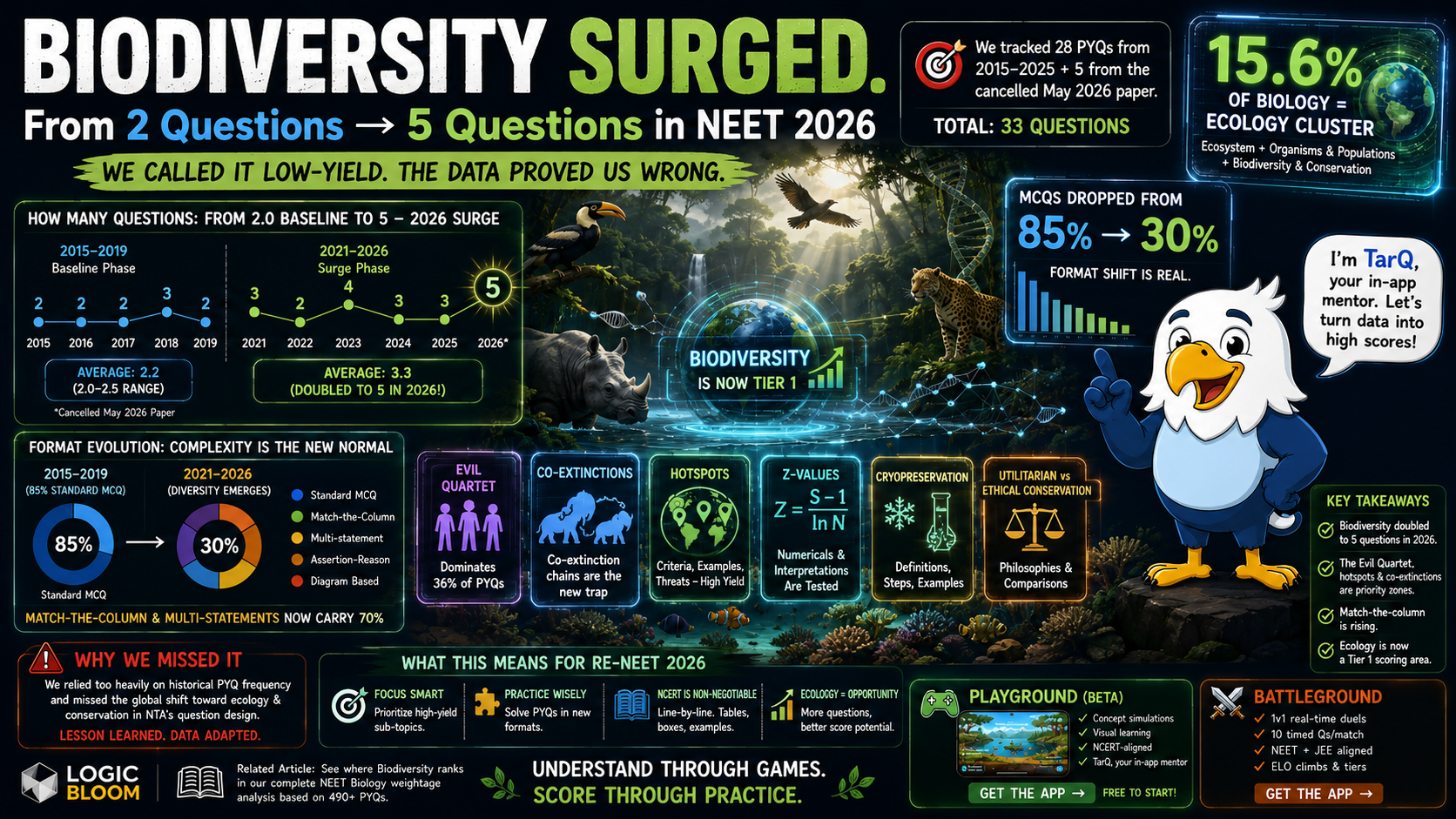
We Predicted This Chapter Wouldn't Surge. It Did. Here's What the Data Actually Says.
Let's start with the uncomfortable truth:
Biodiversity and Conservation surged from a 2.5-question baseline to 5 questions in the cancelled NEET 2026 paper. We didn't predict it. We called it a "low-yield" chapter. We were wrong.
We named this failure the "Biodiversity Under-Claim" in our public prediction audit — one of three methodology failures we documented after the cancelled exam. The lesson: pure historical PYQ frequency is necessary but not sufficient. NTA is actively reweighting toward ecology and conservation, driven by global shifts in climate policy and environmental health.
This article is the correction. We tracked 28 verified questions from Biodiversity and Conservation across every NEET sitting from 2015 to 2025, plus the 5 questions from the cancelled May 2026 paper. The patterns — once you account for the surge — are clearer than we expected.
This is our 11th PYQ analysis, and it fills the last gap in our Re-NEET 2026 strategy. The Ecology cluster now has two complete analyses: this one and Ecosystem.
| 🎯 Standard MCQs dropped from 85% to under 30%. Match-the-column and multi-statement now carry 70% of the chapter. | |
|---|---|
| The Evil Quartet, Z-values, hotspot criteria, Costanza's $33 trillion — NTA now tests 4 facts per question instead of 1. You can't memorise your way through a match-the-column pairing May, Humboldt, Ehrlich, and Tilman in one item. Logic Bloom's Playground (BETA) simulates these connections visually with TarQ, your in-app mentor — understand the relationships first, then the matching becomes obvious. | Get the app → Free to start. |
How Many Questions: From 2.0 Baseline to 5 — The Surge Nobody Predicted
| Year | Questions | Context |
|---|---|---|
| 2026 (cancelled) | 5 | Record high — bioprospecting, ethical arguments, Costanza valuation, co-extinctions, Sixth Extinction |
| 2025 | 2 | Ex-situ conservation + Evil Quartet match-the-column |
| 2024 + Re-exam | 8 | Peak year across all sittings — hotspots, sacred groves, cryopreservation, latitudinal gradients, Evil Quartet |
| 2023 | 1 | Evil Quartet — habitat loss as #1 driver |
| 2022 | 0 | No standalone Biodiversity questions |
| 2021 | 0 | No standalone Biodiversity questions |
| 2020 + Phase 2 | 2 | Species-area relationship + Amazon biodiversity |
| 2019 | 2 | Rio Earth Summit + habitat loss as top driver |
| 2018 | 0 | No standalone Biodiversity questions |
| 2017 | 0 | No standalone Biodiversity questions |
| 2016 + Phase 2 | 2 | IUCN Red List + Parthenium as alien species |
| 2015 | 1 | In-situ vs ex-situ definitions |
2015-2019 average: 2.0 questions/year. 2024-2026: 5.0 questions/year. That's a 2.5x jump. The chapter went from appearing sporadically — with two complete zero-question years (2017, 2018) — to commanding 5+ questions in the most recent papers.
The 2024 cycle alone produced 8 questions across the main exam and re-exam. Combined with the cancelled 2026 paper's 5 questions, the data is unambiguous: Biodiversity has been permanently elevated from a peripheral chapter to a Tier 1 scoring zone. This isn't a spike — it's a structural shift aligned with NTA's broader push toward environmental biology.
Combined with Ecosystem and Organisms and Populations, the full Ecology cluster contributed 14 questions (15.6% of Biology) in the cancelled paper — the same tier as Genetics and Human Physiology.
Sub-Topic Frequency: The Evil Quartet Dominates Everything
| Sub-topic | Questions (2015–2026) | Share |
|---|---|---|
| Biodiversity Loss / Threats (Evil Quartet) | 12 | 36.4% |
| Conservation — Ex-Situ (zoos, seed banks, cryopreservation) | 5 | 15.2% |
| Conservation — In-Situ (national parks, sacred groves, biosphere reserves) | 4 | 12.1% |
| Biodiversity Patterns (latitudinal gradients, species-area) | 4 | 12.1% |
| Importance of Biodiversity (utilitarian vs ethical) | 3 | 9.1% |
| Biodiversity Hotspots (Myers' criteria) | 2 | 6.1% |
| IUCN Red List / Extinction Rates | 2 | 6.1% |
| International Conventions (Rio Summit, CBD) | 1 | 3.0% |
The Evil Quartet alone accounts for 36% of all questions. Biodiversity Loss + Conservation (in-situ and ex-situ) together make up 63.7% — nearly two-thirds of everything NTA asks. The chapter is fundamentally about two things: why species are disappearing and what we're doing about it.
The surge sub-topic: "Importance of Biodiversity" (narrowly utilitarian vs broadly utilitarian vs ethical arguments) barely existed in the 2015-2019 data. The cancelled 2026 paper tested it twice — bioprospecting as a narrowly utilitarian concept AND the ethical argument for intrinsic species value. This is the sub-topic that's accelerating fastest.
What's Increasing in Frequency
The "why conserve" philosophical taxonomy. NTA is moving beyond "what is biodiversity" into "why does it matter." The three-tier framework from NCERT — narrowly utilitarian (direct economic value, bioprospecting), broadly utilitarian (ecosystem services, pollination, oxygen), and ethical (intrinsic value, moral obligation) — surged in the cancelled 2026 paper. Students who skipped this section because it felt "philosophical" lost easy marks.
Co-extinctions. Habitat loss has been tested to exhaustion as the #1 Evil Quartet member. NTA is pivoting to the least-known member: co-extinctions through obligate mutualism and host-parasite relationships. The cancelled 2026 paper tested this directly. A plant goes extinct → its obligate pollinator goes extinct → the parasite dependent on that pollinator goes extinct. Cascading loss.
Advanced ex-situ technology. The simple "zoo vs national park" question is dead. NTA now tests cryopreservation (preserving gametes at sub-zero temperatures for long-term viability), tissue culture micropropagation, and in vitro fertilisation as modern conservation tools. The 2024 re-exam tested cryopreservation specifically.
What's Decreasing or Fading
Standalone convention dates are gone. "When was the Rio Earth Summit?" (1992) appeared in 2019 but hasn't returned as a primary question. These dates now appear only as distractors inside match-the-column items — never as the main question.
Simple "name the hotspot" questions are fading. NTA no longer asks "Which is a biodiversity hotspot?" They ask "What are the criteria for hotspot designation?" — demanding you know Norman Myers' dual requirement: high endemism + 70% habitat loss. The shift is from geography to logic.
The Format Shift: 85% → Under 30% Standard MCQ
| Format | 2015–2018 | 2022–2026 |
|---|---|---|
| Standard MCQ | 85% | ~30% |
| Match the Column | 8% | ~35% |
| Multi-statement / Statement I & II | 5% | ~35% |
| Assertion-Reason | 2% | 0% (eliminated) |
Match-the-column surged from 8% to 35%. This chapter is uniquely suited for matching because it contains an enormous density of names, numbers, and classifications — May + 7 million species, Humboldt + species-area, Ehrlich + rivet popper, Wilson + Evil Quartet. NTA can test four separate facts in a single question by pairing scientists with their contributions.
Assertion-Reason has been eliminated entirely. NTA dropped this format because it generated legal disputes over whether "R correctly explains A." It's been replaced by the cleaner "Statement I and Statement II" format — which tests the same cognitive skill without the causation ambiguity.
| 🎯 The Evil Quartet has 4 members. NTA has tested habitat loss to exhaustion. Co-extinctions are next. | |
|---|---|
| Habitat loss, overexploitation, alien invasions, co-extinctions — but NTA is pivoting to the cascading effects. When a plant dies, its obligate pollinator dies, and the parasite on that pollinator dies. Understanding this chain matters more than listing the four causes. Logic Bloom's Playground (BETA) simulates extinction cascades visually with TarQ — see how one loss triggers three, then face the multi-statement questions that test this understanding. Then duel it out on Battleground — 1v1 timed matches where Ecology questions hit at exam speed. | Play the simulation → Free to start. |
The Evil Quartet: NTA's Favourite Biodiversity Weapon
Edward Wilson's four causes of biodiversity loss — habitat loss, overexploitation, alien species invasions, and co-extinctions — have been tested 12 times across 10 years. That's more than any other concept in this chapter. But how NTA tests it has evolved significantly.
| Evolution Phase | How NTA Tested It | Example |
|---|---|---|
| Phase 1 (2015-2019) Simple identification |
"What is the most important cause of extinction?" → Habitat loss | Tested in 2019 and 2023 as a direct, single-fact MCQ. Guaranteed easy mark if you know the hierarchy. |
| Phase 2 (2020-2024) Component matching |
Match-the-column pairing Evil Quartet components with specific examples | 2025: Match Evil Quartet, ex-situ, Lantana, Dodo with their correct categories. Tests all four members simultaneously. |
| Phase 3 (2026) Mechanism testing |
Multi-statement on co-extinctions — testing the cascade mechanism, not just the label | Cancelled 2026 paper: Testing obligate host-parasite co-extinction dynamics. You need to understand why co-extinction happens, not just that it exists. |
The trajectory is clear. NTA has exhausted simple "what is the #1 cause?" questions. The next phase tests the internal mechanics of each Quartet member — especially co-extinctions, the least-known member. For Re-NEET, prepare all four members at mechanism depth, not label depth.
The Species-Area Relationship: Three Levels of Testing
The equation S = cAz (or its logarithmic form: log S = log c + z log A) represents the most technical concept in this chapter. NTA tests it at three distinct levels:
| Level | What NTA Tests | What You Need to Know |
|---|---|---|
| Level 1: Historical attribution | Who discovered it? Where? | Alexander von Humboldt. South American jungles. Appears in match-the-column alongside May, Ehrlich, Tilman. |
| Level 2: Ecological interpretation | What does the relationship mean? | "Species richness increases with area, but only up to a limit." The phrase "up to a limit" is the exact NCERT qualifier NTA tests (2020, 2024). |
| Level 3: Z-value interpretation | What do specific Z-values mean? | Small areas: Z = 0.1–0.2 (regardless of taxonomic group). Entire continents: Z = 0.6–1.2. Frugivorous birds in tropical forests: Z = 1.15 (the most specific NCERT data point). A steep Z means a large area was analysed. |
The Level 3 trap: NTA can present a Z-value of 1.15 and ask what it indicates. Students who only memorised the equation won't know. Students who understood that a steep slope means continental-scale analysis will catch it instantly.
The 10 Concepts NTA Returns To
| 🎯 10 Most Repeated Biodiversity Concepts in NEET (2015–2026) | ||
|---|---|---|
| 1. | Habitat loss = #1 cause of extinction | Tested 4+ times. Page 264. "The most important cause driving animals and plants to extinction." |
| 2. | In-situ vs ex-situ definitions | Tested 4+ times. Section 15.2.2. National parks = in-situ. Zoos, seed banks = ex-situ. |
| 3. | Amazon rainforest = highest biodiversity | Tested 3 times. Page 261. 40,000 plants, 125,000 invertebrates, 3,000 fishes, 1,300 birds. |
| 4. | Latitudinal gradient — why tropics are richest | Tested 3 times. Section 15.1.2. Undisturbed evolutionary time + constant environment + high solar energy. |
| 5. | Alien species invasions (Parthenium, Lantana, Nile Perch) | Tested 3 times. Page 265. Nile Perch in Lake Victoria → 200+ cichlid species extinct. |
| 6. | Species-area relationship (Humboldt, Z-values) | Tested 2 times. Section 15.1.2. S = cAz. Z = 0.1–0.2 (small areas), 0.6–1.2 (continents). |
| 7. | Norman Myers' hotspot criteria | Tested 2 times. Page 266. High endemism + 70% habitat loss = hotspot designation. |
| 8. | Robert May's 7 million species estimate | Tested 2 times. Page 259. Conservative global estimate vs extreme 20-50 million range. |
| 9. | IUCN Red List = threatened species database | Tested 2 times. Organizational recall — IUCN maintains the list, not UNEP or WWF. |
| 10. | Utilitarian vs ethical conservation arguments | Surging. Bioprospecting = narrowly utilitarian. Pollination = broadly utilitarian. Intrinsic value = ethical. |
Cross-Chapter Connections
| Cross-Chapter Link | What It Tests | Example |
|---|---|---|
| Biodiversity + Ecosystem | Costanza's $33 trillion valuation bridges ecosystem services and biodiversity | Cancelled 2026 paper: match-the-column pairing soil formation (50%) with nutrient recycling (<10%) |
| Biodiversity + Organisms & Populations | Competitive exclusion drives biodiversity loss | Nile Perch introduction → competitive elimination of 200+ native cichlid species |
| Biodiversity + Biological Classification | Taxonomic hierarchy and species counting | Insects = 70% of all animals, fungi outnumber vertebrates combined |
| Biodiversity + Evolution | Speciation and adaptive radiation generate biodiversity | Undisturbed evolutionary time in tropics = higher speciation = more species |
Re-NEET 2026 / NEET 2027 Predictions
Predicted Format Distribution
| Format | Predicted Share |
|---|---|
| Match the Column | ~35% |
| Multi-statement / Statement I & II | ~35% |
| Standard MCQ | ~30% |
Top 5 Sub-Topics Most Likely to Appear
| # | Predicted Topic | Why It's Due |
|---|---|---|
| 1 | Co-extinctions (cascading obligate relationships) | Habitat loss is tested to exhaustion. NTA is pivoting to the Evil Quartet's least-known member. Tested in cancelled 2026 — will return in Re-NEET. |
| 2 | Utilitarian vs ethical arguments for conservation | Surged in 2026 with two questions. The three-tier classification (narrowly utilitarian / broadly utilitarian / ethical) is NTA's newest focus area. |
| 3 | Latitudinal gradients — the "why" not the "where" | NTA no longer asks where diversity is highest. They ask why. The three mechanisms (evolutionary time, environmental constancy, solar energy) will be tested as a multi-statement. |
| 4 | Advanced ex-situ technology (cryopreservation) | "Zoo vs national park" is dead. Cryopreservation, tissue culture, in vitro fertilisation are the new testing ground. Tested in 2024 re-exam. |
| 5 | Species-area Z-value interpretation | The equation has been tested at Level 1 (who) and Level 2 (what). Level 3 (Z-value meaning) is overdue. Expect a statement testing what Z = 1.15 indicates. |
3 Concepts Due for a Return
| Concept | Last Tested | Likely Format |
|---|---|---|
| Taxonomic ratios (insects = 70% of animals, fungi > vertebrates) | Not tested recently as standalone | Match-the-column pairing taxonomic groups with their global percentage shares. |
| Indian genetic diversity (50,000 rice strains, 1,000 mango varieties) | Not tested recently | Multi-statement on India as mega-diversity nation — 2.4% land area, 8.1% global species. |
| Rivet Popper Hypothesis (Paul Ehrlich's airplane analogy) | Appears in match-the-column only | Statement I & II: testing whether losing a "wing rivet" (keystone species) vs a "seat rivet" (redundant species) has different ecosystem impact. |
Predicted Cross-Chapter Combinations
Costanza Valuation Map (Biodiversity + Ecosystem): Integrating the $33 trillion estimate with "broadly utilitarian" conservation arguments. Trap: students confusing soil formation (50%) with nutrient recycling (<10%).
Alien Species + Competitive Exclusion (Biodiversity + Organisms & Populations): Nile Perch introduction → competitive elimination of native cichlids. A multi-statement connecting invasion biology with population interaction theory.
Hotspot Conservation Paradox: Hotspots represent <2% of Earth's land area, but protecting them would reduce ongoing extinctions by 30%. This ratio is a perfect statement-based trap.
The Memorisation Load: What You Must Know Cold
This chapter has the highest raw memorisation density of any Biology chapter. The sheer volume of specific numbers, names, and statistics makes it uniquely suited for match-the-column format. Here's the non-negotiable list:
| 📌 Numbers You Must Memorise for Re-NEET / NEET 2027 | |
|---|---|
| Robert May's estimate | 7 million global species (conservative). Extreme range: 20-50 million. |
| Amazon statistics | 40,000 plants, 125,000 invertebrates, 3,000 fishes, 427 amphibians, 427 mammals, 378 reptiles, 1,300 birds. |
| India's biodiversity | 2.4% of land area, 8.1% of global species. 50,000 rice strains, 1,000 mango varieties. |
| Z-values | Small areas: 0.1–0.2. Continents: 0.6–1.2. Frugivorous birds: 1.15. |
| Hotspot criteria | High endemism + 70% habitat loss. Total: 34 hotspots globally (NCERT base). |
| Extinction metrics | 784 species lost in 500 years (338 vertebrates, 359 invertebrates, 87 plants). |
| Rainforest loss | Reduced from 14% to 6% of Earth's surface. |
| Key conventions | Rio Earth Summit: 1992. Johannesburg: 2002. |
How to Prepare Based on the Data
| 📌 Data-Driven Preparation Strategy for Biodiversity NEET 2027 | |
|---|---|
| Treat this as a Tier 1 chapter — not a revision-week afterthought | 5 questions in the cancelled paper. 8 questions across 2024 sittings. This chapter now demands the same preparation intensity as Inheritance or Biotechnology. |
| Master the Evil Quartet at mechanism depth, not label depth | Don't just list the four causes. Understand the cascade: habitat fragmentation → population isolation → inbreeding → genetic drift → extinction. Co-extinctions through obligate relationships are the next testing frontier. |
| Learn the three conservation arguments as a taxonomy | Narrowly utilitarian: bioprospecting, direct economic value. Broadly utilitarian: ecosystem services, pollination, oxygen. Ethical: intrinsic value, moral obligation. NTA will present a service and ask which category it belongs to. |
| Memorise the number table above — it's match-the-column ammunition | This chapter's unique weakness is its data density. The numbers (7 million, 0.1-0.2, 70%, $33 trillion) are the raw material for 35% of questions. Flash-card them. |
| Connect Biodiversity to Ecosystem — they're tested as one unit | Costanza's valuation, ecosystem services, and the broadly utilitarian argument all bridge both chapters. Prepare them together, not separately. |
| Understand the connections through simulation, then duel to score | The Evil Quartet cascade, species-area curves, and the Costanza valuation are hard to internalise from text. Logic Bloom's Playground (BETA) simulates extinction cascades and ecosystem service flows visually with TarQ — understand first, then take that understanding into Battleground — 1v1 duels under real time pressure. Free to start. |
Done analysing? Now play, understand, and duel.
| 🎯 Biodiversity doubled to 5 questions. Ecology is now 15.6% of Biology. The data says: stop ignoring this chapter. | |
|---|---|
| 🎮 Playground (BETA) Understand through games — with TarQ, your in-app mentor |
Play through interactive simulations: watch how one extinction cascades through obligate relationships (co-extinction chain), explore species-area curves and see Z-values change as your area expands, and classify conservation arguments into their philosophical tiers. Each chapter map pairs concept games with readings and MCQs — understand first, then answer. Get the app → |
| ⚔️ Battleground Score through practice — 1v1 real-time duels |
Take the concepts you understood in Playground and test them under real time pressure. Challenge a friend or get matched live. 10 timed questions per match across Physics, Chemistry, Biology — JEE Main + Advanced + NEET aligned. ELO climbs through 6 tiers: Bronze → Silver → Gold → Platinum → Diamond → Archeon. Get the app → |
| Understand through games. Score through practice. Get Logic Bloom — Free to start → |
|
FAQs — Biodiversity and Conservation NEET PYQ
Q1: How many questions come from Biodiversity and Conservation in NEET?
Biodiversity averaged 2.0 questions per year from 2015-2019 but surged to 5 questions in the cancelled NEET 2026 paper and 8 questions across all 2024 sittings. Combined with Ecosystem and Organisms and Populations, the full Ecology cluster contributed 14 questions (15.6% of Biology) in NEET 2026. Prepare for 4-5 Biodiversity questions as the new baseline.
Q2: What is the most tested concept from Biodiversity in NEET?
Habitat loss and fragmentation as the #1 driver of extinction is the most tested concept, appearing 4+ times. The Evil Quartet as a whole (habitat loss, overexploitation, alien invasions, co-extinctions) accounts for 36% of all questions from this chapter. In-situ vs ex-situ conservation definitions are the second most tested area.
Q3: What is the Evil Quartet in NEET Biology?
Edward Wilson's framework identifying four major causes of biodiversity loss: habitat loss and fragmentation (the dominant cause), overexploitation, alien species invasions (e.g., Nile Perch, Parthenium, Lantana), and co-extinctions (cascading loss through obligate relationships). NTA has tested this framework 12 times across 10 years, evolving from simple identification to mechanism-level multi-statement questions.
Q4: Has the question format changed for Biodiversity in NEET?
Drastically. Standard MCQs dropped from 85% (2015-2018) to under 30% (2022-2026). Match-the-column surged to 35%, and multi-statement formats surged to 35%. This chapter is uniquely suited for matching because it contains dense data — scientist names, species counts, Z-values, convention dates — that NTA can pair in a single question testing four facts simultaneously.
Q5: Why did Biodiversity surge in NEET 2026?
The surge from 2.5 to 5 questions reflects a structural reweighting by NTA toward environmental biology, aligned with global shifts in climate policy and conservation science. The NMC curriculum increasingly emphasises environmental health as foundational to medical practice. This is not a one-year spike — the 2024 cycle also showed elevated testing (8 questions across sittings). Treat Biodiversity as a permanent Tier 1 chapter for Re-NEET and NEET 2027.