Organisms & Populations NEET PYQ — 40% From Population Interactions Alone
5 NCERT organism pairs account for 80% of interaction questions. The birth rate calculation trap most students get wrong. And the logistic equation tested 4 ways — none repeated. Re-NEET pattern map.
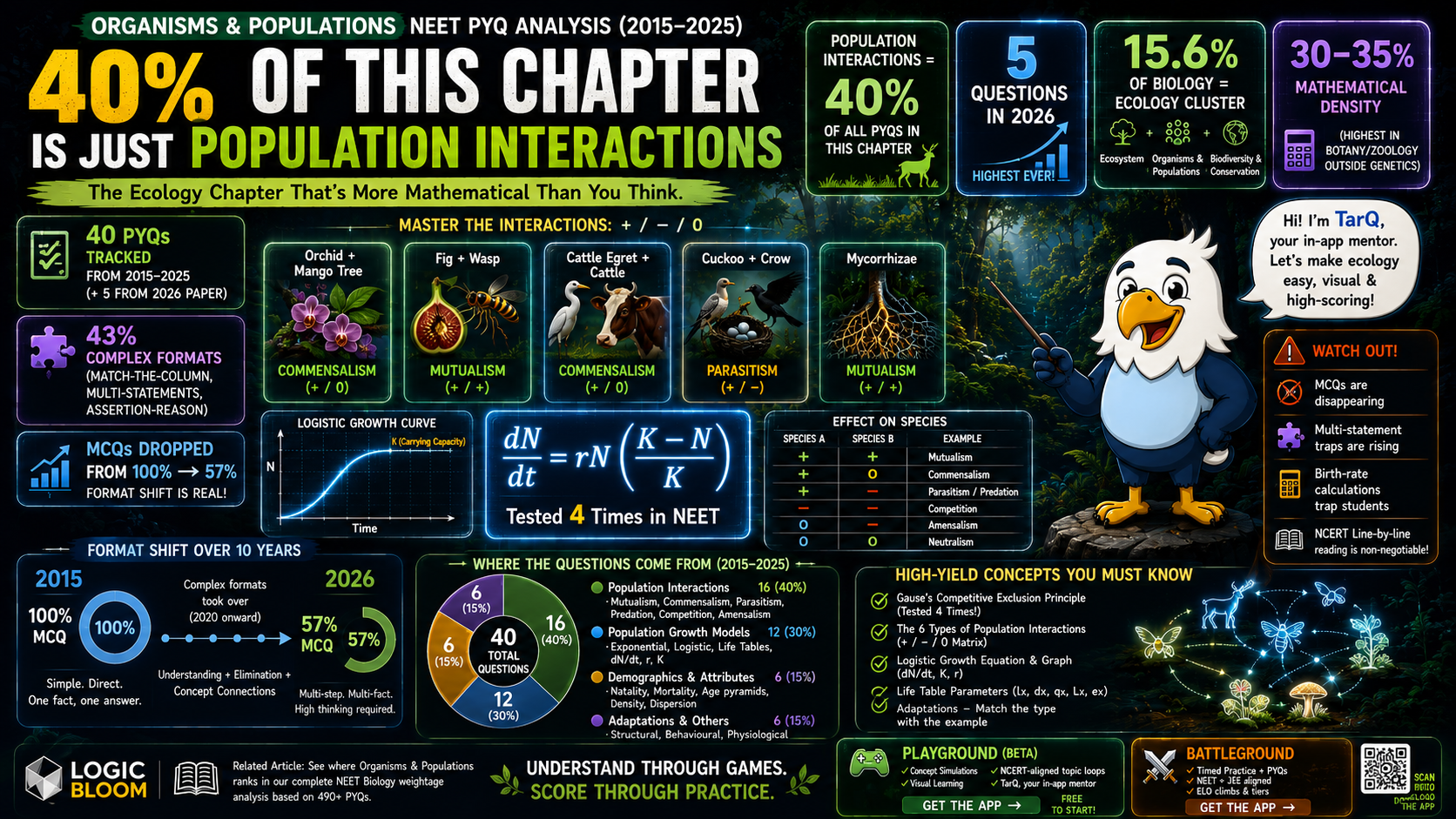
The Foundation of the 14-Question Ecology Cluster — And It's More Mathematical Than You Think
Here's the number that reframes this entire chapter:
Population Interactions — mutualism, commensalism, parasitism, predation, competition, amensalism — account for 40% of every question NTA has asked from Organisms and Populations in 10 years.
Not 40% of ecology. Not 40% of biology. 40% of this single chapter. And the way NTA tests it has transformed: in 2015, they asked "What type of interaction is clownfish-anemone?" (one fact, one second). In 2026, they presented five interaction statements and asked which combination was correct (five facts, five verifications, one minute).
But here's what most students miss: this chapter has the highest mathematical density of any chapter in Botany/Zoology outside Mendelian Genetics. Roughly 30-35% of questions require either direct calculation (per capita birth rates, death rates) or mathematical interpretation (when does dN/dt = 0? what does K represent?). Students who approach this as "just memorise the organism pairs" lose 4-8 marks.
This is our 12th PYQ analysis, and it completes the Ecology cluster. We've already published analyses for Ecosystem and Biodiversity and Conservation. Together, these three chapters contributed 14 questions (15.6% of Biology) in the cancelled NEET 2026 paper — the same tier as Genetics and Human Physiology.
| 🎯 NTA doesn't just ask "what is mutualism?" anymore. They give you 5 interaction statements and ask which combination is correct. | |
|---|---|
| Orchid-mango = commensalism. Fig-wasp = mutualism. Egret-cattle = commensalism. Cuckoo-crow = parasitism. You need to hold all four in your head simultaneously. Logic Bloom's Playground (BETA) simulates these interaction networks visually with TarQ, your in-app mentor — see how each pair maps to the +/−/0 matrix, then face the multi-statement questions. | Get the app → Free to start. |
How Many Questions: The Stabilising Anchor at 3.6/Year — Now Surging to 5
| Year | Questions | Context |
|---|---|---|
| 2026 (cancelled) | 5 | Verhulst-Pearl equation, sexual deceit (Ophrys), fig-wasp deep biology, interaction matrix, commensalism |
| 2025 | — | Data pending for this chapter specifically |
| 2024 | 5 | Carrying capacity K, Gause's principle multi-statement, fitness definition, sigmoid phases, orchid trap |
| 2023 + Manipur | 5 | Brood parasitism, interaction matching, assertion-reason on commensalism, snail birth rate calculation, niche definition |
| 2022 | 4 | Exponential growth conditions, resource partitioning, growth-pyramid matching, Drosophila death rate |
| 2021 | 2 | Gause repeat, amensalism matrix |
| 2020 + Phase 2 | 4 | Allen's Rule, exponential equation (e), immigration impact, predation |
| 2019 | 1 | Mycorrhizae = mutualism (repeat) |
| 2018 | 4 | Natality, expanding pyramid, demographic equation, amensalism in antibiotics |
| 2017 | 3 | Logistic asymptote at K=N, mycorrhizae, camouflage |
| 2016 + Phase 2 | 4 | Logistic equation, K=N condition, parasitism matrix, Gause's principle × 2 |
| 2015 | 3 | Clownfish-anemone, competition (−,−), tropical rainforest biome |
10-year average: 3.6 questions/year. 2023-2026 average: 5.0 questions/year. The chapter has surged from a stable 3-4 baseline to a consistent 5-question contributor — making it the co-anchor of the Ecology cluster alongside Ecosystem.
At 4-5 questions per year, this chapter alone delivers 16-20 marks. Combined with Ecosystem (3-4 questions) and Biodiversity (4-5 questions), the complete Ecology cluster is now worth 40-60 marks — from just three chapters.
Sub-Topic Frequency: Population Interactions Dominate at 40%
| Sub-topic | Questions (10 yr) | Share |
|---|---|---|
| Population Interactions (mutualism, commensalism, parasitism, predation, competition, amensalism) | 16 | 40.0% |
| Population Growth Models (exponential, logistic, carrying capacity K) | 9 | 22.5% |
| Population Attributes (birth rate, death rate, immigration, demographic equations) | 6 | 15.0% |
| Interspecific Competition (Gause's principle, resource partitioning) | 5 | 12.5% |
| Adaptations (Allen's Rule, camouflage, sexual deceit) | 3 | 7.5% |
| Organisms & Environment / Age Pyramids | 2 | 5.0% |
Two pillars carry 62.5% of the chapter: Population Interactions (40%) + Population Growth Models (22.5%). If you master the six interaction types with their NCERT organism pairs AND the logistic growth equation with its mathematical derivations, you've covered nearly two-thirds of everything NTA asks.
The missing sub-topic: Life History Variations (r-selected vs K-selected species) has never been directly tested in the modern era. It's the biggest dormant concept in the chapter — and the most overdue.
What's Increasing in Frequency
Mathematical depth on population growth. NTA's evolution is clear: 2016 asked "identify the logistic equation" (recognition). 2017 asked "when does the growth rate equal zero?" (derivation). 2023 asked "calculate the per capita birth rate from raw data" (computation). 2024 asked "identify the variable K" (isolation). Each year tests a deeper layer of the same equation.
Specific organism pairs in interactions. NTA no longer asks "what is mutualism?" — they assume you know. Instead: "Is orchid-on-mango-tree mutualism or commensalism?" (commensalism — the orchid benefits, the tree is unaffected). The NCERT pairs are tested with surgical precision: Fig-Wasp, Orchid-Mango, Egret-Cattle, Clownfish-Anemone, Cuckoo-Crow. These five pairs account for 80%+ of empirical interaction questions.
Multi-statement interaction matrices. The cancelled 2026 paper gave five interaction definitions and asked which combination was correct — testing all six interaction types in a single question. This format is NTA's new favourite for this chapter because population interactions have exactly the right density: six types, each with distinct +/−/0 signatures, each with specific NCERT examples.
What's Decreasing or Dormant
Life history variations are completely absent. r-selected vs K-selected, semelparity vs iteroparity, Pacific salmon's single reproductive event — none of it has been directly tested in the modern era. It's either permanently deprioritised or massively overdue.
Diagram-based questions have vanished. Despite the visually rich S-curve, J-curve, and age pyramids, NTA hasn't printed these diagrams in years. Instead, they describe the curves in text and test whether you can mentally reconstruct them — a harder skill than recognising a printed graph.
Abiotic factors and conformers/regulators are fading. Eurythermal vs stenothermal, euryhaline vs stenohaline — these overlap with Human Physiology and are increasingly tested there rather than here.
The Format Shift: 100% → 57% Standard MCQ
| Format | 2015–2018 | 2022–2026 |
|---|---|---|
| Standard MCQ | 100% | 57% |
| Multi-statement / Statement I & II | 0% | 24% |
| Match the Column | 0% | 14% |
| Assertion-Reason | 0% | 5% |
43% of questions are now complex formats — up from zero before 2020. The multi-statement format is especially dangerous here because NTA can combine a well-known concept (Gause's principle) with an obscure NCERT line (herbivores are more adversely affected by competition than carnivores) in the same Statement I/II question. Students who only memorised the bold text get trapped by Statement II.
| 🎯 dN/dt = rN(K−N)/K has been tested 4 times. But NTA never asks the same thing twice. | |
|---|---|
| 2016: "Identify the equation." 2017: "When does growth reach zero?" 2024: "What does K represent?" 2026: "Which equation is Verhulst-Pearl?" Same formula, four difficulty levels. Understanding why the equation works is the only defence. Logic Bloom's Playground (BETA) lets you manipulate r, N, and K in a population growth simulation with TarQ — watch the S-curve form in real time, see what happens when N approaches K. Then duel it out on Battleground — 1v1 matches where ecology questions hit under exam pressure. | Play the simulation → Free to start. |
The Logistic Equation: NEET's Most Tested Ecological Formula
dN/dt = rN(K−N)/K — the Verhulst-Pearl logistic growth equation — has been tested 4 times in 10 years, making it the most tested mathematical concept in this chapter. But NTA has never asked the same question twice.
| Year | What NTA Asked | The Skill Tested |
|---|---|---|
| 2016 | "Which equation describes logistic growth?" | Recognition — pick the right formula from four options |
| 2016 | "When does growth rate equal zero?" | Mathematical derivation — when N/K = 1, the (K−N)/K term becomes zero |
| 2017 | "Asymptote is obtained when?" | Conceptual — linking the mathematical condition (K=N) to the ecological concept (carrying capacity reached) |
| 2024 | "Carrying capacity is represented by?" | Variable isolation — identifying K as the specific symbol |
| 2026 | "Which equation depicts Verhulst-Pearl logistic growth?" | Named attribution — linking the equation to its historical creators |
The next level: NTA has tested recognition, derivation, interpretation, variable isolation, and attribution. The remaining untested angle is calculation — providing raw population data and asking students to apply the equation. Given the 2023 Manipur snail birth rate calculation (which tripped most students), a numerical logistic growth problem is high probability for Re-NEET or NEET 2027.
The 5 NCERT Organism Pairs NTA Tests On Repeat
NTA doesn't test random organism examples. They test the exact pairs from NCERT Chapter 13 — and these five pairs account for 80%+ of all empirical interaction questions:
| 🎯 The 5 NCERT Organism Pairs You Must Know Cold | |||
|---|---|---|---|
| Orchid on Mango tree | Commensalism (+, 0) | Tested 3 times | The #1 trap: students confuse this with mutualism. The orchid gains support; the mango is unaffected. |
| Mycorrhizae (fungi + plant roots) | Mutualism (+, +) | Tested 3 times | Fungi provides mineral absorption; plant provides organic nutrition. Both benefit. |
| Fig tree and Wasp | Mutualism (+, +) | Tested 2 times | Tight co-evolution: wasp pollinates fig, fig provides oviposition site. One-to-one species specificity. |
| Cattle Egret and grazing cattle | Commensalism (+, 0) | Tested 2 times | Egret benefits from insects disturbed by cattle. Cattle is unaffected. NOT mutualism. |
| Cuckoo and Crow | Brood parasitism | Tested 2 times | Cuckoo lays eggs in crow's nest. Crow unknowingly raises cuckoo chick. Evolved mimicry of egg appearance. |
The assertion-reason trap (2023): NTA presented "Commensalism means one benefits, other unaffected" as the Assertion, and "Egrets forage near cattle" as the Reason. Both true. But the Reason doesn't explain the definition — it merely illustrates it. Answer: "Both true, R is not the correct explanation of A." Students who don't understand the logical hierarchy between definition and example get caught.
The 10 Concepts NTA Returns To
| 🎯 10 Most Repeated Organisms & Populations Concepts in NEET (2015–2026) | ||
|---|---|---|
| 1. | Gause's Competitive Exclusion Principle | Tested 4 times. Page 236. "Two closely related species competing for the same resources cannot co-exist indefinitely." |
| 2. | Verhulst-Pearl logistic equation: dN/dt = rN(K−N)/K | Tested 4 times. Page 231. Recognition, derivation, interpretation, variable isolation all tested. |
| 3. | Commensalism: Orchid on Mango tree (+, 0) | Tested 3 times. Page 237. The mutualism-commensalism confusion is NTA's favourite trap. |
| 4. | Mutualism: Mycorrhizae (+, +) | Tested 3 times. Page 238. Fungi-plant root symbiosis. |
| 5. | Interaction matrix (+, −, 0 symbols) | Tested 3 times. Table 13.1. All six interaction types mapped to algebraic signs. |
| 6. | Mathematical birth/death rate calculations | Tested 2 times. Page 227. Per capita rates from raw population data (Drosophila, snails). |
| 7. | K = N condition (growth rate reaches zero) | Tested 2 times. Page 231. When population equals carrying capacity, dN/dt = 0. |
| 8. | Mutualism: Fig-Wasp co-evolution | Tested 2 times. Page 238. One-to-one pollinator-plant specificity. |
| 9. | Commensalism: Cattle Egret (+, 0) | Tested 2 times. Page 237. Insects disturbed by grazing = benefit; cattle unaffected. |
| 10. | Brood parasitism: Cuckoo | Tested 2 times. Page 236. Egg mimicry and nest takeover. |
Cross-Chapter Connections
| Cross-Chapter Link | What It Tests | Example |
|---|---|---|
| Organisms & Populations + Ecosystem | Population interactions driving trophic dynamics | Predator removal destabilises food web — connects predation theory to energy flow |
| Organisms & Populations + Biodiversity | Competitive exclusion drives alien species extinction | Nile Perch → competitive elimination of 200+ cichlid species (Gause's principle in action) |
| Organisms & Populations + Microbes / Biotech | Amensalism via antibiosis | 2018: Penicillium producing antibiotics = applied amensalism (−, 0) |
| Organisms & Populations + Sexual Reproduction in Plants | Fig-wasp and Ophrys-bumblebee pollination ecology | 2026: Sexual deceit of Ophrys tested as co-evolutionary adaptation |
| Organisms & Populations + Evolution | Darwinian fitness = r (intrinsic rate of natural increase) | 2024: Competition defined through "lowered biological fitness" |
Re-NEET 2026 / NEET 2027 Predictions
Predicted Format Distribution
| Format | Predicted Share |
|---|---|
| Standard MCQ | ~50% |
| Multi-statement / Statement I & II | ~25% |
| Match the Column | ~15% |
| Assertion-Reason | ~10% |
Top 5 Sub-Topics Most Likely to Appear
| # | Predicted Topic | Why It's Due |
|---|---|---|
| 1 | Resource Partitioning (MacArthur's warblers) | Gause's principle is tested to saturation (4 times). Its counter-mechanism — how species co-exist by partitioning resources — was tested once in 2022 and is due for a multi-statement. |
| 2 | Mathematical calculation of r (intrinsic rate) | NTA escalated from simple death rate (2022) to birth rate trap (2023 Manipur). Next: provide raw birth and death data, ask students to calculate r = b − d, then apply it. |
| 3 | Age pyramids (expanding vs stable vs declining) | Expanding pyramid tested in 2018. Match-the-column pairing pyramid shapes with demographic status is overdue and perfectly suited for the format. |
| 4 | Behavioral adaptations (sexual deceit, diapause) | Ophrys-bumblebee sexual deceit tested in cancelled 2026. Diapause (suspended development in zooplankton) vs hibernation vs aestivation is completely dormant and overdue. |
| 5 | Multi-statement on all six interaction types | The 2026 format — five interaction statements, pick the correct combination — will return. NTA has found a format that tests the entire Table 13.1 in one question. |
3 Concepts Due for a Return
| Concept | Last Tested | Likely Format |
|---|---|---|
| r-selected vs K-selected species (semelparity vs iteroparity) | Not tested in modern era (~2016) | Match-the-column: Pacific salmon (semelparity/r-selected) vs mammals (iteroparity/K-selected). Or multi-statement with trade-off logic. |
| Bergmann's Rule + Allen's Rule together | Allen's alone in 2020 | Statement I & II comparing body size (Bergmann's) with extremity proportion (Allen's) in cold climates. Testing both together is overdue. |
| Diapause vs hibernation vs aestivation | Dormant for 3+ years | Match-the-column: diapause (zooplankton, suspended development), hibernation (bears, winter), aestivation (snails/fish, summer heat). |
Predicted Cross-Chapter Combinations
Population Growth + Human Population Explosion: Applying the exponential growth equation Nt = N0ert to real human demographic data from the Reproductive Health chapter. Tests ecological mathematics through a public health lens.
Competitive Exclusion + Alien Species Invasions (Biodiversity): Gause's principle as the mechanism behind Nile Perch eliminating cichlids, or African catfish displacing native Indian species. Tests population theory through conservation application.
Predation + Ecosystem Trophic Dynamics: Removing a top predator → unmitigated interspecific competition at lower trophic levels → ecosystem destabilisation. Bridges population interactions with energy flow.
The Birth Rate Calculation Trap — NTA's Newest Mathematical Weapon
The 2023 Manipur paper contained a question that tripped most students despite being straightforward mathematics:
250 snails in a pond. One year later: 2,500 snails. Calculate the per capita birth rate.
The trap: Students divided 2,500 ÷ 250 = 10, and selected "10" as the birth rate. Wrong. The birth rate is the number of new births per individual — not the final population divided by the initial population. Net new births = 2,500 − 250 = 2,250. Per capita birth rate = 2,250 ÷ 250 = 9.
This trap works because students confuse "growth factor" (which includes the original population) with "birth rate" (which counts only new individuals). The NTA will reuse this mathematical framework — expect per capita rate calculations with similar misdirection in Re-NEET.
How to Prepare Based on the Data
| 📌 Data-Driven Preparation Strategy for Organisms & Populations NEET 2027 | |
|---|---|
| Memorise the 5 NCERT organism pairs as a system, not a list | Orchid-Mango (commensalism), Fig-Wasp (mutualism), Mycorrhizae (mutualism), Egret-Cattle (commensalism), Cuckoo-Crow (parasitism). Know the +/−/0 matrix for each. NTA will present all five in a single multi-statement question. |
| Master the logistic equation as a three-part concept | Know the formula: dN/dt = rN(K−N)/K. Know the zero condition: when N = K, growth stops. Know the ecological meaning: K = carrying capacity = maximum population the environment sustains. NTA tests all three independently. |
| Practice per capita rate calculations — don't fall for the growth factor trap | Birth rate = new births ÷ initial population. Death rate = deaths ÷ initial population. Net growth rate r = birth rate − death rate. The 2023 snail trap works because students divide final by initial instead of (final − initial) by initial. |
| Know Gause's principle AND its counter-mechanism | Competitive exclusion (Gause): two species can't co-exist on the same limiting resource. Resource partitioning (MacArthur): they CAN co-exist by dividing the resource. Both are tested — and NTA pairs them in Statement I/II. |
| Prepare r-selected vs K-selected — it's the biggest dormant concept | Never tested in the modern era. Pacific salmon = semelparity (one big reproductive event, then death). Mammals = iteroparity (multiple reproductive events). The evolutionary trade-off between quantity and quality of offspring is perfectly suited for match-the-column. |
| Simulate the interactions, then duel to score | The +/−/0 matrix is hard to hold in memory from text alone. Logic Bloom's Playground (BETA) lets you play through population interaction networks visually and manipulate growth curves by changing r and K in real time — with TarQ guiding the concept. Then take that understanding into Battleground — 1v1 duels under real time pressure. Free to start. |
Done analysing? Now play, understand, and duel.
| 🎯 The Ecology cluster is complete. 3 chapters, 14 questions in NEET 2026, one connected data set. | |
|---|---|
| 🎮 Playground (BETA) Understand through games — with TarQ, your in-app mentor |
Play through interactive simulations: map the +/−/0 interaction matrix for all six population interaction types, manipulate r and K to watch the S-curve form (and see what happens when N exceeds K), calculate per capita rates without falling for the growth factor trap, and build food webs where removing a predator triggers cascading competition. Each chapter map pairs concept games with readings and MCQs — understand first, then answer. Get the app → |
| ⚔️ Battleground Score through practice — 1v1 real-time duels |
Take the concepts you understood in Playground and test them under real time pressure. Challenge a friend or get matched live. 10 timed questions per match across Physics, Chemistry, Biology — JEE Main + Advanced + NEET aligned. ELO climbs through 6 tiers: Bronze → Silver → Gold → Platinum → Diamond → Archeon. Get the app → |
| Understand through games. Score through practice. Get Logic Bloom — Free to start → |
|
FAQs — Organisms and Populations NEET PYQ
Q1: How many questions come from Organisms and Populations in NEET?
The chapter averaged 3.6 questions per year from 2015-2025, surging to 5 questions in both 2023 and 2024 sittings and in the cancelled 2026 paper. Combined with Ecosystem and Biodiversity, the full Ecology cluster contributed 14 questions (15.6% of Biology) in NEET 2026. Expect 4-5 questions from this chapter alone.
Q2: What is the most tested concept from Organisms and Populations in NEET?
Two concepts share the top spot at 4 appearances each: Gause's Competitive Exclusion Principle and the Verhulst-Pearl logistic growth equation (dN/dt = rN(K−N)/K). Population Interactions as a sub-topic dominates overall at 40% of all questions, with the Orchid-Mango commensalism pair and Mycorrhizae mutualism as the most repeated organism examples.
Q3: Is this chapter mathematical?
Yes — it has the highest mathematical density of any Botany/Zoology chapter outside Mendelian Genetics. Roughly 30-35% of questions require either direct calculation (per capita birth/death rates from raw data) or mathematical interpretation (when does dN/dt equal zero, what does K represent). The 2023 Manipur paper included a birth rate calculation trap that most students answered incorrectly.
Q4: Which organism pairs must I memorise for this chapter?
Five NCERT pairs account for 80%+ of empirical interaction questions: Orchid on Mango tree (commensalism), Mycorrhizae (mutualism), Fig tree and Wasp (mutualism), Cattle Egret and grazing cattle (commensalism), and Cuckoo in crow's nest (brood parasitism). Know the +/−/0 matrix signature for each pair. NTA tests these exact pairs, not random examples.
Q5: How has the question format changed for this chapter?
Standard MCQs dropped from 100% (2015-2018) to 57% (2022-2026). Multi-statement formats surged to 24%, match-the-column to 14%, and assertion-reason to 5%. NTA now tests multiple interaction types in a single question — presenting five statements and asking which combination is correct. This multiplies the cognitive load per question by a factor of four to five.