Physics · Mechanics · Chapter notes
System of Particles and Rotational Motion · Class 11 Notes
System of Particles and Rotational Motion Class 11 notes: centre of mass, torque, moment of inertia, axes theorems, rolling, 17 worked JEE and NEET questions.
Every Class 11 and 12 chapter in the app: a game to play, a short read, then questions that check you. Free to start

In short
The centre of mass moves as if all the mass sat there. All the external forces act as if applied there. Torque is to rotation what force is to translation. Moment of inertia plays the role of mass. Moment of inertia depends on the axis. The parallel and perpendicular axis theorems move you between axes. With no external torque, angular momentum stays constant. Kinetic energy need not. Rolling without slipping is translation plus rotation, with the contact point at rest.
Contents
- ·How to Read This Set and which exam needs what
- 01Rigid Bodies and Kinds of Motion three ways to move
- 02Centre of Mass particles, solids, holes
- 03Motion of the Centre of Mass and Linear Momentum only external forces count
- 04The Vector Product size, direction, components
- 05Angular Velocity and Angular Acceleration v = ωr
- 06Torque and Angular Momentum the lever arm
- 07Equilibrium of a Rigid Body couples, levers, centre of gravity
- 08Moment of Inertia the top topic
- 09Theorems of Parallel and Perpendicular Axes nearly every shift
- 10Kinematics of Rotation about a Fixed Axis three equations
- 11Dynamics of Rotation about a Fixed Axis the twin table
- 12Angular Momentum about a Fixed Axis, and Its Conservation arms in, spin faster
- 13Rolling Motion JEE only
- 14JEE Advanced Challenge Set five hard problems
- 15Quick Review: What JEE Main Repeats 20 cards
- ★Rotational Motion · Fact Sheet
How to Read This Set
- Keep one idea in mind all through: every linear quantity has a rotational twin. The table in Section 11 lists them.
- Sections 01 to 07 build the tools. Sections 08 to 13 use them on spinning bodies.
- Check each section's badge. Green is for everyone. Orange is for JEE. Magenta is mostly JEE Advanced.
- Orange boxes are traps. Each one comes from a mistake real papers punish.
- Try every worked question before reading its answer. The JEE Advanced set at the end is meant to be hard.
The rationalised NCERT book dropped two sections from this chapter. They are the axes theorems and rolling motion. But the exams did not drop them equally.
- Axes theorems: still listed in the NEET 2026 and JEE Main 2026 syllabi. Everyone must learn them (Section 09).
- Rolling motion: not listed in the NEET 2026 syllabus. The JEE Main 2026 syllabus does not name it either, but recent JEE Main papers still ask it. The JEE Advanced syllabus lists "rolling without slipping of rings, cylinders and spheres". So Section 13 is for JEE students.
NEET students can skip Section 13 and the JEE Advanced set.
In our JEE Main analysis, rotational motion was the heaviest mechanics topic. It gave about 1.5 to 2 questions a shift. Moment of inertia alone was 22% of mechanics questions. We have not yet analysed NEET for this chapter.
Rigid Bodies and Kinds of Motion
- So far, we treated bodies as point particles. Real bodies have size.
- A rigid body has a definite shape that does not change.
- The distance between any two of its particles stays fixed.
- No real body is perfectly rigid. But many bodies bend so little that we can treat them as rigid.
- A rigid body can move in three ways:
- Pure translation: every particle has the same velocity at any instant.
- Rotation about a fixed axis: every particle moves in a circle around the axis. Each circle lies in a plane perpendicular to the axis, with its centre on the axis.
- Translation plus rotation: a wheel rolling down a slope does both.
- A body fixed at a point (like a spinning top) can also rotate. Then the axis itself can change direction. We study only the fixed-axis case here.
- In pure rotation, particles on the axis do not move at all. Particles farther from the axis move faster.
Centre of Mass
Two particles
- The centre of mass (CM) is one point that stands for the whole mass when we describe motion.
- For two particles on the x-axis, of masses and at and :
- For equal masses, the CM lies exactly midway.
- For unequal masses, it lies closer to the heavier mass.
Many particles
- Here is the total mass.
- In vector form: .
Continuous bodies
- A solid body has particles packed so close that we treat its mass as continuous.
- Divide it into tiny pieces of mass . Replace the sum with an integral:
- For a uniform body with symmetry, the CM lies at the geometric centre.
- Uniform rod: at its midpoint.
- Ring, disc, sphere, cube: at the centre.
- Uniform triangular lamina: at the centroid, where the medians meet.
- The CM need not lie inside the material. A ring's CM is at its empty centre.
Bodies with a piece cut out (JEE favourite)
- Treat the hole as a body of negative mass.
- Find the mass of the removed piece from the area ratio.
- Area scales as radius squared. So a hole of radius in a disc of radius removes of the mass.
- A hole of half the radius removes one quarter of the mass, not half. This exact slip appears in JEE Main papers.
Masses of 1 kg, 2 kg and 3 kg sit at (0, 0), (4 m, 0) and (0, 3 m). How far is their centre of mass from the origin?
- 1.7 m
- 2.0 m
- 2.8 m
- 4.0 m
Show answer
A uniform disc of radius has a circular hole of radius cut out. The hole's centre is from the disc's centre. How far does the centre of mass shift, and which way?
- , towards the hole
- , away from the hole
- , towards the hole
- , away from the hole
Show answer
Motion of the Centre of Mass and Linear Momentum
The CM moves like a single particle
- Differentiate twice with time:
- Internal forces come in equal and opposite pairs, by Newton's third law. So they cancel in the sum.
- Only external forces change the motion of the CM.
- So the CM moves as if all the mass were there, with all the external forces acting there.
- We do not need to know the internal forces to track the CM.
Linear momentum of a system
- Total momentum .
- Newton's second law for a system: .
- If the external force is zero, is constant, so the CM moves with constant velocity.
- Example: a radium nucleus at rest decays into a radon nucleus and an alpha particle. The two fly apart in opposite directions. The CM stays at rest.
- Example: a shell explodes in mid-air. Gravity is the only external force. So the CM keeps following the same parabola, even after the explosion.
- An explosion changes the pieces' paths, not the CM's path. Only external forces can bend the CM's path.
A shell is fired at 45°. Without an explosion, it would land 80 m away on level ground. At the top of its path, it explodes into two equal pieces. One piece falls straight down from rest. Where does the other piece land? Ignore air resistance.
- 40 m from the gun
- 80 m from the gun
- 120 m from the gun
- 160 m from the gun
Show answer
The Vector Product
- The vector (cross) product of and is a vector :
- is the angle between and .
- is perpendicular to the plane of and .
- Its direction follows the right-hand rule. Curl your fingers from to . Your thumb points along .
- The magnitude equals the area of the parallelogram made by and .
Properties
- Not commutative: . Order matters.
- Distributive: .
- , because .
- Unit vectors: , , . Reverse the order and the sign flips.
- .
In components
- Write it as a determinant:
- The dot product gives a number, using . The cross product gives a vector, using . Mixing them up is the most common slip in torque questions.
Angular Velocity and Angular Acceleration
- In rotation about a fixed axis, every particle moves in a circle.
- All particles turn through the same angle in the same time.
- The rate of change of this angle is the angular velocity, .
- A particle at perpendicular distance from the axis has linear speed:
- So particles farther from the axis move faster. Particles on the axis do not move.
- Angular velocity is a vector. It points along the axis, given by the right-hand rule.
- In vector form: .
- For a fixed axis, keeps the same direction. Only its size can change.
- Angular acceleration is . For a fixed axis it also points along the axis.
- A point on a rotating disc that is speeding up has two accelerations. Tangential: . Towards the centre: . They are perpendicular, so add them as vectors.
Torque and Angular Momentum
Torque (moment of force)
- A force can turn a body. Its turning effect is the torque:
- runs from the axis (or origin) to the point where the force acts.
- Two useful ways to read :
- , where is the lever arm: the perpendicular distance from the axis to the force's line.
- , where is the part of the force perpendicular to .
- Torque is zero if the force passes through the axis, or if .
- SI unit: N m. Dimensions: .
- Torque and work have the same dimensions, . But torque is a vector and work is a scalar. Do not write torque in joules.
Angular momentum of a particle
- For a particle with momentum at position :
- A particle moving in a straight line can have angular momentum about a point. It only needs a lever arm.
- The link with torque:
- This is the rotational twin of .
- For a point particle, use , not . This slip appears in JEE Main papers.
A system of particles
- Total angular momentum .
- Internal torques cancel in pairs, when internal forces act along the lines joining the particles.
- So only external torque changes :
- Conservation of angular momentum: if , then is constant.
A force N acts at the point m. What is the magnitude of the torque about the origin?
- N m
- N m
- 5 N m
- 7 N m
Show answer
Equilibrium of a Rigid Body
Two conditions
- A rigid body is in mechanical equilibrium when both its momenta stay constant.
- Translational equilibrium: total external force is zero, .
- Rotational equilibrium: total external torque is zero, .
- One condition can hold without the other.
Couple
- A couple is a pair of equal and opposite forces with different lines of action.
- The net force is zero, so the CM does not accelerate.
- But the net torque is not zero. So the body turns.
- Examples: turning a steering wheel; turning a tap; a compass needle in a uniform magnetic field.
Principle of moments (the lever)
- A lever is a light rod pivoted at a point called the fulcrum.
- At balance, the torques about the fulcrum cancel:
- is the load and its arm. is the effort and its arm.
- Mechanical advantage . A longer effort arm lifts a bigger load.
Centre of gravity
- The centre of gravity (CG) is the point where the total gravitational torque on the body is zero.
- If is the same everywhere over the body, the CG and the CM are the same point.
- For a very tall body, changes with height. Then CG and CM differ slightly.
- A body hung from its CG balances in any position.
A uniform metre rule balances on a knife edge at the 40 cm mark. A 20 g mass hangs at the 10 cm mark. What is the mass of the rule?
- 60 g
- 20 g
- 12 g
- 80 g
Show answer
Moment of Inertia
Where it comes from
- A body rotates about a fixed axis with angular speed .
- A particle at distance has speed .
- Total kinetic energy:
- Here is the moment of inertia about that axis.
- It plays the role of mass in rotation. It measures how hard it is to change the body's rotation.
What it depends on
- The mass of the body.
- How that mass is spread around the axis. Mass farther from the axis counts much more, because of .
- The position and direction of the axis. The same body has different about different axes.
- It does not depend on how fast the body spins.
Radius of gyration
- Write . Then is the radius of gyration.
- It is the distance at which all the mass, packed into one point, would give the same .
- also depends on the axis.
Standard values (state them; derivations are not needed)
| Body | Axis | |
|---|---|---|
| Thin ring, radius | Through centre, perpendicular to plane | |
| Thin ring | Any diameter | |
| Thin rod, length | Through centre, perpendicular to rod | |
| Thin rod | Through one end, perpendicular to rod | |
| Disc, radius | Through centre, perpendicular to plane | |
| Disc | Any diameter | |
| Hollow cylinder | Its own axis | |
| Solid cylinder | Its own axis | |
| Solid sphere | Any diameter | |
| Hollow sphere (thin shell) | Any diameter |
- The last row is not in the NCERT table. JEE uses it often, so learn it.
- A ring and a disc of the same mass and radius: the ring has twice the . All the ring's mass sits at the rim. The disc spreads some mass close to the axis.
Theorems of Parallel and Perpendicular Axes
NCERT removed this section in the rationalised book. But both the NEET 2026 and JEE Main 2026 syllabi still list "parallel and perpendicular axes theorems and their applications". So learn it fully.
Perpendicular axis theorem (planar bodies only)
- Take a flat body (lamina) in the x-y plane.
- The z-axis is perpendicular to the lamina. All three axes meet at one point.
- Example: a ring has . By symmetry, . So each diameter has .
- Similarly, a disc's diameter has .
Parallel axis theorem (any body)
- Take an axis through the CM, with moment of inertia .
- Take any parallel axis at distance :
- Example: a rod about one end: .
- Example: a disc about a tangent perpendicular to its plane: .
- The parallel axis theorem must start from an axis through the CM. You cannot jump between two non-CM axes directly. Go to the CM axis first, then out again.
- The perpendicular axis theorem works only for flat bodies. It fails for a sphere or a cylinder.
A uniform rod has mass and length . It rotates about a perpendicular axis through a point from one end. What is its moment of inertia?
Show answer
A thin ring has moment of inertia about the axis through its centre, perpendicular to its plane. What is its moment of inertia about a tangent that lies in its plane?
Show answer
Kinematics of Rotation about a Fixed Axis
- With constant angular acceleration , the equations match those of linear motion:
- is the angle turned, in radians.
- One revolution rad. To convert rpm to rad/s, multiply by .
- Convert revolutions to radians and rpm to rad/s before using these equations. Our JEE Main analysis lists rpm conversion as a repeated trap.
Dynamics of Rotation about a Fixed Axis
Work, power and the second law
- A torque turning a body through a small angle does work .
- Power: .
- Work done by the torque goes into rotational kinetic energy.
- This gives the rotational form of Newton's second law:
- Only the torque component along the fixed axis matters. Other components are cancelled by the bearings.
The twin table
| Linear motion | Rotation about a fixed axis |
|---|---|
| Displacement | Angular displacement |
| Velocity | Angular velocity |
| Acceleration | Angular acceleration |
| Mass | Moment of inertia |
| Force | Torque |
| Work | Work |
| Kinetic energy | Kinetic energy |
| Power | Power |
| Momentum | Angular momentum |
- A pulley with mass needs torque to speed up. So the string tension is less than the hanging weight. A massless-pulley answer is wrong here.
A light string is wound on a uniform disc pulley of mass 2 kg and radius 0.2 m. The pulley turns freely on a fixed horizontal axle. A 1 kg block hangs from the string. Find the tension in the string. Take m/s2.
- 0 N
- 10 N
- 5 N
- 6.7 N
Show answer
A flywheel with kg m2 spins at 30 rad/s. A constant braking torque stops it in exactly 15 revolutions. What is the torque?
- 6.0 N m
- 1.9 N m
- 3.0 N m
- 0.95 N m
Show answer
Angular Momentum about a Fixed Axis, and Its Conservation
- For rotation about a fixed axis, the angular momentum along the axis is .
- Then . If is constant, this is again.
- If the external torque is zero, stays constant.
- If changes, must change the other way.
Everyday examples
- A person on a swivel chair spins with arms stretched out. When she pulls her arms in, falls and she spins faster.
- A skater or a ballet dancer pulls in her arms to spin faster.
- A diver curls up in mid-air to turn more somersaults. Then stretches out before entering the water to slow the turning.
If angular momentum is conserved, rotational kinetic energy is conserved too.
. When falls with fixed, rises. The extra energy comes from the work her muscles do pulling the arms in.
A student stands on a turntable spinning freely. With arms out, the system's moment of inertia is 6 kg m2. He pulls his arms in, and it becomes 2 kg m2. What happens to the rotational kinetic energy?
- It stays the same
- It becomes 3 times
- It becomes 9 times
- It becomes one third
Show answer
Disc A ( kg m2) spins at 50 rad/s about a frictionless axle. Disc B ( kg m2) is at rest on the same axle. B is dropped onto A, and they spin together. How much kinetic energy is lost, in joules? Enter an integer.
Show answer
Rolling Motion
Rolling was removed from the rationalised NCERT book and is not in the NEET 2026 syllabus. NEET students can skip this section. JEE students cannot.
Rolling without slipping
- A rolling wheel translates and rotates at the same time.
- Its CM moves forward with speed .
- At the point of contact, the ground does not slide under the wheel. So the contact point is momentarily at rest.
- This gives the rolling condition:
- Velocity of any point = velocity of CM + velocity due to rotation about the CM.
- Contact point: .
- Centre: .
- Top point: .
This chapter is a set of short games in the Logic Bloom app.
Kinetic energy of rolling
- is the radius of gyration about the CM axis.
- is 1 for a ring, for a disc or solid cylinder, for a solid sphere.
Rolling down an incline
- A smaller means a bigger share of energy goes into translation.
- So a solid sphere reaches the bottom first, then a disc, then a ring. Mass and radius do not matter.
- Friction is needed for rolling, but static friction at the contact point does no work. So mechanical energy is conserved.
- Rolling up a slope with the same starting speed, bodies with a larger climb higher. The heights for sphere, disc and ring are in the ratio 14 : 15 : 20. This exact ratio appears in JEE Main papers.
A solid sphere, a disc and a ring all roll without slipping. Each starts up the same incline with the same speed . Find the ratio of the heights they reach (sphere : disc : ring).
- 1 : 1 : 1
- 20 : 15 : 14
- 4 : 5 : 10
- 14 : 15 : 20
Show answer
Read less, play more
Now play it.
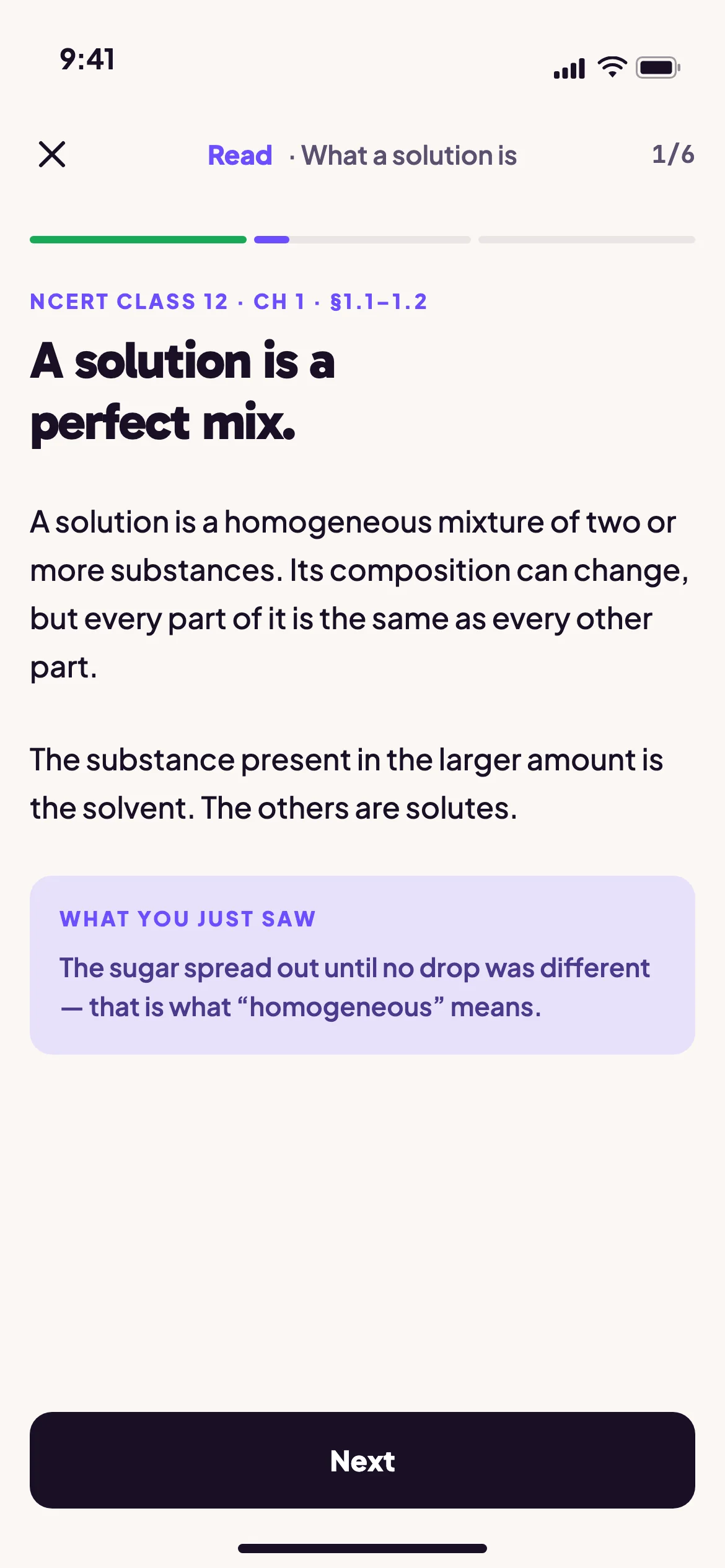
In the app a chapter starts as a game you play, then a short read, then questions that check you. A full chapter, understood, in 45 to 60 minutes.

JEE Advanced Challenge Set
Five problems. Each needs calculus, a second chapter, a surprising result, an optimisation, or a solution path you build yourself. Take 6 to 8 minutes each.
A disc of radius has surface mass density . Here is the distance from its centre, and is a constant. It rolls without slipping down a fixed incline of angle 30°. The axis is through its centre, perpendicular to its face. Friction is enough to prevent slipping. Take m/s2. Find the acceleration of its centre, in m/s2, correct to two decimal places.
Show answer
A uniform rod of mass and length is hinged at one end. It is held horizontal and then released. At the instant of release, which of the following is/are correct? (One or more of the following may be correct.)
- (A) The angular acceleration of the rod is .
- (B) The free end accelerates downward at , faster than free fall.
- (C) The force from the hinge on the rod is , upward.
- (D) Every point of the rod accelerates faster than .
Show answer
A uniform rod of mass and length lies at rest on a frictionless horizontal table. It is free, with no pivot. A lump of putty of mass moves on the table at speed , perpendicular to the rod. It hits one end and sticks. Just after the impact, what is the angular velocity, and which point of the rod is momentarily at rest?
- ; the centre of the rod
- ; the point from the far (unstruck) end
- ; the point from the far end
- ; the far end
Show answer
A uniform rod 1.2 m long can be pivoted at any point along its length. It swings in a vertical plane with small oscillations. Take m/s2. For which distance of the pivot from the centre is the period smallest, and what is that period?
- m; s
- m; s
- m; s
- m; s
Show answer
A spool of mass has outer radius and an inner axle of radius . Take its moment of inertia about its axis as . It stands on a rough horizontal floor. A thread is wound on the axle. It leaves from the bottom of the axle and is pulled horizontally with force . The spool rolls without slipping. Which of the following is/are correct? (One or more of the following may be correct.)
- (A) The spool's centre accelerates towards the pull at .
- (B) Friction on the spool is , opposite to the pull.
- (C) If the thread left from the top of the axle instead, friction on the spool would be zero.
- (D) The spool rolls away from the direction of the pull.
Show answer
Quick Review: What JEE Main Repeats
Frequency bands come from our JEE Main analysis. NEET data for this chapter is coming.
When can you use ?
Why it recurs: Our analysis found it in nearly every shift.
Which bodies obey ?
Why it recurs: Applied to a sphere, it gives a wrong answer.
Ring vs disc, same and , central perpendicular axis?
Why it recurs: Every composite-shape question starts here.
Thin rod: centre axis vs end axis?
Why it recurs: Rod-based composites are a fixed archetype.
Solid sphere vs hollow sphere about a diameter?
Why it recurs: Used in rolling and composite questions.
A disc loses a hole of half its radius. What fraction of mass goes?
Why it recurs: A named trap in our analysis.
What does mean, and does it depend on the axis?
Why it recurs: Often asked as a ratio between two axes.
What is the lever arm?
Why it recurs: is the fastest route.
How do you change rpm to rad/s?
Why it recurs: A named trap in our analysis.
A pulley with mass: is the tension equal to the hanging weight?
Why it recurs: Pulley-with-mass questions are frequent.
A skater pulls her arms in. What happens to and to KE?
Why it recurs: Students wrongly conserve KE.
Two discs stick on one axle. What is conserved?
Why it recurs: A favourite numerical-answer setup.
Angular momentum of a point particle about a point?
Why it recurs: A named trap in our analysis.
Speed of the contact point and the top of a rolling wheel?
Why it recurs: Velocity-of-a-point questions.
Heights reached by sphere, disc, ring with the same speed?
Why it recurs: A named trap in our analysis.
Which rolls down fastest: ring, disc or solid sphere?
Why it recurs: Smallest wins.
Where does the CM of an exploding shell go?
Why it recurs: Explosion forces are internal.
Where is the CM of two unequal masses?
Why it recurs: The basis of every CM question.
What does a couple do?
Why it recurs: Net force zero, net torque not zero.
What unit must be in for ?
Why it recurs: Revolutions must be multiplied by .
★ Rotational Motion · Fact Sheet
One page for the night before the exam.
Centre of mass
· continuous: ·
Hole as negative mass; radius removes
Vector product
Right-hand rule,
Torque and angular momentum
, ·· means constant
Equilibrium
andLever:
Moment of inertia
· · (flat bodies)Ring · disc · rod (centre) · rod (end)
Solid sphere · hollow sphere · ring diameter · disc diameter
Rotation about a fixed axis
· · · ·
·
Rolling (JEE)
· contact point at rest · top moves at ·
: ring 1, disc , solid sphere
FAQ
System of Particles and Rotational Motion: common questions
Is rolling motion in the NEET 2026 syllabus?
No. It was removed from the rationalised NCERT book and is not listed in the NEET 2026 syllabus. JEE students still need it.
Are the parallel and perpendicular axis theorems still needed?
Yes. NCERT removed the section, but the NEET 2026 and JEE Main 2026 syllabi both still list them.
Why does a skater spin faster when she pulls her arms in?
No external torque acts, so angular momentum Iω stays constant. Pulling her arms in lowers I, so ω rises.
What is the difference between centre of mass and centre of gravity?
The centre of gravity is where the total gravitational torque is zero. In a uniform gravitational field, it is the same point as the centre of mass.
Which reaches the bottom of an incline first: a ring, a disc or a solid sphere?
The solid sphere, then the disc, then the ring. The sphere has the smallest k²/R², so more of its energy goes into moving forward.
Before the exam
What the paper actually asks from this chapter
Read next
More physics notes
You have read it
Now play it.
Reading a chapter and understanding it are different things. In the app every chapter is Do · Read · Verify: a game you play, a short read, then questions that check you. A full chapter, understood, in 45 to 60 minutes.
- DoA game built for the idea
- ReadThe short NCERT explainer
- VerifyQuestions that check you
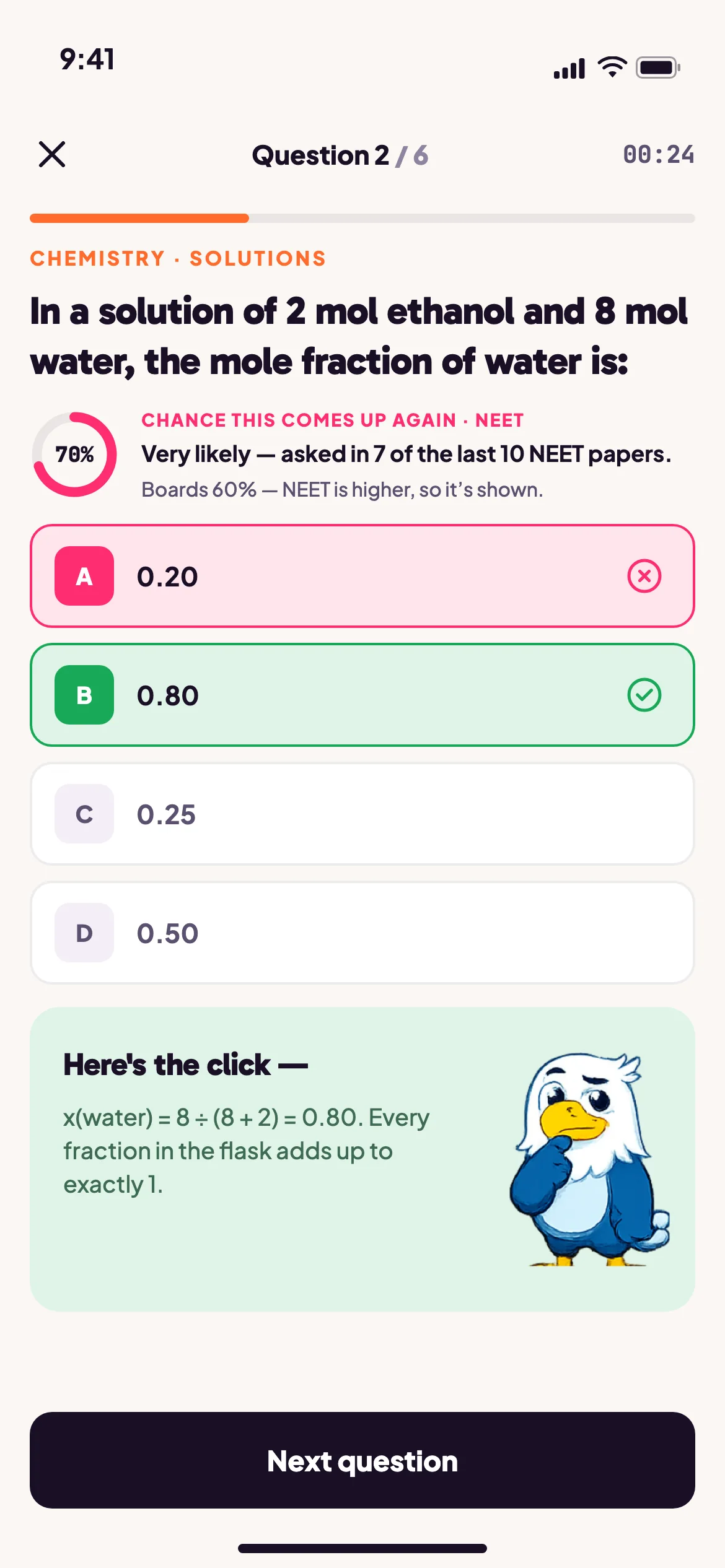

Still stuck at 11pm? TarQ AI reads the answer you got wrong and teaches the idea behind it, not just the right option.