Physics · Mechanics · Chapter notes

Work, Power and Energy · Class 11 Notes

Complete Class 11 notes on Work, Power and Energy: 11 diagrams, 15 worked numericals to JEE Advanced depth, and a one-page formula sheet. Read free online or download the PDF.

Class 11JEE MainJEE AdvancedNEETCBSE BoardsNCERTFree, no sign up
28Pages
11Diagrams
15Numericals

In short

Work is done only when a force moves something along its own direction: W = Fd cosθ. The work done by all forces equals the change in kinetic energy, which is the work-energy theorem. When no friction acts, kinetic and potential energy simply trade places, so total mechanical energy stays constant. Power is how fast that work happens.

Contents
  1. ·How to Read This Set
  2. 1Work what counts as work, and its sign
  3. 2Work by a Changing Force
  4. 3Kinetic Energy and the Work-Energy Theorem
  5. 4Potential Energy gravity, springs, and conservative forces
  6. 5Conservation of Mechanical Energy
  7. 6Power how fast the work is done
  8. 7Collisions elastic, inelastic, and restitution
  9. 8Important Questions 15 worked numericals
  10. 9JEE Advanced Challenge 6 problems at real Advanced level
  11. Work, Power & Energy · Fact Sheet
0

How to Read This Set

  • This chapter is worth marks in all three exams. So it is built to JEE Advanced depth.
  • Each section carries a badge. It tells a NEET student what they still need.
  • Most of the text is in points, not paragraphs. Read the points, then study the drawing.
  • Every numerical answer here was checked by computer before printing.
Think it through
One idea runs through the whole chapter
  • Energy is never created or destroyed.
  • It only changes form, or moves from one body to another.
  • So most questions become: where did the energy start, and where did it end up?
  • Once you can answer that, the algebra is easy.
1

Work

In NEET and JEE
  • In physics, work needs two things: a force, and movement along that force.
  • Push a wall all day. Nothing moves. You have done zero work.
  • Work is a scalar. It has size and sign, but no direction.
  • The SI unit is the joule (J). 1 J = 1 N × 1 m.
Only the part of the force along the movement does work. The sideways part does none.mFF cosθθdisplacement dOnly the part of F ALONG ddoes work.W = F d cosθThe sideways part F sinθlifts nothing here, so itdoes no work at all.
Only the part of the force along the movement does work. The sideways part does none.
Work done by a constant force
W=Fd=FdcosθW = \vec{F}\cdot\vec{d} = F\,d\cos\theta

θ is the angle between the force and the displacement.

The sign tells you the story

Three angles, three signs. The angle between force and movement decides everything.THE SIGN OF WORK IS SET BY THE ANGLEθ = 0°force along motionW is POSITIVEθ = 90°force across motionW is ZEROθ = 180°force against motionW is NEGATIVE
Three angles, three signs. The angle between force and movement decides everything.
  • Positive work adds energy to the body. It speeds up.
  • Negative work takes energy away. It slows down.
  • Zero work means the force is at right angles to the motion.
  • Friction usually does negative work. It points against the sliding.
Trap alert
Three forces that often do zero work
  • The normal force on a block sliding along the floor. It is at 90°.
  • The tension in a string as a stone whirls in a circle. Also 90°.
  • Gravity on a bag you carry level across a room.
  • Carrying a heavy bag feels tiring, but the physics work is zero.
Not sure when work is zero?
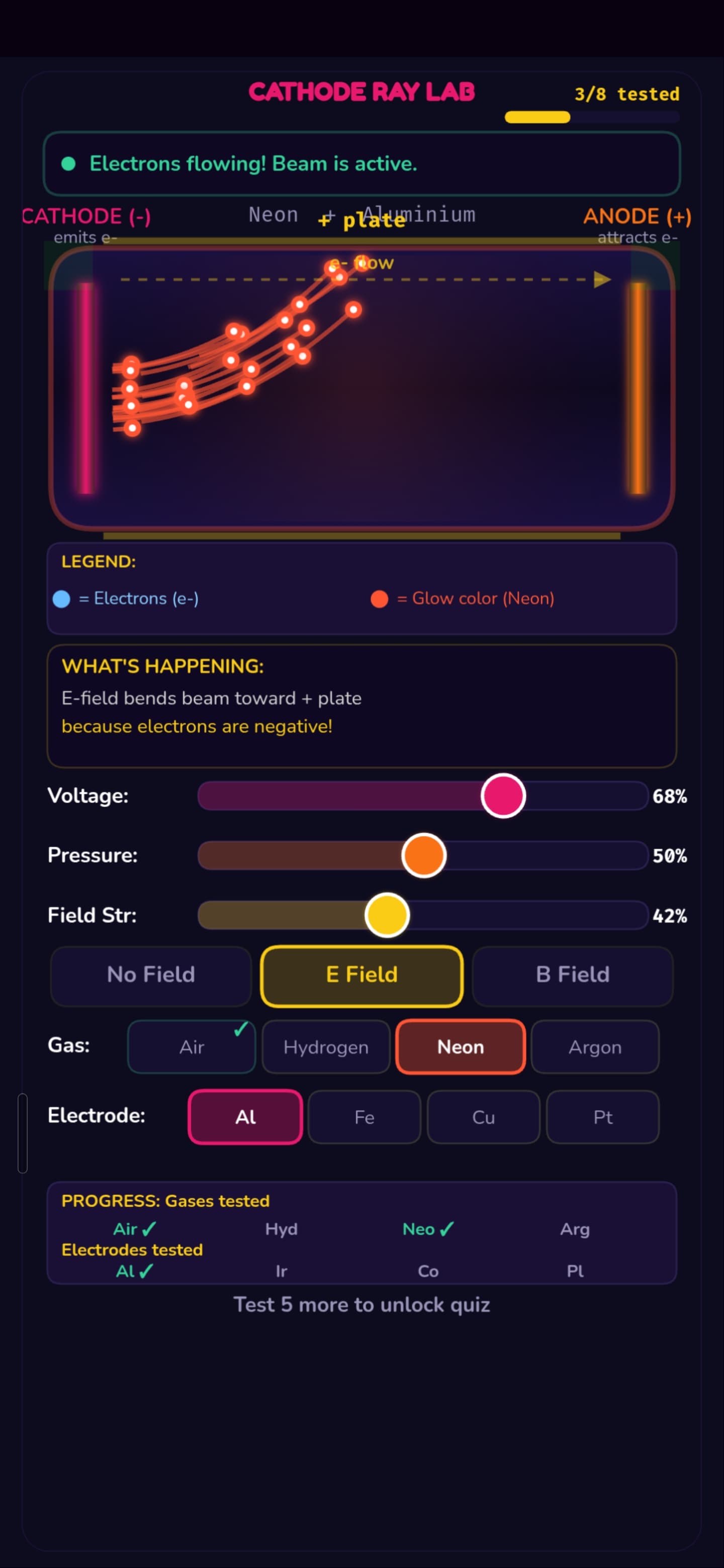
Turn the force and watch the work change sign.

Drag the arrow around and see W go from positive, through zero, to negative. The cosθ in the formula stops being something you memorise.

Play this concept in the app
2

Work by a Changing Force

JEE Main and Advanced
  • The formula W = Fd cosθ works only when F is constant.
  • Springs, gravity far from Earth, and many real forces change as you move.
  • Then you must add up the work in tiny steps.
  • On a force against distance graph, that sum is simply the area under the curve.
Split the area into shapes you know. A rectangle plus a triangle here gives 40 J.FORCE THAT CHANGES: WORK IS THE AREA UNDER THE GRAPHx (m)F (N)02610rectangle10 × 2 = 20 Jtriangle½ × 4 × 10 = 20 JTOTAL WORK20 + 20 = 40 JFor a curve, the areabecomes an integral.
Split the area into shapes you know. A rectangle plus a triangle here gives 40 J.
Work done by a variable force
W=x1x2Fdx=area under the F-x graphW = \int_{x_1}^{x_2} F\,dx = \text{area under the } F\text{-}x \text{ graph}
Think it through
How to read the graph safely
  • Area above the x-axis is positive work.
  • Area below the x-axis is negative work.
  • Add them with their signs. Do not just add the sizes.
  • For straight lines, break the shape into rectangles and triangles.
3

Kinetic Energy and the Work-Energy Theorem

In NEET and JEE
  • Kinetic energy is the energy a body has because it is moving.
  • It is always positive. It never has a direction.
  • Double the speed and the kinetic energy becomes four times larger.
  • This is why stopping distance grows so fast with speed.
Kinetic energy
K=12mv2=p22mK = \frac{1}{2}mv^2 = \frac{p^2}{2m}
The net work done on a body equals its change in kinetic energy. Nothing else is needed.WORK-ENERGY THEOREM: NET WORK CHANGES KINETIC ENERGYmubeforeK = ½ m u²mvafterK = ½ m v²net force acts over this distanceW(net) = ½ m v² − ½ m u² = ΔK
The net work done on a body equals its change in kinetic energy. Nothing else is needed.
Work-energy theorem
Wnet=KfKi=ΔKW_{net} = K_f - K_i = \Delta K
  • This is the big shortcut of the chapter.
  • You do not need to know the force at every instant.
  • You do not need the time taken either.
  • You only need the speed at the start and at the end.
Trap alert
Use the NET work, not one force
  • W(net) means the work of every force added together.
  • Include friction. Include gravity. Include the applied force.
  • A common slip is to use only the applied force and forget friction.
  • If the body speeds up, W(net) must come out positive.
4

Potential Energy

In NEET and JEE
  • Potential energy is stored energy. It depends on position, not on speed.
  • Lift a book and you store energy in it. Let go and that energy returns.
  • Stretch a spring and you store energy in the spring.
  • Potential energy is always measured from a level you choose.
The two you need
Ugravity=mghUspring=12kx2U_{gravity} = mgh \qquad U_{spring} = \frac{1}{2}kx^2
The spring force grows as you stretch it. The stored energy is the triangular area under the line.A SPRING STORES ENERGY AS YOU STRETCH ITF = kxxxFarea = ½ k x²this is the stored energy
The spring force grows as you stretch it. The stored energy is the triangular area under the line.
  • A spring pulls back with force F = kx, where k is the spring constant.
  • The stored energy is ½kx², not kx².
  • Stretching from 10 cm to 20 cm costs three times more than the first 10 cm.
  • That is because energy depends on x squared, not on x.

Conservative and non-conservative forces

Gravity does the same work along both paths. Only the change in height matters.GRAVITY DOES NOT CARE WHICH PATH YOU TAKEABpath 1path 2hBoth paths: W = − m g hOnly the HEIGHT matters.Friction is different. A longerpath always costs more, so itswork depends on the route.
Gravity does the same work along both paths. Only the change in height matters.
  • A conservative force does the same work whichever path you take.
  • Gravity and the spring force are conservative. So we can define a potential energy for them.
  • A non-conservative force depends on the path. Friction is the main one.
  • A longer path always means more heat lost to friction.
Think it through
Why friction has no potential energy
  • Potential energy means the energy can be fully returned.
  • A stretched spring gives back everything you put in.
  • Friction turns the energy into heat and sound.
  • That heat spreads out and cannot be pulled back. So there is nothing to store.
5

Conservation of Mechanical Energy

In NEET and JEE
  • Mechanical energy is kinetic plus potential: E = K + U.
  • If only conservative forces act, E stays the same throughout the motion.
  • So kinetic energy and potential energy simply trade places.
  • This turns many hard problems into one line of algebra.
A pendulum trades potential for kinetic and back again. The two bars always add to the same total.A SWINGING PENDULUM TRADES ONE ENERGY FOR THE OTHERKEPEhighest pointall PE, no KEKEPElowest pointall KE, no PEKEPEin betweensome of eachKE + PE staysthe same thewhole time.
A pendulum trades potential for kinetic and back again. The two bars always add to the same total.
Conservation of mechanical energy
Ki+Ui=Kf+UfK_i + U_i = K_f + U_f

valid only when no friction or other non-conservative force acts

A moving block stops when all its kinetic energy has gone into the spring.KINETIC ENERGY TURNS INTO SPRING ENERGYmvmoving inmfully stoppedcompression xAt maximum compression the block stops.All its kinetic energy is now in the spring.½ m v² = ½ k x²
A moving block stops when all its kinetic energy has gone into the spring.
  • Falling from height h: v = √(2gh). The mass cancels out.
  • A block hitting a spring: ½mv² = ½kx² at maximum compression.
  • At maximum compression the block is momentarily at rest.
  • A pendulum released from height h reaches the same speed as a free fall from h.
Trap alert
When friction is present, energy is NOT conserved
  • Mechanical energy drops. The lost part becomes heat.
  • Use this instead: Ki + Ui + Wfriction = Kf + Uf.
  • W(friction) is negative, so it eats into the total.
  • Total energy of the universe is still conserved. Only the mechanical part falls.
Energy bars not clicking?
Slide the pendulum and watch the two bars swap.

Move the bob to any angle and see kinetic and potential energy trade in real time. The total bar never changes height, which is the whole idea.

Play this concept in the app
6

Power

In NEET and JEE
  • Power is the rate of doing work. It answers: how fast?
  • Two people can do the same work. The faster one has more power.
  • The SI unit is the watt (W). 1 W = 1 J/s.
  • 1 horsepower = 746 W. 1 kWh = 3.6 × 10⁶ J, and it is a unit of energy, not power.
The same job done in half the time needs twice the power.SAME WORK, DIFFERENT TIME: THAT IS POWERlifts 10 min 20 secondsP = 1000 Wlifts 10 min 10 secondsP = 2000 WSame job done.Half the time.Twice the power.
The same job done in half the time needs twice the power.
Power, three ways
Pavg=WtPinst=dWdt=FvP_{avg} = \frac{W}{t} \qquad P_{inst} = \frac{dW}{dt} = \vec{F}\cdot\vec{v}
  • Use P = Fv when a body moves at steady speed against a resisting force.
  • A car at constant speed: the engine power equals resistance × speed.
  • For a pump lifting water: useful power = mgh / t.
  • If efficiency is given, input power = useful power / efficiency.
Trap alert
kWh is energy, not power
  • Your electricity bill is in kilowatt-hours.
  • A kWh is power × time, so it measures energy used.
  • A 1000 W heater run for 1 hour uses 1 kWh.
  • Calling it a unit of power is a common exam trap.
7

Collisions

In NEET and JEE
  • In every collision, momentum is conserved. This is always true.
  • Kinetic energy is a different matter. It may or may not be conserved.
  • That single difference splits collisions into two types.
  • Always write the momentum equation first. It never fails you.
Momentum is conserved in both. Kinetic energy survives only the elastic one.TWO KINDS OF HEAD-ON COLLISIONELASTIC: they bounce apartubeforeafter: both move, KE is conservedPERFECTLY INELASTIC: they stickubeforeafter: one lump, KE is lostMomentum is conserved in BOTH. Kinetic energy is conserved only in the elastic one.
Momentum is conserved in both. Kinetic energy survives only the elastic one.
  • Elastic: kinetic energy is conserved. The bodies bounce apart.
  • Inelastic: some kinetic energy becomes heat and sound.
  • Perfectly inelastic: the bodies stick and move as one. Energy loss is largest here.
  • Real collisions are almost always somewhere in between.
Head-on elastic collision, one dimension
v1=m1m2m1+m2u1+2m2m1+m2u2v_1 = \frac{m_1-m_2}{m_1+m_2}u_1 + \frac{2m_2}{m_1+m_2}u_2
v2=m2m1m1+m2u2+2m1m1+m2u1v_2 = \frac{m_2-m_1}{m_1+m_2}u_2 + \frac{2m_1}{m_1+m_2}u_1
Think it through
Three cases worth memorising
  • Equal masses: they simply swap velocities.
  • Heavy hits light at rest: the heavy one carries on, the light one shoots off at nearly 2u.
  • Light hits heavy at rest: the light one bounces straight back at nearly the same speed.
  • These three cover a large share of the objective questions asked.

Coefficient of restitution

Each bounce reaches e squared times the height before it. The pattern never changes.EVERY BOUNCE IS SHORTER BY THE SAME FACTORhe²he⁴he⁶he = speed after speed before0 ≤ e ≤ 1e = 1 is elastic.e = 0 means they stick.
Each bounce reaches e squared times the height before it. The pattern never changes.
Coefficient of restitution
e=speed of separationspeed of approach=v2v1u1u2e = \frac{\text{speed of separation}}{\text{speed of approach}} = \frac{v_2-v_1}{u_1-u_2}
  • e = 1 is perfectly elastic. e = 0 is perfectly inelastic.
  • A ball dropped from h rebounds to e²h.
  • After n bounces the height is e2nh.
  • Total distance travelled before stopping is h(1+e²)/(1−e²).
Energy lost in a perfectly inelastic collision
ΔK=m1m22(m1+m2)(u1u2)2\Delta K = \frac{m_1 m_2}{2(m_1+m_2)}(u_1-u_2)^2
8

Important Questions

Fifteen numericals, tagged by exam. They rise in difficulty. Try each one before reading the working.

Q1
Four forces, one block
NEET

A 10 kg block is pulled 10 m along a rough floor by a 50 N force at 37° above the horizontal. Take μ = 0.2 and g = 10. Find the work done by each force, and the final speed from rest. (sin 37° = 0.6, cos 37° = 0.8)

CoreFind the normal force first. The upward part of F lightens the block, so N is not mg.
Working
N=mgFsinθ=10030=70 Nf=0.2(70)=14 NN = mg - F\sin\theta = 100 - 30 = 70\ \text{N} \Rightarrow f = 0.2(70) = 14\ \text{N}
WF=(50cos37)(10)=400 J,Wfriction=140 JW_F = (50\cos 37^\circ)(10) = \mathbf{400\ \text{J}}, \qquad W_{friction} = \mathbf{-140\ \text{J}}
Wgravity=Wnormal=0Wnet=260 JW_{gravity} = W_{normal} = 0 \Rightarrow W_{net} = 260\ \text{J}
12mv2=260v=7.2 m/s\frac{1}{2}mv^2 = 260 \Rightarrow v = \mathbf{7.2\ \text{m/s}}
TrapN is 70 N, not 100 N. The lifting part of the force reduces it. Using mg gives f = 20 N and a wrong answer throughout.
Q2
Work from a graph
JEE MAIN

A force acts along the x-axis. It stays at 10 N from x = 0 to x = 2 m. It then falls in a straight line to zero at x = 6 m. Find the total work done.

CoreWork is the area under the force against distance graph. Split it into a rectangle and a triangle.
Working
rectangle=10×2=20 J\text{rectangle} = 10 \times 2 = 20\ \text{J}
triangle=12×4×10=20 J\text{triangle} = \frac{1}{2} \times 4 \times 10 = 20\ \text{J}
W=40 JW = \mathbf{40\ \text{J}}
TrapYou cannot use W = Fd here, because F changes. Taking an average force works only when the change is linear, which it is in the second part but not overall.
Q3
Stopping a bullet
NEET

A 10 g bullet moving at 200 m/s is stopped by a wooden block after going 20 cm into it. Find the average resistive force.

CoreUse the work-energy theorem. The resistive force removes all the kinetic energy.
Working
Ki=12(0.01)(200)2=200 JK_i = \frac{1}{2}(0.01)(200)^2 = 200\ \text{J}
Wresist=200=F(0.20)F=1000 NW_{resist} = -200 = -F(0.20) \Rightarrow F = \mathbf{1000\ \text{N}}
TrapConvert grams to kilograms and centimetres to metres first. Leaving the mass as 10 makes the answer 1000 times too large.
Q4
The second stretch costs more
JEE MAIN

A spring has k = 200 N/m. Find the work needed to stretch it from 0 to 10 cm, then from 10 cm to 20 cm. Compare them.

CoreUse U = ½kx² and take the difference. Energy depends on x squared.
Working
W1=12(200)(0.1)2=1 JW_1 = \frac{1}{2}(200)(0.1)^2 = \mathbf{1\ \text{J}}
W2=12(200)[(0.2)2(0.1)2]=3 JW_2 = \frac{1}{2}(200)\left[(0.2)^2 - (0.1)^2\right] = \mathbf{3\ \text{J}}
TrapThe second 10 cm costs three times as much, not the same. Equal stretches never need equal work, because the force keeps growing.
Q5
Block meets spring
JEE MAIN

A 2 kg block slides at 4 m/s on a smooth floor and hits a spring of k = 800 N/m. Find the maximum compression.

CoreAt maximum compression the block has stopped. All its kinetic energy is now in the spring.
Working
12mv2=12kx2x=vmk\frac{1}{2}mv^2 = \frac{1}{2}kx^2 \Rightarrow x = v\sqrt{\frac{m}{k}}
x=42800=0.2 mx = 4\sqrt{\frac{2}{800}} = \mathbf{0.2\ \text{m}}
TrapThe block is at rest at maximum compression, but its acceleration is largest there. Zero speed does not mean zero force.
Q6
Pendulum at the bottom
NEET

A pendulum of length 2 m is released from rest with the string horizontal. Find the speed of the bob at the lowest point. Take g = 10.

CoreOnly gravity and tension act. Tension does no work, so mechanical energy is conserved.
Working
mgL=12mv2v=2gLmgL = \frac{1}{2}mv^2 \Rightarrow v = \sqrt{2gL}
v=2(10)(2)=6.3 m/sv = \sqrt{2(10)(2)} = \mathbf{6.3\ \text{m/s}}
TrapThe mass cancels, so a heavy bob and a light bob arrive at the same speed. The tension never appears, because it is always at 90° to the motion.
Q7
Down a rough slope
JEE MAIN

A block starts from rest and slides 5 m down a 30° incline with μ = 0.25. Find its speed at the bottom. Take g = 10.

CoreMechanical energy is not conserved here. Subtract the work done against friction.
Working
mgLsinθμmgLcosθ=12mv2mgL\sin\theta - \mu mgL\cos\theta = \frac{1}{2}mv^2
v=2gL(sinθμcosθ)=2(10)(5)(0.50.2165)v = \sqrt{2gL(\sin\theta - \mu\cos\theta)} = \sqrt{2(10)(5)(0.5 - 0.2165)}
v=5.3 m/sv = \mathbf{5.3\ \text{m/s}}
TrapWithout friction the answer would be 7.07 m/s. Forgetting the friction term is the standard error. Note the mass cancels again.
Q8
Power of a pump
NEET

A pump lifts 200 kg of water through 10 m in 20 s. Its efficiency is 80%. Find the useful power and the input power. Take g = 10.

CoreUseful power is the work against gravity divided by time. Input power is larger because of losses.
Working
Puseful=mght=200(10)(10)20=1000 WP_{useful} = \frac{mgh}{t} = \frac{200(10)(10)}{20} = \mathbf{1000\ \text{W}}
Pinput=10000.8=1250 WP_{input} = \frac{1000}{0.8} = \mathbf{1250\ \text{W}}
TrapDivide by the efficiency, never multiply. The input must always be bigger than the useful output, so if your answer is smaller, you have divided the wrong way.
Q9
Car at steady speed
JEE MAIN

A car moves at a constant 20 m/s against a total resistance of 500 N. Find the power delivered by the engine.

CoreConstant speed means zero acceleration. So the driving force exactly equals the resistance.
Working
F=500 N,P=Fv=500×20=10 kWF = 500\ \text{N}, \qquad P = Fv = 500 \times 20 = \mathbf{10\ \text{kW}}
TrapThe mass of the car is not needed at all. It is given only to tempt you into using it. At constant speed the net force is zero.
Q10
Power grows with time
JEE MAIN

A constant 20 N force pulls a 5 kg block from rest on a smooth floor. Find the instantaneous power at t = 3 s, and the average power over those 3 s.

CoreForce is constant but speed is not. So instantaneous power keeps rising.
Working
a=Fm=4 m/s2v=at=12 m/sa = \frac{F}{m} = 4\ \text{m/s}^2 \Rightarrow v = at = 12\ \text{m/s}
Pinst=Fv=20×12=240 WP_{inst} = Fv = 20 \times 12 = \mathbf{240\ \text{W}}
Pavg=Wt=F12at2t=120 WP_{avg} = \frac{W}{t} = \frac{F \cdot \frac{1}{2}at^2}{t} = \mathbf{120\ \text{W}}
TrapAverage power is not the same as instantaneous power. Here the average is exactly half, because the speed rose linearly from zero.
Q11
Equal masses, elastic
NEET

A 1 kg ball moving at 6 m/s hits an identical ball at rest head-on. The collision is perfectly elastic. Find both velocities afterwards.

CoreFor equal masses in a perfectly elastic head-on collision, the two simply exchange velocities.
Working
v1=m1m2m1+m2u1=0,v2=2m1m1+m2u1=u1v_1 = \frac{m_1-m_2}{m_1+m_2}u_1 = 0, \qquad v_2 = \frac{2m_1}{m_1+m_2}u_1 = u_1
v1=0 m/s,v2=6 m/s\mathbf{v_1 = 0\ \text{m/s}, \quad v_2 = 6\ \text{m/s}}
TrapThe first ball stops completely. This is why a Newton's cradle works. Both momentum and kinetic energy check out, which no other pair of answers does.
Q12
Unequal masses, elastic
JEE MAIN

A 2 kg body moving at 10 m/s hits a 3 kg body at rest head-on and elastically. Find both velocities afterwards.

CoreApply the standard elastic formulas, then verify with momentum and kinetic energy.
Working
v1=235(10)=2 m/s,v2=2(2)5(10)=8 m/sv_1 = \frac{2-3}{5}(10) = \mathbf{-2\ \text{m/s}}, \qquad v_2 = \frac{2(2)}{5}(10) = \mathbf{8\ \text{m/s}}
check p: 20=2(2)+3(8)=20 \text{check } p: \ 20 = 2(-2)+3(8) = 20 \ \checkmark
check K: 100=12(2)(4)+12(3)(64)=100 \text{check } K: \ 100 = \frac{1}{2}(2)(4) + \frac{1}{2}(3)(64) = 100 \ \checkmark
TrapThe minus sign means the lighter body bounces back. A lighter body always rebounds when it hits a heavier one at rest. Always run the two checks.
Q13
Counting the bounces
JEE MAIN

A ball is dropped from 5 m onto a floor with e = 0.8. Find the height after the first and second bounces, and the total distance it travels before coming to rest.

CoreEach bounce multiplies the height by e squared. The total path is a geometric series.
Working
h1=e2h=0.64(5)=3.2 m,h2=e4h=2.05 mh_1 = e^2 h = 0.64(5) = \mathbf{3.2\ \text{m}}, \qquad h_2 = e^4 h = \mathbf{2.05\ \text{m}}
total=h1+e21e2=5(1.640.36)=22.8 m\text{total} = h\,\frac{1+e^2}{1-e^2} = 5\left(\frac{1.64}{0.36}\right) = \mathbf{22.8\ \text{m}}
TrapThe height falls by e² each time, not by e. The total distance is finite even though the number of bounces is infinite, which surprises most students.
Q14
How much energy is lost
JEE MAIN

A 4 kg body moving at 5 m/s strikes a 6 kg body at rest. They stick together. Find their common velocity and the kinetic energy lost.

CoreMomentum is conserved. Kinetic energy is not, so find it before and after and take the difference.
Working
v=m1u1m1+m2=4(5)10=2 m/sv = \frac{m_1 u_1}{m_1+m_2} = \frac{4(5)}{10} = \mathbf{2\ \text{m/s}}
Ki=50 J,Kf=12(10)(4)=20 JK_i = 50\ \text{J}, \qquad K_f = \frac{1}{2}(10)(4) = 20\ \text{J}
ΔK=30 J lost, which is 60%\Delta K = \mathbf{30\ \text{J lost, which is } 60\%}
TrapNever apply conservation of kinetic energy to a sticking collision. The shortcut formula m1m2(u1−u2)²/2(m1+m2) gives the same 30 J.
Q15
The ballistic pendulum
JEE MAIN

A 20 g bullet moving at 300 m/s embeds itself in a 2 kg block hanging from a string. Find how high the block rises. Take g = 10.

CoreThis is two separate stages. Momentum for the collision, then energy for the swing. Never mix them.
Working
stage 1, momentum: (0.02)(300)=(2.02)VV=2.97 m/s\text{stage 1, momentum: } (0.02)(300) = (2.02)V \Rightarrow V = 2.97\ \text{m/s}
stage 2, energy: 12(2.02)V2=(2.02)gh\text{stage 2, energy: } \frac{1}{2}(2.02)V^2 = (2.02)gh
h=V22g=0.44 mh = \frac{V^2}{2g} = \mathbf{0.44\ \text{m}}
TrapUsing energy conservation for stage 1 is wrong, because the bullet embeds and loses energy. Using momentum for stage 2 is also wrong, because gravity acts. Each stage needs its own rule.
9

JEE Advanced Challenge

JEE Advanced mainly
  • Six problems at genuine JEE Advanced level. Expect 5 to 8 minutes each.
  • Each one needs two or more ideas joined together, not one formula.
  • Two use real Advanced formats: one multiple-correct, one numerical answer.
  • Every assumption is stated in the question, as a real Advanced paper does.
Think it through
What makes a problem Advanced, not Main
  • A Main problem tells you which idea to use. You then do the algebra.
  • An Advanced problem hides the idea. Finding it is the problem.
  • In A2 below, the whole question turns on one hidden fact: at maximum compression both blocks move at the same speed.
  • Spot that and it takes two lines. Miss it and there is no way in.
A1
The engine that cannot pull hard at speed
JEE ADVNUMERICAL

A car of mass 1000 kg has an engine giving a constant power of 40 kW. It starts from rest on a level road. Ignore friction and air resistance. Find its speed 25 s later. Give your answer in m/s, correct to two decimal places.

CoreConstant power means the force is not constant. As v grows, F = P/v falls. So you cannot use the equations of motion. Start from Newton's second law and separate the variables.
Working
P=Fv=mdvdtv0vmvdv=0tPdtP = Fv = m\frac{dv}{dt}v \Rightarrow \int_0^v mv\,dv = \int_0^t P\,dt
12mv2=Ptv=2Ptm\frac{1}{2}mv^2 = Pt \Rightarrow v = \sqrt{\frac{2Pt}{m}}
v=2(40000)(25)1000=2000=44.72 m/sv = \sqrt{\frac{2(40000)(25)}{1000}} = \sqrt{2000} = \mathbf{44.72\ \text{m/s}}
TrapUsing v = u + at is the trap, and it needs a constant force. Note the neat side result: 12mv2=Pt\frac{1}{2}mv^2 = Pt says the whole energy delivered has become kinetic energy, which you could also have written down directly from the work-energy theorem.
A2
A spring caught between two blocks
JEE ADVANCED

A 2 kg block slides at 6 m/s along a frictionless floor. A light spring of k = 1000 N/m is fixed to its front face. It strikes a stationary 4 kg block. Find the maximum compression of the spring.

CoreCompression is largest at the instant the two blocks stop approaching each other. At that moment they move with the same velocity. Use momentum to find it, then energy for the rest.
Working
momentum: (2)(6)=(2+4)vv=2 m/s\text{momentum: } (2)(6) = (2+4)v \Rightarrow v = 2\ \text{m/s}
energy: 12(2)(6)2=12(6)(2)2+12kx2\text{energy: } \frac{1}{2}(2)(6)^2 = \frac{1}{2}(6)(2)^2 + \frac{1}{2}kx^2
36=12+500x2x=0.22 m36 = 12 + 500x^2 \Rightarrow x = \mathbf{0.22\ \text{m}}
TrapSetting the first block's whole 36 J into the spring gives 0.27 m and is wrong, because the second block is moving too and keeps 12 J. This is the same hidden step as a perfectly inelastic collision, except here the energy is stored instead of lost.
A3
The chain that pulls itself off the table
JEE ADVANCED

A uniform chain of length 3 m lies on a frictionless table. One third of it hangs over the edge. It is released from rest. Find the speed of the chain as the last link leaves the table. Take g = 10.

CoreThe mass is spread out, so track the centre of mass of the hanging part, not one point. Compute the potential energy at the start and at the end, and let energy conservation do the rest.
Working
start: hanging mass M3, its centre L6 below the edge\text{start: hanging mass } \frac{M}{3}, \text{ its centre } \frac{L}{6} \text{ below the edge}
Ui=M3gL6=MgL18,Uf=MgL2U_i = -\frac{M}{3}g\frac{L}{6} = -\frac{MgL}{18}, \qquad U_f = -Mg\frac{L}{2}
12Mv2=MgL2MgL18=4MgL9\frac{1}{2}Mv^2 = \frac{MgL}{2} - \frac{MgL}{18} = \frac{4MgL}{9}
v=8gL9=8(10)(3)9=5.16 m/sv = \sqrt{\frac{8gL}{9}} = \sqrt{\frac{8(10)(3)}{9}} = \mathbf{5.16\ \text{m/s}}
TrapTreating the hanging third as a point mass at the edge gives zero drop and no answer at all. The mass M cancels, so the chain's weight never mattered. Only its length did.
A4
Slide down, then squash a spring
JEE ADVANCED

A 2 kg block is released from rest on a rough incline of 30°, with μ = 0.25. It slides 4 m along the incline before touching an unstretched spring of k = 500 N/m lying along the slope. Find the maximum compression. Take g = 10.

CoreFriction acts over the whole path, including the part while the spring is being squashed. So the distance in the friction term is (4 + x), not 4. That makes the equation a quadratic.
Working
mgsinθ(d+x)μmgcosθ(d+x)=12kx2mg\sin\theta(d+x) - \mu mg\cos\theta(d+x) = \frac{1}{2}kx^2
(104.33)(4+x)=250x2250x25.67x22.68=0(10 - 4.33)(4+x) = 250x^2 \Rightarrow 250x^2 - 5.67x - 22.68 = 0
x=0.31 mx = \mathbf{0.31\ \text{m}}
TrapUsing a friction distance of 4 m instead of (4 + x) is the classic error here. Friction depends on the path length travelled, never on the displacement. Gravity is the opposite, and that contrast is exactly what the question is testing.
A5
Which statements survive
JEE ADVMULTIPLE CORRECT

A ball strikes an identical stationary ball head-on. The coefficient of restitution is e = 0.5. One or more of the following are correct. Identify all of them.

(A) Both balls move forward after the collision
(B) The first ball ends with one third of the speed of the second
(C) The fractional loss of kinetic energy is 37.5%
(D) The first ball rebounds backwards

CoreWrite the two conditions: momentum conservation, and the definition of e. Solve them together, then test each statement against the result.
Working
u=v1+v2andv2v1=eu=0.5uu = v_1 + v_2 \quad\text{and}\quad v_2 - v_1 = eu = 0.5u
v1=0.25u,v2=0.75uv_1 = 0.25u, \qquad v_2 = 0.75u
KfKi=(0.25)2+(0.75)21=0.625loss=37.5%\frac{K_f}{K_i} = \frac{(0.25)^2+(0.75)^2}{1} = 0.625 \Rightarrow \text{loss} = 37.5\%
A, B and C are correct\mathbf{\text{A, B and C are correct}}
Trap(D) fails: both velocities came out positive, so nothing rebounds. A body only rebounds when it strikes something heavier. The general result is worth carrying: for equal masses the fractional energy loss is (1e2)/2(1-e^2)/2, which gives 37.5% at e = 0.5.
A6
Why they always separate at a right angle
JEE ADVANCED

A moving ball collides obliquely and elastically with an identical stationary ball. Both are smooth. Prove that after the collision the two velocities are at 90° to each other.

CoreWrite momentum as a vector equation and energy as a scalar one. Then square the vector equation and compare the two.
Working
momentum: u=v1+v2\text{momentum: } \vec{u} = \vec{v_1} + \vec{v_2}
energy (elastic): u2=v12+v22\text{energy (elastic): } u^2 = v_1^2 + v_2^2
square the first: u2=v12+v22+2v1v2\text{square the first: } u^2 = v_1^2 + v_2^2 + 2\,\vec{v_1}\cdot\vec{v_2}
v1v2=0the angle is 90\Rightarrow \vec{v_1}\cdot\vec{v_2} = 0 \Rightarrow \mathbf{\text{the angle is } 90^\circ}
TrapThis holds only for equal masses and only when the collision is perfectly elastic. If e < 1 the angle comes out less than 90°. Snooker players rely on this result without ever deriving it.

★ Work, Power & Energy · Fact Sheet

Every formula for revision day. Print this page alone.

WORK

W = F d cosθ

Scalar, unit joule.
Zero when force is at 90°.

VARIABLE FORCE

W = area under F-x graph

Above axis positive,
below axis negative.

KINETIC ENERGY

K = ½mv² = p²/2m

Always positive.
Double v gives 4 times K.

WORK-ENERGY THEOREM

W(net) = ΔK

Needs every force,
including friction.

POTENTIAL ENERGY

U = mgh (gravity)

U = ½kx² (spring)
Spring force F = kx.

CONSERVATIVE FORCE

Same work on any path.

Gravity and springs yes.
Friction no.

ENERGY CONSERVATION

Kᵢ + Uᵢ = Kᶠ + Uᶠ

Only without friction.
Else add W(friction).

FREE FALL & SPRING

v = √(2gh) from height h

½mv² = ½kx² at full
compression.

POWER

P = W/t = F·v

Unit watt. 1 hp = 746 W.
kWh is ENERGY, not power.

COLLISIONS

Momentum always conserved.

KE conserved only if elastic.
Equal masses swap velocity.

RESTITUTION

e = separation / approach

Rebound height = e²h
After n bounces eⁿ² h.

INELASTIC LOSS

ΔK = m₁m₂(u₁−u₂)² / 2(m₁+m₂)

Largest when they stick.
Momentum still conserved.

You have read it

Now play it.

Reading a chapter and understanding it are different things. In the app this chapter becomes a game you play, a short read, then practice that tests you at every step. A full chapter, understood, in 45 to 60 minutes. Free to start.

  1. A Logic Bloom concept game: a simulation you change and watch, before any of the language
    PlayA game built for the concept
  2. A short NCERT-aligned explainer in the Logic Bloom app
    ReadThe short NCERT explainer
  3. Timed practice questions in the Logic Bloom app
    PracticeTimed, until it sticks

Still stuck at 11pm? TarQPro reads the answer you got wrong and teaches the idea behind it, not just the right option.