Sexual Reproduction in Flowering Plants NEET PYQ — The Ploidy, Embryo Sac and Pollination Traps That Decide This Chapter (2015-2026)
Sexual Reproduction in Flowering Plants NEET PYQs (2015-2026): 78 questions mapped, ploidy and embryo sac traps, pollination examples and 12 exam-level PYQs.
In the app: real past questions on every chapter, and TarQ AI explains every miss. Free to start

One chapter, nine sub-topics, and the same traps every year.
Sexual Reproduction in Flowering Plants is one of the safest scoring chapters in NEET Botany. It turns up in every single paper. The questions come straight from NCERT lines, figures and examples. A student who knows the chapter cold can bank 3 to 5 questions without solving anything.
The catch is precision. NEET does not ask what an embryo sac is. It asks how many cells and how many nuclei it has, and which cell holds the polar nuclei. It does not ask what water pollination is. It asks whether water lily is pollinated by water. The marks go to the student who remembers the exact line, not the general idea.
The format has changed too. Up to 2019, almost every question was one-line recall. Since 2025, 9 of the 12 questions from this chapter came as Assertion-Reason, two-statement, sequence or match-the-following. These formats punish a half-remembered fact twice. Since the paper is now 180 compulsory questions, you cannot skip them either.
We analysed every question NEET asked from this chapter from 2015 to 2026, including NEET 2026 and Re-NEET 2026. That is 78 questions across 20 papers. This is part of Logic Bloom's NEET PYQ analysis series.
The decade at a glance: where the marks sit
We sorted all 78 questions into the nine sub-topics of the NCERT chapter. Pollination leads by a distance. Post-fertilisation events come second. The ovule, embryo sac and double fertilisation work as one connected story, and together they rival pollination.
| Rank | Sub-topic | Count | Share | Papers (of 20) |
|---|---|---|---|---|
| 1 | Pollination: types, agents, plant examples | 19 | 24.4% | 13 |
| 2 | Post-fertilisation: endosperm, embryo, seed, fruit | 12 | 15.4% | 8 |
| 3 | Pistil, ovule and megasporogenesis | 10 | 12.8% | 8 |
| 4 | Anther structure and wall layers | 9 | 11.5% | 8 |
| 4 | Embryo sac (female gametophyte) | 9 | 11.5% | 8 |
| 6 | Microsporogenesis and the pollen grain | 8 | 10.3% | 8 |
| 7 | Outbreeding devices and pollen-pistil interaction | 6 | 7.7% | 6 |
| 8 | Double fertilisation | 4 | 5.1% | 4 |
| 9 | Apomixis and polyembryony | 1 | 1.3% | 1 |
Two readings matter. First, pollination and post-fertilisation together give 31 of the 78 questions, about 40 percent. Second, the ovule, embryo sac and double fertilisation give another 23. NEET now writes questions that run across all three, from the megaspore mother cell to the endosperm. Learn them as one sequence, not three topics.
Apomixis looks dead at 1 direct question, but it is not. It appears again and again as a wrong option inside statement questions. It is also the most likely sub-topic to return as a full question, which we cover in the predictions.
How the chapter has moved, paper by paper
| Paper | Qs | What was tested |
|---|---|---|
| AIPMT 2015 | 5 | Hilum, geitonogamy, floral rewards, honey-from-pollen (false), filiform apparatus |
| Re-AIPMT 2015 | 6 | Coconut water, scutellum, banana parthenocarpy, meiosis in both sporogeneses, filiform apparatus, endosperm before embryo |
| NEET 2016 Phase 1 | 5 | Filament attachment, tapetum-dehiscence (false), liquid nitrogen storage, coconut water, pollen-pistil chemistry |
| NEET 2016 Phase 2 | 3 | Meiosis in MMC, ovule = megasporangium, water hyacinth and water lily |
| NEET 2017 | 5 | Functional megaspore, wind-pollination traits, dioecy, insect rewards, double fertilisation only in angiosperms |
| NEET 2018 | 3 | Liquid nitrogen at −196°C, syngamy plus triple fusion, filiform apparatus |
| NEET 2019 | 4 | Fate of the two male gametes, perisperm, ovules become seeds, parthenogenesis |
| NEET 2019 Odisha | 3 | Vallisneria, false fruits, synergids guide the tube |
| NEET 2020 Phase 1 | 3 | Hilum, water hyacinth and water lily, "two generations one within the other" |
| NEET 2020 Phase 2 | 3 | False fruits, dichogamy, sporopollenin |
| NEET 2021 | 4 | 7-celled 8-nucleate sac, xenogamy, viability families, haploid antipodals |
| NEET 2022 | 3 | Cleistogamy two-statement, tapetum nourishes, bees dominant |
| Re-NEET 2022 | 3 | Perisperm in beet and black pepper, anther wall layers, dioecy |
| NEET 2023 | 3 | Synergid, zygote, PEN ploidy in order; insect-pollinated flowers; tassels of maize |
| NEET 2023 Manipur | 3 | Geitonogamy, five-step embryo sac sequence, viability families |
| NEET 2024 | 7 | Five-statement hydrophily, wind-pollinated figure, hilum, embryo sac, Amorphophallus reward, nucellus stores food, exine fossils |
| Re-NEET 2024 | 3 | Sporopollenin fossils, nucellus food, cleistogamy assured seed-set |
| NEET 2025 | 5 | A-R on 7-celled sac, A-R on wind and water flowers, 1 meiosis plus 3 mitoses, A-R on tapetum, outbreeding two-statement |
| NEET 2026 | 3 | Microsporogenesis sequence, abiotic vs biotic adaptations, coconut endosperm |
| Re-NEET 2026 | 4 | PEN is 3n, albuminous seeds and perisperm match, anther wall order, emasculation and bagging |
The count barely moves: 4.3 a paper from 2015 to 2019, 3.2 from 2020 to 2022, and 4.0 from 2023 to Re-NEET 2026. What moved is the format. The 34 questions up to 2019 were almost all one-line recall or a single false statement. The recent ones stack two or three facts into one question. The facts are the same. The margin for a fuzzy memory is not.
What is still tested, and what is dead
This chapter is unusual: the rationalised NCERT cut nothing from it. Every one of the nine sub-topics is live. Two small changes still matter.
| Still tested (revise all of it) | Changes to know |
|---|---|
| Flower and anther structure; microsporogenesis and pollen; ovule and megasporogenesis; embryo sac; pollination and its agents; outbreeding and pollen-pistil interaction; double fertilisation; endosperm, embryo, seed and fruit; apomixis and polyembryony | The old Chapter 1, Reproduction in Organisms, is deleted, so this chapter is now Chapter 1. Seed dormancy was cut from Plant Growth and Development. But the seed maturation and dormancy lines in this chapter remain. That includes the 10 to 15 percent moisture figure and the Lupinus arcticus and Phoenix dactylifera records. |
One line needs care. NEET 2023 asked the function of the tassels in maize. It was based on the NCERT sentence that calls the tassels of the corn cob the stigma and style that trap pollen. Botanically, the tassel at the top of a maize plant is the male inflorescence that sheds pollen, and the silks on the cob catch it. Read the line in your own current NCERT print, and read the question stem closely if it comes again.
Cluster 1: Pollination, the biggest scorer in the chapter
Pollination gave 19 questions, a quarter of the chapter. NCERT packs a lot of contrasts and exceptions into four pages, which makes it ideal for statement questions. Three ideas carry most of the marks: the three kinds of pollination, the floral traits of each agent, and the named plant examples.
Autogamy, geitonogamy, xenogamy
| Type | Pollen goes from | Needs an agent? | Genetically |
|---|---|---|---|
| Autogamy | Anther to stigma of the same flower | No | Self |
| Geitonogamy | Anther to stigma of another flower on the same plant | Yes | Self, the same as autogamy |
| Xenogamy | Anther to stigma of a flower on a different plant | Yes | Cross, the only type that brings genetically different pollen |
Geitonogamy is the trap NEET loves. It works like cross-pollination, because a pollinator has to carry the pollen. But the pollen comes from the same plant, so genetically it is self-pollination. If a question asks which type needs an agent but is genetically autogamy, the answer is geitonogamy, never xenogamy.
Cleistogamy is the second favourite. Cleistogamous flowers never open, so they are always autogamous. Viola, Oxalis and Commelina make both open (chasmogamous) and closed (cleistogamous) flowers. The upside is assured seed-set even without pollinators. The downside is that cross-pollination is impossible.
The agents and their traits
| Agent | Flower traits NCERT lists | Examples |
|---|---|---|
| Wind | Light, non-sticky pollen; well-exposed stamens; large, often feathery stigma; often a single ovule per ovary; many flowers packed into an inflorescence | Grasses, maize |
| Water | Rare, about 30 genera, mostly monocots; pollen protected from wetting by a mucilaginous covering | Vallisneria, Hydrilla (fresh water), Zostera (sea grass) |
| Insects | Large, colourful, fragrant flowers rich in nectar; small flowers packed into an inflorescence; foul odour for flies and beetles; sticky pollen | Bees are the dominant pollinators |
Wind and water flowers share one line that NEET 2025 used as an Assertion-Reason pair. They are not very colourful and do not produce nectar. The reason is that they do not need to attract animals, and they make huge amounts of pollen to cover the losses.
Then there are the exceptions. Water hyacinth and water lily live in water, but their flowers rise above the surface, and insects or wind pollinate them. NEET has asked this in 2016, 2020 and inside a 2024 statement question. Vallisneria and Zostera are both water-pollinated, but differently. In Vallisneria, the female flower reaches the surface on a long stalk and the pollen floats to it. In Zostera, the female flower stays under water and long, ribbon-like pollen drifts inside the water.
Q. Which pair is correctly matched with its pollination mechanism?
Working
- Water lily and water hyacinth are pollinated by insects or wind, so (A) and (D) fail.
- The long stalk belongs to Vallisneria, not Zostera, so (B) fails.
- In Vallisneria, the pollen grains are released onto the water surface and drift to the female flower.
Answer (C)
Trap (B) swaps the two water-pollinated plants, the most common error in hydrophily questions.
The insect examples NCERT names
- Amorphophallus: the tallest flower, about 6 feet. It offers a safe place to lay eggs as a floral reward. Tested in 2024.
- Yucca and its moth: neither can complete its life cycle without the other. The moth lays eggs in the locule of the ovary and pollinates the flower at the same time.
- Ophrys: one petal looks like a female bee. The male bee tries to mate with it and gets dusted with pollen. This is sexual deceit.
- Pollen and nectar robbers: visitors that take the reward without pollinating.
Cluster 2: Post-fertilisation events, the example bank
This cluster gave 12 questions, and nearly all of them are example-to-structure matches. Coconut water, perisperm, false fruits and the scutellum come up again and again. Learn the examples in pairs with the structure, because NEET hides the structure and shows the example.
Endosperm comes first
Endosperm develops before the embryo. This is a tested line (Re-AIPMT 2015). The primary endosperm nucleus divides again and again without walls, giving free-nuclear endosperm. Walls form later, giving cellular endosperm. Coconut shows both at once. Tender coconut water is free-nuclear endosperm with thousands of nuclei. The white kernel around it is cellular endosperm. Both are 3n.
Seeds: albuminous, non-albuminous, perispermic
| Seed type | What happens | NCERT examples |
|---|---|---|
| Non-albuminous | Endosperm fully used up by the embryo before the seed matures | Pea, groundnut, beans |
| Albuminous | Part of the endosperm remains in the mature seed | Wheat, maize, barley, castor |
| Perispermic | Some nucellus survives in the seed as perisperm, which is 2n | Black pepper, beet |
Perisperm is the word NEET swaps most. It is leftover nucellus, so it is maternal and diploid. Endosperm is 3n. Pericarp is the fruit wall, from the ovary wall. Three words, three origins, three questions.
Dicot and monocot embryo
In a dicot embryo, the part of the axis above the cotyledons is the epicotyl, ending in the plumule. The part below is the hypocotyl, ending in the radicle with its root cap. In a grass embryo there is one large, shield-shaped cotyledon to one side, the scutellum. The radicle and root cap sit inside a sheath, the coleorhiza. The shoot apex and a few leaf primordia sit inside a hollow foliar structure, the coleoptile.
Seed and fruit facts
- Ovules become seeds, the ovary becomes the fruit, the ovary wall becomes the pericarp, and the integuments become the seed coat. The micropyle stays as a small pore in the seed coat. NEET 2019 used "ovules develop into embryo sac" as the false option.
- Mature seeds dry to 10 to 15 percent moisture and become dormant.
- Lupinus arcticus seeds germinated after about 10,000 years. A 2000-year-old Phoenix dactylifera seed from King Herod's palace near the Dead Sea also germinated.
- False fruits: the thalamus also forms part of the fruit. Apple, strawberry, cashew.
- Parthenocarpic fruits form without fertilisation and are seedless. Banana.
Q. In which of these does the edible part include a 2n tissue that came from the nucellus?
Working
- Nucellus that survives in the seed is perisperm, found in black pepper and beet.
- Coconut kernel and wheat endosperm are 3n endosperm.
- Banana pulp is fruit tissue that formed without fertilisation.
Answer (B)
Trap (A) and (C) tempt students who think any stored food in a seed is perisperm.
Cluster 3: Ovule, embryo sac and double fertilisation, one continuous story
These three sub-topics gave 23 questions together. Recent papers join them into one question: start at the megaspore mother cell and end at the endosperm. So learn them as one sequence.
The ovule
The ovule hangs from the placenta on a stalk, the funicle. The point where the ovule body joins the funicle is the hilum. One or two protective integuments wrap the ovule but leave a small opening, the micropyle. The opposite end is the chalaza. Inside sits the nucellus, a mass of cells with plenty of stored food. NEET asked the hilum three times and the nucellus's food store twice in 2024. The ovule is the megasporangium, which NEET 2016 asked directly.
From one cell to seven
Count the divisions, because NEET 2025 did. One megaspore mother cell, which is 2n, sits in the micropylar region of the nucellus. It divides by meiosis once, giving four haploid megaspores. Three degenerate, and one stays functional. Its nucleus then divides by mitosis three times, without walls: 1 to 2, 2 to 4, 4 to 8 nuclei. Walls then form around six nuclei. The other two, the polar nuclei, stay in the large central cell.
So the total is 1 meiosis and 3 mitoses. Forming the embryo sac from a single megaspore is called monosporic development.
Now count the cells and nuclei. Three antipodals at the chalazal end. Two synergids and an egg at the micropylar end, which together make the egg apparatus. One large central cell with two polar nuclei. That gives 7 cells and 8 nuclei. NEET 2025 set the trap exactly here. The assertion said 7-celled and 8-nucleate, which is true. The reason said the egg apparatus has 2 polar nuclei, which is false.
The synergids carry special thickenings at their micropylar tips, the filiform apparatus. It guides the pollen tube in. NEET has asked this four times. Every cell of the embryo sac is haploid, because all eight nuclei come from one haploid megaspore by mitosis.
Double fertilisation
The pollen tube enters through the micropyle and goes into one of the synergids through the filiform apparatus. It never enters the egg directly. It releases both male gametes into that synergid. From there, the two gametes go two different ways.
Double fertilisation is unique to flowering plants, a line NEET 2017 tested. After it, the synergids and antipodals degenerate. The zygote becomes the embryo, and the primary endosperm cell becomes the endosperm.
Q. A plant has 24 chromosomes in its leaf cells. How many chromosomes are in a synergid, the zygote, the primary endosperm nucleus and the nucellus, in that order?
Working
- The leaf is 2n = 24, so n = 12.
- The synergid is part of the embryo sac, so it is n = 12.
- The zygote is n + n = 24.
- The primary endosperm nucleus is n + n + n = 36.
- The nucellus is maternal tissue, so it stays 2n = 24.
Answer (A)
Trap (B) swaps the zygote and endosperm. (C) makes the synergid diploid. (D) treats the nucellus like endosperm.
Don't just read the traps
Dodge them on real past questions.
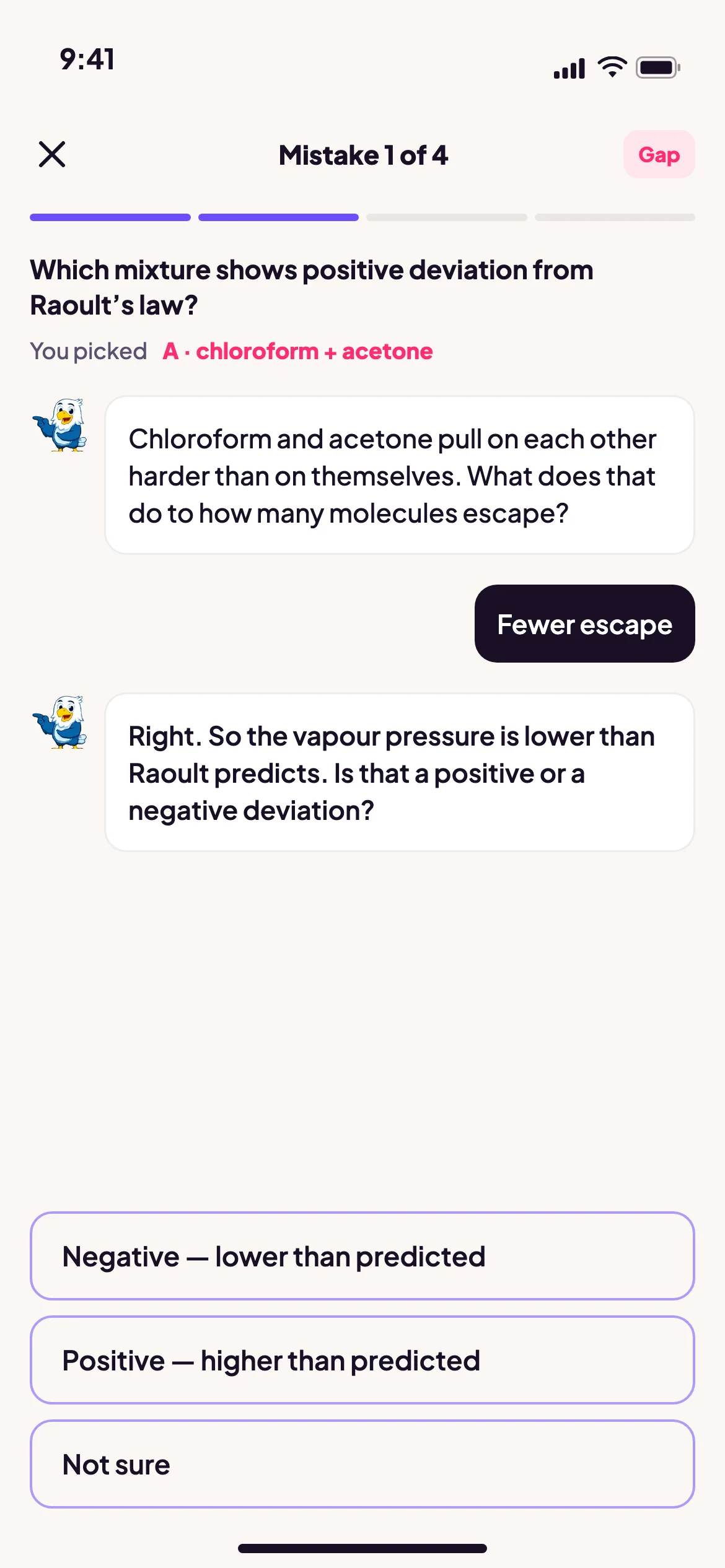
The app has the real past questions on this chapter. Stuck on one? Ask TarQ AI and it teaches the idea behind it, not just the answer.
Mistake DNA Coming soon
TarQ's short list of the traps you keep falling for.
Cluster 4: The anther and the pollen grain
These two sub-topics gave 17 questions. The single most repeated false statement in the whole chapter lives here: "Tapetum helps in the dehiscence of the anther."
The anther and its four wall layers
A typical anther is bilobed, and each lobe has two thecae, so it is dithecous. In cross-section it is four-sided, with a microsporangium in each corner, two per lobe. Each microsporangium is round in section and wrapped in four wall layers.
Order, outside to inside: epidermis, endothecium, middle layers, tapetum. The outer three protect the anther and help it split open to release pollen. The tapetum only nourishes the developing pollen. Its cells have dense cytoplasm and usually more than one nucleus, which NEET 2025 turned into an Assertion-Reason pair.
From sporogenous tissue to pollen
In a young anther, the centre is sporogenous tissue. Each of its cells can become a pollen mother cell, which divides by meiosis to form a microspore tetrad. As the anther dries, the four microspores separate and grow into pollen grains. NEET 2026 asked this as a four-step sequence: sporogenous tissue, pollen mother cell, microspore tetrad, pollen grain.
The pollen grain
- Exine: hard outer layer made of sporopollenin, the most resistant organic material known. It survives high heat, strong acids and alkalis, and no enzyme breaks it down. That is why pollen is preserved as fossils (2024, Re-NEET 2024). Germ pores are the gaps where sporopollenin is absent.
- Intine: thin, continuous inner wall of cellulose and pectin.
- Two cells: a large vegetative cell with plenty of food and an irregular nucleus, and a small, spindle-shaped generative cell floating in it.
- Shedding stage: in over 60 percent of flowering plants, pollen is shed at this 2-celled stage. In the rest, the generative cell divides first and pollen is shed 3-celled.
- Viability: about 30 minutes in rice and wheat; months in Rosaceae, Leguminosae and Solanaceae (2021, 2023).
- Storage: for years in liquid nitrogen at −196°C, in pollen banks for crop breeding (2016, 2018).
- Allergy: Parthenium, or carrot grass, came into India with imported wheat and causes pollen allergy.
The pollen grain is the male gametophyte. The male gametes are inside it. If an option calls the pollen grain the male gamete, it is wrong.
Q. Which statement about microsporangium wall layers is correct?
Working
- NCERT groups the epidermis, endothecium and middle layers together: they protect and help dehiscence.
- So (C) is right.
- Nourishing is the tapetum's job, so (A) fails.
- The tapetum is the innermost layer, so (B) fails.
Answer (C)
Trap (D) is the most repeated false statement in this chapter, used by NEET since 2016.
Cluster 5: Outbreeding devices and apomixis
These gave 7 direct questions, but they appear as options in many more. The rules are short and exact.
| Condition | Example | Stops autogamy? | Stops geitonogamy? |
|---|---|---|---|
| Monoecious (male and female flowers on one plant) | Castor, maize | Yes | No |
| Dioecious (male and female flowers on separate plants) | Papaya | Yes | Yes |
Plants avoid self-pollination in three other ways. Pollen may be released before or after the stigma is ready. The anther and stigma may sit at different positions. And self-incompatibility, a genetic mechanism, may stop self pollen from germinating or growing a tube in the pistil.
Pollen-pistil interaction is a chemical dialogue. The pistil recognises compatible pollen and lets it grow, and rejects the rest. In artificial hybridisation, the anthers of a bisexual female parent are removed before they open (emasculation), and the flower is bagged. If the female parent has unisexual flowers, there is nothing to emasculate. The buds are just bagged, pollinated, and rebagged. Re-NEET 2026 tested exactly this difference.
Apomixis, polyembryony and parthenocarpy
Apomixis is making seeds without fertilisation. It is a form of asexual reproduction that mimics sexual reproduction. NCERT names Asteraceae and grasses. It happens in two ways. In some species the egg forms without meiosis, so it is 2n, and it grows into an embryo without fertilisation. More often, as in Citrus and mango, some nucellar cells around the embryo sac divide, push into the sac and become embryos. A seed with several embryos shows polyembryony.
Why it matters: if a hybrid is made apomictic, its seeds do not segregate. The farmer can keep sowing them year after year and keep the hybrid traits, instead of buying new hybrid seed every year.
Keep three terms apart. Apomixis gives a seed without fertilisation. Parthenocarpy gives a fruit without fertilisation, and no seed, as in banana. Parthenogenesis is an egg growing into an embryo without fertilisation, which NEET 2019 asked.
The 10 traps NEET keeps setting
| ⚠️ The traps, and the NCERT truth behind each | |
|---|---|
| Tapetum and dehiscence | The outer three wall layers help dehiscence. The tapetum only nourishes pollen. "Tapetum helps dehiscence" is false every time. |
| Cells vs nuclei | The embryo sac is 7-celled and 8-nucleate. The central cell holds two nuclei. The polar nuclei are in the central cell, not the egg apparatus. |
| Where the tube goes | The pollen tube enters a synergid through the filiform apparatus, never the egg or the central cell. |
| Geitonogamy | Needs a pollinator, but is genetically autogamy. Only xenogamy brings new genes. |
| Aquatic is not hydrophily | Water hyacinth and water lily are pollinated by insects or wind. Vallisneria pollen floats on the surface; Zostera pollen moves under water. |
| Dominant pollinator | Bees, not moths or butterflies. NEET 2022 used the moth version as the false statement. |
| 2-celled shedding | Over 60 percent of species shed 2-celled pollen. The generative cell, not the vegetative cell, makes the two male gametes. |
| Perisperm vs pericarp vs endosperm | Perisperm is leftover nucellus, 2n, in black pepper and beet. Pericarp is the fruit wall. Endosperm is 3n. |
| Fruit types | Apple, strawberry, cashew are false fruits. Banana is parthenocarpic, not false. |
| Monoecy vs dioecy | Castor and maize stop only autogamy. Papaya stops both autogamy and geitonogamy. |
Reference sheet: the ploidy of everything
Ploidy questions are the cleanest marks in the chapter if you hold one rule. Anything that is part of the parent plant is 2n. Anything inside the embryo sac or the pollen grain is n. Only the endosperm line is 3n.
| 🧠 Ploidy reference: if the leaf is 2n | ||
|---|---|---|
| 2n, parent plant | Anther wall (young tapetum included), sporogenous tissue, pollen mother cell, megaspore mother cell, nucellus, integuments, funicle, ovary wall | Perisperm, seed coat and pericarp stay 2n because they come from these |
| n, gametophyte | Microspores, pollen grain, vegetative and generative cells, male gametes, megaspores, synergids, egg, antipodals, each polar nucleus | Everything in the embryo sac comes from one haploid megaspore |
| 2n, new plant | Zygote and the whole embryo: plumule, radicle, cotyledons, scutellum, coleoptile, coleorhiza | Male gamete (n) + egg (n) |
| 3n, endosperm line | Primary endosperm nucleus, endosperm, coconut water and kernel, aleurone layer of cereals | Male gamete (n) + 2 polar nuclei (n + n) |
| More than 2n | Mature tapetum cells, which often have more than one nucleus | Not a fusion product |
| 2n, clone of mother | Nucellar embryos of Citrus and mango | No fertilisation, so genetically maternal |
The example table
| Plant | Fact NEET pairs it with |
|---|---|
| Viola, Oxalis, Commelina | Both chasmogamous and cleistogamous flowers |
| Vallisneria, Hydrilla | Fresh-water hydrophily |
| Zostera | Marine sea grass, submerged female flowers, ribbon-like pollen |
| Water hyacinth, water lily | Aquatic, but insect or wind pollinated |
| Amorphophallus | Tallest flower; safe egg-laying site as reward |
| Yucca | Moth lays eggs in the ovary locule while pollinating |
| Ophrys | Petal mimics a female bee: sexual deceit |
| Castor, maize | Monoecious: autogamy prevented, geitonogamy not |
| Papaya | Dioecious: autogamy and geitonogamy both prevented |
| Rice, wheat | Pollen viable about 30 minutes |
| Rosaceae, Leguminosae, Solanaceae | Pollen viable for months |
| Parthenium | Came with imported wheat; pollen allergy |
| Papaver / Michelia | Syncarpous / apocarpous multicarpellary gynoecium |
| Wheat, paddy, mango / papaya, watermelon, orchids | One ovule per ovary / many ovules per ovary |
| Coconut | Water = free-nuclear endosperm; kernel = cellular endosperm |
| Pea, groundnut, beans | Non-albuminous seeds |
| Wheat, maize, barley, castor | Albuminous seeds |
| Black pepper, beet | Perisperm |
| Apple, strawberry, cashew | False fruits |
| Banana | Parthenocarpic fruit |
| Citrus, mango | Nucellar polyembryony |
| Lupinus arcticus / Phoenix dactylifera | Seed viable about 10,000 years / 2000 years |
12 must-attempt NEET questions on this chapter, with the traps named
These twelve cover the real spread of formats: single-correct, Assertion-Reason, two-statement, "how many are correct", sequence and match-the-following. Each one is built on a trap NEET has actually used. Try each before reading the answer.
1. The root tip cells of a cereal have 42 chromosomes. How many chromosomes are in an aleurone cell, a synergid and a scutellum cell, in that order?
Working
- 2n = 42, so n = 21.
- The aleurone layer is the outer layer of the endosperm, so it is 3n = 63.
- A synergid is in the embryo sac, so it is n = 21.
- The scutellum is the cotyledon of the grass embryo, so it is 2n = 42.
Answer (A)
Trap (C) makes the synergid diploid. (D) treats the scutellum as endosperm because it touches it. (B) swaps endosperm and embryo.
2. Assertion (A): Geitonogamy is functionally cross-pollination.
Reason (R): In geitonogamy, the pollen is genetically the same as the flower receiving it, because both flowers are on the same plant.
Working
- Both statements are true NCERT lines.
- But geitonogamy is functionally cross-pollination because it needs a pollinating agent.
- R explains why it is genetically autogamy, which is a different point.
Answer (B)
Trap (A) tempts anyone who sees two true statements on the same topic and links them by reflex.
3. Statement I: In over 60 percent of angiosperms, pollen grains are shed at the 3-celled stage.
Statement II: The two male gametes are formed by mitotic division of the generative cell.
Working
- Over 60 percent shed pollen at the 2-celled stage, so Statement I is wrong.
- The generative cell does divide by mitosis to give the two male gametes, so Statement II is right.
Answer (D)
Trap (A) catches students who remember "60 percent" but not which stage it goes with.
4. How many of these statements are correct?
a. Perisperm in black pepper and beet is diploid.
b. Pea and groundnut have albuminous seeds.
c. Tender coconut water is free-nuclear endosperm.
d. Banana is a false fruit in which the thalamus forms the fruit.
e. Castor seed keeps part of its endosperm at maturity.
Working
a is correct: perisperm is leftover nucellus, which is 2n. b is wrong: pea and groundnut are non-albuminous. c is correct. d is wrong: banana is parthenocarpic. e is correct: castor is albuminous.
Answer (B)
Trap (C) usually comes from marking d as correct, mixing up false fruits and seedless fruits.
5. Match List I with List II.
List I: P. Vallisneria Q. Zostera R. Amorphophallus S. Yucca
List II: I. Moth lays eggs in the ovary locule while pollinating II. Female flower reaches the water surface on a long stalk III. Female flower stays submerged; pollen carried inside water IV. Flower offers a safe place to lay eggs
Working
- Vallisneria uses the long stalk, so P-II.
- Zostera keeps the female flower under water, so Q-III.
- Amorphophallus offers an egg-laying site, so R-IV.
- Yucca has the moth that lays eggs in the ovary, so S-I.
Answer (C)
Trap (A) swaps the two water plants. (B) swaps the two egg-laying stories.
6. Arrange these events in the correct order for a majority of flowering plants.
A. Sporogenous tissue B. Microspore tetrad C. Pollen mother cell D. Pollen shed at the 2-celled stage E. Generative cell divides inside the pollen tube
Working
- Sporogenous cells become pollen mother cells, which undergo meiosis to form tetrads.
- Microspores mature into pollen, which in most species is shed 2-celled.
- The generative cell divides later, as the tube grows.
Answer (B)
Trap (D) is the 3-celled pattern, which is the minority. (A) puts the tetrad before meiosis.
7. Into which cell does the pollen tube release the two male gametes?
Working
- The tube enters a synergid through the filiform apparatus and releases both gametes into its cytoplasm.
- From there, one moves to the egg and the other to the central cell.
Answer (C)
Trap (A) assumes the gamete is delivered straight to the egg. (B) assumes the same for triple fusion.
8. In a typical mature, unfertilised embryo sac, how many cells have exactly one nucleus, and how many nuclei does the largest cell have?
Working
- Seven cells: two synergids, one egg, three antipodals and one central cell.
- The first six have one nucleus each.
- The central cell, the largest, has the two polar nuclei.
Answer (D)
Trap (A) forgets the central cell is binucleate. (B) counts 8 cells for 8 nuclei. (C) counts only the egg apparatus.
9. Statement I: In castor, autogamy is prevented but geitonogamy is not.
Statement II: If the female parent bears unisexual flowers, emasculation is not needed in artificial hybridisation.
Working
- Castor is monoecious.
- Its male and female flowers are on one plant, so pollen can move between them: geitonogamy is possible.
- A unisexual female flower has no anthers, so there is nothing to remove.
- It is just bagged.
Answer (A)
Trap (D) comes from thinking any unisexual plant blocks geitonogamy. That is true only for dioecious plants like papaya.
10. Assertion (A): Nucellar embryos in Citrus are genetically identical to the mother plant.
Reason (R): They develop from diploid nucellar cells by mitosis, without fertilisation.
Working
- The nucellus is maternal 2n tissue.
- Embryos made from it by mitosis, with no meiosis and no fusion, carry exactly the mother's genes.
- R is the reason A is true.
Answer (A)
Trap (D) comes from assuming every embryo in a seed must come from a zygote.
11. Which statement about the wall of a microsporangium is incorrect?
Working
- The order is epidermis, endothecium, middle layers, tapetum, so (A) is true.
- (B) and (D) are NCERT lines.
- The tapetum nourishes pollen; it does not help dehiscence.
Answer (C)
Trap This exact false line has been used since NEET 2016. Students who know the tapetum is "important" mark it true.
12. Which statement about cleistogamous flowers is not correct?
Working
- Cleistogamous flowers never open.
- Pollen can only reach the stigma of the same flower, so they cannot be cross-pollinated.
- That is their disadvantage.
Answer (D)
Trap (C) looks too good to be true, but it is the NCERT line tested in Re-NEET 2024.
What to expect in NEET 2027 and 2028
The 2024 to 2026 papers set a clear pattern. NTA tests the same facts, but stacks more of them into each question. These are the five most likely archetypes next.
1. A ploidy chain, as a sequence or match (very likely). It has come in 2021, 2023 and Re-NEET 2026. Expect three or four structures in one stem, such as synergid, zygote, primary endosperm nucleus and nucellus, or a chromosome-number version with the aleurone layer. Use the reference sheet above until it is automatic.
2. A five-statement pollination question (very likely). NEET 2024 used one on hydrophily. The next one will probably mix Yucca, Amorphophallus, Vallisneria versus Zostera, water lily, and monoecy versus dioecy. Count each statement on its own. Option elimination does not work in this format.
3. Apomixis returns as a full question (likely). It has had one direct question in twelve years, while sitting in the NCERT text as a full section. Expect an Assertion-Reason on why apomictic hybrids keep their traits, or a statement question on the two routes: the 2n egg and nucellar embryos in Citrus and mango.
4. A diagram read as a set of facts (likely). The grass embryo, the ovule and the embryo sac are the prime candidates. The question will name a part and ask what it does or where it sits: the coleoptile around the shoot apex, the coleorhiza around the radicle, the filiform apparatus at the micropylar end.
5. The tapetum line, again (likely). It has appeared in some form in 2016, 2022, Re-NEET 2022, 2025 and Re-NEET 2026. Whether it asks function, position or nuclei, the answer comes from the same three NCERT lines.
How to split your revision time: about a third on pollination and outbreeding, a third on the ovule-to-endosperm sequence with its ploidy, a quarter on seeds, fruits and apomixis, and the rest on the anther wall and pollen grain. Nothing in this chapter is deleted, so skip nothing.
Reading is step one
Now beat the traps.
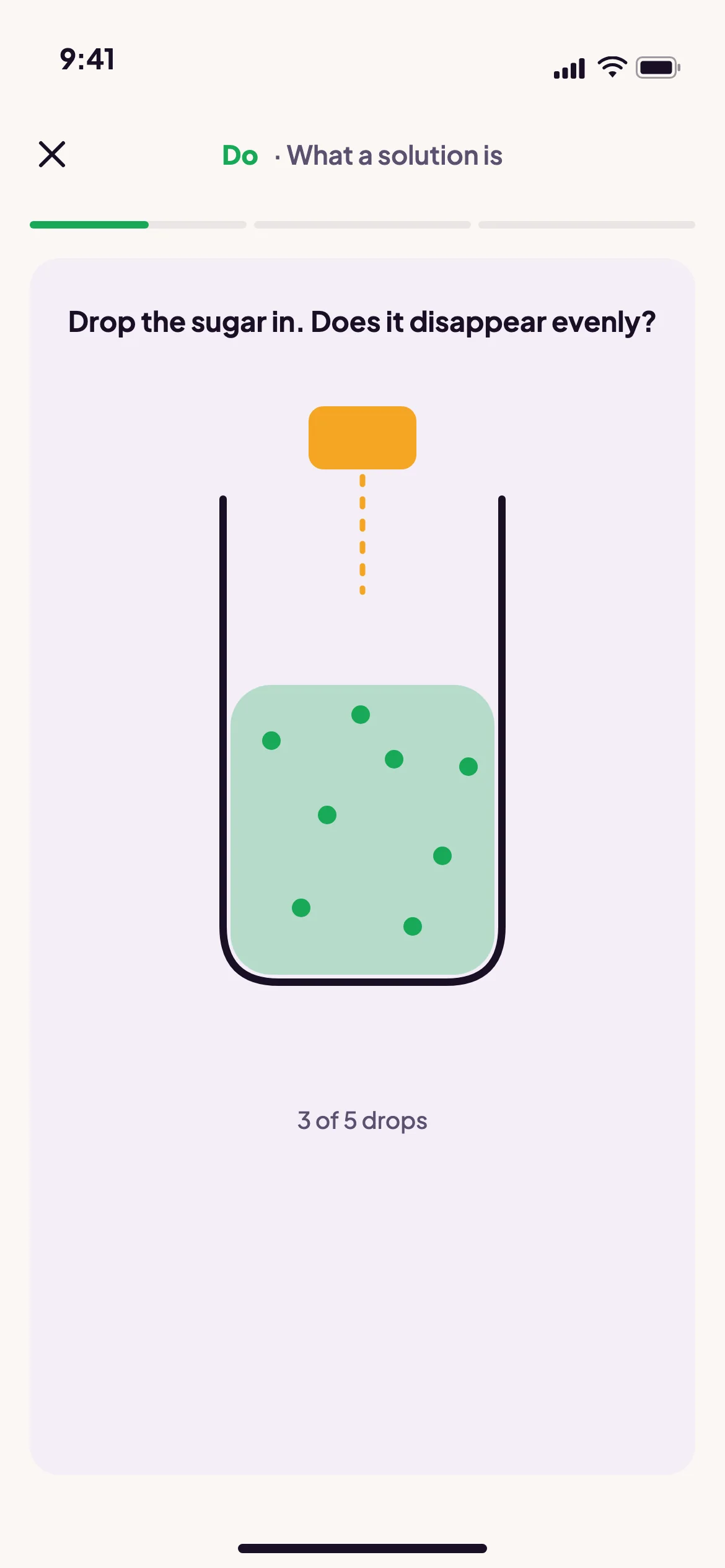
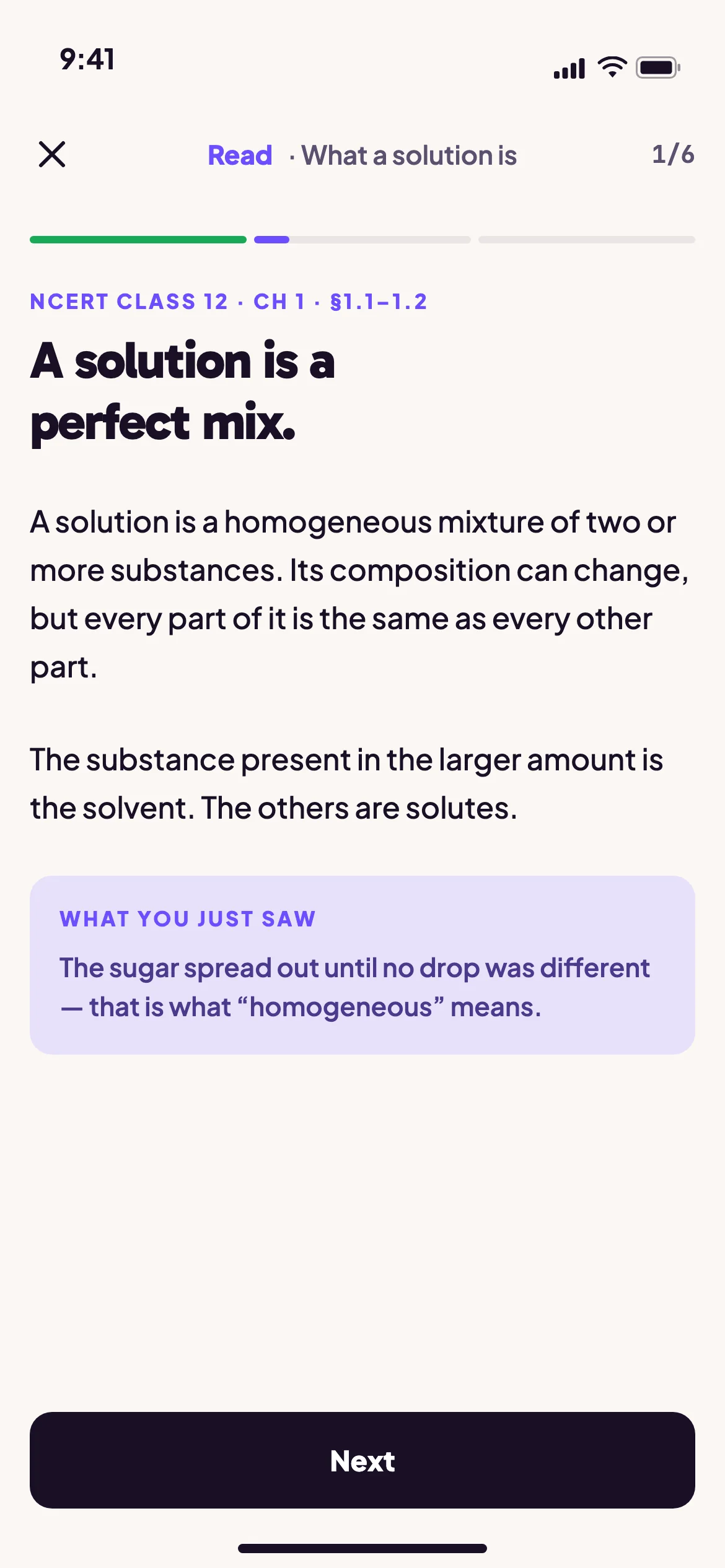
Reading a chapter and understanding it are different things. In the app every chapter is Do · Read · Verify: a game you play, a short read, then questions that check you. A full chapter, understood, in 45 to 60 minutes.
- DoA game built for the idea
- ReadThe short NCERT explainer
- VerifyQuestions that check you
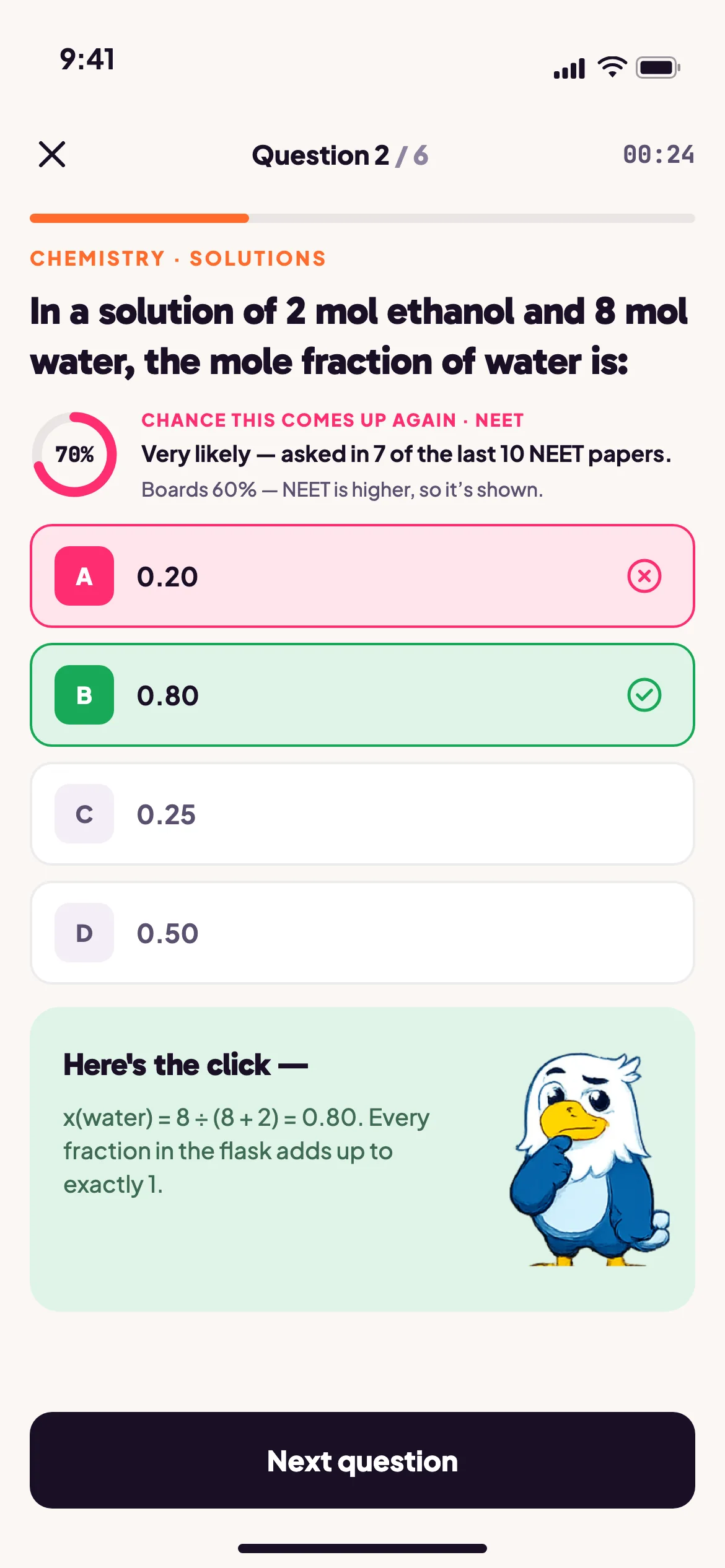

Still stuck at 11pm? TarQ AI reads the answer you got wrong and teaches the idea behind it, not just the right option.