NEET 2026 — The 48-Hour Biology Revision Plan (Built From 430 PYQs Across 8 Chapters)
NEET 2026 rescheduled. You now have 4-6 weeks, not 48 hours. Same PYQ data, expanded strategy. 490+ questions across 10 chapters decoded. Chapter-by-chapter priority plan for the new exam date.
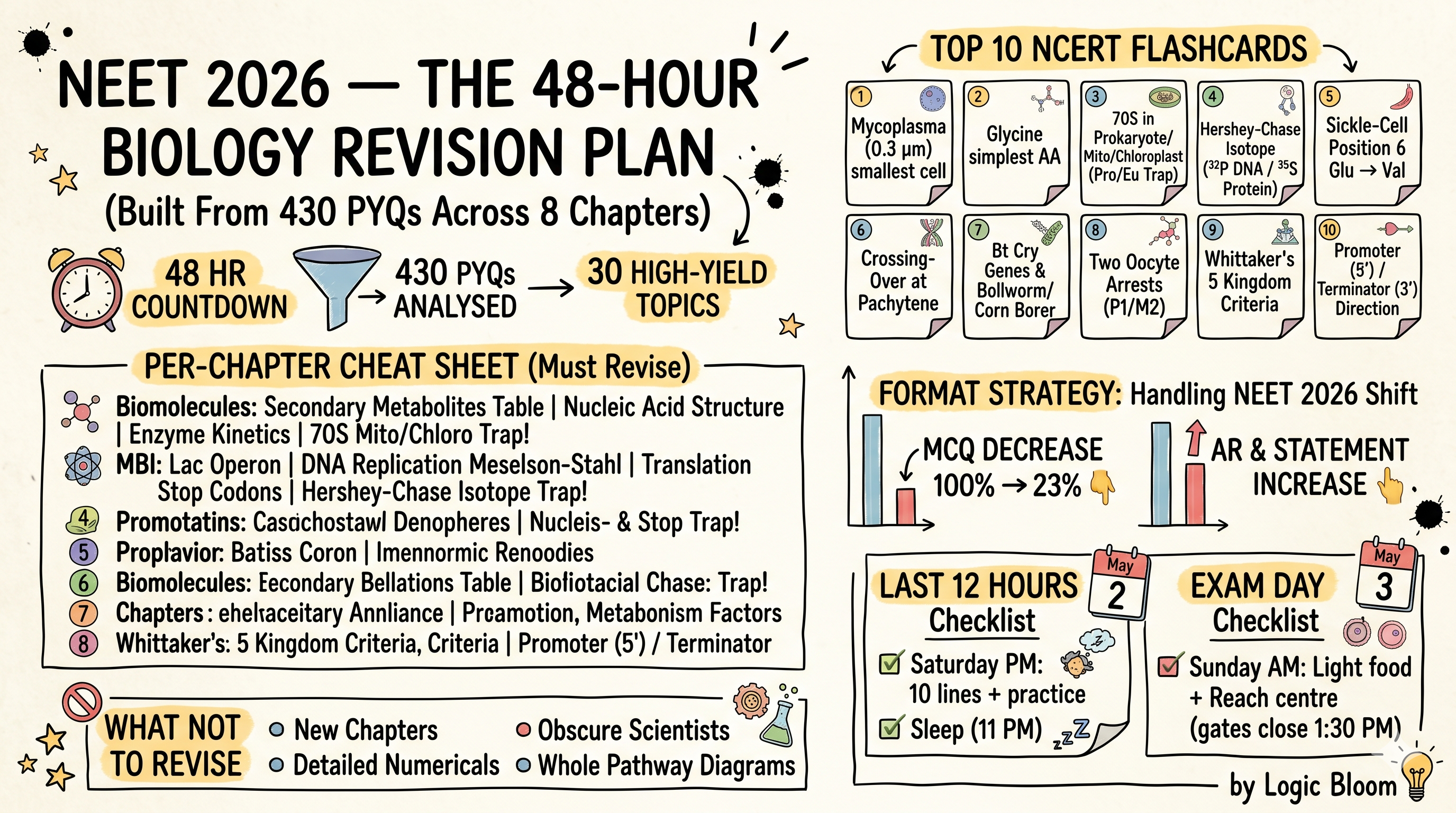
Introduction: NEET 2026 — The 48-Hour Biology Revision Plan Built From 430 PYQs
NEET 2026 is on Sunday, May 3, 2:00–5:00 PM. You have 48 hours. The worst thing you can do right now is open a new chapter. The best thing is to revise what NTA actually tests — and that pattern is unusually predictable.
We've analysed 430 NEET Biology PYQs across 8 high-weightage chapters from 2015 to 2025. That data tells us, with surprising precision, which sub-topics show up year after year, which NCERT lines have been recycled four or five times, and which traps NTA still sets in 2026. This guide pulls the highest-yield 30 sub-topics from those 8 chapters into a single 48-hour plan.
Going deeper on any chapter? Jump straight in:
| Chapter | PYQs Analysed | Deep Dive |
|---|---|---|
| Biomolecules | 50 | Full analysis → |
| Molecular Basis of Inheritance | 89 | Full analysis → |
| Cell: The Unit of Life | 55 | Full analysis → |
| Principles of Inheritance | 52 | Full analysis → |
| Biological Classification | 42 | Full analysis → |
| Biotechnology: Principles & Processes | 44 | Full analysis → |
| Cell Cycle and Cell Division | 62 | Full analysis → |
| Human Reproduction | 36 | Full analysis → |
The 10 NCERT Lines That Have Been Tested Most Often (2015–2025)
If you read nothing else in the next 12 hours, read these. Each has been tested four or more times across the last 11 NEET papers — many more than once in 2024 and 2025 alone.
| 🎯 10 Most-Repeated NCERT Lines in NEET (2015–2025) | |||
|---|---|---|---|
| 1. | "Mycoplasma is the smallest known cell, about 0.3 µm in length" | Cell | The "smallest" anchor — also tested as smallest free-living organism |
| 2. | "Glycine is the simplest amino acid; it has no side chain" | Biomolecules | Standard easy mark — also tested via "amino acid without optical isomerism" |
| 3. | "Ribosomes in prokaryotes are 70S, in eukaryotes 80S, but mitochondria and chloroplasts have 70S" | Cell / Biomolecules | The single most-trapped fact in NEET Biology |
| 4. | "Hershey and Chase used ³²P (DNA) and ³⁵S (protein) to prove DNA is the genetic material" | MBI | Tested via radioactive labels, percentage transferred, or experimental setup |
| 5. | "Sickle-cell anaemia is caused by glutamic acid being replaced by valine at position 6 of the β-globin chain" | Inheritance | Position 6, β-chain, Glu → Val. Memorise exactly — position matters. |
| 6. | "Crossing over occurs at the pachytene stage of Prophase I" | Cell Cycle | The pachytene–diplotene confusion is NTA's signature trap |
| 7. | "cry genes encode Bt toxins; cryIAc and cryIIAb control cotton bollworms; cryIAb controls corn borer" | Biotechnology | Pest–gene matching is a near-annual question |
| 8. | "The primary oocyte is arrested at Prophase I until puberty; the secondary oocyte at Metaphase II until fertilisation" | Human Reproduction | Two arrests, two stages — students confuse them every year |
| 9. | "Whittaker's five-kingdom classification is based on cell structure, body organisation, mode of nutrition, reproduction, and phylogenetic relationships" | Biological Classification | The five criteria — verbatim recall question |
| 10. | "Promoter is upstream (5'), terminator is downstream (3') of the structural gene" | MBI | Direction confusion is the #1 transcription trap |
Per-Chapter Cheat Sheet — What to Revise Tonight
The structure below draws from our PYQ data: the top 3 sub-topics that have appeared most frequently in each chapter, plus the one signature trap NTA keeps setting.
Biomolecules — 50 PYQs analysed
| Priority | Sub-topic | Key Detail |
|---|---|---|
| Must revise 1 | Secondary metabolites table | Alkaloids (morphine, codeine), terpenoids (rubber, monoterpenes), essential oils, drugs, pigments. NCERT Class 11 Ch 9 Page 158. Direct table-recall questions every 1–2 years. |
| Must revise 2 | Nucleic acid structure | Chargaff's rules (A=T, G=C), B-form double helix dimensions (2 nm width, 3.4 nm per turn, 10 base pairs per turn), Watson-Crick base pairing. |
| Must revise 3 | Enzyme kinetics and classification | Six classes (oxidoreductases, transferases, hydrolases, lyases, isomerases, ligases), pH/temperature optima, competitive vs non-competitive inhibition. |
| 🚨 Signature trap | 70S vs 80S ribosomes | The textbook says eukaryotes have 80S — but mitochondria and chloroplasts inside eukaryotic cells have 70S ribosomes. NTA tests this almost every year. |
Molecular Basis of Inheritance — 89 PYQs — highest weightage chapter
| Priority | Sub-topic | Key Detail |
|---|---|---|
| Must revise 1 | Lac operon | Structural genes (z, y, a), regulatory gene (i), promoter, operator. Lactose acts as inducer, binds repressor, frees operator. Negative regulation. Active vs inactive states. |
| Must revise 2 | DNA replication | Semi-conservative (Meselson-Stahl, ¹⁵N experiment), 5'→3' direction only, leading vs lagging strand, Okazaki fragments, DNA polymerase III, ligase, primase. |
| Must revise 3 | Translation | Initiation codon AUG, stop codons UAA, UAG, UGA. Ribosome small subunit binds first. mRNA capping (5' methylguanosine), tailing (3' poly-A). |
| 🚨 Signature trap | Hershey-Chase isotope assignment | ³²P labels DNA (phosphorus is in the backbone). ³⁵S labels protein (sulphur is in cysteine and methionine). Students reverse them under pressure. |
Cell: The Unit of Life — 55 PYQs analysed
| Priority | Sub-topic | Key Detail |
|---|---|---|
| Must revise 1 | Cell organelle membrane classification | Single-membrane (ER, Golgi, lysosome, vacuole, peroxisome), double-membrane (nucleus, mitochondria, chloroplast), no-membrane (ribosome, centriole, cytoskeleton). |
| Must revise 2 | Mitochondria and chloroplast comparison | Both semi-autonomous, both have 70S ribosomes, both have circular DNA. Inner membrane infoldings: cristae (mito) vs thylakoids (chloroplast). |
| Must revise 3 | Fluid mosaic model | Singer & Nicolson (1972). Phospholipid bilayer. Cholesterol stabilises in animals. Lipid:protein ratio varies — highest protein in inner mitochondrial membrane (~75%). |
| 🚨 Signature trap | Function confusion between organelles | Peroxisome handles H₂O₂ and oxidation. Lysosome digests via acid hydrolases. Glyoxysome converts fat to sugar (in plant seeds). Don't mix them up. |
Principles of Inheritance — 52 PYQs analysed
| Priority | Sub-topic | Key Detail |
|---|---|---|
| Must revise 1 | Pedigree analysis | Autosomal dominant (every generation, both sexes equal), autosomal recessive (skips generations), X-linked recessive (affected males, carrier females, no male-to-male transmission). |
| Must revise 2 | Sex-linked disorders | Haemophilia (factor VIII or IX deficiency), colour blindness (red-green, on X), Duchenne muscular dystrophy (X-linked recessive). |
| Must revise 3 | Chromosomal disorders | Down (trisomy 21, 47 chromosomes), Klinefelter (XXY, 47, sterile male with gynaecomastia), Turner (XO, 45, sterile female with short stature). |
| 🚨 Signature trap | Codominance vs incomplete dominance | ABO blood groups → codominance (both A and B expressed in AB). Snapdragon flower colour (red × white = pink) → incomplete dominance. Students reverse the examples. |
Biological Classification — 42 PYQs analysed
| Priority | Sub-topic | Key Detail |
|---|---|---|
| Must revise 1 | Kingdom Fungi sub-classes | Phycomycetes (aseptate hyphae, Rhizopus), Ascomycetes (ascus, Penicillium, Neurospora), Basidiomycetes (basidium, mushrooms, rusts, smuts), Deuteromycetes (imperfect fungi, Alternaria, Trichoderma). |
| Must revise 2 | Lichens and mycorrhiza | Lichen = algae (phycobiont) + fungi (mycobiont), mutualism, SO₂ bioindicator. Mycorrhiza = fungus + plant root, helps phosphorus absorption. |
| Must revise 3 | Viruses, viroids, prions | Virus has nucleic acid + protein coat (capsid). Viroid = naked RNA, causes potato spindle tuber disease. Prion = infectious protein, causes BSE and CJD. |
| 🚨 Signature trap | Mode of nutrition mismatches | Archaebacteria are NOT all autotrophs. Mycoplasma is the smallest free-living organism — read the question carefully (context matters). |
Biotechnology: Principles and Processes — 44 PYQs analysed
| Priority | Sub-topic | Key Detail |
|---|---|---|
| Must revise 1 | pBR322 features | Ori (copy number control), ampR gene, tetR gene, recognition sites for EcoRI, BamHI, HindIII, SalI, PvuII. BamHI/SalI are inside tetR; PvuI/PstI are inside ampR. The rop gene controls plasmid copy number. |
| Must revise 2 | Restriction enzyme nomenclature | EcoRI (E. coli, R strain, first enzyme). HindIII (Haemophilus influenzae, d strain, third). Recognise palindromic sequences and sticky end logic. |
| Must revise 3 | PCR cycle | Denaturation 94–95°C, annealing 50–60°C, extension 72°C. Taq polymerase from Thermus aquaticus. Three steps × 25–30 cycles. DNA copies = 2ⁿ after n cycles. |
| 🚨 Signature trap | Blue-white selection | Insert disrupts lacZ gene → no β-galactosidase → no X-gal cleavage → white colony = recombinant. Blue colonies = no insert. Students reverse the colour-recombinant logic every year. |
Cell Cycle and Cell Division — 62 PYQs analysed
| Priority | Sub-topic | Key Detail |
|---|---|---|
| Must revise 1 | Prophase I sub-stages in order | Leptotene (chromosomes condense) → Zygotene (synapsis, synaptonemal complex forms) → Pachytene (crossing over, recombination nodules) → Diplotene (synaptonemal complex dissolves, chiasmata visible) → Diakinesis (terminalisation). |
| Must revise 2 | Mitosis vs Meiosis comparison | Number of divisions, chromosome number outcome, where each occurs (mitosis everywhere; meiosis only in germ cells). Mitosis = 2 identical daughter cells. Meiosis = 4 haploid gametes. |
| Must revise 3 | Cytokinesis differences | Animals: cleavage furrow forms inward (centripetal). Plants: cell plate forms from centre outward — centrifugal — because the cell wall blocks inward cleavage. |
| 🚨 Signature trap | Pachytene vs Diplotene | Pachytene = crossing over occurs. Diplotene = synaptonemal complex dissolves, chiasmata become visible. NTA swaps these in match-the-column questions every year. |
Human Reproduction — 36 PYQs analysed
| Priority | Sub-topic | Key Detail |
|---|---|---|
| Must revise 1 | Spermatogenesis vs Oogenesis | Spermatogenesis: spermatogonium → primary spermatocyte (2n) → 2 secondary spermatocytes (n) → 4 spermatids → 4 sperm. Oogenesis: oogonium → primary oocyte (arrested at Prophase I) → secondary oocyte + first polar body → ovum + second polar body (one functional gamete). |
| Must revise 2 | Menstrual cycle hormonal control | FSH stimulates follicular growth, LH surge triggers ovulation around day 14, corpus luteum secretes progesterone, fall in progesterone causes menstruation. |
| Must revise 3 | Implantation and placenta | Implantation ~6–7 days post-fertilisation. Placenta secretes hCG (early pregnancy marker), hPL, oestrogen, progesterone, and relaxin. |
| 🚨 Signature trap | Two oocyte arrest points | Primary oocyte → arrested at Prophase I (until puberty). Secondary oocyte → arrested at Metaphase II (until fertilisation). Both arrests appear in the same question — confusing the two stages loses 4 marks. |
Format Strategy — Handling NEET 2026's Question Types
Standard MCQs have dropped from over 90% of biology questions in 2015–2018 to around 35–45% in 2024–2025. If you've been preparing only for single-fact MCQs, the next 24 hours need to include format drilling.
| Format | Approach | Time Budget |
|---|---|---|
| Multi-statement | Read all four statements first before reading the options. Mark each as T or F. Then match your T/F pattern to the options. Prevents the trap where one option has 3 correct + 1 incorrect. | 75–90 seconds |
| Assertion-Reason | Evaluate the assertion as standalone (T/F). Evaluate the reason as standalone (T/F). Only then judge whether the reason explains the assertion. The biggest failure is judging A and R together from the start. | 75–90 seconds |
| Match the Column | Solve from the side with fewer entries. Match the easiest 2 first, eliminate them, then handle harder pairs. If column B has 5 items and column A has 4, one item in B is a decoy. | 60–75 seconds |
| Standard MCQ | If you don't recognise it in 20 seconds, mark for review and move on. Don't grind. | 30–40 seconds |
If multi-statement and match-the-column traps still feel like guessing rather than recognition, that's a memorisation gap, not a knowledge gap. Logic Bloom's Playground breaks each chapter into NCERT-aligned topic loops — interactive games for the concepts that don't stick from text alone, plus NEET-format practice on the same topic. Currently in beta.
What NOT to Revise in the Next 48 Hours
This list is as important as the must-revise one. Students lose marks not because they didn't study enough but because they panic-studied the wrong things.
| 🚫 Skip These Tonight — Not Worth the Stress-to-Marks Ratio | |
|---|---|
| New chapters | Any chapter you haven't seriously revised yet — new content in 48 hours = stress, not retention. Trust the chapters you know. |
| Numerical-heavy topics | Population genetics calculations, Hardy-Weinberg if you're rusty, ecological pyramid math, ATP calculations from glycolysis–Krebs–ETC. Low yield in biology relative to revision time. |
| Obscure scientist names and dates | Beyond the top 10: Beadle-Tatum, Griffith, Avery, Hershey-Chase, Meselson-Stahl, Watson-Crick, Wilkins-Franklin, Mendel, Morgan, Sutton-Boveri. |
| Memorising entire pathway diagrams | Glycolysis with all 10 enzymes, Calvin cycle with all intermediates — if these aren't already locked in, the marginal mark isn't worth the panic. |
| Mock test marathons | One full-length test today is fine for stamina. Two or three will tank your morale right before the real one. |
The Last 12 Hours — Saturday Evening + Sunday Morning
| Time | What to Do |
|---|---|
| Saturday evening (May 2) | One quick scan of the 10 NCERT lines above. Aloud, twice. Then 30 minutes of NEET-format practice on your two strongest chapters — to leave the day on a confidence high. Pack everything tonight: admit card (two printouts), photo ID (Aadhaar), passport-size photo, pen (black/blue ballpoint), self-declaration form. Eat light. Sleep by 11 PM. |
| Sunday morning (May 3, 7–10 AM) | Wake up by 7–8 AM. No new revision before breakfast. Light breakfast (avoid heavy oily food). Read the 10 NCERT lines one final time at 10 AM. That's it. |
| 12:30 PM | Reach the centre. Gates close at 1:30 PM — no exceptions. Carry a transparent water bottle (permitted). Don't open notes at the centre. Aadhaar authentication is mandatory this year — keep your Aadhaar number ready. |
| 1:55–2:00 PM | Fill roll number, test booklet code, and signature on OMR sheet — neatly, with a fresh pen. Don't start solving questions during this window. The clock starts at 2:00 PM sharp. |
Exam Hall — OMR Rules and Time Strategy
Two hundred candidates around you will lose 5–15 marks to OMR mistakes alone. Don't be one of them.
| Rule | What It Means in Practice |
|---|---|
| Darken bubbles fully | Half-darkened bubbles are scanned as ambiguous. Press firmly — one clean fill, no tick, no cross, no letter. |
| No rough work on OMR | Use the test booklet for all calculations. The OMR scanner reads every mark on the sheet. |
| Two pens | Same ink type. Never use whitener. If you mark the wrong bubble, you cannot erase — the scanner reads both. |
| Last 10 minutes (4:50–5:00 PM) | Stop solving. Use this time only to: (a) re-check OMR bubbling against the test booklet, (b) confirm roll number and booklet code, (c) re-darken any lightly marked bubbles. More marks are recovered here than by attempting two extra questions in panic. |
Negative marking math: each correct = +4, each wrong = −1, unattempted = 0. To benefit from guessing, your odds of being right must exceed 1 in 5 (20%). If you've eliminated even one option, guessing is positive expected value. Don't blank-leave questions where you can eliminate at least one option.
Section strategy: Most high-scorers start with biology — it's NCERT-direct and builds early confidence. Aim to finish 90 biology questions in 50–60 minutes. Use the saved time on chemistry and physics.
Done Revising? Now Play, Practice, or Duel.
If concepts in the chapters you've already studied still feel like memorisation rather than understanding, Logic Bloom's Playground breaks every NCERT chapter into topic loops — each topic with an interactive game, a reading, a video, and timed NEET 2026-format questions: multi-statement, assertion-reason, match-the-column, all built from exact NCERT lines. Spaced revision blocks and boss challenges lock concepts in. TarQ guides you through. Currently in beta.
Or take it head-to-head: Battleground is our 1v1 real-time arena — challenge a classmate, climb six ELO tiers from Bronze to Archeon, and lock in revision through competitive recall.
Twenty focused minutes per chapter on Saturday evening will give you more retention than three hours of passive reading.
See where these 8 chapters rank in our complete NEET Biology weightage analysis.
Understand through games. Score through practice. Free.
Start your last 48-hour session on Logic Bloom →
FAQs — NEET 2026 Last Minute Revision
Q1: What should I revise the night before NEET 2026?
Stick to your strongest chapters. Run through the 10 most-repeated NCERT lines listed above: Mycoplasma size, Glycine simplicity, 70S/80S ribosomes, Hershey-Chase isotopes, sickle-cell substitution, pachytene crossing-over, Bt cry genes, oocyte arrest stages, Whittaker's classification basis, promoter-terminator direction. Do 30 minutes of NEET-format practice on chapters you already know. Sleep by 11 PM.
Q2: Which biology chapters carry the highest NEET weightage?
From our analysis of 430 PYQs across 2015–2025: Molecular Basis of Inheritance leads with 89 questions, followed by Cell Cycle & Division (62), Cell: The Unit of Life (55), Principles of Inheritance (52), Biomolecules (50), Biotechnology (44), Biological Classification (42), and Human Reproduction (36). Together, over 60% of biology questions across the last 11 NEET papers.
Q3: How should I attempt the NEET 2026 biology section?
Most high-scorers start with biology because it's NCERT-direct and builds early confidence. Aim to finish 90 biology questions in 50–60 minutes — well under the one-minute-per-question average. Skip any question that doesn't trigger recognition in 20 seconds and return later. Reserve the last 10 minutes for OMR verification. See the full strategy in the NTA NEET 2026 official guidelines.
Q4: Is multi-statement and assertion-reason really replacing standard MCQs in NEET 2026?
Yes — the data from our 430-question analysis is clear. Across all 8 chapters, standard MCQs dropped from over 90% in 2015–2018 to around 35–45% in 2024–2025. The remaining 55–65% are multi-statement, assertion-reason, and match-the-column. Drilling the format reflex in the last 24 hours is now as important as content revision. See our master weightage analysis for the full breakdown.
Q5: What documents do I need to carry to the NEET 2026 exam centre?
Carry the printed NEET 2026 admit card, the duly filled self-declaration form (mandatory for 2026), a passport-size photograph identical to the one uploaded in the application, a valid government-issued photo ID (Aadhaar is the most reliable, since Aadhaar authentication is mandatory at the centre this year), and a black or blue ballpoint pen. A transparent water bottle is permitted. Phones, smartwatches, calculators, and any electronic device are strictly prohibited.