Chemistry · Atomic Structure · Chapter notes
Structure of the Atom · Class 11 Notes
Class 11 notes on Structure of the Atom: subatomic particles, Thomson and Rutherford, Planck and the photoelectric effect, the hydrogen spectrum, the Bohr model, dual nature, quantum numbers and electronic configuration.
In short
The atom was taken apart and rebuilt over about thirty years. Cathode rays gave the electron, scattering gave the nucleus, and the hydrogen spectrum showed energy comes in steps. Bohr fixed the steps by decree; de Broglie and Heisenberg explained why they exist, and the quantum model replaced orbits with orbitals described by four quantum numbers.
Contents
- 1The Discovery of Subatomic Particles
- 2Atomic Number, Mass Number, Isotopes and Isobars
- 3Early Atomic Models: Thomson and Rutherford
- 4The Nature of Light: Waves, Quanta and Spectra
- 5Atomic Spectra and the Hydrogen Spectrum
- 6The Bohr Model of the Atom
- 7Wave-Particle Duality and the Uncertainty Principle
- 8The Quantum Mechanical Model and Quantum Numbers
- 9Electronic Configuration: Filling the Orbitals
- ·Structure of the Atom: One-Page Formula Sheet
The Discovery of Subatomic Particles
For a long time the atom was believed to be the smallest, indivisible unit of matter, exactly as its Greek name atomos (uncuttable) suggests. That picture broke apart in the late nineteenth century, when experiments with electric discharge revealed that atoms are themselves built from smaller charged particles. Understanding how each one was found is the natural way into this chapter.
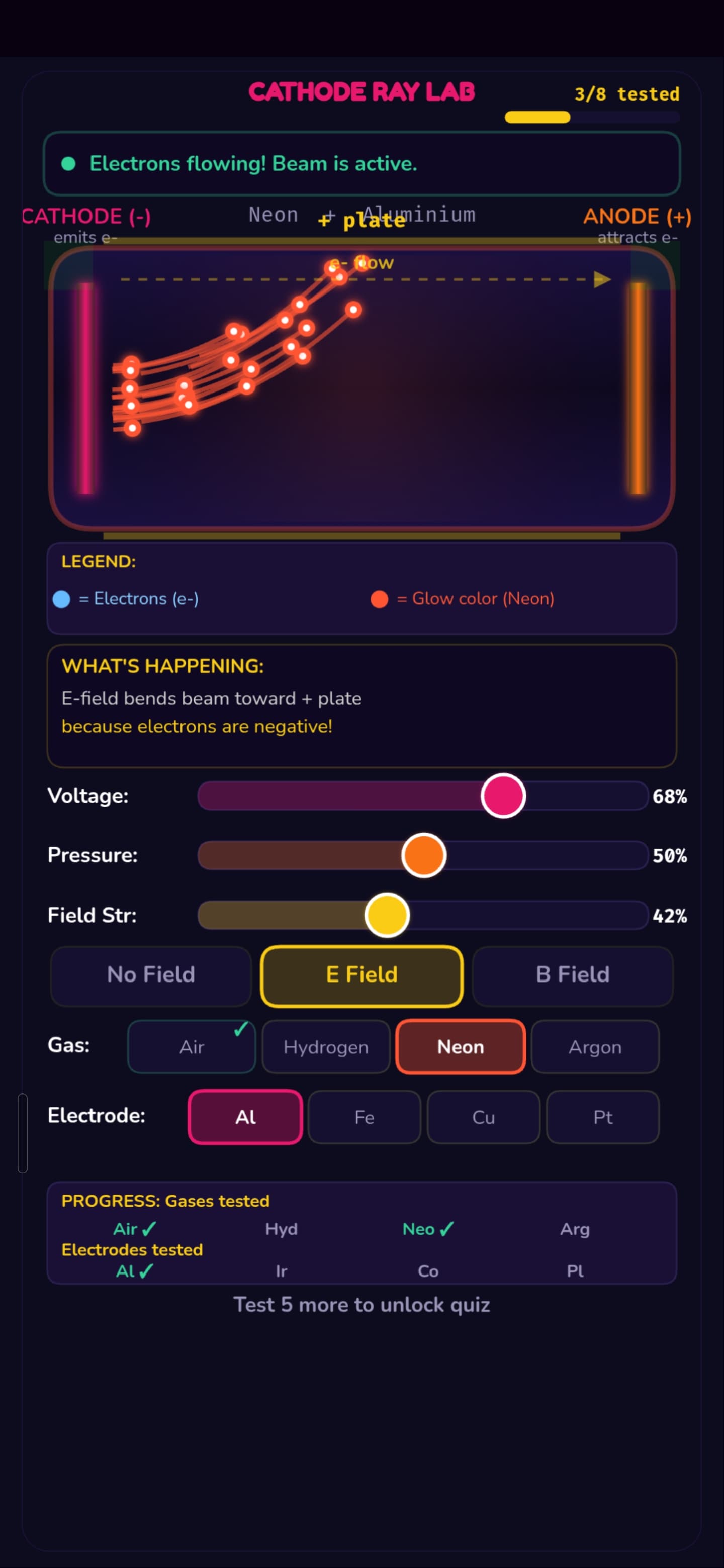
When a high voltage is applied across a gas at very low pressure inside a discharge tube, a stream of particles travels from the cathode to the anode. These are cathode rays. Careful study showed they travel in straight lines, are deflected by electric and magnetic fields toward the positive plate (so they are negatively charged), and, crucially, have the same properties whatever gas or electrode is used. This universality meant the negative particle, the electron, is a building block of every atom.
J. J. Thomson (1897) measured the charge-to-mass ratio of the electron as e/me = 1.758 × 10¹¹ C/kg. Later, Millikan's oil-drop experiment fixed the charge itself at e = 1.602 × 10⁻¹⁹ C, from which the electron mass came out as 9.1 × 10⁻³¹ kg.
Modifying the tube with a perforated cathode revealed rays travelling in the opposite direction: anode rays or canal rays. Unlike cathode rays, their charge-to-mass ratio depended on the gas used, and the lightest positive particle appeared with hydrogen. That particle is the proton, with charge +1.602 × 10⁻¹⁹ C and mass 1.672 × 10⁻²⁷ kg, roughly 1836 times the electron's mass.
James Chadwick (1932) bombarded beryllium with α-particles and found a neutral particle of mass almost equal to the proton (1.674 × 10⁻²⁷ kg). This is the neutron, and its discovery completed the trio of subatomic particles that concern us.
| Particle | Charge (C) | Relative charge | Mass (kg) |
|---|---|---|---|
| Electron | −1.602 × 10⁻¹⁹ | −1 | 9.1 × 10⁻³¹ |
| Proton | +1.602 × 10⁻¹⁹ | +1 | 1.672 × 10⁻²⁷ |
| Neutron | 0 | 0 | 1.674 × 10⁻²⁷ |
Atomic Number, Mass Number, Isotopes and Isobars
Once the particles were known, atoms could be catalogued by how many of each they contain. Two counts do all the work.
Mass number (A) = number of protons + number of neutrons
number of neutrons = A − Z
• Isotopes: same Z, different A (same protons, different neutrons). Example: hydrogen's three isotopes protium, deuterium, tritium. They are chemically identical but differ in mass.
• Isobars: same A, different Z (different elements with the same mass number). Example: 40Ar, 40K, 40Ca.
• Isotones: same number of neutrons (A − Z equal).
• Isoelectronic species: same number of electrons (for example Na+, Mg2+, Ne, F− all have 10).
For 3517Cl: Z = 17, so 17 protons and 17 electrons. A = 35, so neutrons = 35 − 17 = 18. For the ion Cl−, the electron count rises to 18 while protons stay at 17.
Early Atomic Models: Thomson and Rutherford
Knowing the particles exist is one thing; arranging them into a model of the atom is another. Two early attempts set the stage for the quantum picture.
Thomson pictured the atom as a uniform sphere of positive charge with electrons embedded in it, like seeds in a watermelon or plums in a pudding, hence the nicknames watermelon model and plum-pudding model. The positive and negative charges balanced, making the atom neutral. It explained neutrality but, as the next experiment showed, it was wrong about where the mass and positive charge sit.
Rutherford directed a beam of α-particles (positive, massive) at an ultra-thin gold foil and watched where they landed. Three observations, and their conclusions, define the nuclear atom:
• Most passed straight through undeviated: the atom is mostly empty space.
• A few were deflected through small angles: there is a concentrated positive charge that repels them.
• Very few (about 1 in 20,000) bounced almost straight back: all the positive charge and nearly all the mass are packed into a tiny central nucleus.
Rutherford concluded that electrons orbit the nucleus like planets around the sun. But classical physics kills this model: an orbiting (accelerating) charge must continuously radiate energy, spiral inward, and crash into the nucleus in about 10−8 seconds. Matter would be unstable. Rutherford's model also said nothing about how electrons are arranged or why atoms give sharp line spectra. Fixing these needed a new idea: quantisation.
The Nature of Light: Waves, Quanta and Spectra
The atom's secrets were unlocked by studying the light it absorbs and emits. To follow Bohr's model you first need the physics of electromagnetic radiation.
Light is an electromagnetic wave, described by its wavelength λ, frequency ν, and speed c (3 × 10⁸ m/s in vacuum). These are linked by c = νλ. A related quantity is the wavenumber (1/λ), the number of waves per unit length. All electromagnetic radiation, from radio waves to γ-rays, forms a continuous spectrum.
Classical physics could not explain black-body radiation. Max Planck proposed a radical fix: energy is not continuous but comes in discrete packets called quanta. The energy of one quantum is proportional to its frequency:
Here h is Planck's constant. This single equation, that light delivers energy in lumps, is the seed of all quantum chemistry.
Find the energy of a photon of green light, λ = 500 nm. E = hc/λ = (6.626 × 10⁻³⁴)(3 × 10⁸) / (500 × 10−9) = 3.98 × 10⁻¹⁹ J, which is about 2.48 eV. Shorter-wavelength photons carry more energy.
When light of high enough frequency strikes a metal, electrons are ejected. The puzzling facts: emission is instantaneous, happens only above a threshold frequency ν0 (no matter how bright a dim red light, it ejects nothing below threshold), and the ejected electrons' kinetic energy depends on frequency, not intensity. Einstein explained it by treating light as photons:
One photon ejects one electron. The photon's energy hν pays the work function W (the binding energy) and the rest becomes the electron's kinetic energy. This established the dual, particle-like nature of light.
A metal has work function 2.0 eV. Light of frequency 1.5 × 10¹⁵ Hz strikes it. Photon energy = hν = (6.626 × 10⁻³⁴)(1.5 × 10¹⁵) = 9.94 × 10⁻¹⁹ J = 6.21 eV. Maximum kinetic energy = 6.21 − 2.0 = 4.21 eV.
Atomic Spectra and the Hydrogen Spectrum
A glowing solid gives a continuous rainbow, but a glowing gas of atoms gives something stranger and more informative: light at only a few sharp wavelengths. These line spectra are the fingerprints of atoms.
An emission spectrum is the set of bright lines an excited atom emits. An absorption spectrum is the set of dark lines left when white light passes through the gas and certain wavelengths are absorbed. The lines sit at the same wavelengths in both, and every element has a unique pattern. The sharpness of the lines is the clue: atomic energy is quantised.
Hydrogen, the simplest atom, gives a line spectrum that fits a beautifully simple formula. The wavenumber of each line is:
Here n1 < n2 are whole numbers, and RH is the Rydberg constant. The lines fall into series, each fixed by the lower level n1.
| Series | n1 (lower) | Region | Note |
|---|---|---|---|
| Lyman | 1 | Ultraviolet | Highest energy |
| Balmer | 2 | Visible | The only visible series |
| Paschen | 3 | Infrared | |
| Brackett | 4 | Infrared | |
| Pfund | 5 | Far infrared | Lowest energy |
Find the wavelength of the H-α line (n2 = 3 to n1 = 2). 1/λ = RH(1/4 − 1/9) = 1.097 × 107 × (5/36) = 1.524 × 10⁶ m−1. So λ = 656.3 nm, a red line, exactly as seen.
If an electron drops from level n to the ground state, the maximum number of distinct spectral lines produced is n(n − 1)/2. From n = 4, that is 4 × 3 / 2 = 6 lines. This is a favourite quick question.
The Bohr Model of the Atom
Niels Bohr (1913) fused Rutherford's nucleus with Planck's quanta into a model that, for hydrogen, predicted the spectrum almost perfectly. He did it by simply postulating quantisation.
• Electrons revolve only in certain allowed stationary orbits of fixed energy, without radiating. This solves Rutherford's collapse problem by decree.
• The allowed orbits are those where the angular momentum is quantised: mvr = nh/2π, with n = 1, 2, 3, ...
• Energy is emitted or absorbed only when an electron jumps between orbits, and the photon energy equals the gap: ΔE = E2 − E1 = hν.
From the postulates, Bohr derived the radius and energy of each orbit for a one-electron species of nuclear charge Z:
En = −13.6 × (Z²/n²) eV
vn = 2.18 × 10⁶ × (Z/n) m/s
The energy is negative because the electron is bound: zero energy is the free electron at infinity. The radius grows as n², and the levels crowd together as n rises.
For hydrogen (Z = 1): E1 = −13.6 eV (ground state), E2 = −3.40 eV, E3 = −1.51 eV. The energy needed to remove the electron from the ground state, the ionisation energy, is 0 − (−13.6) = 13.6 eV. The first orbit radius is 0.529 Å, called the Bohr radius.
Bohr's model is a triumph for hydrogen but breaks down elsewhere. It cannot explain the spectra of multi-electron atoms, the finer splitting of lines (fine structure), the effect of magnetic fields (Zeeman effect) or electric fields (Stark effect), and the shapes of molecules. Its deepest fault is philosophical: it arbitrarily mixes classical orbits with quantum jumps and violates the uncertainty principle by assuming a definite orbit. A fully quantum model was needed.
Wave-Particle Duality and the Uncertainty Principle
Two ideas from the 1920s dissolved the notion of an electron as a tiny ball on a track, and forced the move from orbits to orbitals.
If light (a wave) can behave as particles, de Broglie reasoned, then particles should behave as waves. He proposed that every moving particle has an associated wavelength:
For everyday objects mv is huge, so λ is unimaginably small and no wave shows. For an electron, λ is comparable to atomic sizes, so its wave nature matters. An electron accelerated through V volts has λ = 12.27/√V Å.
An electron accelerated through 100 V has λ = 12.27/√100 = 12.27/10 = 1.227 Å. This is close to atomic dimensions, which is exactly why electron diffraction works and why electron microscopes can resolve atoms.
It is impossible to know, at the same instant and with unlimited precision, both the position and the momentum of a small particle like an electron. The more precisely you fix one, the less precisely you can know the other:
This is not a measurement flaw but a fundamental property of nature. Its consequence for chemistry is profound: a precise Bohr orbit (exact position and momentum together) is impossible. We must speak instead of the probability of finding an electron in a region, which leads to the orbital.
The Quantum Mechanical Model and Quantum Numbers
Schrödinger (1926) captured the electron's wave nature in a wave equation. Its solutions, the wave functions ψ, describe allowed energy states, and each is labelled by a set of quantum numbers. The square of the wave function, ψ², gives the probability of finding the electron at a point.
An orbital is a region of space around the nucleus where the probability of finding an electron is high (conventionally, above 90%). It replaces Bohr's fixed path. An orbital is not an orbit: it is a three-dimensional probability cloud, and its shape and size are fixed by three quantum numbers, while a fourth describes the electron itself.
| Quantum number | Symbol | Tells you | Allowed values |
|---|---|---|---|
| Principal | n | Shell, size and energy | 1, 2, 3, ... |
| Azimuthal | l | Subshell, orbital shape | 0 to (n − 1) |
| Magnetic | ml | Orbital orientation | −l to +l |
| Spin | ms | Electron spin direction | +½ or −½ |
• Principal (n): the shell. Larger n means a bigger, higher-energy orbital. The shell holds at most 2n² electrons.
• Azimuthal (l): the subshell and shape. l = 0, 1, 2, 3 are called s, p, d, f. A subshell holds 2(2l+1) electrons.
• Magnetic (ml): how many orientations that subshell has, which is (2l + 1) orbitals: s has 1, p has 3, d has 5, f has 7.
• Spin (ms): each orbital holds two electrons of opposite spin.
A node is a region of zero probability. An orbital has a total of (n − 1) nodes, split into angular nodes (equal to l) and radial nodes (equal to n − l − 1). For a 2p orbital: n = 2, l = 1, so 1 angular node and 0 radial nodes. These counts are frequent one-mark questions.
Electronic Configuration: Filling the Orbitals
The final task is to distribute an atom's electrons among its orbitals. Three rules govern the filling, and together they explain the whole structure of the periodic table.
• Aufbau principle: electrons fill the lowest-energy orbitals first. The order follows increasing (n + l); if two orbitals tie, the one with lower n fills first. The familiar sequence is 1s, 2s, 2p, 3s, 3p, 4s, 3d, 4p, ...
• Pauli exclusion principle: no two electrons in an atom can have all four quantum numbers identical. In practice, an orbital holds at most two electrons, and they must have opposite spins.
• Hund's rule of maximum multiplicity: within a subshell, every orbital gets one electron before any gets a second, and these singly-occupied orbitals all have parallel spins.
Nitrogen (Z = 7): 1s² 2s² 2p³. By Hund's rule the three 2p electrons occupy the three separate 2p orbitals with parallel spins, giving three unpaired electrons. Oxygen (Z = 8): 1s² 2s² 2p⁴, so one 2p orbital now holds a pair and two are singly filled, giving two unpaired electrons.
Exactly half-filled and completely filled subshells have extra stability, thanks to their symmetric distribution and greater exchange energy. This is why chromium is [Ar] 3d5 4s1 (not 3d4 4s2) and copper is [Ar] 3d10 4s1 (not 3d9 4s2): the atom borrows an s electron to reach the stable half-filled or filled d subshell. These two exceptions are almost guaranteed exam material.
| Subshell | l | Orbitals (2l+1) | Max electrons 2(2l+1) |
|---|---|---|---|
| s | 0 | 1 | 2 |
| p | 1 | 3 | 6 |
| d | 2 | 5 | 10 |
| f | 3 | 7 | 14 |
Structure of the Atom: One-Page Formula Sheet
Everything for revision day.Now play it.
Reading a chapter and understanding it are different things. In the app this chapter becomes a game you play, a short read, then practice that tests you at every step. A full chapter, understood, in 45 to 60 minutes. Free to start.
- PlayThe Structure of the Atom game
- ReadThe short NCERT explainer
- PracticeTimed, until it sticks

Still stuck at 11pm? TarQPro reads the answer you got wrong and teaches the idea behind it, not just the right option.