Chemistry · Organic Chemistry · Chapter notes
Aldehydes, Ketones and Carboxylic Acids · Class 12 Notes
Class 12 Chemistry notes on Aldehydes, Ketones and Carboxylic Acids: the carbonyl group, preparations and named reactions, nucleophilic addition and the reactivity order, the aldol and Cannizzaro fork, oxidation and reduction, the distinguishing tests, acidity, and a JEE Advanced tier on mechanism, tautomerism and the ortho effect.
In short
One polar bond explains the whole chapter. Oxygen has already pulled the pi cloud away from the carbonyl carbon, so that carbon is electron poor and nucleophiles attack it — the opposite of an alkene. Reactivity falls as you add alkyl groups and bulk, which is why aldehydes react faster than ketones, and whether a carbonyl has an alpha hydrogen decides between aldol and Cannizzaro.
Contents
- ·How to Read This Set
- 1The Carbonyl Group one polar bond, and what follows
- 2Preparation routine routes and four named reactions
- 3Nucleophilic Addition the core reaction, and the reactivity order
- 4The Alpha Hydrogen Fork aldol against Cannizzaro
- 5Oxidation and Reduction how far each reagent goes
- 6Telling Them Apart the tests, in the order you run them
- 7Carboxylic Acids why they beat phenols and alcohols
- 8Mechanism and Stereochemistry JEE Advanced tier begins
- 9Keto and Enol Forms tautomerism and enol content
- 10The Ortho Effect the rule that ignores the group
- 11Acid Derivatives one order governs every interconversion
- ★Aldehydes, Ketones and Carboxylic Acids · Fact Sheet
How to Read This Set
This chapter is built in two tiers. Sections 1 to 7 are the full syllabus for NEET and JEE Main. Sections 8 to 11 are the JEE Advanced layer, where you are asked to explain the mechanism and predict the stereochemistry rather than just name a product.
The carbonyl carbon is electron poor, so nucleophiles attack it.
Alkenes react with electrophiles. Carbonyls do the exact opposite, because the oxygen has already pulled the pi cloud away from the carbon.
- If you are sitting NEET or JEE Main, sections 1 to 7 plus the fact sheet are complete. Nothing in the Advanced tier will be asked of you.
- If you are sitting JEE Advanced, read all eleven. The last four are where the marks separate candidates, because they cannot be answered from memory.
- Read each section, then study the drawing beside it. The drawings carry information the prose deliberately does not repeat.
- Before writing any product, ask two questions in this order.
- One: is this an aldehyde or a ketone? That fixes the reactivity.
- Two: does it have an alpha hydrogen? That decides whether it can give an aldol at all, or must give Cannizzaro instead.
- Almost every wrong answer in this chapter comes from skipping the second question.
The Carbonyl Group
The carbon and oxygen are joined by a double bond, exactly as two carbons are in an alkene. But oxygen is far more electronegative, so it drags the pi cloud towards itself. That single difference reverses the chemistry.
The carbon is sp2 hybridised, so the group is trigonal planar with bond angles near 120°. That flatness matters later, because it is why addition products come out racemic.
- Carbonyl compounds have no O-H, so they cannot hydrogen bond to each other. Their boiling points sit between alkanes and alcohols of similar mass.
- They can accept hydrogen bonds from water, so the lower members dissolve well.
- Carboxylic acids form dimers through two hydrogen bonds, so they boil higher than alcohols of comparable mass.
Preparation
The routine routes
| Starting material | Reagent | Product |
|---|---|---|
| 1° alcohol | PCC, or Cu at 573 K | aldehyde |
| 2° alcohol | PCC or K2Cr2O7 | ketone |
| alkyne | H2O / H2SO4, HgSO4 | ethyne gives ethanal, others give ketones |
| alkene | O3, then Zn / H2O | aldehyde and ketone (ozonolysis) |
| acyl chloride | H2 / Pd-BaSO4 | aldehyde (Rosenmund) |
| nitrile | DIBAL-H, or SnCl2/HCl | aldehyde |
| ester | DIBAL-H | aldehyde |
The four named preparations
In Rosenmund reduction the palladium is deliberately poisoned with BaSO4 and sulfur. Without the poison the reaction would run straight past the aldehyde to the alcohol. The same idea appears in Lindlar's catalyst. A poisoned catalyst is not a weaker catalyst, it is a catalyst that has been told where to stop.
Nucleophilic Addition
The nucleophile attacks the carbon. The pi electrons move onto the oxygen, which becomes an alkoxide, and a proton then picks it up. The carbon changes from planar sp2 to tetrahedral sp3.
| Reagent | Product | Note |
|---|---|---|
| HCN | cyanohydrin | adds one carbon; hydrolysis then gives a hydroxy acid |
| NaHSO3 | bisulfite addition compound | crystalline, so it is used to purify carbonyls |
| R-MgX, then H2O | alcohol | HCHO gives 1°, other aldehydes 2°, ketones 3° |
| alcohol / dry HCl | hemiacetal, then acetal | acetals are used to protect a carbonyl group |
| NH2-OH | oxime | addition, then elimination of water |
| NH2-NH2 | hydrazone | 2,4-DNP gives the orange test precipitate |
The NaHSO3 adduct is a solid you can filter off, and dilute acid or alkali regenerates the original carbonyl. So it is a purification tool, not just a reaction. It works for aldehydes and for methyl ketones, but bulkier ketones are too hindered.
Drag groups on and off the carbonyl and watch the reactivity bar move. The order stops being a list to memorise.
The Alpha Hydrogen Fork
The hydrogen on the carbon next to the carbonyl is acidic, because the anion left behind is stabilised by the C=O. Whether a compound has one decides which reaction it can give at all.
The product is a beta-hydroxy aldehyde. On heating it loses water to give an alpha, beta-unsaturated carbonyl. A cross aldol between two different partners that both have alpha hydrogens gives four products, which is why it is rarely useful.
One molecule is oxidised to the acid salt, the other reduced to the alcohol. In a crossed Cannizzaro with HCHO present, formaldehyde is always the one oxidised, because it is the better hydride donor.
Oxidation and Reduction
| Reagent | Does what | Applies to |
|---|---|---|
| Tollens' / Fehling's | gentle oxidation to the acid | aldehydes only |
| KMnO4 or K2Cr2O7 | oxidation to the acid | aldehydes; ketones need harsh conditions and cleave |
| NaBH4 or LiAlH4 | reduction to the alcohol | both aldehydes and ketones |
| Zn-Hg / conc. HCl | C=O all the way to CH2 | Clemmensen, acidic conditions |
| NH2NH2 / KOH, glycol | C=O all the way to CH2 | Wolff-Kishner, basic conditions |
Both convert C=O into CH2, so the choice is never about the carbonyl. Use Wolff-Kishner if the molecule has an acid-sensitive group, and Clemmensen if it has a base-sensitive one. A question that mentions another functional group is telling you which to pick.
Telling Them Apart
Run the tests in this order. Each one narrows the field: carbonyl or not, then aldehyde or ketone, then aliphatic or aromatic.
It is positive for a CH3CO- group, or a CH3CH(OH)- group which oxidises to it. So ethanal gives it, propanone gives it and ethanol gives it, but propanal and methanol do not. Read the structure, not the family.
Carboxylic Acids
- An alkoxide has its charge on one oxygen with nothing to share it, so an alcohol is barely acidic.
- A phenoxide spreads the charge into the ring, but onto carbon atoms, which hold it poorly.
- A carboxylate spreads it over two equivalent oxygen atoms, and both C-O bonds become identical in length. That is the best stabilisation of the three.
What changes the strength
| Change | Effect | Because |
|---|---|---|
| add -I groups (Cl, NO2, F) | stronger | the anion is stabilised |
| add more of them | stronger still | trichloroacetic beats dichloro beats chloro |
| move the -I group away | weaker | induction fades after about three carbons |
| add +I alkyl groups | weaker | acetic acid is weaker than formic |
| -NO2 on a benzoic ring | stronger | -M and -I both pull |
| -OCH3 at the para position | weaker | +M pushes density in |
Reactions of the -COOH group
| Reagent | Product | Note |
|---|---|---|
| NaHCO3 | salt + CO2 + H2O | the test that separates acids from phenols |
| alcohol / conc. H2SO4 | ester | esterification, and it is reversible |
| PCl5, PCl3 or SOCl2 | acyl chloride | SOCl2 is preferred, since the by-products are gases |
| NH3, then heat | amide | goes through the ammonium salt |
| LiAlH4 | 1° alcohol | NaBH4 is too mild to touch a -COOH |
| Cl2 / red P | alpha-chloro acid | Hell-Volhard-Zelinsky, needs an alpha hydrogen |
| soda lime, heat | alkane | decarboxylation, loses CO2 |
- NaBH4 does not reduce a carboxylic acid. Only LiAlH4 or diborane will.
- HVZ needs an alpha hydrogen, so benzoic acid and formic acid cannot give it.
- Formic acid has an aldehyde group hidden inside it, so it is the one carboxylic acid that reduces Tollens and Fehling reagents.
Mechanism and Stereochemistry
Advanced questions rarely ask for the product alone. They ask which face was attacked, what the intermediate was, and whether the product turns out optically active.
- Aldol: base removes the alpha hydrogen to give an enolate. That enolate is the nucleophile, and it attacks a second carbonyl.
- Cannizzaro: hydroxide adds to the carbonyl, then a hydride shifts from that intermediate to a second molecule. It is an internal redox, which is exactly why it needs no alpha hydrogen.
- Acetal formation: needs dry HCl. The acid protonates the oxygen first, which makes the carbon far more electrophilic. Water present would reverse the whole thing.
Semicarbazide has two NH2 groups, yet only one forms the semicarbazone. The other nitrogen has its lone pair delocalised into the neighbouring C=O, so it is no longer available to act as a nucleophile. Same molecule, two nitrogens, only one of them free.
Keto and Enol Forms
An alpha hydrogen can move to the carbonyl oxygen. The two forms are tautomers: real, separate structures in equilibrium, not resonance forms of one structure.
- Resonance structures differ only in where the electrons are drawn. They are not real, separate species.
- Tautomers differ in where an atom sits, here a hydrogen. Both are real and can in principle be isolated.
- Acetylacetone is about 80 percent enol, because its enol is conjugated and held by an internal hydrogen bond. Phenol is 100 percent enol, since its keto form would break aromaticity.
The Ortho Effect
Every ortho-substituted benzoic acid is stronger than benzoic acid itself, whether the group is electron donating or withdrawing. A group at the ortho position twists the -COOH out of the ring plane, so it can no longer conjugate with the ring, and the carboxylate ends up better stabilised. The cause is steric, not electronic, which is precisely why the usual +I and -I reasoning fails here.
Acid Derivatives
| Reaction | What it does | Condition |
|---|---|---|
| Baeyer-Villiger | inserts an O next to the carbonyl, giving an ester | a peroxy acid, such as mCPBA |
| Perkin | aromatic aldehyde to an unsaturated acid | anhydride and its sodium salt |
| Benzoin condensation | joins two benzaldehydes | aqueous ethanolic KCN |
| Hunsdiecker | silver salt of an acid to an alkyl halide | Br2; the chain shortens by one carbon |
| Kolbe electrolysis | carboxylate salt to an alkane | electrolysis; the chain doubles |
| HVZ | alpha-halogenation of an acid | Cl2 / red P, needs an alpha hydrogen |
The oxygen inserts on the side of the group that migrates best, and the order is tertiary alkyl > cyclohexyl > secondary > phenyl > primary > methyl. So an unsymmetrical ketone gives one ester in large excess rather than a mixture. Advanced questions turn on picking the right side.
Run the aldol and Cannizzaro step by step, then flip a carbonyl over and see why the product comes out racemic.
★ Aldehydes, Ketones and Carboxylic Acids · Fact Sheet
Every rule for revision day. Print this page alone.
THE CARBONYL
C is δ+, O is δ−sp², trigonal planar, 120°
Nucleophiles attack the carbon.
REACTIVITY ORDER
HCHO > CH3CHO > CH3COCH3> C6H5CHO > C6H5COCH3
Steric and electronic agree.
NAMED PREPS
Rosenmund: acyl chlorideStephen: nitrile
Etard and Gattermann-Koch: ring.
THE ALPHA FORK
Has alpha-H: ALDOL, dil. NaOHNo alpha-H: CANNIZZARO, conc. NaOH
HCHO and PhCHO give Cannizzaro.
C=O TO CH2
Clemmensen: Zn-Hg / HCl, acidicWolff-Kishner: NH2NH2 / KOH, basic
Choose by the other group.
THE TESTS
2,4-DNP: any carbonylTollens: any aldehyde
Fehling: ALIPHATIC aldehyde only.
IODOFORM
CH3CO- or CH3CH(OH)-Ethanal, propanone, ethanol yes
Propanal and methanol no.
ACIDITY ORDER
Cl3CCOOH > HCOOH > C6H5COOH> CH3COOH > phenol > ethanol
Carboxylate: charge on TWO O.
COOH REACTIONS
NaBH4 will NOT reduce itHVZ needs an alpha-H
HCOOH reduces Tollens.
STEREOCHEMISTRY
Planar sp² has two facesCyanohydrin comes out RACEMIC
so it is optically inactive.
ENOL CONTENT
Propanone 0.00025%Acetylacetone 80%
Phenol 100%, to keep aromaticity.
ORTHO EFFECT
ALL ortho-substituted benzoicacids beat benzoic acid.
Steric, not electronic.
Before the exam
What the paper actually asks from this chapter
Read next
More chemistry notes
Now play it.
Reading a chapter and understanding it are different things. In the app this chapter becomes a game you play, a short read, then practice that tests you at every step. A full chapter, understood, in 45 to 60 minutes. Free to start.
- PlayA game built for the concept
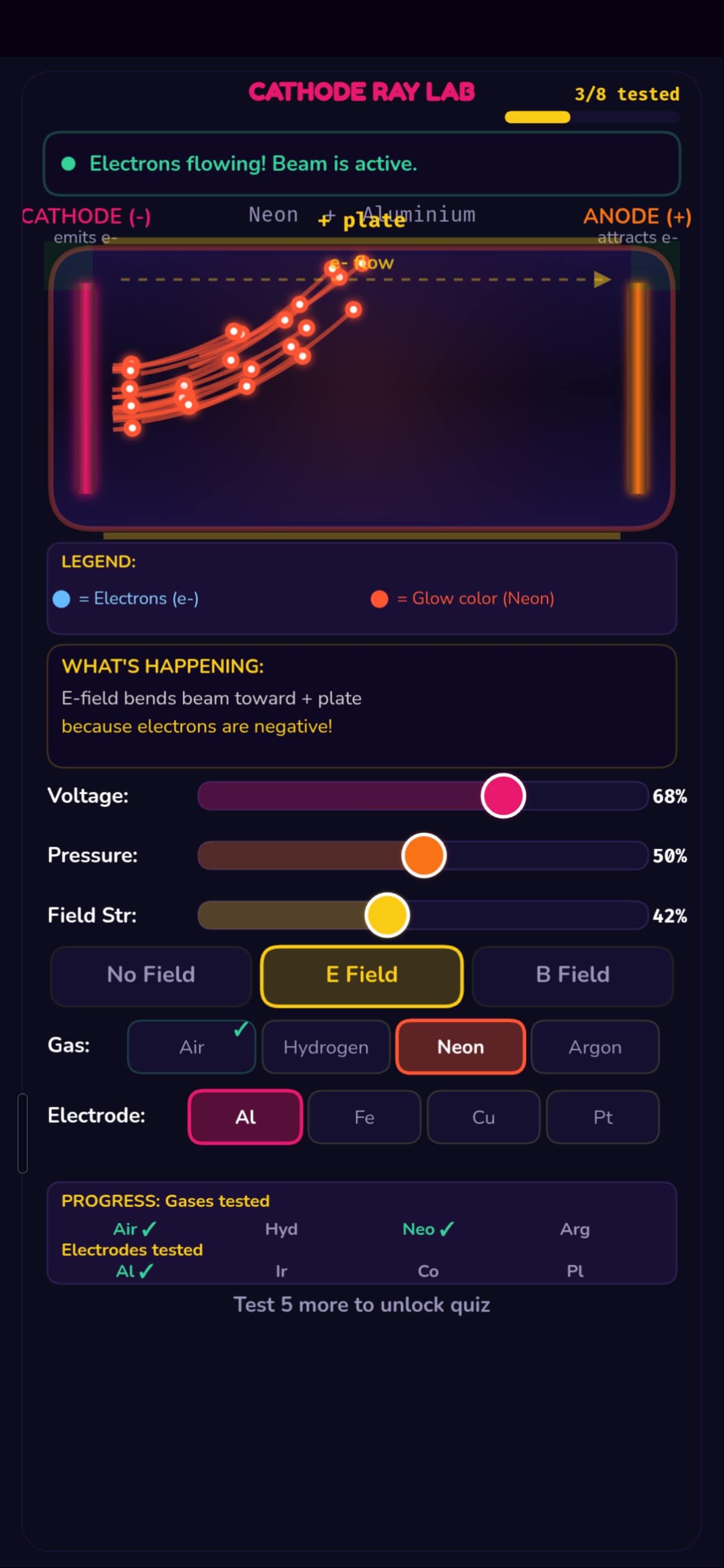
- ReadThe short NCERT explainer
- PracticeTimed, until it sticks

Still stuck at 11pm? TarQPro reads the answer you got wrong and teaches the idea behind it, not just the right option.