Human Eye and Colourful World Class 10 Notes — Defects & Scattering
Complete notes on Human Eye and Colourful World (Class 10 NCERT Ch 10). Covers eye defects, prism dispersion, atmospheric refraction, Tyndall effect & scattering with solved numericals.
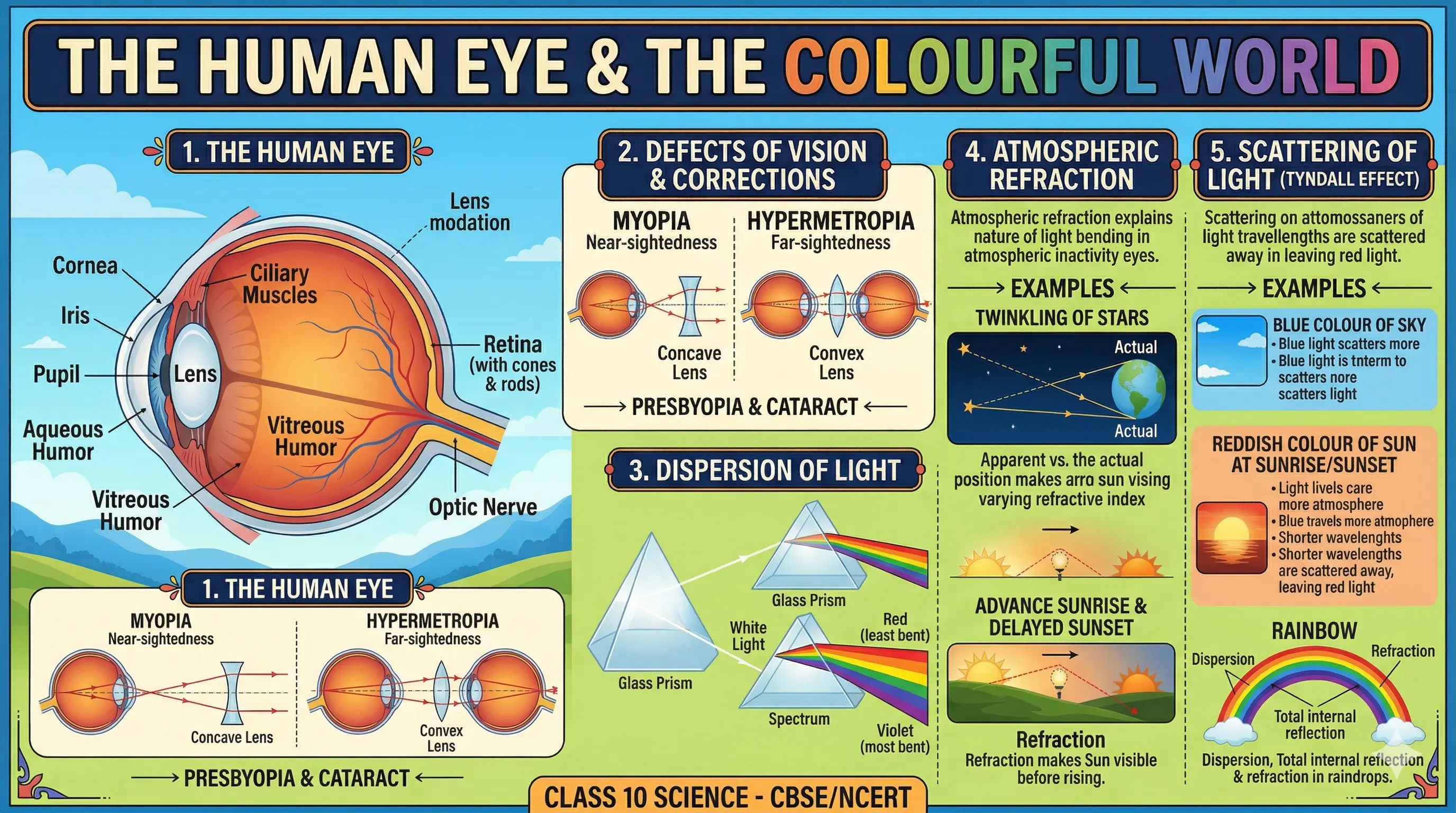
Introduction: Human Eye and Colourful World Class 10 Notes — Why the Sky Is Blue and Your Glasses Work
This is the chapter where physics stops being abstract and starts explaining things you see every single day.
Why is the sky blue? Why does the sun look red at sunrise? Why does a prism split white light into a rainbow? Why do some people need glasses? Every answer comes from one chapter — Human Eye and the Colourful World (NCERT Class 10, Chapter 10).
The concepts connect directly to refraction and Snell's law from Chapter 9, so if you haven't covered refraction yet, start there first — this chapter builds on it.
The Human Eye — A Biological Lens System
Your eye is essentially a camera. Understanding it requires the same lens optics from Chapter 9, applied to biology.
| Part | Structure | Function |
|---|---|---|
| Cornea | Transparent curved front surface | Responsible for most of the eye's refraction. Fixed curvature — focussing power doesn't change. |
| Iris & Pupil | Iris = coloured ring; Pupil = central opening | Controls amount of light entering. Pupil constricts in bright light, dilates in dim light — automatic response. |
| Crystalline Lens | Flexible convex lens (jelly-like protein) | Fine-focuses the image. Changes shape (and focal length) to focus on near or far objects. |
| Ciliary Muscles | Muscles attached to the lens | Relax → lens thins → long focal length (far objects). Contract → lens thickens → short focal length (near objects). |
| Retina | Light-sensitive layer at the back of the eye | Contains rods (dim light, B&W) and cones (colour, bright light). Image formed here is real, inverted, diminished. |
| Optic Nerve | Nerve bundle from retina to brain | Carries electrical signals to the brain for processing. Brain flips the inverted image right-side up. |
Power of Accommodation
The power of accommodation is the ability of the eye lens to adjust its focal length to focus on objects at different distances. It's what makes the human eye superior to any fixed-focal-length camera lens.
| Term | Definition | Normal Value |
|---|---|---|
| Near point | Closest distance at which the eye can focus comfortably (least distance of distinct vision) | 25 cm (represented as D in formulas) |
| Far point | Farthest distance at which the eye can see clearly | Infinity (∞) |
Board exam trap: "The focal length of the eye lens is fixed" — FALSE. The whole point of accommodation is that the focal length changes. However, there are limits. Below 25 cm, even maximum accommodation cannot focus the image on the retina — which is why you can't read text held 5 cm from your eye.
Defects of Vision and Their Correction
This section carries the maximum marks in board exams from this chapter. Three defects, three corrections — know the ray diagrams for each.
| Defect | Problem | Cause | Correction |
|---|---|---|---|
| Myopia (Near-sightedness) | Cannot see distant objects. Image forms in front of retina. | Eyeball too long OR lens too curved → excessive converging power → focal length too short. | Concave (diverging) lens. Diverges rays slightly so eye lens can focus them on the retina. f = −(far point distance). |
| Hypermetropia (Far-sightedness) | Cannot see nearby objects. Image forms behind retina. | Eyeball too short OR lens too flat → insufficient converging power → focal length too long. | Convex (converging) lens. Converges diverging rays from a near object before they enter the eye. Near point shifts to 25 cm effectively. |
| Presbyopia (Ageing eye) | Difficulty focusing both near AND far. Common above age 40. | Ciliary muscles weaken + lens loses flexibility with age → reduced power of accommodation. | Bifocal lenses — upper portion concave (distance), lower portion convex (reading). |
Board exam note on Presbyopia: It is sometimes described as a combination of myopia and hypermetropia — that is not accurate. It is specifically a loss of accommodation due to ageing, not the same structural problem as either defect.
Worked Numerical: Corrective Lens Power
Question: A person cannot see objects clearly beyond 200 cm. (a) What defect does this person have? (b) What type of lens is needed? (c) What is the power of the corrective lens?
Solution:
(a) The person's far point is 200 cm instead of infinity — they cannot see distant objects clearly → Myopia (near-sightedness).
(b) Myopia is corrected using a concave lens.
(c) The concave lens must form a virtual image of a distant object (at infinity) at the person's far point (200 cm).
Using the lens formula: 1/v − 1/u = 1/f
u = −∞ (object at infinity) | v = −200 cm = −2 m (virtual image at far point)
1/(−2) − 1/(−∞) = 1/f → 1/f = −1/2 → f = −2 m
Power P = 1/f = −0.5 D
The person needs a concave lens of power −0.5 dioptres.
Dispersion of Light Through a Prism
When white light enters a triangular glass prism, it bends toward the base at the first surface, travels through the glass, and bends again at the second surface. The total bending is the angle of deviation (δ).
The key insight: different colours have slightly different refractive indices in glass. Violet bends the most (highest n), red bends the least (lowest n). The single beam of white light splits into a spectrum — dispersion.
| Colour | Wavelength | Refractive Index in Glass | Deviation |
|---|---|---|---|
| Violet | Shortest (~380–450 nm) | Highest | Most deviated |
| Indigo, Blue, Green, Yellow, Orange | Intermediate | Intermediate (decreasing) | Intermediate |
| Red | Longest (~620–750 nm) | Lowest | Least deviated |
Spectrum order from most to least deviated: VIBGYOR
Newton's Recombination Experiment: Newton showed that passing the spectrum from one prism through a second identical inverted prism recombines it back to white light — proving that white light is a mixture of all seven colours, and the prism doesn't add colour, it only separates what's already there.
Atmospheric Refraction — Why Stars Twinkle
The atmosphere is made of layers of air with different temperatures and densities. Warm air is less dense (lower n), cold air is denser (higher n). This creates a continuously changing refractive index from ground level to outer space.
| Phenomenon | Cause | Key Fact |
|---|---|---|
| Twinkling of stars | Stars are point sources — atmospheric fluctuations change apparent brightness and position continuously. | Planets don't twinkle: they appear as tiny discs, so fluctuations from different parts average out to steady light. |
| Advanced sunrise / Delayed sunset | Sunlight near horizon refracts through denser lower atmosphere, bending downward toward the observer — sun appears above its actual position. | Sun visible ~2 min before actual sunrise and ~2 min after actual sunset → day is ~4 minutes longer due to atmospheric refraction. |
| Flattened sun at horizon | Lower edge of sun refracted more than upper edge (travels through denser air). | Sun appears oval/flattened at sunrise and sunset. |
Scattering of Light — The Big Board Exam Section
This section explains the most visually striking everyday phenomena and carries significant marks in boards.
Tyndall Effect
When a beam of light passes through a colloid (a mixture with fine suspended particles — fog, smoke, diluted milk), the particles scatter the light, making the beam visible. This is the Tyndall effect.
Examples: Sunbeams visible through a dusty room, light beam in fog or mist, the bluish tinge of smoke from a fire.
Key condition: The particles must be comparable to or smaller than the wavelength of light. Very small particles (like air molecules) preferentially scatter shorter wavelengths (blue/violet). Very large particles scatter all wavelengths equally (white scattering).
Rayleigh Scattering — Why the Sky Is Blue
According to Rayleigh's law of scattering, the amount of scattering by tiny particles (like atmospheric gas molecules) is inversely proportional to the fourth power of wavelength:
Scattering ∝ 1/λ⁴
| Phenomenon | What Happens | Why |
|---|---|---|
| Blue sky | Sky appears blue during daytime | Blue and violet have short wavelengths → scatter the most. Eyes are more sensitive to blue than violet, and upper atmosphere absorbs some violet → sky looks blue. |
| Dark sky at altitude | Sky appears darker blue from a mountain or aeroplane | Fewer molecules to scatter light. In outer space → sky appears completely black (no atmosphere). |
| Red/orange sun at sunrise & sunset | Sun appears red/orange near the horizon | Sunlight travels through a much thicker atmospheric layer at low angles. Most blue and violet light is scattered away; remaining longer-wavelength red and orange light reaches the eye. |
| Red sky near horizon at sunset | Entire horizon sky appears reddish | Scattered blue light has been redirected away; clouds and atmosphere near horizon are illuminated primarily by red/orange light. |
| Red danger signals | Traffic lights, stop signs, brake lights use red | Red has the longest visible wavelength → scatters the least → travels farthest through fog, rain, and dust without being scattered away. |
Quick Revision Summary
| 📌 Human Eye and Colourful World — Class 10 Quick Reference | |
|---|---|
| Eye Structure | Cornea (most refraction) → Iris/Pupil (light control) → Lens (variable focal length, controlled by ciliary muscles) → Retina (real, inverted image). Optic nerve → brain. |
| Accommodation | Eye adjusts focal length via ciliary muscles + lens shape. Near point = 25 cm (D). Far point = infinity (normal eye). |
| Myopia | Can't see far. Image forms before retina. Eyeball too long / lens too curved. Corrected by concave lens. f = −(far point distance). |
| Hypermetropia | Can't see near. Image forms behind retina. Eyeball too short / lens too flat. Corrected by convex lens. |
| Presbyopia | Age-related loss of accommodation (ciliary muscles + lens flexibility). Corrected by bifocal lenses. |
| Prism Dispersion | White light → VIBGYOR. Violet deviates most (highest n), red least (lowest n). n differs for each wavelength. |
| Atmospheric Refraction | Stars twinkle (point source + fluctuating atmosphere). Planets don't (disc source). Sun visible ~2 min early + sets ~2 min late = +4 min daylight. |
| Rayleigh Scattering | Scattering ∝ 1/λ⁴. Blue sky (short λ scatters more). Red sunset (thick atmosphere → blue scattered away). Red signals (red scatters least → travels farthest). |
| Tyndall Effect | Light beam visible in colloids (dust, fog, smoke). Fine suspended particles scatter light sideways. |
Conclusion: The Chapter That Explains Your World
Human Eye and the Colourful World is rare among Class 10 chapters — every concept is something you've already observed. The red sun, the blue sky, the glasses on your face, the twinkling stars on a clear night. Once you understand the physics, these stop being things you just see and become things you understand. That shift — from passive observation to active explanation — is exactly what NCERT is trying to build, and exactly what earns you marks in boards.
To see how the human eye focuses light and how corrective lenses work — interactively — Logic Bloom's Playground lets you simulate myopia, hypermetropia, and prism dispersion in real time. Pair it with our refraction and Snell's law notes for complete Class 10 optics mastery.
Try the Human Eye simulation free on Logic Bloom →
FAQs — Human Eye and Colourful World Class 10
Q1: Why can't a person with myopia see distant objects clearly?
In a myopic eye, the eyeball is elongated or the lens is too curved, giving it excessive converging power. This causes parallel rays from distant objects to converge and form the image in front of the retina rather than on it, resulting in a blurred image. A concave lens of appropriate power corrects this by diverging the rays slightly before they enter the eye, so the eye lens can then focus them correctly on the retina.
Q2: Why do stars twinkle but planets do not?
Stars are so far away that they appear as point sources of light. As starlight passes through atmospheric layers with constantly changing refractive index, the light is refracted irregularly, causing fluctuations in brightness and apparent position — this is twinkling. Planets are much closer and appear as tiny discs. Light from different parts of the disc averages out the atmospheric fluctuations, so overall brightness remains steady and planets appear to shine without twinkling.
Q3: Why does the sky appear blue during the day?
Sunlight entering the atmosphere encounters gas molecules (nitrogen, oxygen) that are much smaller than the wavelength of visible light. According to Rayleigh scattering, scattering is proportional to the inverse fourth power of wavelength — so shorter wavelengths scatter far more intensely. Blue and violet scatter the most, but since our eyes are more sensitive to blue and the upper atmosphere absorbs some violet, the sky appears blue.
Q4: Why does the sun appear reddish at sunrise and sunset?
At sunrise and sunset, sunlight must travel through a much longer path through the atmosphere compared to noon. During this extended journey, most of the shorter wavelength light — blue and violet — is scattered away in other directions by atmospheric molecules. The light that finally reaches the observer's eye is predominantly the longer wavelength red and orange light, making the sun appear reddish.
Q5: What is the difference between myopia and hypermetropia?
Myopia (near-sightedness) means the person can see nearby objects clearly but distant objects are blurred because the image forms in front of the retina — corrected with a concave lens. Hypermetropia (far-sightedness) means the person can see distant objects clearly but nearby objects are blurred because the image forms behind the retina — corrected with a convex lens. The defects are essentially opposite: one involves too much converging power, the other too little.