Refraction of Light Class 10 | Snell's Law, Lens Formula & Numerical's
Master refraction of light for Class 10 NCERT. Covers Snell's Law, refractive index, total internal reflection, lens formula with sign convention, and solved numericals.
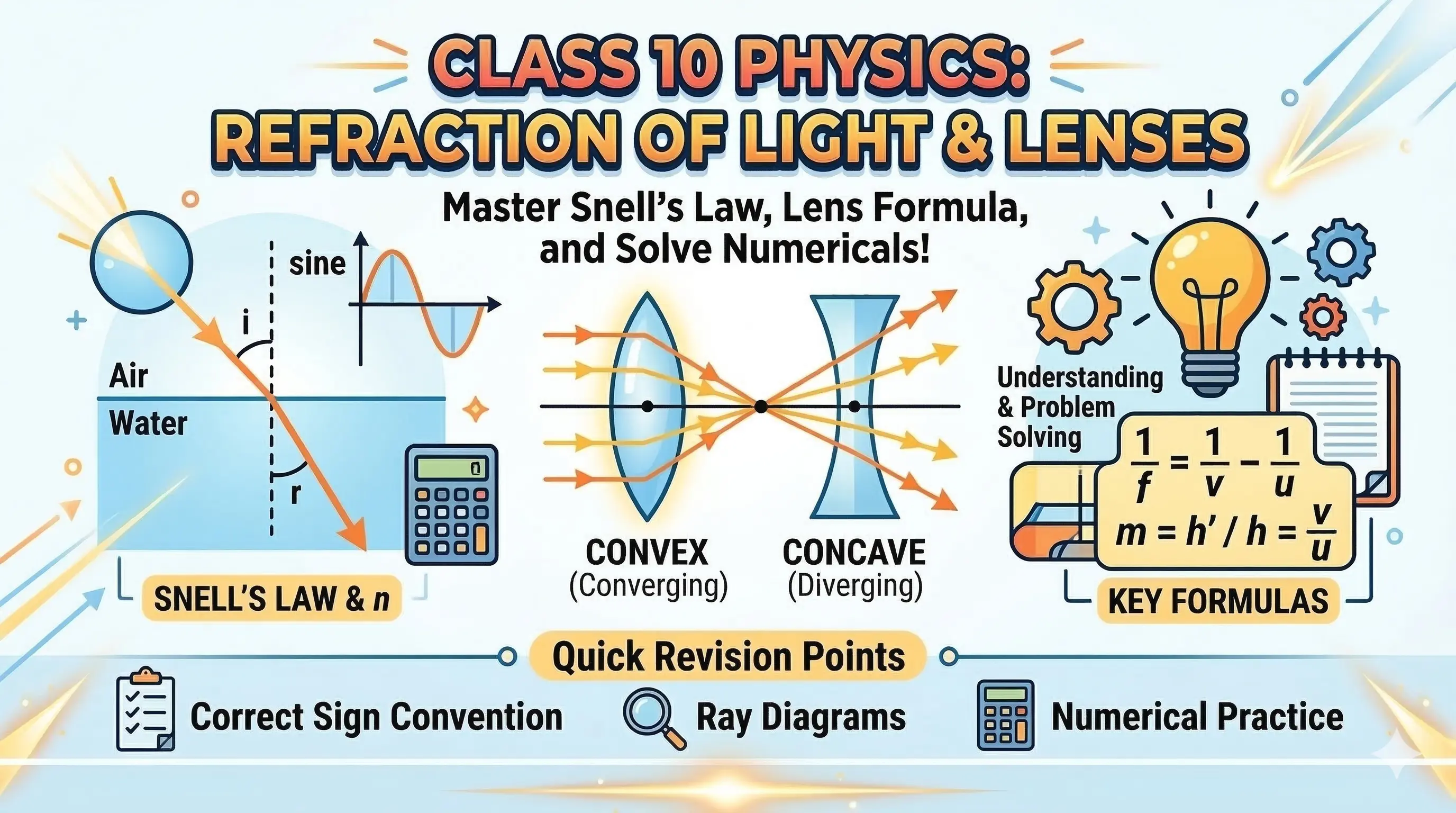
Introduction: What Is Refraction and Why Does It Matter?
Light travels in a straight line — until it doesn't. The moment a ray crosses from one medium into another, it bends. That bending is refraction, and it is responsible for everything from the apparent shallowness of a swimming pool to the corrective power of your spectacles.
Class 10 Physics, Chapter 10 (Light — Reflection and Refraction, NCERT) treats refraction as one of its two core topics. If you can nail the laws, the formula, and the sign convention, the numericals become mechanical. This article builds the concept from the ground up so that both the theory and the problem-solving click at the same time.
What Is Refraction of Light?
When light travels from one transparent medium to another — say, from air into glass — its speed changes. Speed and direction are linked: when speed changes at an angle, the ray bends at the boundary. This phenomenon is refraction.
Three terms to fix in your mind immediately:
- The Normal — an imaginary line perpendicular to the refracting surface at the point of incidence.
- Angle of Incidence (i) — angle between the incident ray and the normal, measured in the first medium.
- Angle of Refraction (r) — angle between the refracted ray and the normal, measured in the second medium.
Key observation: If light goes from a rarer medium (lower optical density, e.g., air) to a denser medium (higher optical density, e.g., glass), it bends toward the normal. Going the other way — denser to rarer — it bends away from the normal. This is not an arbitrary rule; it follows directly from the change in wave speed at the boundary.
The Two Laws of Refraction (Snell's Law)
As stated in NCERT Class 10 Chapter 10, the laws of refraction are:
Law 1: The incident ray, the refracted ray, and the normal at the point of incidence all lie in the same plane.
Law 2 (Snell's Law): The ratio of the sine of the angle of incidence to the sine of the angle of refraction is constant for a given pair of media and a given colour of light.
sin i / sin r = constant = n₂₁
This constant n₂₁ is called the refractive index of medium 2 with respect to medium 1. The full, combined form of Snell's Law — and the version used in every numerical — is:
n₁ sin i = n₂ sin r
Refractive Index — What It Actually Means
The refractive index is a measure of how much a medium slows down light relative to its speed in vacuum.
n = c / v
Where c = speed of light in vacuum = 3 × 10⁸ m/s, and v = speed of light in the medium. Since light always slows down in a medium, n ≥ 1 for all real materials.
| Medium | Approximate Refractive Index |
|---|---|
| Vacuum | 1.00 (by definition) |
| Air | 1.0003 ≈ 1.00 |
| Water | 1.33 |
| Crown Glass | 1.52 |
| Diamond | 2.42 |
Diamond's high refractive index (2.42) is precisely why it bends light so dramatically and produces that characteristic sparkle. A higher refractive index always means the medium slows light down more — and therefore bends it more sharply at the boundary.
Total Internal Reflection
This is a special outcome of refraction logic, and it carries significant marks in board exams. When light travels from a denser medium to a rarer medium, the angle of refraction is greater than the angle of incidence. As the angle of incidence increases, there comes a critical angle (θ_c) at which the refracted ray grazes along the surface — angle of refraction = 90°. Beyond this angle, no refraction occurs. All light is reflected back into the denser medium. This is total internal reflection (TIR).
sin θ_c = n₂ / n₁ (where n₁ > n₂)
TIR is the operating principle behind optical fibres — light signals bounce along a glass core indefinitely without leaking, making modern internet infrastructure possible. It is also why endoscopes can transmit images around bends inside the human body.
Refraction Through a Glass Slab
When a ray passes through a glass slab with parallel surfaces (like a window pane), it refracts at the first surface and refracts again at the second. The emergent ray is parallel to the incident ray but laterally displaced. The lateral shift increases with slab thickness, angle of incidence, and refractive index of the glass. This is why objects viewed through thick glass appear shifted sideways — a phenomenon you can test at any window.
Refraction by Spherical Lenses
NCERT Chapter 10 builds on the refraction concept to explain lenses, which are the real-world payoff of Snell's Law. A lens refracts light twice — once at each curved surface — and the combined effect either converges or diverges the rays.
Convex (Converging) Lens: Thicker at the centre. Converges parallel rays to a real focal point F on the other side. Used in magnifying glasses, cameras, projectors, and the human eye's cornea-lens system.
Concave (Diverging) Lens: Thinner at the centre. Diverges rays; the refracted rays appear to originate from a virtual focal point F on the same side as the object. Used in spectacles for myopia (short-sightedness).
The Lens Formula, Magnification, and Power
The Lens Formula relates object distance, image distance, and focal length:
1/v − 1/u = 1/f
Where v = image distance from optical centre, u = object distance from optical centre, f = focal length.
New Cartesian Sign Convention:
- All distances measured from the optical centre O.
- Distances in the direction of incident light (rightward) are positive.
- Distances opposite to incident light (leftward) are negative.
- Object is always placed to the left → u is always negative.
- Convex lens: f is positive. Concave lens: f is negative.
Magnification:
m = v / u
| Value of m | Nature of Image |
|---|---|
| m > 0 (positive) | Virtual and erect |
| m < 0 (negative) | Real and inverted |
| |m| > 1 | Magnified (larger than object) |
| |m| < 1 | Diminished (smaller than object) |
Power of a Lens:
P = 1 / f (in metres)
Unit: Dioptre (D). Convex lens → positive power. Concave lens → negative power. When two thin lenses are placed in contact: P_total = P₁ + P₂. This is why opticians combine lenses when prescribing spectacles — they simply add the powers.
Solved Numerical Problem
Problem: A convex lens has a focal length of 20 cm. An object is placed 30 cm in front of the lens. Find: (a) the position of the image, (b) the magnification, and (c) the nature of the image.
Given:
- Focal length: f = +20 cm (convex lens → positive)
- Object distance: u = −30 cm (object on left → negative by sign convention)
Step 1 — Apply the Lens Formula:
1/v − 1/u = 1/f
1/v − 1/(−30) = 1/20
1/v + 1/30 = 1/20
1/v = 1/20 − 1/30 = (3 − 2)/60 = 1/60
v = +60 cm
Step 2 — Magnification:
m = v/u = (+60)/(−30) = −2
Step 3 — Interpretation:
- v = +60 cm → image is on the opposite side of the lens from the object → Real image
- m = −2 → image is inverted and twice the size of the object
Answer: The image forms 60 cm beyond the lens. It is real, inverted, and magnified (2×). This corresponds to the object being placed between F and 2F of a convex lens — a standard position-outcome pair you should memorise for board exams.
Common Mistakes to Avoid
| Mistake | Correct Approach |
|---|---|
| Writing u = +30 cm instead of u = −30 cm | Object is always to the left → u is always negative. Sign convention is not optional. |
| Using mirror formula (1/v + 1/u = 1/f) for a lens problem | Lens formula has a minus sign: 1/v − 1/u = 1/f. These are different formulas. |
| Using f = R/2 for a lens (confusing with mirrors) | The relation f = R/2 applies only to spherical mirrors. Lens focal length is independent. |
| Calculating Power with f in centimetres | Power = 1/f requires f in metres. Always convert: 25 cm → 0.25 m → P = +4 D. |
Quick Revision Summary
| 📌 Refraction of Light — Class 10 Quick Reference | |
|---|---|
| Refraction | Bending of light when it crosses media due to change in speed |
| Snell's Law | n₁ sin i = n₂ sin r |
| Refractive Index | n = c/v (always ≥ 1) |
| Direction of Bending | Denser medium → toward normal; Rarer medium → away from normal |
| Total Internal Reflection | Occurs when angle of incidence > critical angle in a denser medium; used in optical fibres |
| Lens Formula | 1/v − 1/u = 1/f (New Cartesian sign convention) |
| Magnification | m = v/u; negative = real inverted; positive = virtual erect |
| Power | P = 1/f(m), unit = Dioptre (D) |
| Convex Lens | Converging; f positive; P positive |
| Concave Lens | Diverging; f negative; P negative |
Conclusion: From Concept to Confidence
Refraction is one of those chapters where the physics is genuinely elegant — a single principle (speed changes at boundaries) explains why pools look shallow, why diamonds sparkle, why optical fibres work, and why your spectacles correct your vision. The lens formula and sign convention require care, not brilliance. Get them clean in your head and the numericals follow naturally.
If you want to build an intuitive feel for how rays actually bend before you tackle problems on paper, Logic Bloom's Playground has an interactive refraction simulation where you can drag a light ray across media and watch Snell's Law play out in real time — before solving a single numerical. Concept-first, always.
Try the refraction simulation free on Logic Bloom →
FAQs About Refraction of Light Class 10
Q1: What is refraction of light in simple words?
Refraction is the bending of light when it travels from one transparent medium to another. It happens because the speed of light changes between media. For example, light slows down when entering glass from air, and this speed change causes the ray to bend at the boundary.
Q2: What is Snell's Law formula for Class 10?
Snell's Law states: n₁ sin i = n₂ sin r, where n₁ and n₂ are the refractive indices of the first and second media, i is the angle of incidence, and r is the angle of refraction. For Class 10 NCERT, this is also written as sin i / sin r = n₂₁ (refractive index of medium 2 with respect to medium 1).
Q3: Why does a pencil look bent when dipped in water?
When light from the submerged part of the pencil crosses from water (denser) to air (rarer), it bends away from the normal. Your eye traces this ray back in a straight line and perceives the pencil tip at a shallower, shifted position — making it appear broken or bent at the water surface. This is a direct real-world consequence of Snell's Law.
Q4: What is the difference between a convex and concave lens?
A convex lens is thicker at the centre and converges light rays to a real focal point — it has positive focal length and positive power. A concave lens is thinner at the centre and diverges light rays — it has negative focal length and negative power. Convex lenses are used in cameras and reading glasses; concave lenses correct short-sightedness (myopia).
Q5: What is total internal reflection and where is it used?
Total internal reflection (TIR) occurs when light travelling in a denser medium strikes the boundary with a rarer medium at an angle greater than the critical angle — causing all light to reflect back into the denser medium with zero refraction. TIR is the principle behind optical fibres (internet data transmission), endoscopes used in medicine, and the brilliance cut of diamonds.