Kinetic Theory and Thermodynamics JEE Main PYQ. The Gas-Mixture, Adiabatic and Cycle-Efficiency Traps That Decide This Block (2015-2026)
Kinetic Theory and Thermodynamics JEE Main PYQ analysis (2015-2026), Physics. About 350 questions mapped: mixture gamma, adiabatic work, PV cycles, 9 traps.
In the app: 360+ JEE Main questions on Kinetic Theory and Thermodynamics, 210+ of them from past papers. Free to start

About two questions a shift, and most of them reward one careful habit.
Kinetic Theory and Thermodynamics together form one of the steadiest blocks in JEE Main Physics. We counted about 350 questions from 2015 to 2026. That is close to two questions in every shift, around 8 percent of the Physics marks. Roughly 40 percent come from Kinetic Theory and 60 percent from Thermodynamics.
Three sub-topics carry half the block. Thermodynamic processes, degrees of freedom with gas mixtures, and PV diagrams together give about 50 percent of the questions. Master those three and you have the core.
The traps are unusually predictable here. Students average γ directly for a mixture. They use Cp for internal energy. They apply the Carnot formula to a cycle that is not Carnot. Each of these mistakes produces a neat, wrong answer that sits waiting in the options.
This block also sits right next to Chemistry. You study the first law twice, with opposite sign conventions. Mixing them up is one of the most common ways to lose a mark here.
We analysed every Kinetic Theory and Thermodynamics question across JEE Main sessions from 2015 to 2026, including January and April 2026. This is part of Logic Bloom's JEE Main analysis series, after SHM and Waves and Modern Physics.
The decade at a glance: where the marks sit, by format
The ten sub-topics are far from equal. Processes alone carry a quarter of the block. The format column tells you whether to expect options or an NVQ box.
| Rank | Sub-topic | Unit | Questions | Share | Format lean |
|---|---|---|---|---|---|
| 1 | Thermodynamic processes (isothermal, adiabatic, isobaric, isochoric, polytropic) | Thermo | 92 | 26% | Heavy NVQ |
| 2 | Degrees of freedom and gas mixtures | KTG | 44 | 13% | Balanced |
| 3 | PV diagrams and cycles | Thermo | 41 | 12% | Mostly MCQ |
| 4 | Molecular speeds | KTG | 39 | 11% | Mostly MCQ |
| 5 | First law and internal energy | Thermo | 37 | 11% | Heavy NVQ |
| 6 | Pressure and kinetic energy | KTG | 35 | 10% | Balanced |
| 7 | Heat engines and cycle efficiency | Thermo | 31 | 9% | Heavy NVQ |
| 8 | Ideal gas equation, connected vessels | KTG | 16 | 5% | Heavy NVQ |
| 9 | Mean free path, collision frequency | KTG | 10 | 3% | Almost all MCQ |
| 10 | Second law and reversibility | Thermo | 7 | 2% | MCQ only |
Here is how the block has moved year by year.
| Year | KTG | Thermo | What repeated across shifts |
|---|---|---|---|
| 2015 to 2018 | 1 to 4 | 2 to 7 | Polytropic PVⁿ = constant; Carnot with refrigerator COP |
| 2019 | 16 | 14 | γ of a monatomic + diatomic mixture in 3 shifts; ΔU/Q = 1/γ for isobaric heating |
| 2020 | 14 | 19 | NVQs arrive; final temperature when two gases mix |
| 2021 | 24 | 35 | Mean free path calculations; adiabatic compression work |
| 2022 | 17 | 25 | "Gas does work Q/4, find C" in 3 shifts; volume ratios of 8 and 27 |
| 2023 | 19 | 27 | Energy of non-rigid diatomic molecules; internal energy of mixtures |
| 2024 | 21 | 17 | vrms of H₂ vs O₂ in 5 January shifts; collision frequency and mixture γ in April |
| 2025 | 12 | 22 | Compulsory NVQs begin; connected vessels at 500 K and 1000 K |
| 2026 | 16 | 18 | Spring-loaded piston; statements on ΔU and γ = 1 + 2/f |
Year totals come from the session-by-session map, which counts slightly fewer questions than the topic totals above. The pattern is the same either way. In 2024 to 2026, almost every concept in one shift echoed a neighbouring shift. A template you meet in Session 1 is very likely to return in Session 2.
What is in this block, and what is not
| In this block (revise this) | Not in this block |
|---|---|
| Ideal gas equation and mixtures; pressure and kinetic energy; molecular speeds; degrees of freedom and equipartition; mean free path; first law; all named processes; PV diagrams and cycles; engine efficiency and refrigerator COP; second law and reversibility | Calorimetry, expansion, latent heat and heat transfer (a separate unit); Newton's law of cooling (deleted); enthalpy, Hess's law and Gibbs energy (Chemistry) |
One more shift matters. States of Matter left the Chemistry syllabus in 2024. All gas-law and gas-mixture questions now land here, in Physics. That is why connected vessels and mixtures have grown since then.
Part 1: Kinetic Theory of Gases
Gas laws and connected vessels
Most gas-law questions now come as connected vessels or a moving piston. Two conservation rules solve almost all of them. If the vessels are just joined, the total number of moles stays fixed. If they are also insulated and rigid, the total internal energy stays fixed too.
Q. (NVQ) Two insulated rigid vessels of volume V and 2V are joined by a closed valve. The smaller holds a diatomic gas at 7 kPa and 500 K. The larger holds the same gas at 8 kPa and 1000 K. The valve is opened. The final pressure is (x/3) kPa. Find x.
Solution
- No heat enters and no work is done, so total internal energy is fixed.
- For one gas, U = (f/2)PV.
- So 7 × V + 8 × 2V = P(3V), which gives P = 23/3 kPa.
- The temperatures drop out completely.
Answer 23
Trap Averaging the two pressures ignores that the second vessel is twice as big. Trying to track temperature with PV = nRT takes far longer.
Pressure, kinetic energy and temperature
Two facts carry this sub-topic. Pressure comes from molecular speed: P = ⅓ρv²rms. And the average translational kinetic energy of one molecule is (3/2)k_BT, whatever the gas. So at the same temperature, a helium atom and an argon atom carry the same kinetic energy. NTA tests this with mass ratios like 4 : 40 placed in the options to tempt you.
A useful link follows: the translational kinetic energy of all molecules in a volume equals (3/2)PV. Note the word "translational". If the question asks for total internal energy, you need (f/2)PV instead.
Molecular speeds
Three speeds describe a gas, and all three grow as √(T/M). They differ only in the number in front.
The order is always v_rms > v_avg > v_mp, in the ratio √3 : √(8/π) : √2. Pressure and kinetic energy use v_rms. The peak of the curve is v_mp. NTA's favourite setup asks at what temperature one gas's speed matches another's. Because v ∝ √(T/M), equal speeds of the same type mean equal T/M.
Q. (MCQ) At what temperature is the most probable speed of helium (M = 4) equal to the rms speed of oxygen (M = 32) at 47°C?
Solution
- Oxygen is at 320 K.
- Set v_mp(He) = v_rms(O₂) and square: 2R T_He / 4 = 3R × 320 / 32.
- The right side is 30R, so T_He = 60 K.
- That is −213°C.
Answer (A)
Trap (B) forgets to convert back from kelvin; (C) uses v_rms for helium too, giving 40 K; (D) swaps the 2 and the 3, giving 90 K.
Degrees of freedom and gas mixtures
This is the second biggest sub-topic, and the γ-mixture trap lives here. Each degree of freedom carries ½k_BT per molecule. From the count f, everything else follows: Cv = (f/2)R, Cp = Cv + R, and γ = 1 + 2/f.
| 🧠 Degrees of freedom and γ | |||
|---|---|---|---|
| Monatomic (He, Ar) | f = 3 | Cv = 3R/2 | γ = 5/3 |
| Rigid diatomic (O₂, N₂) | f = 5 | Cv = 5R/2 | γ = 7/5 |
| Diatomic with vibration | f = 7 | Cv = 7R/2 | γ = 9/7 |
| Rigid non-linear (CH₄, NH₃) | f = 6 | Cv = 3R | γ = 4/3 |
| Each vibrational mode | adds 2 to f, one for motion and one for the spring | ||
The mixture rule. Never average γ directly. Internal energy adds up, so average Cv first: Cv_mix = (n₁Cv₁ + n₂Cv₂)/(n₁ + n₂). Then Cp_mix = Cv_mix + R and γ_mix = Cp_mix/Cv_mix. For 1 mol monatomic plus 1 mol diatomic, the right answer is 3/2. Averaging γ gives 23/15, which NTA puts in the options on purpose.
The vibration rule. Treat a gas as rigid unless the stem says "non-rigid", "high temperature" or "vibrational mode". When it does, add 2 per mode, not 1.
Q. (NVQ) A mixture holds 2 mol of a monatomic gas and 1 mol of a non-linear polyatomic gas. Each polyatomic molecule has 3 translational, 3 rotational and 1 vibrational mode active. The ratio γ of the mixture is p/q in lowest terms. Find p + q.
Solution
- The polyatomic gas has f = 3 + 3 + 2(1) = 8, so Cv = 4R.
- The monatomic gas has Cv = 3R/2.
- Then Cv_mix = (2 × 1.5R + 1 × 4R)/3 = 7R/3, and Cp_mix = 10R/3.
- So γ = 10/7, and p + q = 17.
Answer 17
Trap Adding 1 for the vibration gives 32. Ignoring the vibration gives γ = 3/2 and 5.
Mean free path and collision frequency
This small area is almost always an MCQ, usually two statements to judge. The mean free path is λ = k_BT / (√2 π d² P). Read which quantity is held fixed.
- At fixed volume, the number density is fixed, so λ does not change when you heat the gas. Collision frequency rises as √T.
- At fixed pressure, λ grows in proportion to T.
- Doubling the molecular diameter cuts λ to a quarter, since it depends on 1/d².
Dodge the trap
3 real JEE Main questions on Kinetic Theory and Thermodynamics. Can you get all 3?
A polyatomic ideal gas has 24 vibrational modes. What is the value of γ?
Not quite. It's C.
Gamma equals 1 plus 2 over the total degrees of freedom of the molecule. Total f = 3 translational + 3 rotational + 2×24 vibrational = 54, so γ = 1 + 2/54, which is close to 1.03.
The trap Counting each vibrational mode as one degree of freedom instead of two gives a noticeably different, larger gamma.
The efficiency of a Carnot engine, working between the steam point and the ice point, will be:
Not quite. It's A.
Carnot efficiency depends only on the ratio of the absolute source and sink temperatures. Η=1−(273/373)=100/373=26.81%.
The trap Using the Celsius values directly instead of kelvin gives a much larger, incorrect efficiency.
What is the effect on the root mean square velocity of oxygen molecules if the temperature is doubled and the oxygen molecule dissociates into atomic oxygen?
Not quite. It's B.
Rms velocity is proportional to the square root of temperature divided by molar mass. Doubling T and halving M together scale v_rms by √(2 ÷ 0.5) = √4 = 2.
The trap Ignoring the halved molar mass and accounting only for doubled temperature gives √2 instead of 2.
0 of 3
That is what the traps are for: they look right. The app has 360+ JEE Main questions on Kinetic Theory and Thermodynamics, 210+ of them from past papers, and TarQ AI explains any you get stuck on.
Every past question comes with a paid plan.
Part 2: Thermodynamics
The first law, and the sign convention that trips everyone
In Physics, the first law reads Q = ΔU + W, where W is the work done by the gas. Expansion makes W positive, and compression makes it negative. Chemistry uses the opposite sign for work. Students who study both mix them up.
Take a gas compressed by 20 J of outside work while it gives out 50 J of heat. In Physics, Q = −50 J and W = −20 J. So ΔU = Q − W = −50 + 20 = −30 J. Mixing in the Chemistry sign gives −70 J, which is the trap option.
The other trap here: ΔU = nCvΔT in every process, not just at constant volume. Internal energy depends only on temperature. Students who use nCpΔT for an isobaric process get the heat instead of ΔU. For isobaric heating, the fractions are fixed: ΔU/Q = 1/γ and W/Q = 1 − 1/γ.
Thermodynamic processes, the biggest sub-topic
| Process | Rule | Work by gas | Heat capacity |
|---|---|---|---|
| Isochoric | V fixed, P/T constant | 0 | Cv |
| Isobaric | P fixed, V/T constant | PΔV = nRΔT | Cp |
| Isothermal | PV constant, ΔU = 0 | nRT ln(V₂/V₁) | infinite |
| Adiabatic | PV^γ, TV^(γ−1) constant, Q = 0 | (P₁V₁ − P₂V₂)/(γ − 1) | 0 |
| Polytropic | PVⁿ constant | (P₁V₁ − P₂V₂)/(n − 1) | Cv + R/(1 − n) |
How NVQs get their clean numbers. For a monatomic gas, γ = 5/3. So examiners pick volume ratios of 8 or 27, which have exact cube roots. A volume change of 8 times changes temperature by 8^(2/3) = 4 times. For γ = 3/2, they pick a ratio of 4. Spot the ratio, and the arithmetic takes seconds.
Polytropic shortcuts. If P ∝ V^k, then n = −k. If the gas does work W = Q/k, then ΔU = (1 − 1/k)Q, and the molar heat capacity follows from that. The "work is Q/4" version ran in three shifts of June 2022.
Isothermal vs adiabatic on a PV diagram
An adiabatic curve is γ times steeper than an isothermal one through the same point. Which one sits higher depends on direction.
Many students learn "the adiabatic is always below". That is true only for expansion. In compression the adiabatic ends at a higher pressure, and more work is done on the gas. Also watch for swapped axes. On a V-P graph, the adiabatic is the less steep curve.
Q. (MCQ) One mole of a monatomic gas at pressure P and volume V expands adiabatically to 27V. Its change in internal energy is:
Solution
- PV^(5/3) is constant, so P₂ = P × (1/27)^(5/3) = P/243.
- Then P₂V₂ = (P/243)(27V) = PV/9.
- So ΔU = (P₂V₂ − P₁V₁)/(γ − 1) = (PV/9 − PV)/(2/3) = −(4/3)PV.
Answer (A)
Trap (B) gives the work done by the gas, not ΔU; (C) forgets to divide by γ − 1; (D) forgets to multiply P₂ by 27V.
Cycles and engine efficiency
In a full cycle the gas returns to its start, so ΔU = 0 and net heat equals net work. On a P-V graph, net work is the enclosed area. A clockwise loop is an engine with positive work. Swap the axes to a V-P graph and clockwise means negative work.
The Carnot trap. Efficiency = 1 − T_low/T_high is only for a Carnot cycle, with two isothermals and two adiabatics. For any other loop, efficiency = net work ÷ heat absorbed. Count only the branches where the gas takes in heat.
Q. (NVQ) Two moles of a monatomic gas run the clockwise cycle A(P₀, V₀) → B(2P₀, V₀) → C(2P₀, 2V₀) → D(P₀, 2V₀) → A. The efficiency is (200/k)%. Find k.
Solution
- Net work is the area, P₀V₀.
- On A→B the volume is fixed and nRΔT = P₀V₀, so Q = (3/2)P₀V₀.
- On B→C the pressure is fixed and nRΔT = 2P₀V₀, so Q = (5/2)(2P₀V₀) = 5P₀V₀.
- The other two branches give out heat.
- So heat in = (13/2)P₀V₀, and efficiency = 2/13 = (200/13)%.
Answer 13
Trap Using Cv instead of Cp on B→C gives 9. The Carnot formula with T_min/T_max = 1/4 gives a wrong 75%.
Engines, refrigerators and the second law
For an engine between two reservoirs, efficiency = 1 − T₂/T₁ with temperatures in kelvin. For a refrigerator, COP = T₂/(T₁ − T₂). Using Celsius here is the classic slip: 27°C and 127°C give 25% in kelvin, but a wrong 79% in Celsius. Second-law questions are rare and always conceptual. The favourite is free expansion: no work, no heat, no temperature change, yet the process is irreversible.
| ⚡ The 9 traps, one line each | |
|---|---|
| ΔU | Always nCvΔT, in every process. Never nCpΔT. |
| Sign of work | Physics: Q = ΔU + W, work by the gas is positive. |
| Adiabatic vs isothermal | Adiabatic below in expansion, above in compression. |
| γ of a mixture | Average Cv, not γ. |
| Vibration | Each mode adds 2 to f, and only when the stem says so. |
| Kelvin | Every ratio of temperatures needs kelvin. |
| Carnot shortcut | Only for Carnot cycles. Otherwise, work ÷ heat in. |
| Cycle direction | Clockwise is positive work on P-V, negative on V-P. |
| Speeds | v_rms > v_avg > v_mp. The peak is v_mp. |
The formula sheet you need cold
| Quantity | Formula |
|---|---|
| Ideal gas | PV = nRT = Nk_BT |
| Pressure from speed | P = ⅓ρv²rms |
| KE per molecule | (3/2)k_BT translational; (f/2)k_BT total |
| Speeds | v_rms = √(3RT/M), v_avg = √(8RT/πM), v_mp = √(2RT/M) |
| Equipartition | Cv = (f/2)R, Cp = Cv + R, γ = 1 + 2/f |
| Mixture | Cv_mix = (n₁Cv₁ + n₂Cv₂)/(n₁ + n₂) |
| Mean free path | λ = k_BT / (√2 π d² P) |
| First law | Q = ΔU + W, ΔU = nCvΔT |
| Adiabatic | PV^γ, TV^(γ−1), T^γ P^(1−γ) constant |
| Polytropic heat capacity | C = Cv + R/(1 − n) |
| Engine | η = W/Q_in; reservoir limit 1 − T₂/T₁ |
| Refrigerator | COP = Q₂/W; reservoir limit T₂/(T₁ − T₂) |
12 must-attempt JEE Main questions, built on real PYQ patterns
These twelve follow the templates JEE Main repeats most. Seven are MCQs and five are NVQs, close to the real mix. Each needs at least two steps or turns on a trap. Try each before reading the answer.
1. (MCQ) A vessel holds a gas at 300 K and 2 atm. It is heated to 400 K, and some gas leaks out so that the pressure stays 2 atm. What fraction of the original gas escaped?
Working
- P and V are fixed, so n ∝ 1/T.
- The gas left is 300/400 = 3/4 of the original.
- So 1 − 3/4 = 1/4 escaped.
Answer (A)
Trap (B) uses 400/300 − 1; (C) gives the fraction left, not the fraction lost.
2. (NVQ) Oxygen fills a 2 L vessel at 1.0 × 10⁵ Pa. Find the total translational kinetic energy of its molecules, in joules. Round off to the nearest integer.
Working
- Translational KE of all molecules = (3/2)PV = 1.5 × 10⁵ × 2 × 10⁻³ = 300 J.
- Rotation does not count, because the question says translational.
Answer 300
Trap Using (5/2)PV for diatomic oxygen gives 500, which is total internal energy.
3. (MCQ) At what temperature is the rms speed of hydrogen (M = 2) equal to the rms speed of oxygen (M = 32) at 47°C?
Working
- Equal rms speeds need equal T/M.
- Oxygen is at 320 K, so T_H₂ = 320 × 2/32 = 20 K.
- That is −253°C.
Answer (B)
Trap (A) forgets to convert back to Celsius; (C) flips the mass ratio; (D) uses the square root of the mass ratio.
4. (MCQ) Consider two statements.
Statement I: When a gas in a sealed rigid container is heated, its mean free path does not change.
Statement II: In the same sealed container, the collision frequency rises in proportion to √T.
Choose the correct answer.
Working
- A sealed rigid container fixes the number density, so λ = 1/(√2 π d² n) stays the same.
- The molecules move faster, as √T, over the same path length.
- So collisions happen more often, also as √T.
- Both statements hold.
Answer (A)
Trap (D) uses λ ∝ T, which is true only at constant pressure.
5. (NVQ) A non-linear polyatomic gas has some vibrational modes active. Its ratio Cp/Cv is 8/7. How many vibrational modes are active?
Working
- γ = 1 + 2/f, so 8/7 = 1 + 2/f, which gives f = 14.
- A non-linear molecule has 3 + 3 = 6 without vibration.
- Each mode adds 2, so 6 + 2m = 14 and m = 4.
Answer 4
Trap Adding 1 per mode gives 8.
6. (MCQ) A container holds 2 mol of a monatomic gas and 3 mol of a rigid diatomic gas at temperature T. The total internal energy is:
Working
- U = n(f/2)RT for each gas.
- Monatomic: 2 × (3/2)RT = 3RT.
- Diatomic: 3 × (5/2)RT = 7.5RT.
- Total = 10.5RT.
Answer (C)
Trap (A) treats all 5 mol as monatomic; (B) treats all 5 mol as diatomic; (D) uses Cp in place of Cv.
7. (NVQ) A gas is compressed by 20 J of work done on it. During the compression it gives out 50 J of heat. By how many joules does its internal energy decrease? Round off to the nearest integer.
Working
- In Physics, Q = ΔU + W, with W the work done by the gas.
- Here Q = −50 J and W = −20 J.
- So ΔU = −50 − (−20) = −30 J.
- Internal energy falls by 30 J.
Answer 30
Trap Mixing in the Chemistry sign for work gives 70.
8. (MCQ) A rigid diatomic gas is heated at constant pressure. What fraction of the heat supplied goes into work done by the gas?
Working
- At constant pressure, Q = nCpΔT and W = nRΔT.
- So W/Q = R/Cp = 1 − 1/γ.
- For a diatomic gas, γ = 7/5, so W/Q = 2/7.
Answer (B)
Trap (A) is the fraction that goes into ΔU; (C) uses the monatomic value; (D) is γ itself.
9. (NVQ) A monatomic ideal gas at 27°C is compressed adiabatically to one-eighth of its volume. Find its final temperature in kelvin. Round off to the nearest integer.
Working
- TV^(γ−1) is constant, with γ − 1 = 2/3.
- So T₂ = 300 × 8^(2/3) = 300 × 4 = 1200 K.
Answer 1200
Trap Starting from 27 instead of 300 gives 108; using γ in place of γ − 1 gives 9600.
10. (MCQ) The same gas sample is compressed from the same start to half its volume, once isothermally and once adiabatically. Which is correct?
Working
- Isothermal halving gives 2P₀.
- Adiabatic halving gives 2^γ P₀, which is larger since γ > 1.
- In compression the adiabatic curve lies above the isothermal all the way.
- So the area under it, the work done on the gas, is also larger.
Answer (C)
Trap (A) applies "adiabatic is below", which is true only for expansion; (D) gets the pressure right but not the area.
11. (NVQ) A monatomic ideal gas expands so that its pressure is directly proportional to its volume. Its molar heat capacity in this process is xR. Find x.
Working
- P ∝ V means PV⁻¹ is constant, so the polytropic index is n = −1.
- Then C = Cv + R/(1 − n) = (3/2)R + R/2 = 2R.
- So x = 2.
Answer 2
Trap Reading P ∝ V as n = +1 makes it isothermal. Writing R/(n − 1) instead of R/(1 − n) gives 1.
12. (MCQ) An engine working between two reservoirs has an efficiency of 25% with its sink at 27°C. By how much must the source temperature rise to make the efficiency 40%, keeping the same sink?
Working
- The sink is 300 K.
- At 25%, 300/T₁ = 0.75, so T₁ = 400 K.
- At 40%, 300/T₁′ = 0.60, so T₁′ = 500 K.
- The source must rise by 100 K.
Answer (D)
Trap (A) works in Celsius; (B) lowers the sink instead of raising the source; (C) uses T₂/η for the new source.
What to expect in JEE Main 2027
The 2027 syllabus matches 2026, and all five NVQs stay compulsory. Expect about two questions from this block per shift. Five setups look most likely.
1. An adiabatic or polytropic NVQ in most sessions. Volume ratios of 8 or 27 for monatomic gases, or 4 for γ = 3/2. Also "work is Q/k, find C" and P ∝ V^k types.
2. Gas mixtures and connected vessels. With gases gone from the Chemistry syllabus, these now land here. Pair a monatomic gas with a diatomic or vibrating one, and average Cv.
3. Cycle efficiency from first principles. With the Carnot wording removed, examiners lean on W ÷ heat in for drawn cycles. One or two shifts may still use 1 − T₂/T₁ or a refrigerator COP.
4. Statement pairs. Expect statements on mean free path, collision frequency, kinetic energy being independent of mass, and ΔU = nRΔT/(γ − 1).
5. Mechanics crossover. A spring-loaded piston or a cylinder split by a movable piston, solved by balancing forces and then applying the gas laws.
How to split your time: 45% on processes, PV diagrams and the first law. 35% on degrees of freedom, mixtures and connected vessels. 20% on speeds, mean free path and engine formulas.
Reading is step one
Now beat the traps.
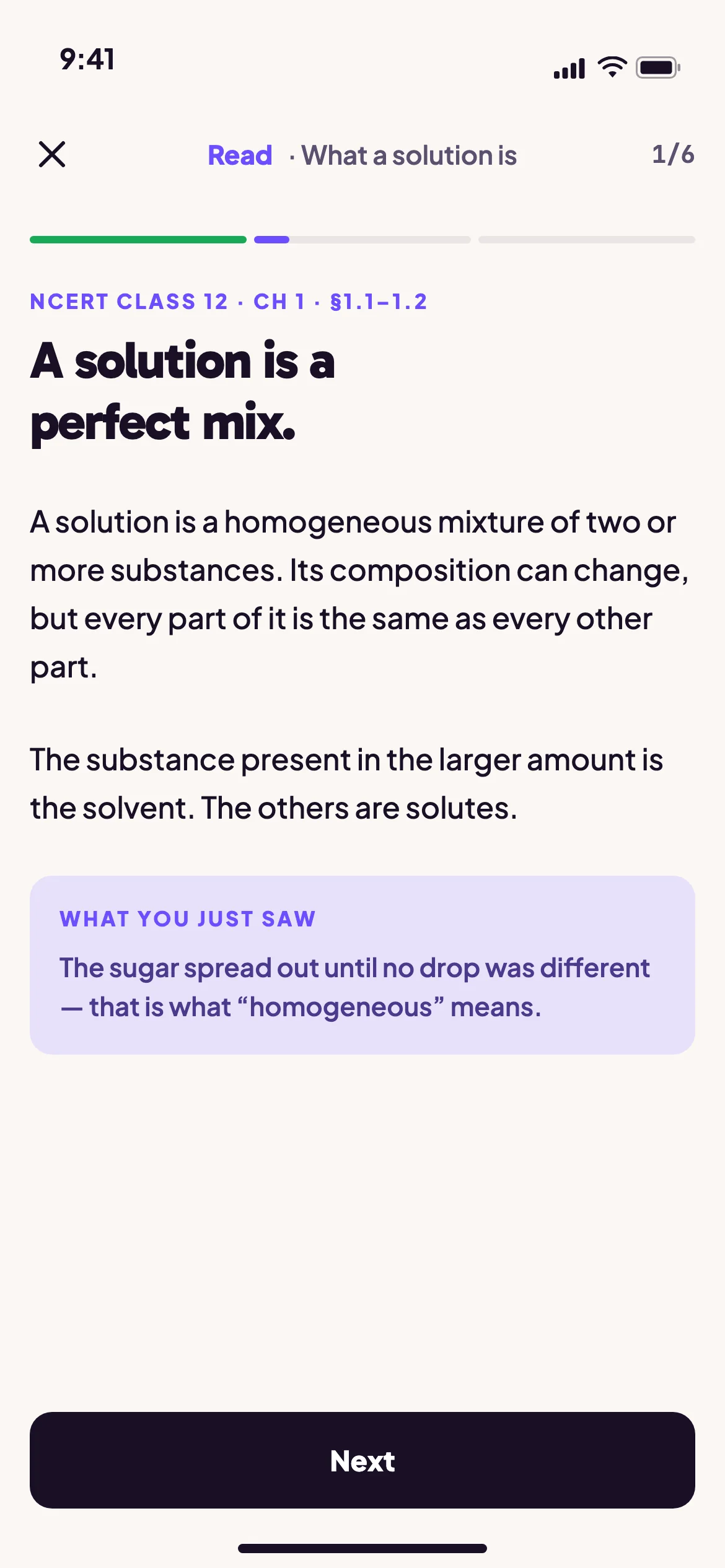
Reading a chapter and understanding it are different things. In the app every chapter is Do · Read · Verify: a game you play, a short read, then questions that check you. A full chapter, understood, in 45 to 60 minutes.
- DoA game built for the idea

- ReadThe short NCERT explainer
- VerifyQuestions that check you
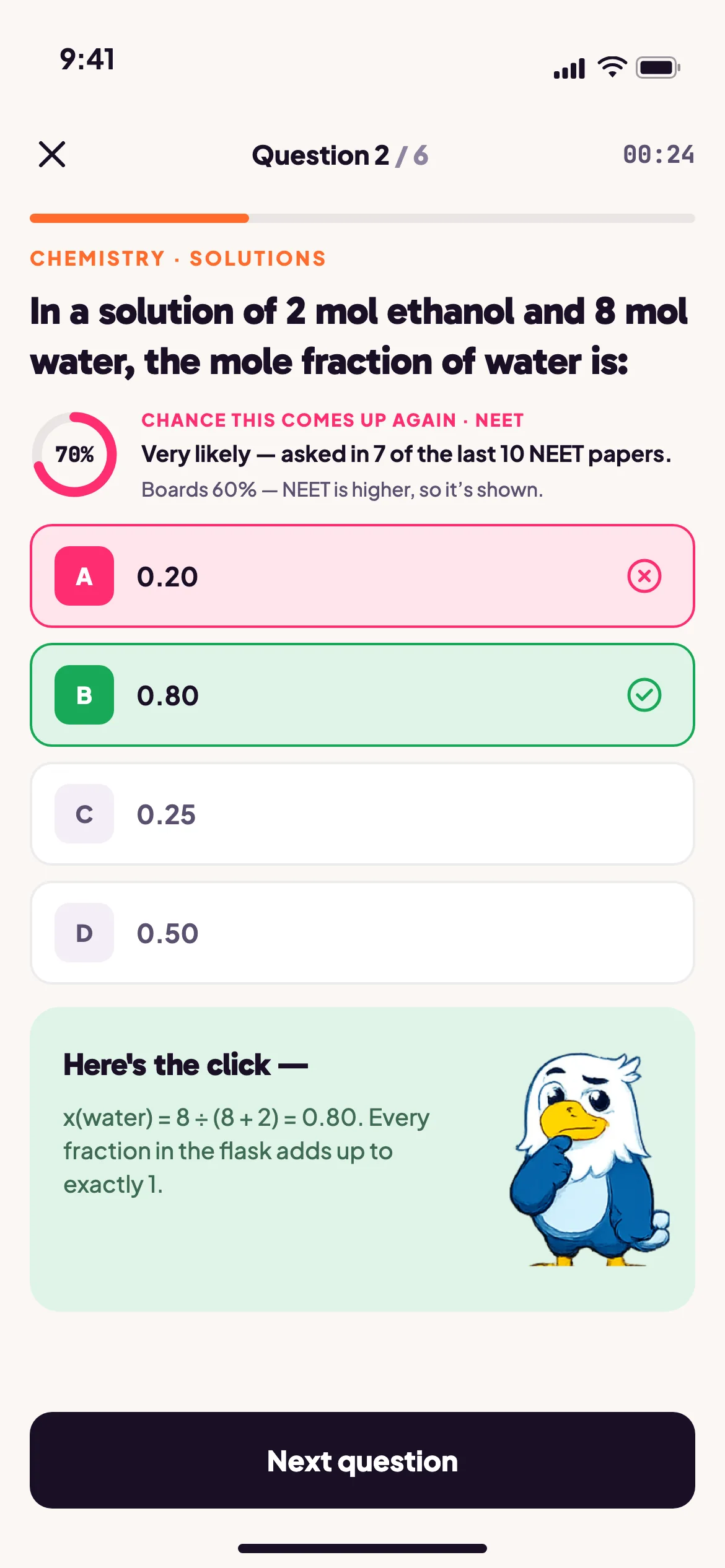

Still stuck at 11pm? TarQ AI reads the answer you got wrong and teaches the idea behind it, not just the right option.